On November 15, 1864, the city of Atlanta burned behind him, and William Tecumseh Sherman had just cut the last thread connecting him to the United States government. Three days earlier, at a telegraph station fifty miles north of the city, he had given the order to sever the wire. That single strand of copper had been the only communication link between his 62,000 men and Washington, to Grant, to anyone who could recall them or redirect them. Now it was dead, and there was no precedent for what came next—no supply line, no communication, no map anyone fully trusted.
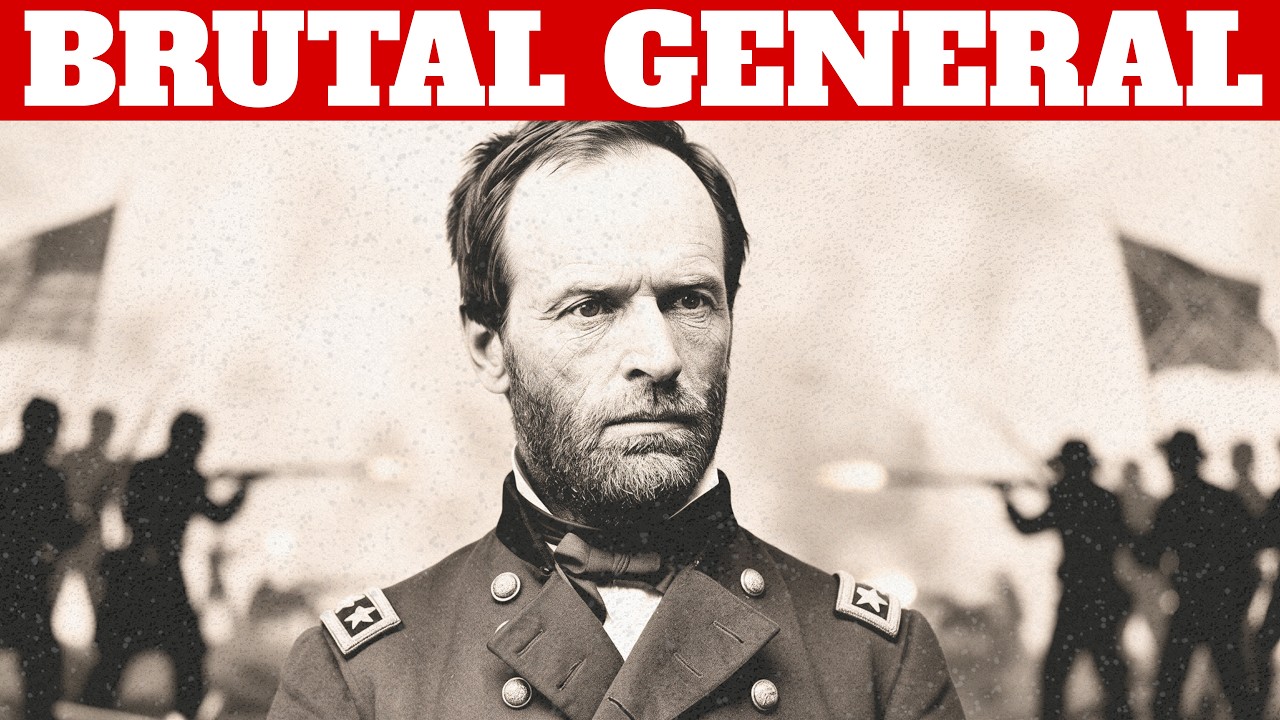
The man the newspapers had called insane three years earlier had just bet the entire Western War on a campaign without precedent on the continent. For the next five weeks, no one in the United States government would know whether William Tecumseh Sherman was alive. The man who made that decision had spent his whole life learning to trust no one and nothing except one man. Sherman was born in Lancaster, Ohio, in 1820, the son of Charles Robert Sherman, a justice on the Ohio Supreme Court.
The family had eleven children and almost no money. When Charles died in 1829, William was nine years old. There was no estate. The children were scattered among relatives and neighbors like furniture after a foreclosure.
William went to Thomas Ewing, a prominent Ohio lawyer and future United States senator, a house that ran on ambition and order. Ewing took the boy in but never formally adopted him. He grew up inside political power without ever belonging to it. His birth name was Tecumseh, after the Shawnee chief his father had admired.
The Ewings had him baptized, and a priest added the name William—a name his birth family had never chosen. He later married Ellen Ewing, the daughter of the man who raised him, his foster sister. He owed everything to a family whose name he never carried, and that fact sat under every decision he would ever make. He was a ward who understood institutions from the inside and trusted none of them.
He graduated sixth in his class at West Point in 1840. He was sent to Florida, then to California. He missed combat in the Mexican War entirely. That war made the reputations of nearly every officer who would matter in the conflict to come.
He watched from the edge of the continent while men with half his ability built careers on a war he never got to fight. He resigned his commission. He tried banking in San Francisco and failed when the panic of 1857 broke the city’s credit. He tried law in Kansas and could not make it stick.
By 1859, the man the Union would eventually need more than almost anyone else was working as a schoolmaster, running the Louisiana State Seminary of Learning and Military Academy. He lived among the planter class. He understood their world. He liked many of them personally.
When Louisiana seceded, he resigned and wept. He knew what the war would cost because he had lived inside the thing it was going to destroy. The war found him not as a warrior, but as a man who had failed at everything except understanding the enemy. The person who saw Sherman clearly was Ulysses S.
Grant. Their bond was forged in the wreckage of Shiloh, in April 1862. Sherman had just been pulled from command in Kentucky, with the newspapers printing the word “insane”—not hinting at it, printing it. Grant had nearly been removed after Shiloh’s first day.
Caught off guard, they said. Drunk, they said. Neither man had anyone left to defend him except the other. During the two brutal days of fighting, especially the punishing first day, Sherman was wounded twice and had three horses shot from under him.
He did not break. What Grant saw was a man who could absorb chaos and keep moving. What Sherman saw in Grant was a man who did not explain himself to reporters and did not panic when the plan fell apart. Grant stood by him when he was called crazy.
He stood by Grant when Grant was called a drunk. And now they stood by each other. That bond was the emotional spine of everything that followed. It was the only trust in Sherman’s life that the war did not break.
In late 1861, Sherman had been given command of the Department of the Cumberland. He assessed the situation and told Secretary of War Simon Cameron what he needed: 200,000 men to hold Kentucky and push into Tennessee. Cameron was stunned, and word of the number reached the press. The newspapers printed it as proof of delusion.
Insane Sherman, asking for an impossible army. He was quietly relieved of command—not court-martialed, just moved aside, the army’s method for discarding a man without paperwork. History later confirmed the number he asked for was almost exactly what the Union eventually needed in that theater. The press that called him insane was never held to account.
Cameron himself was forced out weeks later and quietly reassigned overseas. The system had a clean, efficient process for handling inconvenient truth: leak it, discredit the source, transfer the man who did the leaking. The Atlanta campaign broke something in Sherman that had been bending for months. Through the summer of 1864, he spent four months flanking, entrenching, and grinding against Confederate General Joseph E.
Johnston, and then John Bell Hood. At Kennesaw Mountain in June, he ordered a frontal assault against his own instincts. Three thousand Union casualties in a matter of hours. He learned the lesson with other men’s blood and did not repeat it.
Atlanta fell on September 2, 1864. Sherman ordered the civilian population expelled. John Bell Hood protested. Sherman wrote back in language the war would not forget: “War is cruelty, and you cannot refine it.
” He meant it literally. He had spent three years watching the Union try to fight a war that left the southern economy intact. He had watched men die by the thousands to take a crossroads that meant nothing if the system behind the Confederate army still functioned—the crops, the railroads, the cotton gins, the belief. He decided the war would not end by killing soldiers.
It would end by breaking the capacity of the Confederacy to believe it could survive. This was not a collapse; it was a decision. He chose to fight a war no one had authorized, against an enemy no doctrine had named. From November 15 to December 21, 1864, he marched 300 miles from Atlanta to Savannah.
Sherman split the army into two wings and a cavalry screen. The orders were specific: forage liberally off the land, destroy every railroad, burn every cotton gin, empty every smokehouse, leave nothing the Confederate war effort could use. In practice, that meant rails torn from the ground, heated over bonfires, and twisted around trees. Columns of smoke visible for miles in every direction.
Livestock slaughtered or driven off. Plantation houses stripped to the walls. And behind the army, thousands of freed black men, women, and children walked out of slavery and followed the column south. They had no guarantee of safety.
They had no rations. They walked because the army was moving, and the army was not enslaving them. And that was enough. At Ebenezer Creek in December, Union Corps commander General Jefferson C.
Davis—no relation to the Confederate president—ordered the pontoon bridge pulled up before the freed people following his corps could cross. Dozens drowned in the freezing water, men, women, and children. Sherman knew. He did not punish Davis.
He did not mention it in his official report. The march reached Savannah on December 21. Sherman sent a telegram to Lincoln, offering the city of Savannah as a Christmas gift. The cost of that gift was still floating in Ebenezer Creek.
On January 12, 1865, in Savannah, Secretary of War Edwin Stanton arrived and insisted Sherman sit down with black community leaders. Twenty ministers and church elders came into the room. Garrison Frazier spoke for the group. He was sixty-seven years old, a Baptist minister who had purchased his own freedom and his wife’s freedom for $1,000 in gold and silver four years before the war began.
Stanton asked what freedom meant. Frazier answered: “Placing us where we could reap the benefit of our own labor. ”
Four days later, Sherman issued Special Field Orders No. 15.
It set aside 400,000 acres of confiscated coastal land, from Charleston to Jacksonville, reserved exclusively for freed black families—forty-acre plots, with army mules on loan. Within months, 40,000 people settled that land. They built homes. They planted crops.
They organized their own governance. Sherman had issued the order strictly as a temporary military measure to manage the refugees following his army, not as a permanent grant of title. He believed only Congress or the president could make that promise binding. Then Lincoln was assassinated.
Andrew Johnson took office. Johnson revoked the order. The land went back to the former enslavers. The people who had built on it were removed.
“Forty acres and a mule” became the most famous broken promise in American history. Sherman did not fight the reversal. He did not speak publicly against it. The promise that Garrison Frazier had defined in that room in Savannah was never honored by the government that made it.
Back in November, on the outskirts of Atlanta, the columns kept moving south, and behind them the fires had not stopped. Sherman had committed his men to the unknown. He had an entire army and no way home except forward. Every mile they marched made retreat more impossible.
That was the strategy. He had turned his own army into a weapon that could not be recalled. The Confederate response shattered before it could form. John Bell Hood took his army north into Tennessee instead of chasing Sherman—a gamble built on desperation that ended in slaughter.
At the Battle of Franklin in November, Hood ordered a frontal assault across two miles of open ground. Nearly 7,000 Confederate casualties in five hours, six generals dead. At the Battle of Nashville in December, Union General George Thomas destroyed what was left. Hood’s army ceased to exist as a fighting force.
Behind Sherman in Georgia, Confederate General Joseph Wheeler’s cavalry harassed the flanks but could not slow the columns. The Georgia militia mustered but was outnumbered and barely trained. Governor Joseph Brown and Confederate General P. G.
T. Beauregard issued proclamations calling for scorched-earth resistance. Almost no one complied. The Confederacy could not stop what Sherman was doing because no one had ever done it before.
There was no doctrine for fighting a war against your own farmland. Sherman turned north into the Carolinas in early 1865. South Carolina, the state that started the war, received the worst of it. Columbia burned on February 17.
Who set the fires has been argued since the night it happened: cotton bales in the streets set alight, high winds, Union soldiers with torches, retreating Confederates who fired the stores. Sherman denied ordering it. The city burned regardless. The army moved faster through the Carolinas than it had through Georgia.
Confederate General Joseph E. Johnston surrendered to Sherman at Bennett Place, North Carolina, on April 26, 1865. Sherman offered terms—generous terms. Too generous.
Washington said so. Stanton and the War Department publicly repudiated the agreement, accusing him of overstepping his authority. Some implied disloyalty. He was humiliated in the national press for the second time in the war.
At the Grand Review in Washington on May 24, 1865, Sherman marched his army down Pennsylvania Avenue—tens of thousands of men, tanned and lean, walking in a looser step than the eastern armies. When he reached the reviewing stand, he shook the president’s hand. Then he turned to Stanton. Stanton extended his hand.
Sherman looked at him, dropped his arm, and walked past. The crowd saw it. The newspapers printed it. The army watched their general refuse to forgive the man who had shamed him.
He never did. Stanton remained Secretary of War and became the center of the impeachment crisis under Johnson. He was nominated to the Supreme Court in 1869. He died four days after his confirmation.
Grant became president and protected Sherman’s position. Their bond held until Grant’s death in 1885. John Bell Hood lost his command, lost his fortune speculating in cotton after the war, and died in a yellow fever epidemic in New Orleans in 1879. His wife died the same week.
One of his children followed. President Andrew Johnson was impeached, survived by a single vote, and served out his term as a man nobody trusted. Garrison Frazier, the minister who defined freedom in a room full of generals and politicians, disappears from the documented record within a few years of that meeting. No pension file has been found.
No grave has been confirmed. Sherman fought a war the army had not designed and the government had not fully authorized. He understood that the Confederacy was not only an army. It was a system—an economy, a logistics chain, a social order held together by belief.
Breaking the army without breaking the system meant the war would never end. He was right about that. He was also the man who let Ebenezer Creek happen and said nothing. He was the man who issued the most consequential land order of the war and then watched it be revoked without raising his voice.
He made the suffering of freed black refugees a secondary calculation to the movement of his columns. The system he broke was real. The system he served was not clean. Both of those things are true at once, and the record does not let you choose only one.
In Georgia, his name became a curse that lasted a century. Families passed down stories of buried silver and burned houses. Some of those stories were real. Some were invented.
All of them carried the same weight. In black communities along the Sea Islands of Georgia and South Carolina, the memory of Special Field Orders No. 15 never died. Gullah-Geechee families on those islands traced their presence to the brief window when the government said the land was theirs.
Among Union veterans, the march was the thing they talked about for the rest of their lives—not because of the fighting, which was light, but because of the strangeness of it. An army untethered from everything, moving through enemy country with no orders but forward. His letters to Grant sit in the Library of Congress. They are among the most honest documents any general left behind.
Special Field Orders No. 15 is in the National Archives. The Sea Islands still hold Gullah-Geechee communities whose land claims trace back to the order Johnson revoked. Federal legislation to study reparations for the descendants of enslaved Americans, named for the forty-acre promise, has been introduced in Congress repeatedly over the decades.
It has never passed into law. The route of the march through Georgia is not a preserved battlefield trail. It is highways and subdivisions and farms. There is no single monument to the March to the Sea.
The evidence is in the pension files, the county deed books, and the land records that still show where the break happened. Garrison Frazier, sixty-seven years old, sitting in a room in Savannah, telling a general and a secretary of war what freedom means. William Tecumseh Sherman, twenty years later, refusing to run for president with absolute finality. Two men who understood exactly what the system was.
One had the power to break it. One had the power to name it. Neither one could make the promise hold.
