In the fall of 1951, a seventy-year-old feud reached its final reckoning in a Chicago courtroom. The man who walked in leaning on a cane was sixty years old but looked older, worn down by decades of running from a name he had tried to bury. Beside him sat his wife, a woman who had married him not knowing who he really was. He wore his white cowboy hat as he took the witness stand.
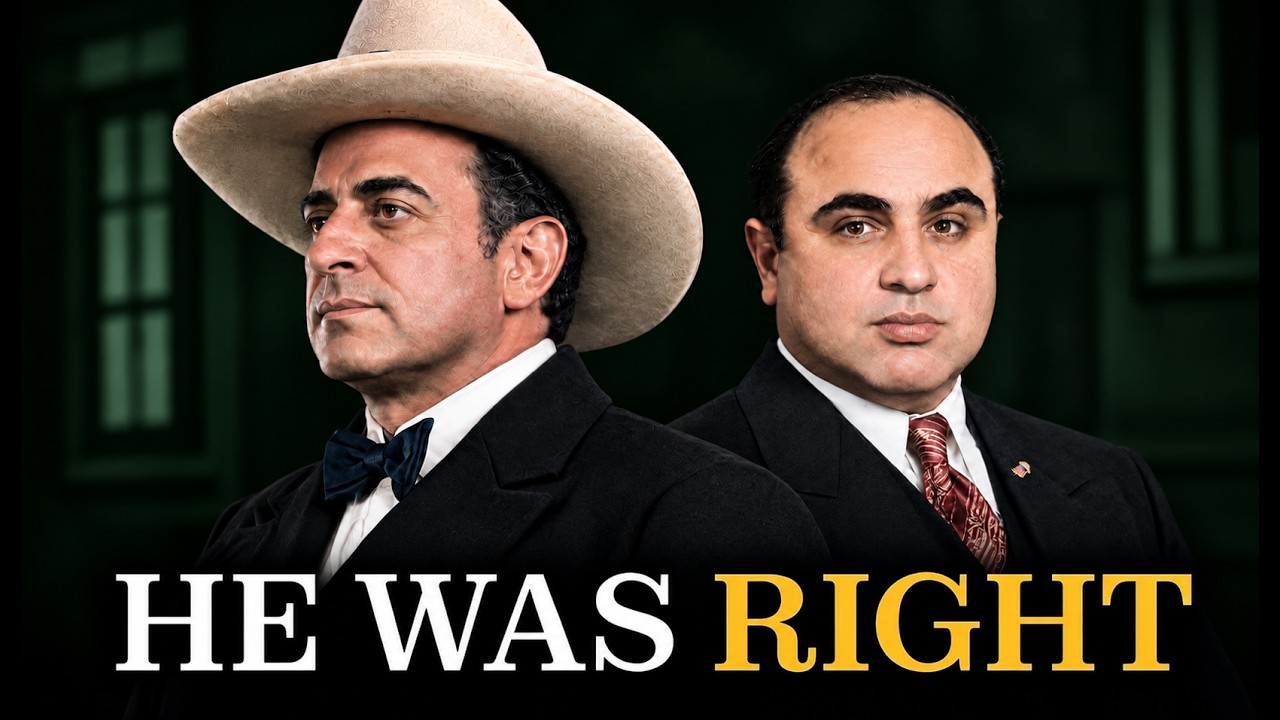
They let him keep it on. Under oath, he testified that a lodge in Wisconsin belonged to him and that he had paid for it himself. Everyone who looked closely at the case knew this was a lie. The lodge belonged to his brother Ralph.
With that lie, the man who had spent thirty years enforcing the law in Nebraska placed himself on the side of the family he had abandoned. The newspapers finally learned the truth about the federal agent they called Two-Gun Hart. He was Vincenzo Capone, the older brother of Al Capone. Vincenzo was born in Italy in 1892, the first of nine children.
His father Gabriele was a barber, and his mother Teresa sewed for a living. When Vincenzo was a small child, the family moved to Brooklyn, New York, where they lived in poverty. The children kept coming one after another: Ralph, then Frank, and in 1899, a boy named Alphonse, the one the world would later know as Al. By the time the family was complete, eleven people were crowded into a small Brooklyn apartment.
In a poor immigrant family like that one, the oldest son carried a heavy burden. He was expected to work, to help his father, and, if his father died, to take his place. He would care for his mother. He would guide his younger brothers and keep them on the straight path.
In families like the Capones, that was not a choice. It was simply what the oldest son did. Vincenzo did not want that life. His family remembered that he loved horses and cowboys, that he would slip away to Staten Island, where the open fields were, and watch Wild West shows when they came to town.
He dreamed of somewhere else. In 1908, at the age of sixteen, he left. One family story says he took his younger brother Al, then about eight, to the ferry. He told Al he could not go any further with him.
Then Vincenzo disappeared. That story comes from the family and was told many years later. What happened next is beyond doubt. A year later, a letter arrived from Kansas.
Vincenzo had joined a circus. For years after that, the family heard almost nothing from him. No one knows for certain why he left. The family told different stories.
In one version, his father broke a violin over his head. In another, he was simply tired of being the oldest son in a poor family of eleven. There is also a popular story that makes Vincenzo a hero. It claims that a street gang attacked little Al with a knife and slashed his face, that the older brother Vincenzo threw the attacker through a window, and then had to flee for his life.
That, the story goes, is how Al got his scars, and that is why Vincenzo left. It is a good story, but people who looked for evidence found something else. Al got his famous scars years later, around 1917, in a saloon in Coney Island. He had said something rude to a young woman, and her brother, Frank Galluccio, slashed Al’s face three times with a knife.
By then, Vincenzo had been gone for about nine years. He was nowhere near that place. Another family story claimed Vincenzo killed someone to protect his brothers, but there is no evidence behind it at all. That matters because the hero story gives Vincenzo a noble reason for leaving.
Without it, the truth looks more plain. He did not leave to save Al. He simply left, and the Capone family lost its oldest son. Vincenzo was not only leaving home.
He was leaving the name. Over the next ten years, Vincenzo drifted. According to his family’s account, he worked with the circus and then with a traveling Wild West show, where he learned to ride and shoot. When he joined the army, he did not register under the name Capone.
In one account, he said his name was James Richard Hart, that he was born in Indiana, and that he was a farmer. Even on the army form, he did not write where he had really come from. While drifting, Vincenzo chose a new family name. He took it from his favorite movie star, a cowboy actor named William S.
Hart, and copied the actor’s big hat, his clothes, and even his way of standing. From then on, he called himself Richard Hart. No one ever heard him use the name Capone again. In the spring of 1919, he jumped off a freight train in a small Nebraska town called Homer.
About five hundred people lived there. He told them an entirely new life story. First, he said he came from Oklahoma. He said he had been a ranch hand.
And he let people think he was of Native American or Mexican descent. He never said he was Italian. He never said he had brothers. There was a reason for hiding so carefully.
At that time, many Americans did not trust Italians. In small towns, an Italian name could keep a man from getting a job, renting a house, or holding any position of authority. A man named Capone would never have gotten a badge in Nebraska. A man named Hart could.
So the name had to go. With the name, he got rid of the family. He told the men at the local veterans’ club that he had fought in France in World War I and that General John Pershing himself had pinned a medal on him. It was a detail worth remembering.
A few weeks later, a sudden flood hit a neighboring town. Vincenzo ran into the water and pulled out an entire family, one person after another. Their daughter was named Kathleen Winch. She was nineteen years old.
That autumn, he married her. She had no idea his real name was Capone. The town loved him after that. They made him town marshal.
The veterans’ league made him their commander. The Boy Scouts gave him a position of responsibility. Homer had a hero, and that hero had brothers in Brooklyn nobody in Homer had ever heard of. And so the oldest son of the Capone family gained a wife, a new name, and a new family, while his old family in Brooklyn did not know where he was.
In 1920, two things happened that separated the brothers forever. The first was Prohibition. America had banned alcohol, and making and selling it became a crime. The government needed agents to stop it, and Vincenzo signed up.
In 1920, the oldest son of the Capone family became a federal Prohibition agent. His job was to chase bootleggers. Al had taken a different path. The year before, he had moved from Brooklyn to Chicago to work for a gangster named Johnny Torio.
Torio’s business was illegal alcohol. So in the same year, one brother went to work enforcing the law, and the other went to work breaking it. The second thing that happened in 1920 was much worse. In November, their father, Gabriele Capone, died.
The family lost its father, and the oldest son was supposed to take charge. Instead, he was in Nebraska calling himself Richard Hart, and the family had heard nothing from him for years. There is no record of him coming home. So Al did it instead.
Al was only the fourth son. He was twenty-one years old. But after their father’s death, Al brought his brother Ralph to Chicago and gave him a job. Ralph was older than Al.
By birth order, Ralph came second, right after Vincenzo. But Al was the one who called for Ralph, and Al was the one who found him work. Soon people started calling Ralph “Bottles” because he ran the bottling side of Al’s business. Al also brought his widowed mother Teresa and the younger children from Brooklyn to Chicago.
In August 1923, the family moved into a brick house at 7244 South Prairie Avenue. It cost fifty-five hundred dollars, and the deed was put in the names of Al’s wife and his mother Teresa. That house became the Capone family home. Al took on every duty the oldest son was supposed to have handled.
He supported his mother. He looked after his brothers. He kept the family together. And by 1923, Al was the second-in-command of the largest gang in Chicago.
He carried the weight of the family and the business at the same time, while the brother born for that task was hundreds of miles away, pretending he was not a Capone at all. That was the real reason for the bitterness. It was not just the badge. It was the empty chair.
In Nebraska, Vincenzo was gaining fame. He was very good at his work. Within weeks, he destroyed five illegal distilleries. Then he worked undercover and arrested twenty men in a single raid.
He wore a big white hat and two pearl-handled pistols on his hips, and the newspapers gave him a nickname: Two-Gun Hart. Vincenzo could be brutal. In 1923, he and another agent chased a car they believed was carrying liquor and shot out its tires. But when the car stopped, the driver was dying.
His name was Ed Murphy. He was thirty-five years old and had a wife and a baby son. The government said the shooting never should have happened. Vincenzo got a warning and went back to work.
Think about how that looked from Chicago. In those same years, Al was rising to the top of the largest bootlegging operation in the country. His older brother, the one who had abandoned the family, was out West making a name for himself by destroying liquor and arresting men who worked in Al’s line of trade. Then came 1924, the year the family took its hardest blow.
In April 1924, Chicago police shot and killed Frank Capone. He was only twenty-nine years old. Frank was the first of the Capone sons to die. The family mourned Frank in the Prairie Avenue house, the one Al had bought for their mother.
There is no record that the oldest brother attended. The fourth son was there to bury Frank. The first son was in Nebraska with a badge and a false name. That same year, a Chicago photographer named Tony Berardi said he saw Al and Vincenzo together with his own eyes.
He said Al introduced his brother as a Prohibition officer from Nebraska. A writer who later interviewed both families thought Al seemed proud of him. Yet no one can prove that meeting ever happened. It rests on the memory of one man who told the story many years later.
And even in that telling, look at what the brothers agreed on. The account says they promised to stay out of each other’s way. Al would stay in Chicago. Vincenzo would stay on his side of the law.
That is not a family reunion. That is two men on opposite sides drawing a line between them. For years after that, Vincenzo kept living as Richard Hart. His wife and children had no idea who he really was.
The brothers were rising in their careers at the same time. In 1927, Vincenzo was chosen to help guard President Calvin Coolidge and his family during their vacation in South Dakota. As far as anyone knows, no one told the president that one of his bodyguards was Al Capone’s brother. In 1929, seven men were shot to death in a garage in Chicago, and Al’s name was on every front page in America.
By 1930, Vincenzo was so famous out West that the post office delivered a letter to him with no address at all, just the name “Hart” and a drawing of two pistols. There is another story from those years. It comes from the Hart family and has never been proven. In September 1930, six men robbed a large bank in Lincoln, Nebraska, and escaped with two million seven hundred thousand dollars.
It was such an enormous amount that the robbery shook the state’s banks, and ordinary families were on the verge of losing their savings. Vincenzo suspected a connection between the robbers and men in Chicago. According to the family, he went to Al and asked for help, and the stolen bonds were recovered. If that happened, it shows how the brothers actually worked.
They did not visit each other. They did not spend holidays together. But when the lawman needed something, he knew exactly which Capone to call. Still, the empty chair stayed empty, and the gap between them was never closed.
And soon, both brothers fell. In 1931, Al Capone was convicted of tax evasion and sentenced to eleven years in prison. He was first sent to a federal prison in Atlanta and later to Alcatraz, the island prison in San Francisco Bay. The most powerful man in Chicago became just a number inside a cell.
That same year, Vincenzo shot and killed a wanted man who refused to surrender, and the government fired him. After that, Vincenzo’s life collapsed completely. He was beaten by relatives of the man he had killed and lost the sight in one eye. He got a small job as marshal in the town of Homer, but the pay was pitiful.
His family moved from one house to another because they could not pay the rent. Then he was accused of stealing canned food from grocery stores, including a store owned by Kathleen’s own father. He lost his job. A boy who grew up in Homer later remembered that in the nightly card game at the pool hall, Vincenzo never once sat with his back to the door.
The town thought he was just a cautious lawman. Then his wartime hero story collapsed too. For years, he had told the local veterans that he had fought in France and earned a medal. But when someone finally checked with the army, there was no record of his service at all.
The veterans took away his command. No one ever settled the matter completely, but Vincenzo never explained it. By 1937, the man who had built an entire life around being Richard Hart was broke, half-blind, and friendless. And he did the one thing he had avoided for nearly thirty years.
He went back to Al Capone. Al was imprisoned at Alcatraz, so Vincenzo went to Ralph, the brother who had followed Al to Chicago after their father died. Ralph took him in. Ralph had served his own prison sentence for taxes, so he knew what it meant to fall.
He did not turn his brother away. Ralph took Vincenzo to his lodge in Wisconsin, bought him new clothes, gave him money, and sent him a check every month after that. According to one account, Ralph and another brother, John, met Vincenzo quietly for the first time in Sioux City, Iowa, not far from Homer. Later, Vincenzo went to Chicago and saw his mother, Teresa, in the house Al had bought for her.
The oldest son had finally come home. It took him nearly thirty years, and he came home because he needed money. Only then did Vincenzo tell Kathleen and the boys the truth. His real name was not Hart.
It was Capone, and his brother was Al Capone. In 1939, Al came out of prison, but he was sick and his mind was failing. His health had completely faded. He moved to Florida and never ran Chicago again.
The two brothers met again at Ralph’s lodge in Wisconsin, more than thirty years after that goodbye at the ferry. In 1946, Vincenzo took his son Harry to the Capone family cabin to meet his famous uncle. Harry had grown up believing his father was just a Nebraska lawman named Hart. Now he was about to meet Al Capone.
According to one account, Harry was asked not to get too close to Al. Even at the end, the older brother still kept Al at a distance. A few months later, in January 1947, Al Capone died in Florida of a stroke. He was forty-eight years old.
But the story was not over. Vincenzo still owed the Capone family, and in 1951, the bill came due. That year, the government pursued Ralph Capone for unpaid taxes, and one of Ralph’s properties, the lodge in Wisconsin, was registered in Vincenzo’s name. Ralph had put the lodge in his name.
Now the checks Ralph had sent for fourteen years had a steep price. On September 21, 1951, Vincenzo walked into a Chicago courtroom to testify. He was fifty-nine years old, walking with a cane, Kathleen at his side. In a photograph from that trip, she sits right next to him in the waiting room while he waits to go in.
His tie is too short to reach his belt, and he wears his big white cowboy hat. He asked to wear it on the witness stand, and they allowed it. Then, under oath, he said the lodge was his and that he had paid for it. But everyone who looked closely agrees it was not true.
It belonged to Ralph. And so the lawman who had once walked away from Al Capone stood in court and lied to protect them. When he gave his real name, the newspapers finally knew who Two-Gun Hart really was. One wire service called him the “white sheep” of the Capone family.
On October 1, 1952, Vincenzo died of a heart attack at his home in Nebraska. Kathleen and his son Harry were with him. He was sixty years old. Kathleen paid for his secrets more than anyone else.
She married him at nineteen, knowing him only as Richard Hart. She had four sons with him: William, Richard Jr. , Sherman, and Harry. William was named after the same movie cowboy her husband had taken his name from.
Sometimes Kathleen and the boys followed him from job to job. Other times, Kathleen stayed home in Homer with the children. A neighbor remembered that he would travel to Chicago and come home with lots of money. According to one account, he never told Kathleen where he was going.
In the hard years, she moved the family from house to house when she could not pay the rent. Some of the food he was accused of stealing had come from her father’s store. Their oldest son, Richard Jr. , joined the army in World War II and never came home.
The son had actually gone to war. His father’s war had no trace on paper. Kathleen was married to him for thirty-three years. She knew his real name for only ten of those years.
And one year before he died, she was beside him in Chicago on the day he swore falsely for his brother. For most of his life, everything people knew about Two-Gun Hart came from Two-Gun Hart himself. The cowboy days in Oklahoma, the Native ancestry, the medal from General Pershing. He told the stories, and the newspapers printed them.
The Capone family, who knew the truth, never told a single reporter. As far as anyone could determine, the story only surfaced in 1951 because Vincenzo gave his real name under oath. So that was the real reason for the bitterness between Al Capone and his brother. Not because he became a lawman.
Brothers end up on opposite sides all the time. The real reason was what Vincenzo left behind. He was the oldest son. So when their father died in 1920, his job was to keep the family together.
Instead, he was hundreds of miles away pretending he had never been a Capone at all. So Al did it for him. Al moved their mother into a house he paid for and put in her name. Al brought Ralph to Chicago.
Al buried Frank from that house. Every duty the oldest son abandoned fell onto the fourth son. Al was only twenty-one when that weight was dropped on him. Al never left behind a letter or a recording about his brother, so we do not have his feelings in his own words.
What we have is the record of what happened. Their father died. The oldest son was gone. And Al, at twenty-one, took care of the mother, the brothers, and the funeral that his older brother should have handled.
That is the context behind the bitterness in this story, and it is what made it so hard for Vincenzo to shake off the name Capone when it became a burden to him. Then, when the life he had invented for himself collapsed, he came back to rely on the very family he had abandoned. The Capones paid his bills. They kept his secret.
And in the end, he had to lie under oath to protect the name he had spent his life running from. That is what makes their story so complicated. It was a mixture of resentment and blood loyalty at the same time. The brother who left still needed the family that stayed.
Vincenzo Capone was buried in a small cemetery on a hill above Homer, Nebraska. But his gravestone does not carry the name Capone. It carries the name Richard J. Hart.
His mother, Teresa, died only a few weeks after him, before the end of that year. She was eighty-four years old and died in Chicago, in the Prairie Avenue house Al had bought for her, the house her oldest son never helped pay for. Why Vincenzo ran in the first place was never settled. Some believe he was simply exhausted by the weight of being the oldest son in a poor family.
Others think he got into trouble with his strict father or with the law. Some say the reason was the country itself. America did not give badges to men named Capone, so he stopped being one. Every answer leads to the same result.
The oldest son left, and the fourth son carried what he left behind. His son Harry gave the shortest answer of all. When he learned the truth about his family, he said it meant nothing to him. But it meant everything to the two brothers who lived through it.
Look at those two places side by side: the brick house in Chicago where the Capone family stayed together, and the stone in Nebraska with a false name on it. Al carried the name Capone. Vincenzo buried it.
