Of the five women history agrees were killed by Jack the Ripper, four died in the open air, in the brief stolen minutes between one passerby and the next. The fifth died behind a locked door in her own bed, with a curtain drawn across the window. That single difference gave her killer something he had never had on any other night: time. The victim was Mary Jane Kelly, and she died in a cramped ground-floor room in Miller’s Court, a cul-de-sac off Dorset Street in Spitalfields, in the early hours of November 9, 1888.
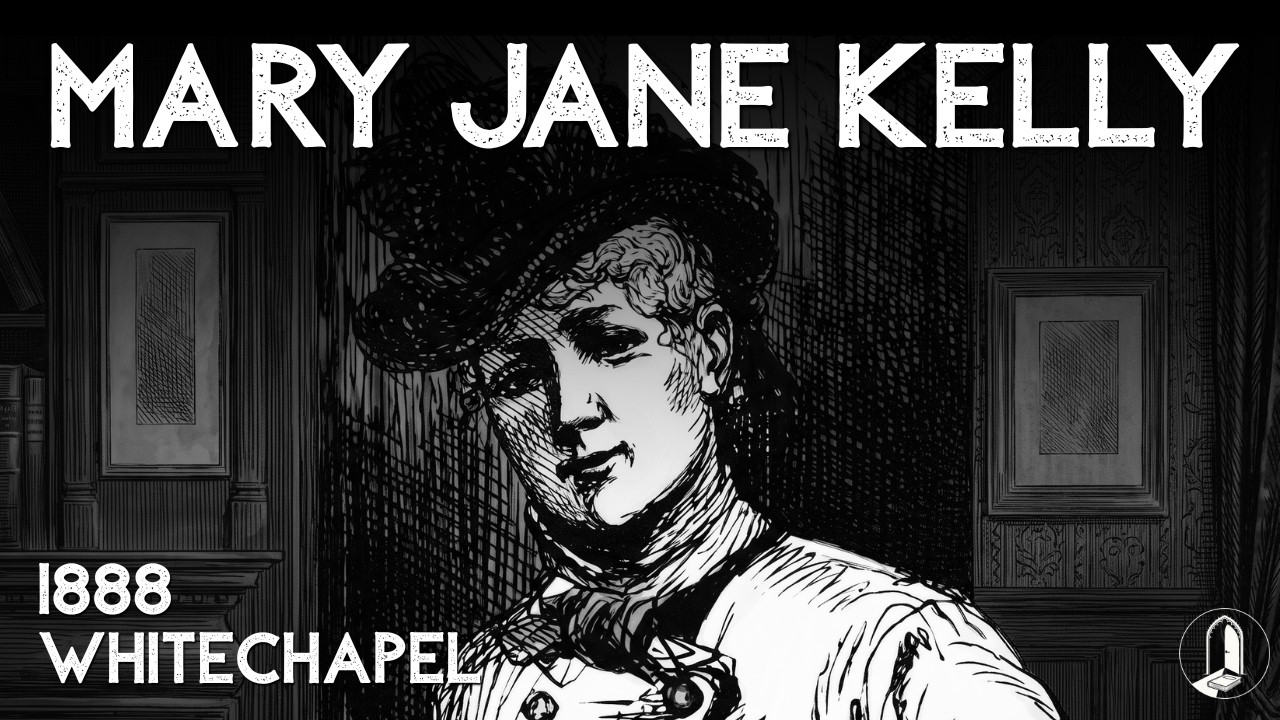
The room was roughly ten feet by twelve, rented for four shillings and sixpence a week. The door carried a spring lock that caught by itself when closed, and its only key had gone missing sometime before. A pane of glass beside the door had been broken in a quarrel at the end of October, stuffed with rag and hung over with an old coat. Anyone could reach through the hole to lift the latch from inside.
Nearly everything known about Kelly’s life comes from one man, Joseph Barnett. He shared her bed and her rent for the last year and eight months of her life. When police and newspapers asked who she was, Barnett answered, repeating the story she had told him, because there was no one else left to tell it. By that account, she was born in Limerick around 1863, and her family moved to Wales while she was still a girl, where her father worked in an ironworks.
At about sixteen, she married a collier named Davies, who was killed in a pit explosion a year or two later. She drifted to Cardiff, then around 1884 to London, where she found work for a time in a West End brothel, and she claimed a brief crossing to France that she cut short. From that trip she took a French spelling she sometimes used: Marie Jeanette. Not one piece of it can be found.
No birth entry in Limerick, no marriage to a collier named Davies, no widow of that name surfacing in Cardiff or London. Searched long enough, the records force an uncomfortable conclusion: a woman with exactly this name and exactly this history seems never to have existed on paper at all. She was tall for the time, around five foot seven, with fair hair and blue eyes. She was known around the courts as Fair Emma, or Ginger, or oddly, Black Mary.
She was rarely alone, usually with two or three other women on her arm, and more than one neighbor remembered her in a spotlessly clean white apron. A former landlord called her a fine scholar, yet Barnett said she used to have him read the newspapers aloud, suggesting she could not read them herself. Dorset Street was spoken of as the worst street in London, a place where two or three hundred people might sleep in a single lodging house for a few pennies a night. Miller’s Court was tied so closely to its landlord that the neighborhood called it McCarthy’s Rents.
Rent was due by the day, and falling behind was not unusual; being turned into the street for it was a constant low background fear. That autumn, a sharper fear sat on top of it. Women had already been found murdered nearby that year: in Bucks Row at the end of August, in a yard behind Hanbury Street a week into September, and then, on one appalling night at the end of September, two in the space of an hour, in Berner Street and in Mitre Square. The district knew a killer was working the same handful of streets, that the police had no name for him, and that he had not finished.
Kelly had not always lived alone in that room. She and Barnett met on Good Friday, April 8, 1887. He was a porter who humped fish at Billingsgate Market. He took her for a drink, arranged to see her the next day, and by that second meeting, they had decided to live together.
They moved through a run of addresses the way poor couples did, usually one step ahead of the rent, and by early spring 1888, they settled into 13 Miller’s Court. She had one habit Barnett could not argue her out of. On bitter nights, when other women had nowhere to go, she let them sleep on the floor of that tiny room. He explained it plainly to a reporter later: she only let them because she was good-hearted and did not like to refuse shelter on cold, bitter nights.
What broke the arrangement was arithmetic. Sometime in the summer of 1888, Barnett lost his job, and the wage that had kept Kelly off the streets vanished with it. She went back to walking the streets because the rent did not stop for sentiment. Then the room began to fill, first with a woman called Julia, and later one named Maria Harvey, sleeping in a space barely big enough for one couple.
Barnett objected. On October 30, the argument caught fire, and in the middle of it, the window pane was broken. He packed his things and moved out to a nearby lodging house, though he kept coming back to see her, some days more than once. Her last days carried a heaviness visible through the record.
She was frightened, and talked about giving it up and going home to Ireland. A young neighbor, Lizzie Albrook, remembered Kelly turning to her and saying: “Whatever you do, don’t you do wrong and turn out as I have. ”
On the evening of November 8, Barnett called round about seven. They parted on good terms.
It was the last time he would see her alive. By that night, she was alone. The women she had sheltered were gone. Barnett was across the district, playing cards until well past midnight.
The last hours of Mary Jane Kelly became a set of glimpses caught by neighbors. A little before midnight, a woman named Mary Ann Cox came into the court out of the rain and saw Kelly ahead of her, very drunk, going into her room with a man. Cox got a look at him: stout, past his youth, a blotchy face and a thick ginger mustache, shabby dark clothes, carrying a can of beer. Kelly managed a good night back.
A few minutes later, through the thin partition, Cox heard her start to sing to herself. In the small hours, Cox kept coming and going, and each time she passed, she could still hear it: Kelly singing the same sentimental song over and over, a ballad called A Violet from Mother’s Grave. After one in the morning, the singing stopped, and the little window went dark. At about two in the morning, a laborer named George Hutchinson, a man who knew Kelly and had given her money before, met her on Commercial Street.
She asked him to lend her sixpence. He had nothing. As she walked away, Hutchinson watched a man step up and stop her. Days later, he sat in a police station and described that man with an extraordinary level of detail: a little over thirty, dark hair, pale face, a mustache curled up at the ends, a long dark coat trimmed with astrakhan fur, a white collar, a black tie fixed with a horseshoe pin, a heavy gold chain across the waistcoat, pale button spats over polished boots.
He even recalled a red handkerchief passing between them. That impossible precision, recalled three nights later on a dark street, has led many to doubt every word of it. At about half past two, a laundress named Sarah Lewis noticed a man standing across from the entrance to Miller’s Court, stoutish, not tall, in a wide-awake hat, doing nothing but looking up the passage as though waiting for someone. She never saw his face.
Around four o’clock, two women, Elizabeth Prater in the room directly above Kelly’s, and Lewis now indoors close by, each caught a single faint cry in the dark. One voice, two words: “Oh, murder. ” On Dorset Street, that cry was so common it meant nothing. Neither woman got up.
Neither would ever quite forgive herself for it. Morning came, and with it a debt. Kelly was twenty-nine shillings behind on her rent. Shortly before eleven, the landlord, John McCarthy, sent his odd-job man, Thomas Bowyer, to knock for some of it.
Bowyer knocked. Nothing. He went round to the broken pane, reached past the old coat, and looked in. Whatever he saw sent him back to the shop unable to get the words out properly.
McCarthy went and looked himself, then ran for the police. The police came, Inspector Beck first, then Abberline, who sealed the court. For nearly three hours, the door stayed shut. The officers on scene believed they were under a standing order to wait: Commissioner Sir Charles Warren had wanted bloodhounds brought in to track the Whitechapel killer.
What none of them knew was that Warren had resigned the day before, and his bloodhound scheme had collapsed with him. The dogs were never coming. Only when that became clear did Superintendent Arnold give the word. In the end, McCarthy forced the door with a pickaxe well into the afternoon.
His verdict was blunt: it looked more like the work of a devil than the work of a man. Two doctors took charge, George Bagster Phillips and Thomas Bond. The cause of death was quick and simple. The killer had cut her throat as she lay on the side of the bed, severing the artery.
Everything else was done afterward, and it was the afterward that told the investigators who they were dealing with. For the first time, the man had been able to close the door and work undisturbed. The doctors believed he had been alone in that room for the better part of two hours. Bond saw no trained hand, just time and a plain knife perhaps six inches long.
Her clothes were folded neatly on a chair. Her boots stood before the hearth. A man’s clay pipe still lay in the room, Barnett’s, the one thing of his left behind. Someone had built up the fire to such a heat it had melted the solder on a kettle.
In the ashes were the burnt remains of clothing and the brim of a hat. Abberline thought the killer had needed light to see by and had fed the flames with whatever came to hand. Of everything the doctors set down, one absence has never stopped being argued over: her heart. She had been found with her face destroyed beyond recognition, and her heart was gone.
When Barnett was brought in to say whether this was the woman he had lived with, he could not do it by her face. He knew her only by her eyes and by her hair. The case broke its own timeline. Bond fixed the hour of death roughly in the small hours, fitting the cry heard around four.
But two people swore it wasn’t so. Caroline Maxwell insisted she had spoken to Kelly alive at about half past eight that morning, and a tailor named Morris Lewis thought he had seen her later still, around ten. Maxwell was gently warned at the inquest that her memory clashed with everyone else’s. Lewis was never called to give evidence at all.
Barnett was held and questioned for hours. The partner who moves out just weeks before a murder is a figure every detective is trained to distrust. But his story held, and they let him go. Whoever had been alone in that room, it had not been him.
A second mystery grew: not only who killed Mary Jane Kelly, but when, and for a stubborn few, whether the woman found on that bed was Mary Jane Kelly at all. The inquest opened on Monday, November 12, 1888, at Shoreditch Town Hall, before the coroner, Roderick Macdonald. It opened and closed the same day, a single sitting for the most notorious murder of the whole series. Some jurymen protested that the death belonged to Whitechapel, not Shoreditch.
Macdonald shut it down with an old rule: an inquest belongs where the body lies, and the body lay in his district. The witnesses came through one after another, and before every account had been heard, Macdonald brought it to a close. The newspapers said openly they were startled by how fast it ended. The jury returned the only words the evidence would carry: willful murder against some person or persons unknown.
That very evening, hours after the coroner had finished, George Hutchinson finally walked into Commercial Street Police Station. Two days earlier, Bond had handed the police a report that tied all five killings to one hand and sketched the kind of man who might commit them: solitary, outwardly unremarkable, quiet, very possibly respectable in dress. A pardon was offered to any accomplice who would come forward and name him. Not one person did.
No one was ever charged. On Monday, November 19, 1888, Mary Jane Kelly was buried at St. Patrick’s Roman Catholic Cemetery in Leytonstone. No family could be found to stand at the grave.
Barnett came. Six of the women who had testified rode behind her coffin. Outside Shoreditch Church, several thousand people crowded the street to watch a stranger they would never have noticed in life be carried past them in death. Then the thing that makes her different from the four before her: the story went quiet.
The Whitechapel murders, as the world has ever counted them, simply stopped. She was the last. Whoever truly opened that door was never again seen at his work. She became, in the end, the image the whole case is remembered by.
Hers was the room that was photographed, her name set like a full stop at the close of every retelling of the Ripper’s autumn. For nearly a century, even her postmortem notes were lost, until they were returned anonymously to Scotland Yard in 1987. Her grave was cleared in the 1950s and later marked again by people who never knew her. More than a century on, far more people know how Mary Jane Kelly died than any proven fact about how she lived.
She is the most famous of the five and the least knowable: the woman whose ruined face ended the terror, and whose name may not even have been her name.
