The Canadian River curved through Indian Territory, and on one hidden bend of it lay a piece of land that no sheriff wanted to enter. It was called Younger’s Bend, and the woman who owned it had turned her home into a wall between wanted men and the law. By the time she was in her thirties, Belle Starr had two names—the one she was born with, Myra Maybelle Shirley, and the one newspapers gave her, the Bandit Queen—and neither of them told the whole story. She had grown up in Missouri, where living on the wrong side of the law was less a choice than a habit learned young.
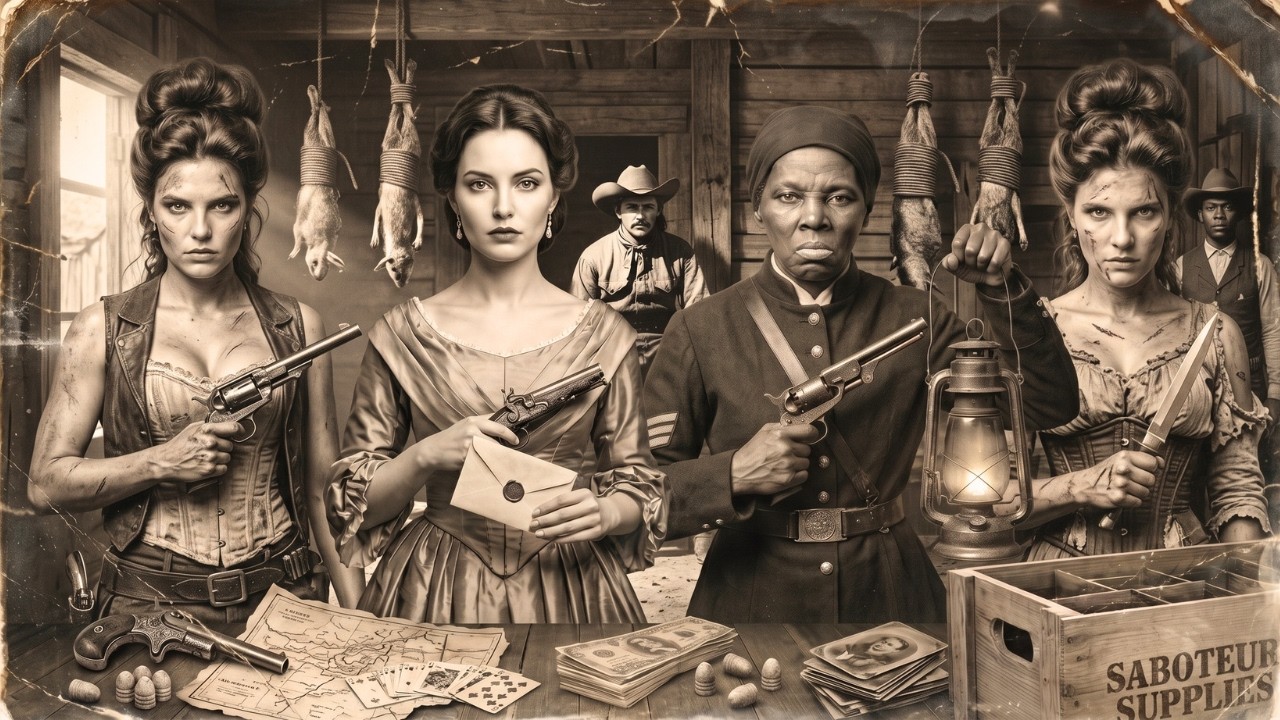
When she married Sam Starr, a Cherokee, her home became the place where horse thieves and fugitives found food, a bed, and the silence of people who didn’t ask questions. Men on the run knew that once they reached Younger’s Bend, they could breathe. For years, the law left her alone. But in 1883, her luck ran out.
Belle was put on trial for horse theft and convicted by Judge Isaac Parker, the federal magistrate known across the frontier as the Hanging Judge because of the number of men he sent to the gallows. She served her prison sentence and walked free, back to the bend in the river. But the conviction had done something she never expected. The papers back east had picked up her story, and they had given her a title that would never let go: the Bandit Queen.
Six years later, in 1889, two days before her forty-first birthday, Belle Starr was riding along a dirt road when someone fired from behind. The shot killed her instantly. No one was ever arrested. To this day, no one knows who pulled the trigger.
She was far from the only woman in the West who lived outside the law. In the early 1870s, travelers crossing Kansas along the dirt roads often stopped at a small inn to eat and rest. Many of them walked through that door and were never seen again. The place was run by the Bender family—the father, the mother, the son, and a young woman named Kate, who claimed to be a healer and said she could talk to spirits.
Kate was the one who did the welcoming. She would greet the guest with a smile and seat him in a chair with his back to a curtain. On the other side of that curtain, someone stood waiting with a hammer. After the blow, the body fell through a trapdoor into the basement, where it was robbed, then buried in the orchard behind the house.
In 1873, neighbors began to wonder. When they went to the inn, they found the house empty, belongings left behind as if the family had fled in a hurry. When the property was dug up, workers pulled around twelve bodies from the ground—men, women, and even a child. The Benders had disappeared days earlier, as if they had sensed the walls closing in.
There were searches, arrests, and rumors that dragged on for years, but no one was ever able to prove where the family actually ended up. A generation later, in the early 1890s, two teenage girls were riding across the Oklahoma plains, armed and on the wrong side of the law. Their real names were Anna McDougal and Jenny Stevens, but the West knew them as Cattle Annie and Little Britches. They had thrown in with the Doolin-Dalton Gang, also known as the Wild Bunch, but their work wasn’t robbing trains or banks.
They sold whiskey illegally, and above all they served as lookouts. When federal marshals got close, the girls would ride ahead and warn the fugitives, giving them time to vanish into the dust before the law arrived. That lasted until 1895, when Marshal Bill Tilghman and his deputy Steve Burke came after them and arrested them after a hard chase. Because they were still underage, they weren’t thrown into a regular jail cell.
Instead, they were sent to a reform school back east, far from everything they knew, to learn how to stay on the right side of the law. By the end of the nineteenth century, the Old West was already running out of room for outlaws. Trains crossed the desert, the telegraph delivered news in minutes, and the great gunmen were dying off one by one. It was in that closing era that a woman did something nobody expected.
In May 1899, near the town of Globe in Arizona Territory, Pearl Hart and an accomplice stopped a stagecoach. To pull off the robbery, she cut her hair short and dressed like a man. With a gun in her hand, she took the passengers’ money—about four hundred dollars—and fled into the wilderness. But the two of them got lost along the way, and a few days later, they were arrested.
Pearl was sent to Yuma Prison, a fortress that wasn’t even set up to hold women. And that’s when her story really took off. Newspapers across the country began writing about the stagecoach bandit. She gave interviews, posed with a rifle in her hands, and became a public favorite.
Released around 1902, Pearl Hart simply dropped out of the records. To this day, no one knows for sure where she ended up. There were other women who never needed to rob a stagecoach to be feared. In mid-nineteenth-century Texas, when the border with Mexico was still a no man’s land, few names carried as much weight as one woman’s.
Sarah Jane Newman earned the nickname Sally Skull by building a life buying and selling horses and mules across the river. She ran the business alone, rode like any cowboy, and was always armed. People said she could draw her revolver faster than most men, and no one ever caught her off guard. She also became famous for marrying five times.
Some of her husbands died. Others disappeared from the story. And there were those who said it was better not to cross her. During the Civil War, she hauled bales of cotton into Mexico, keeping trade alive while the country tore itself apart.
Around 1866, Sally Skull disappeared without a trace. Suspicion fell on her last husband, who many believed was responsible for her death. Her body was never found, and the fate of the armed rancher remains a mystery. Some women rode with the most wanted men in the West and somehow managed to live out a quiet old age.
Laura Bullion was one of them. She rode with Butch Cassidy’s gang, the famous Wild Bunch, and went by the nickname Della Rose. She wasn’t just an outlaw’s girlfriend. She helped with the plans, hid stolen money, and lived alongside Ben Kilpatrick, the gunslinger known as the Tall Texan.
In 1901, the law caught up with her in St. Louis. She had bills in her possession from a train robbery near Wagner, Montana. She spent a few years in prison.
When she got out, she did what no one expected. She disappeared from sight. She changed her name to Freda Lincoln, moved to Memphis, and spent the rest of her days sewing clothes and curtains without drawing anyone’s attention. Laura died in 1961, an old woman.
She was one of the last survivors of that outlaw world, a quiet bridge between the Old West and the modern one. But some of them vanished without even a bridge. Etta Place appears in a single photograph taken in New York in 1901, well dressed, elegant, posing next to the Sundance Kid, one of the most wanted outlaws in the West. And that is just about where her story begins and ends.
No one knows for sure who she really was—not her real name, not where she came from. All that is certain is that she ran with the Wild Bunch, Butch Cassidy and Sundance’s gang, people who robbed banks and trains and then disappeared into the dust before the law could catch up. When things got too hot in the United States, the three of them boarded a ship headed for South America. They ended up in Argentina, where they tried to run a quiet ranch.
But the outlaw life always seemed to come knocking again. Around 1906, Etta simply disappeared off the map. There is no record of her death, no marriage record, no record of her ever going back home. She went down in history like a ghost: one photo, one alias, and a great many questions that no one has ever been able to answer.
While the gunslingers died young, often by the bullet, a Hungarian woman named Mary Katherine Horony did the opposite. She outlived them all. She came to the United States as a young girl and soon fell into the harsh life of dance halls and prostitution. That was where she crossed paths with the man who would define her story: Doc Holliday.
For years, the two lived together, fighting, breaking up, and getting back together, surrounded by shootouts, drinking, and rigged card games. Once, they say, she set fire to a building just to get Doc out of jail—and it worked. He died of tuberculosis in 1887, still a young man. Kate moved on.
She married again, ran a boarding house, and worked as a cook in mining camps. Old and broke, she pulled one last trick. To get into the Arizona Pioneers Home, a rest home for the old settlers of the frontier that only accepted Americans, she swore she had been born in Iowa. It worked.
She died in 1940, nearly ninety years old, peacefully in bed—the kind of ending that almost none of the tough men around her ever got to have. There were those who arrived as mysteries and left the same way. Eleonore Dumont showed up in the American West around 1854, a young French woman with a strong accent, and opened a gambling house in Nevada City, California. The rough men who came to her tables took off their hats before entering because the owner wouldn’t tolerate fighting or swearing at the table.
For more than twenty years, she followed the money. From California to Nevada, she opened and lost saloons, dealing with prospectors, gunslingers, and con men. Her reputation spread from one mining camp to another. Over time, a dark mustache appeared on her upper lip, and people started calling her Madame Mustache—behind her back, of course.
But her luck turned. The debts piled up, her friends disappeared, and age took its toll. One morning in September 1879, her body was found on a road near Bodie. Beside her was a bottle of morphine.
She had made her final bet, and this time she knew she wasn’t going to win. One woman from that world managed to beat the game entirely. She was born Carlotta Thompkins in Kentucky around 1844, but the world knew her by another name taken from a barroom joke: Lottie Deno, from “lotta dinero”—a lot of money. And money was something she knew how to win.
At a time when women didn’t even sit at poker tables, Lottie sat down and cleaned the men out. In Fort Griffin, Texas, she faced armed gunslingers without flinching. They say she kept playing calmly while gunshots rang out outside the saloon. Red-haired, elegant, quiet.
No one knew where she came from, and she wasn’t telling. They even say Lottie inspired Miss Kitty from the old television series Gunsmoke. But the real woman was too smart to die at a card table. Once she had enough money, she walked away from the cards, married Frank Thurmond, and moved to Deming, New Mexico.
She became a respected member of the community, helped build up the town, and died an old woman in her bed in 1934. Almost everyone from that world ended up in a shallow grave. She came out on top. Then there were the legends that grew bigger than the truth.
Rose Dunn became a symbol of the Old West, but almost everything people say about her came from newspapers and fiction. The romantic version of the story says that during the Ingalls shootout in Oklahoma in 1893, she crossed through the gunfire to help her wounded boyfriend, the outlaw George “Bitter Creek” Newcomb. The story caught on—a brave young woman risking her life for love. The problem is that almost none of it can be proven.
The real facts are few and far less glamorous. Rose was barely more than a teenager connected to the Doolin-Dalton gang, the group that terrorized the region. And the ending is harsher than any romance. Her own brothers, who hunted fugitives for money, ended up killing Newcomb to collect the reward.
The rest—the brave-hearted young woman, the tragic ending—was the work of the press, which took an ordinary life and turned it into a legend. The real Rose died an old woman, married and respected, far away from any gunfight. If you look for the common fate of these women, you won’t find the high-noon showdown with the sun beating down and the street empty. In real life, almost none of them met an end like that.
Belle Starr, the so-called Bandit Queen, was shot in the back in 1889 in an ambush that was never solved. Ella Watson, known as Cattle Kate, was hanged by a group of ranchers who accused her of cattle rustling without a trial and without any evidence. Others were slowly worn down by morphine, tuberculosis, or poverty. Many spent years behind bars and came out without a penny, old before their time.
And a good number simply disappeared, like Etta Place, who vanished without a trace—no photo of an ending, no grave, no record of how it came. The truth is hard to swallow. Behind the romantic legend that made it into the movies, these women didn’t die like heroes.
They died cornered, forgotten, or alone, in an Old West that rarely forgave anyone who crossed the line.
