The bell behind them did not stop. It was not meant merely to wake the household. It was an alarm meant to turn every road, every landing, every stretch of the river into part of the hunt. Moses heard it and changed his stroke.
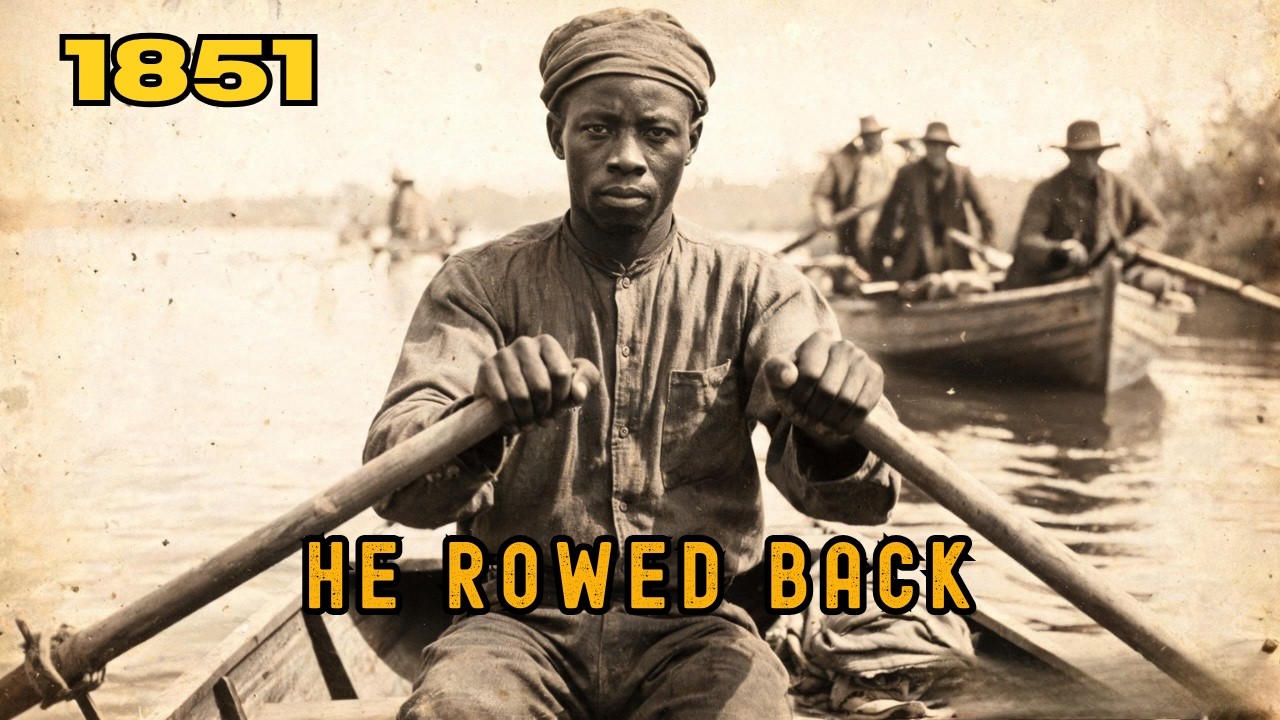
Not straight across the river. Althea looked toward the Indiana shore. That was the direction they needed. It was also the direction anyone watching the river would expect them to take.
Moses turned the small boat downstream. For several minutes they moved with the current, not against it. Althea understood enough to recognize the danger. You are taking us south.
Toward the mouth. That is not north. I know. He offered no further explanation.
The rain struck the surface hard enough to shatter the shoreline reflections. That helped them. It also erased distances. A lamp could appear nearby before they knew whether it stood on a dock, in another boat, or in the hand of a man at the water’s edge.
The Ohio was rising. Branches drifted beside them. The boat struck something submerged and its bow lifted suddenly. Althea gripped the side before she lost her balance.
Moses stopped rowing at once. He listened. Water passed under the hull. No hole.
He resumed rowing. The stolen boat had been built for speed, not for safety in bad weather. Its narrow body responded quickly to the oars. Every sudden movement changed its balance.
Moses had chosen this boat because he knew what was coming. The slow boat would have been easier to hide. It would also have been easier to catch us. Behind them, the farm alarm was spreading.
A second lantern appeared farther down the Kentucky shore. Then a third. The search was already moving beyond the boundaries of Sayer’s property. That was how the system worked.
A man who claimed to own another person did not need to patrol every road himself. He could turn neighbors, hired hands, ferrymen, local officials, and opportunists into instruments of the search. Escaping slavery was rarely a contest between one fugitive and one owner. It was a contest against an entire network.
Moses had seen that network at work before. Althea did not yet know how close they were to it. They kept moving with the current. The rain weakened.
That worried Moses. The storm cover was what had allowed them to leave the landing. Clear weather would make the boat easier to spot. He pulled closer to the Kentucky side.
Althea stared at him. Now they were not only moving in the wrong direction; they were approaching the shore they had just fled. Moses. Keep rowing.
She did. Not because she understood, but because arguing aloud in the middle of the water would do no good. The river narrowed around a low island covered in trees and flood debris. Moses guided the boat behind it.
For a few moments, the Kentucky shore disappeared. He stopped rowing again. The current carried the boat. Althea watched his head turn toward the darkness upstream.
At first she heard only water. Then came the faint rhythm of oars. Another boat. Moses pushed the boat deeper into the island’s shadow.
Get down. They crouched inside the boat. The approaching boat moved along the main channel. Voices carried across the water.
The words were not clear. The sound was enough. Men were already searching from the river. Althea stayed low.
Moses watched through the reeds. He looked less surprised than she expected. That unsettled her more than the voices. The patrol boat kept moving with the current without turning behind the island.
Moses waited until the sound of its oars faded. Then he rose. Althea followed. How did you know they would stay in the channel?
Moses picked up his oar. They are trying to see farther. That does not answer my question. They cannot see far from here.
He pushed the boat away from the island. His explanation was correct. It was also incomplete. They crossed behind the patrol and began to move diagonally toward Indiana.
Only then did Althea understand the first part of his plan. By drifting downstream along the Kentucky side, they had let the first searchers pass them. Now Moses was cutting across behind those men instead of racing them toward the far bank. It was calculated.
It was also extremely dangerous. One mistake would have left them stranded near Sayer’s shore. The current pulled the boat as they entered deeper water. Moses changed the angle immediately.
Left side, harder. Althea rowed again. She pulled harder. The boat turned.
A large branch passed close enough to brush the bow. They continued the crossing. No one spoke. Their progress could not be measured by the shore alone.
The current kept carrying them downstream even as they moved north. The river was not a road. It punished anyone who treated it as one. Moses knew that.
He also knew something else. Midway across, he stopped Althea with a raised hand. She froze. He listened.
Nothing. Then he said quietly, Get down. She looked behind them. There was no light, no voice.
Althea lowered herself. Moses pulled the oars into the boat. They drifted silently. Seconds passed.
Then a lantern appeared upstream. A small boat emerged from the darkness. Althea could now see two men inside. They were cutting across the river, not following the shore, not searching at random.
They were moving toward the direct line between Sayer’s landing and Indiana. If Moses had taken that line, they would have met face to face. The patrol passed far enough upstream that it did not notice them. Althea waited until the lantern disappeared.
Then she sat up. She did not reach for the oar. Moses did. She stopped him.
You knew. Knew what? That they would cross there. It is the shortest way.
That is not what I mean. Moses said nothing. Althea watched him. There was no confusion on his face.
No relief at having guessed correctly. Only confirmation. He had expected it. She picked up her oar again, but the question hung between them.
They continued toward Indiana. The clouds moved over the river. For a short time, the North Star became visible. Althea looked at it.
The symbol was simple. North meant distance. Distance meant chance. But the law passed in 1850 exposed the lie behind that simplicity.
There was no single line they could cross to become safe. Indiana could place them on free soil. It could not make Sayer stop claiming them. That distinction shaped every decision Moses made.
He avoided a landing where the bank rose gently. Instead, he continued farther downstream. Althea noticed. That place was easier.
That is why they will watch it. Again, the same certainty. They passed another possible crossing. Moses rejected it before Althea could speak.
Then another. He chose a stretch of shore choked with fallen timber and brush. No dock, no clear path, no proper place to land. He guided the small boat toward it.
As they approached, Althea heard faint barking from somewhere behind them on the Kentucky side. That sound changed Moses immediately. Not emotionally. Tactically.
He pushed the boat deeper into the debris instead of landing it. Stay here. He stepped into the shallow water. Althea grabbed his sleeve.
Where are you going? To check the bank. You said we would not separate. I am ten feet away.
It has to start somewhere. He looked at her. Their agreement was already shaping his choices. Neither of them yet understood how dangerous that would be.
Moses moved only a few steps from the boat. He tested the ground under his feet. The mud swallowed his shoe almost to the ankle. He came back.
Not here. They pushed the boat out again. The barking grew louder. Moses did not panic.
He guided the boat toward another passage partially blocked by a fallen tree. A boat appeared behind them. Closer this time. A lantern light moved across the water.
Althea saw it. They found us. No, they are coming straight here. They think we are heading for the landing.
Moses turned sharply toward the fallen tree. The opening beside the trunk looked far too narrow. Althea stopped rowing. We will not fit through.
We will. The boat entered sideways. Wood scraped against wood. Althea pulled her shoulder in as branches passed her face.
The pursuing boat reached the wider channel behind them. It slowed. The men aboard did not follow. Moses knew they would not.
The gap was hard to see in the dark and dangerous for a heavier boat. Behind them, the passage branched through drowned trees. The patrol stayed back. Moses pushed the boat deeper into the narrow water.
Only when the lantern light faded did Althea speak. How did you know they would not come through? They do not know what is behind it. Do you?
Moses kept rowing. Althea studied him. Not the river. Him.
She went over the events of the past hour in her mind. The direct crossing he had avoided. The landing he had rejected. The patrol routes he had predicted.
The exact moment he had ordered her down before the second boat appeared. This was no longer ordinary knowledge of the Ohio. Boat repair could explain a knowledge of currents. It could explain a knowledge of hulls.
It could explain a knowledge of waterways. It did not explain a knowledge of how men behave. They came out of the drowned timber into calmer water near the Indiana shore. The sound of the pursuit faded.
For the first time since leaving Sayer’s Landing, land was within reach. Althea should have felt relief. Instead, doubt took its place. She set down her oar.
Moses looked at her. We have to move. She did not. You knew where they would search.
Moses glanced back at the river. Althea. You knew where they would cross. You knew which landing they would watch.
You knew which channel they would not enter. We can talk after we are out of the water. No. The word was quiet.
It stopped him. Althea looked at him directly. How many times have you been on the other side of this? Moses did not answer.
He kept his eyes on the Indiana shore. Althea did not. She was watching him now. The river had stopped being the most dangerous unknown between them.
How many times? she asked again. Moses rested the oars across the small boat. The boat drifted slowly among the drowned trees near the shore.
He had several possible answers. He could have minimized it. He could have said Sayer sometimes took him out at night. He could have said he was only there to steer the boat.
He could have hidden behind the language of forced labor and omitted the purpose of those journeys. Instead, he gave her the important part. Enough to know how they search. Althea’s face changed.
Not just shock. Recognition. The routes he had predicted. The crossings he had avoided.
The way he knew when to drop down before the lights appeared. Everything rearranged itself. You went with them. Moses nodded once.
Sayer had discovered years earlier that Moses was more useful on the river than most of the men he could hire. That usefulness had consequences. When an enslaved man disappeared near the Ohio, or a woman was thought to have taken a boat, or someone reached the river, Sayer wanted the pursuit continued. Moses was sometimes ordered into a search boat.
He rowed. He watched the banks. He read the current. He told the men beside him where a small boat might drift if left alone.
He had been forced to provide the very knowledge that was keeping Althea alive now. The system did more than seize labor. It corrupted skill. Anything a person learned could be used to betray others.
Boat repair, cooking, blacksmithing, knowing the roads, knowing the swamps, knowing the rivers. Slavery treated human ability as another resource to be captured. Althea sat still. Did you help catch them?
The question demanded more than yes or no. Moses understood that. I rowed the boat. That is not what I asked.
No. He looked at her. Then he corrected himself. Yes.
The second answer was harsher because it was true. He had rowed boats that reached people before they could disappear. He had delivered men close enough to be captured. He had watched people dragged back toward the shore they had tried to leave.
He had done it under orders. That did not erase the result. Althea turned her face away. For several seconds, only the current moved.
Moses did not ask her to understand. He had spent years refusing to explain this part of his life. He would not even tell himself. Sayer never allowed that work to be described as a choice.
Moses was told when to get on the boat. He was told when to row. He was told when to turn. Sometimes, an armed man sat close enough to make refusal meaningless.
Other times, the threat was less direct, but just as clear. A beating. A sale. A removal farther south.
Althea moved to a place Moses could never reach. Slaveholders rarely needed to repeat every threat aloud. Once the structure was understood, silence did the work. Althea turned back to him.
Did you ever try to stop one of them? Moses looked at his hands. There had been one attempt. He remembered it very clearly.
A man had crossed from Kentucky in a stolen flat-bottomed boat after midnight. He had reached a narrow inlet before the searchers noticed the place where he had come ashore. Sayer ordered Moses to ride in a pursuit boat before sunrise. Two other men came with them.
Moses knew where the fugitive was most likely heading. He also knew a faster route. He did not take it. Instead, he drove the search boat toward shallow water where the river had deposited mud and broken branches after heavy rains.
The hull struck bottom. One of the men swore. Another got out and pushed the boat. Moses pretended the bottom had changed more than he expected.
The delay lasted several minutes. He had hoped those minutes would be enough. They were not. The fugitive was found later that morning near a farm road.
Moses saw the man brought back again. The man’s face told Moses exactly what those lost minutes had failed to achieve. Althea listened without speaking. Did he know?
Know what? That you tried? Moses shook his head. No.
That answer carried its own punishment. The man had gone back believing that everyone in that search boat had been helping to hunt him. Moses had lived since then with the possibility that this was how he deserved to be remembered. Althea’s anger did not disappear.
It changed shape. She understood what coercion meant. She had lived in its shadow her whole life. But understanding coercion did not make the picture easier to accept.
The man she trusted most had sat, on days, in boats identical to the ones searching for them now. That was not betrayal in the simple sense. It was a pattern particular to slavery. The system placed people in roles that made even the innocent look guilty.
It created guilt out of situations where there was no real choice. It forced victims to watch the suffering of others around them. Then it left them to carry that memory. Althea spoke quietly.
You should have told me. I know. Moses did not answer. There had never been a safe time.
That was also just an excuse. Althea picked up her oar again. Then tell me everything now. Moses nodded.
No promises beyond that. No request for forgiveness. He began to row. They moved toward the shore.
As they went, Moses explained the mechanics of the search. Men who hunted fugitives usually began with assumptions. They assumed panic. They assumed exhaustion.
They assumed the fastest visible route. They watched ferry landings, wagon roads, houses rumored to shelter runaways. They looked for movement more than skill. They expected people fleeing slavery to react out of fear.
That expectation created patterns. Moses had memorized those patterns because his survival had once depended on following them. Now survival depended on reversing them. They think we will hurry, he said.
Althea cut the water with her oar. We are hurrying. They think we will hurry recklessly. That difference mattered.
A desperate person could still make deliberate decisions. Slave catchers relied partly on the belief that fear would reduce judgment. Moses intended to make that belief costly. The boat touched mud near the Indiana shore.
Neither of them celebrated. The landing was too exposed. Moses got out first and pulled the boat through the shallows until the brush hid most of the hull. Althea followed.
Her shoes sank into the wet ground. She climbed onto firmer earth and turned toward the river. Kentucky remained visible through the dark and the rain. Close enough that the distance felt insulting.
A person could cross that water in a small boat and still remain within reach of the system behind it. That was the truth reinforced by the Fugitive Slave Act. Freedom could not be measured in yards of shoreline. Moses pulled branches across the visible side of the boat.
Althea helped without being asked. The tension between them had not ended. It had become more disciplined. There was no time to resolve anything.
Voices could still appear on the river. Dogs could still be brought across. Men could still search the roads before sunrise. Moses pointed inland.
We have to move. Althea looked at him. Do you know where to go beyond here? This is not a place.
No. That was the most honest answer he had given her all night. They entered the trees. Moses no longer walked ahead of her as though his knowledge placed him beyond questioning.
When he changed direction, he explained why. When he stopped, Althea stood beside him, not behind him. The balance between them had shifted. His secret had weakened the trust between them.
But it had also ended a kind of deception. After a few hundred yards, they reached a narrow road heading inland. Moses saw the danger at once. Roads made travel easier.
They also made interception easier. He moved away from it. Althea followed. Before they left the river entirely, she stopped again.
Moses. He turned. Everything they taught you. Wait.
Do you really think it can get us out? Moses looked at the water they had crossed, then at the darkness ahead. Everything they taught me to catch people, I am using now to get you out. Althea held his eyes.
She did not forgive him. Not yet. But she moved. They disappeared together into the woods of Indiana.
Behind them, the Ohio continued to carry search boats through the darkness. Ahead of them lay land that was supposed to be free. But neither of them made the mistake of considering themselves safe. Free soil changed the law around Moses and Althea.
It did not remove the danger. By the time they had moved deep into Indiana, the rain had eased and the eastern horizon was beginning to pale. That was bad for them. Darkness had hidden their movements.
Dawn would reveal them. Moses kept them off the road. Althea did not object. After what he had told her at the river, she no longer assumed every decision he made came from instinct.
She knew now that some of his knowledge had been gained inside pursuit boats. That truth had not become easier to accept, but it had become useful. They moved through the wet trees until they reached a low rise. From there, Althea could see the outline of an abandoned mill farther inland.
The building was partially collapsed on one side. Its wheel no longer turned. No smoke rose from the chimney. To anyone passing at a distance, it looked empty.
Althea stopped. There. Moses looked at her. You know it.
I know what to look for. That was new. Until that moment, Moses had been the one carrying hidden knowledge. Now Althea possessed something he did not.
She had heard about the place through conversations Sayer would never have considered important. Kitchen workers heard the drivers talk. Women carrying food heard the hired men. People moving between buildings noticed which strangers appeared at night.
They noticed which roads certain wagons avoided. Information traveled in the shadow of slavery because people made it travel. Not through formal organizations that men like Sayer could see, but through memory, repetition, and trust. Althea pointed toward the upper window.
Wait. Nothing. Then a light appeared. It stayed for a few seconds, went out, came back.
Althea exhaled. Is that all? Moses did not ask how she knew. That was a lesson the night had already taught them.
Not every source needed to be named. They approached from the rear. The mill door did not open immediately. Moses knocked once, waited, then twice.
Silence. He began to turn away. The door opened a few inches. A Black woman stood behind it.
She was older than Althea, perhaps in her forties, wearing a plain dark dress and a shawl pulled tightly around her shoulders. Her face held no welcome, only assessment. She looked at Althea first, then at Moses. Her expression froze.
Moses noticed. So did Althea. The woman opened the door fully. They entered.
The door closed behind them. The woman did not give her name. She checked the window first, then the back entrance. Only after both were secured did she turn to them.
You came from Kentucky. It was not a question. Althea nodded. The woman looked at Moses again.
Longer this time. Something hardened in her face. I remember you. Moses did not move.
Althea felt the room change. The woman stepped closer. You were in a boat. Moses said nothing.
Years ago. Althea looked at him. The confession at the river returned immediately. The woman had not heard his explanation.
She had only seen what anyone on the shore would have seen. Moses among men searching for someone, a Black man holding an oar in the same boat as the hunters. There was no visible sign of coercion. No evidence of the orders given before the boat left.
No way for anyone watching from the bank to know whether Moses wanted to be there. The woman gave her name then, Naomi Quaid, and did not offer her hand. I remember that boat, Naomi said. I remember who they brought back.
Moses lowered his eyes briefly. So do I. Naomi stared at him. Althea could have stepped between them.
She did not. This was not a misunderstanding that could be resolved by claiming the past was simple. Naomi had seen a pursuit. Moses had been part of it.
Both facts were true. He was forced, Althea said. Naomi looked at her. I did not ask you.
The words were sharp but disciplined. Moses answered for himself. Sayer put me in those boats because I knew the river. Naomi’s expression did not soften.
And the people they found, I remember them. That was not my question. Moses looked at her directly. No, I could not stop most of it.
Most? Naomi heard the word. What does that mean? Moses told her about the shallow channel, the delay, the man who was caught anyway.
He did not present himself as a secret hero. He explained what he had done and what he had failed to do. Naomi listened without interrupting. When he finished, she remained silent.
There was no clear moral category available. Slavery placed people in situations where they were forced to help the system that enslaved them. That did not make the consequences unreal. It did not make witnesses forget what they had seen.
It did not obligate the harmed to forgive immediately. Naomi turned away at last. You need dry clothes. The discussion was over.
Not resolved. Over. That distinction defined the room. She brought them plain clothes from a storage chest.
She set food on a rough table. Moses noticed that the room behind her contained blankets, extra shoes, covered water jugs. This was not the first time people had passed through here. Naomi saw his look.
Do not ask. I was not going to. Good. Althea ate quickly.
Moses barely touched the food. Naomi watched them both. How long since they knew you were gone? Hours, Althea said.
What did you take, a small boat? Naomi’s eyes narrowed. Who is Sayer? That answer changed her posture.
Then they know exactly what they are looking for. Moses nodded. Naomi walked to the closed window. And you came together?
Yes. She turned. Do you plan to stay together? Neither of them answered immediately.
That was answer enough. Naomi looked from Moses to Althea. Then you are easier to find than you think. Althea’s face hardened.
We crossed the river. Naomi shook her head. You crossed the water. The distinction was cruel because it was precise.
Indiana had not erased Sayer’s claim. The Fugitive Slave Act made that danger more formal, not less. Men could cross the river behind them. Officials could assist them.
The people who sheltered fugitives faced legal risk. The machinery of slavery had been extended outward precisely because the enslaved kept escaping its physical borders. Naomi pulled a chair toward the table. There is a route north from here.
Moses looked at her. A route? No. Then what?
Different places? Different people? She gave no names. Not yet.
You could move faster if you separated. Althea answered first. No. Naomi looked at her.
You asked for help. I did not ask to give him up. Moses spoke before Naomi could respond. We stay together.
Naomi’s attention turned to him. That may be what gets you both caught. The room fell quiet. Althea felt the old promise returning between them.
Neither of us reaches freedom by giving up the other. It had protected them from one horror, separation. Naomi was now telling them that the same promise might become a weakness. She moved closer.
If Sayer knows you love each other, he does not have to guess all your choices. Moses listened. He knows you will not choose a path that leaves either of you behind. He knows you will not use a hiding place meant for one person.
He knows if one of you is seen, the other is probably close. Althea looked at Moses. The warning struck harder because it was tactical, not emotional. Their bond created patterns.
Patterns can be tracked, Naomi continued. Do you think he is hunting two fugitives? She shook her head. He is hunting one decision made twice.
Moses understood at once. Althea understood a moment later. That realization changed the scale of the pursuit. Until then, they had thought Sayer’s advantage came from men, boats, horses, the law.
Naomi identified another weapon. Familiarity. Sayer knew enough about them to predict what they would refuse to do. That knowledge could narrow the search.
Moses stood. We leave before daylight. Naomi stared at him. You need rest.
We need distance. You need wisdom more, he almost answered, then stopped. Naomi had earned the right to say that. She moved toward another room.
You stay until dark. Althea looked at Moses. This time he did not make the decision alone. Wait.
She nodded. They stayed. On the other side of the river, Bramwell Sayer did not. By morning he had already crossed into Indiana.
He brought with him men who believed the pursuit was ordinary work. That was the horror at the heart of the system. A woman and a man had escaped captivity. The law treated the act as theft from the person who claimed to own them.
Sayer began asking about roads, sightings at the river, abandoned buildings, anyone known to shelter fugitives. Then he gave the instruction that would shape the next stage of the hunt. Do not look for where a man alone would run. The men around him waited.
Sayer looked north. Look for where he can keep her beside him. He understood the North Star compact without ever hearing it spoken. By late afternoon, Naomi no longer believed the mill would shelter them safely for another night.
The decision was not based on rumor. It was based on suspicious movements. A wagon had stopped on the road earlier than expected. Two men spoke with a farmer behind the tree line.
A rider passed once, then returned from the opposite direction less than an hour later. That was not proof of Sayer’s exact location. It was enough. Naomi watched from behind the shutter.
They are tightening the circle. Moses stood near the back door. How far north is too far if you keep making decisions for two? Althea looked at her.
Naomi did not soften her warning. There is a route through the floodplain, firmer ground beyond that. And another place. Do we stay together?
Althea asked. Naomi hesitated. That depends on whether you want the safest answer or the one you have already decided on. Neither spoke.
The nature of the problem had changed. At the river, the danger had been physical. Boats, currents, lanterns. Now the pursuit was psychological.
Sayer did not need to know exactly where Moses and Althea were. He only needed to predict what they would refuse to do. Moses understood the logic because he had seen hunters use similar assumptions against other fugitives. People rarely fled as individuals without a past.
They carried their relationships with them. A husband looking for a wife. A brother delaying for a sister. A woman avoiding roads that might endanger the one she loved.
Slaveholders understood those bonds because they had spent generations manipulating them. Families could be sold and scattered. Partners could be threatened. Visiting privileges could be granted and withdrawn.
Children could be used to control parents. Love had never been outside the system. The system studied it. Then exploited it.
Moses had known that theoretically. Now he saw how directly Sayer was applying it to them. Naomi showed them the first route. No map.
No written directions. She stood at the back door and gave them landmarks. A split oak. A drainage ditch.
A low hill beyond drowned timber. A broken fence. Then a narrow path heading northwest. You will reach the fence before full dark.
Do not follow it. Why? Moses asked. Because a man who wants to catch two people together will watch the easy road.
Moses looked at her. He had reached the same conclusion himself. Althea noticed. So which way do we go?
Naomi pointed toward the low ground. The part nobody wants. That meant mud and water and brush. Ground that would slow them.
It was also ground where horses would be less useful. They left through the back door. Naomi did not say goodbye. Neither did Moses.
Some departures were safer without ceremony. Althea entered the trees first. Moses followed a few steps behind. For the first time since their escape began, they were moving away from the river instead of toward it.
The floodplain opened before them in patches of standing water and dark soil. Walking slowed at once. Althea tested every step before putting her weight down. Moses used a fallen branch to probe the deep spots.
They spoke only when necessary. Behind them, the abandoned mill faded through the trees. Ahead, the ground offered no clear way. It was exhausting work.
After more than an hour, they reached the split oak Naomi had described. Moses stopped. Fresh tracks cut through the mud nearby. Not footprints.
Hoofprints. Althea saw them. Fresh, yes. Moses crouched.
The edges were still sharp. A horse passed here since the rain eased. Maybe more than one. Moses looked toward the high ground.
The instinctive decision was to leave the mud and move faster. He did not. We stay in the low ground. Althea nodded.
They pushed deeper into the floodplain. Minutes later, voices carried from the rise. Both stopped. Two riders appeared between the trees above them.
Too far to identify clearly. Close enough to be a danger. One of the riders halted. Moses dropped behind a fallen trunk.
Althea did the same. The two men stayed on high ground. One pointed north. The other pointed toward a narrow path wide enough for two people to walk side by side.
Moses understood what they were doing. They were not searching at random. They were choosing routes where two riders could pass side by side and keep speed. Naomi had been right.
Sayer was not tracking their footprints. He was tracking how they moved together. The riders continued on. Moses waited until the sound faded.
Then Althea whispered, He knows. Yes. How far? Moses looked at her.
The weight of the answer settled on them both. They moved again. The ground worsened. Althea stumbled once and caught Moses for balance.
For a few seconds they stood holding the same branch. Then Moses looked ahead. There was a narrow strip of firmer ground to the west. One person could cross it quickly.
Two would have to walk single file. Farther east, a wider route curved around a flooded depression. Moses studied both. Althea saw what he was calculating.
The narrow way. He looked at her. You first. She began to cross.
Moses walked behind her at enough distance that anyone finding one set of tracks would think a single traveler had passed this way. It was a small adjustment. But it represented something larger. For the first time, they were both resisting the logic of their oath.
Not by abandoning each other, but by refusing to move as a pair at every moment. They reached the broken fence near sunset. Naomi had warned them not to follow it. Moses understood why at once.
The fence line ran toward high ground and eventually met a farm road. Easy walking, a clear direction, exactly the route Sayer would expect them to choose together. Moses moved away from it. Althea caught his arm.
Wait. She was looking north. There was a man standing near the road, too far to identify. He was not moving.
That was worse. A farmer would have a reason to be there. A man simply waiting beside the road had another purpose. Moses pulled Althea back.
They retreated into cover before the man turned toward them. The encounter confirmed what Moses was beginning to fear. Sayer’s method was working. Every logical choice they made as two people was narrowing the ground around them.
He is tightening the search. Althea saw the conclusion on his face. No. Moses said nothing.
You are thinking about Naomi’s separate route. I am thinking about getting us out of here. Together. He looked at her.
That word is starting to tell them where we are. Althea’s expression hardened. That word is what got me on the boat. I know.
It got you out of Sayer’s grip, I know. So do not make it the problem. Moses did not answer immediately because she was right and because she was also wrong. The promise had given them the courage to leave.
It was now shrinking their options. Both things could be true. They kept walking northwest. The light faded.
At the next stretch of high ground, Moses found evidence that the search was narrowing again. A branch broken at shoulder height. Mud disturbed near a tree. A horse had been tied there recently.
Sayer’s men were skipping past possible routes to get ahead of them. They did not need to see Moses and Althea directly. They only needed to keep tightening the circle. Moses looked back toward the river.
It was no longer visible, but he knew where it was and he knew what he had left there. Sayer’s small boat. The boat everyone knew. The boat that had announced their escape.
Until that moment, Moses had treated it as something they needed to hide. Now he saw another possibility. The boat was more than a means of transport. It was evidence.
Anyone who saw it would assume Moses and Althea were nearby. Anyone who saw Moses in the boat would assume Althea was with him. Something familiar could expose them. It could also misdirect others about them.
That thought brought no comfort. To use the boat that way, someone would have to return to it. Althea saw Moses looking south. What if you go back?
Nothing yet. She knew at once that was not true. You said no more secrets. I said I would tell you what matters.
This matters. Moses looked toward the darkening trees. The plan was not complete. Only the results were clear.
If Sayer was hunting them because he believed Moses would never leave Althea, the only way to break that pattern might be to make him believe that was still true. That meant separating while convincing him they were still together. Moses began walking again. Althea followed.
Neither of them mentioned the river. But from that moment, Moses’s thinking was no longer only about escape. It was about deception. They stopped near a collapsed shed before full dark.
The building had once stored farm tools. Now one wall leaned inward and part of the roof had fallen. It was not a safe hiding place. It provided just enough concealment to think for a few minutes without standing in the open.
Moses entered first. Althea followed. She saw what he was doing. He took her outer shawl from the bundle.
The cloth they had carried from Naomi’s house. He folded it once. Then he tied one end to a short piece of rope. Althea watched in silence.
Moses avoided looking at her eyes. That confirmed more than the cloth itself. What are you doing? He kept working, testing something.
No. He stopped. Althea moved closer. You were looking back toward the river before.
Now you are tying my shawl to a rope. Tell me. Moses looked at the cloth in his hands. The plan became real the moment she saw it.
Until then, it had been only calculations. The boat. The cloth. The hunters.
Sayer’s certainty. Now it had to pass Althea’s judgment. They know the small boat, Moses said. I know.
They know I took it. I know. If they see it again, they will follow it. Althea’s expression changed.
She understood what he meant before he finished. No. Moses said nothing. No.
Her voice stayed low. That made it harder. He set the shawl on the broken seat beside him. If they see me in that boat with this hanging where they can see it.
They will think you are still with me. And where am I, Moses? Without you? For a while.
You do not mean this. Moses looked at her. Althea stepped closer. Say it all.
He did. He would go back toward the river. He would find the boat where they had hidden it. He would make sure Althea’s shawl stayed visible from a distance.
Then he would move the boat. He would follow the route Sayer expected them to take together. He would not try to disappear at once. The plan depended on being seen.
That was the most dangerous part. Moses had spent the escape hiding his face. Now he intended to be recognized. He would give Sayer something stronger than a footprint.
A conclusion. Moses was still in the stolen boat. Althea’s clothing was visible. A pair that seemed to still be moving together.
Once Sayer accepted that conclusion, the pursuit would turn back toward the river. That would create time for Althea to move inland. Perhaps enough time to disappear into the network Naomi had described. Nothing in an escape allowed certainty.
Althea listened until he finished. Then she asked one question. When were you going to tell me? Moses did not answer.
She nodded once. That was answer enough. You were not going to. I was going to.
When? When I was sure the plan might work. You had already decided. You decided it might be the only way.
That is not the same thing. Moses looked at the open wall of the shed. The dark had settled over the floodplain. The hunters might be closer than they thought.
Time was working against them. But Althea refused to let urgency end the argument. That mattered. Slavery had already deprived her of control over her movement, her work, her separation.
Moses could not claim to save her by making another decision about her life without her consent. That was the moral danger at the heart of his plan. Good intentions did not automatically make control fair. Althea pointed toward the boat.
You do not get to turn me into something tied to a boat and call that saving me. I am not doing that. You are, if you decide where I go and where you die. Moses flinched at the word.
Not visibly enough for anyone but her to notice. But Althea noticed. I did not say I was going to die. You did not need to say it.
The silence settled. The plan had always contained that possibility. Moses had avoided naming it because naming it would make the choice harder to defend. Althea forced the truth into the room.
You are going back toward men who know your face. Yes. You will let them see you. Yes.
And you think you can draw them away from me long enough for me to disappear? Yes. And then what? Moses looked at her.
I know the river. That is not an answer. It is the only answer I have. Althea turned her back.
She stood near the broken wall. For years, she and Moses had survived by refusing to let Sayer define the terms of their relationship. He could control where they worked. He could control when they were allowed near each other.
He could threaten to separate them. But the bond between them remained their own. That was why the oath mattered. No one reaches freedom by giving up the other.
It had been a refusal. A line drawn against a system built on forced separation. Now Moses wanted to cross that line himself. Althea turned back.
You made me repeat it. Moses knew exactly what she meant. The promise. Yes.
I remember. Then remember all of it. He did. He also remembered the rider beside the fence.
The patrols watching routes wide enough for two. The places Sayer could predict because Moses and Althea insisted on moving together. The oath had become visible in how they moved. That was not because the promise was weak.
It was because Sayer understood how to exploit anything fixed. Moses spoke carefully. If we hold to it exactly as we said it, he knows where to look. Althea stared at him.
So your solution is to break it? My solution is to make him think I have not. That was the mechanism. Not separation alone.
Deception. Sayer had to believe Moses and Althea were still together. The owner had to believe the lovers were still exactly as predictable as he had always thought. Only then would he direct his resources in the wrong direction.
Althea looked south. The river was hidden behind trees and distance. But the logic was clear now. You want him to follow you because he thinks I am with you.
Yes. And if he catches you? Moses did not answer. Althea’s face hardened.
No. He looked at her. Then we find another way. We tried the other way already.
We find another way. With what time? She said nothing. Both of them knew.
The search was tightening. The easy routes were watched. The floodplains had slowed them. Sayer was beginning to predict their movements.
Moses continued. If he keeps hunting two people together, we keep giving him the same pattern. Althea’s anger remained, but the argument had reached a point where anger could not erase the facts. She sat on the broken seat.
For a few seconds she looked at the shawl. Then she looked at Moses. You said you promised not to let them take me. I did.
That is not the promise we made. I know. The answer came immediately. No defense.
No attempt to rewrite the past. That made the betrayal more visible. Moses did not claim to have kept the oath. He had chosen to break it because he believed its essence mattered more than its letter.
Althea understood that. But she did not accept his authority to decide it alone. If this happens, I choose my own path, she said. Moses nodded.
Do not tell Naomi’s people to carry me like cargo. I will not. Tell me everything you know about the places they are most likely to search. I will.
And stop calling this a sacrifice. Moses looked at her. I was not. You were thinking it.
He said nothing. Althea continued. Sacrifice makes it sound clean. Like one person gives and another receives.
She pointed toward the river. This is a diversion. Moses listened. You draw them away.
I move north. We are both doing something. He nodded slowly. A diversion.
If you agree. Yes. That distinction mattered because Althea refused to be the passive survivor of Moses’s final plan. She would not accept freedom as something given to her by a man who chose to die.
She would keep walking because she chose it. She would risk going north. He would risk going south. Both were actions.
Neither canceled the other. Moses handed over everything useful he could spare. A short piece of rope. The remainder of the food.
The directions Naomi had given him. He explained where he thought Sayer’s men would gather by morning. Althea corrected one assumption. They will check the high ground before the low ground.
Why? Because they think we are tired. Moses looked at her. She was right.
The searchers expected exhaustion to drive fugitives toward easier terrain. Another pattern. Another assumption to break. They planned the separation together.
No embrace. No long goodbye. Those things would have made the scene easier to watch. Their reality was harder.
They confirmed distances, routes, timing, signals that would never be used because returning to each other early would destroy the plan. When they were ready, Moses picked up Althea’s shawl. She took it from him. For a moment he thought she had changed her mind.
Instead, she tore a narrow strip from the inner edge and placed it in his hand. The rest will go on the boat. Moses closed his fingers around the strip. Althea turned north.
He turned south. They walked a few steps, then both stopped. Moses looked back. Althea did the same.
Neither spoke. There was nothing left to negotiate. They had begun the escape by making a promise not to abandon each other. Now survival required each to walk in the opposite direction.
Althea disappeared between the trees. Moses waited until he could no longer hear her footsteps. Then he faced the river for the first time since leaving Kentucky and began walking back toward Bramwell Sayer. Moses did not return to the river by the route they had taken before.
That was the first place Sayer’s men would expect him to appear. He moved through low ground and crossed behind a stand of trees. Then he approached the Ohio from the downstream direction. By then the rain had stopped completely.
That made the final approach more dangerous. The river could no longer hide him. He needed that. The plan depended on being seen.
Moses reached the place where the boat was hidden under brush and broken branches. It was still there. He stood beside it for a moment without touching anything. That boat had carried them both out of Kentucky.
Now it would carry a lie back to the men hunting them. He uncovered the hull and cleared the debris from the bottom. Then he spread out Althea’s shawl. She had left him most of it.
The narrow strip she had torn away was still inside his shirt. Moses tied the larger piece near the stern of the boat, where it could move in the wind. Not enough to look deliberate. But enough to be recognized.
From a distance, anyone told what Althea had been wearing might assume she was sitting low inside the boat. That assumption was the weapon. Moses pushed the boat into the water. Meanwhile, Althea continued north.
She did not act as though Moses had saved her and the task was finished. That would have been a breach of the decision they had made together. She avoided the high road, crossed the drainage ditch Naomi had described, waited for riders to pass on the road ahead, then moved again. Each step increased the distance between her and the river.
Each step made returning to Moses less likely. That was the price they had accepted. Not because they wanted it, but because Sayer had built his pursuit on the belief that they could not bear to part. Moses rowed toward open water.
He stayed near the Indiana shore at first. No lamps appeared. No voices. For minutes he wondered whether he had returned too late.
Then he saw movement upstream. A light. Another behind it. Search boats.
Moses turned the small boat. He did not flee at once. He let the current reveal him. One of the lanterns changed direction.
A voice carried across the water. Too far to make out words. Close enough to understand what had happened. They had seen the boat.
Moses rowed. Not toward the north. With the current. The first pursuit boat followed.
A second left the shore. The diversion had begun. On land, Sayer received the report of the sighting quickly. His men had been searching inland because he believed Moses would keep Althea beside him.
Now Sayer was told the stolen boat had reappeared. Inside it was a man who looked like Moses. A piece of women’s clothing was visible near the stern. Sayer did not hesitate.
He believed what Moses wanted him to believe. They were still together. That confidence was not irrational. It was based on years of observation.
Moses had protected Althea before. Althea had repeatedly refused to leave Moses. Their escape had begun together. Sayer knew all of that.
What he failed to understand was that people under oppression could change their tactics while keeping their loyalty. He ordered the search redirected back toward the river. The men positioned far inland were pulled back. The pressure around Althea’s route eased.
She did not know that yet. All she knew was that the sounds behind her became less frequent. At one point she stopped under the trees and listened. Nothing.
She wanted to believe that meant Moses’s plan was working. She refused to believe anything else. Not yet. On the Ohio, Moses increased his speed.
The pursuing boat gained ground. That was expected. He knew the boat was fast, but he also knew he was rowing alone. He did not need to outrun them forever.
He needed to set their course. Ahead of him stretched a section of river he remembered from the years Sayer had forced him into search parties. The current looked ordinary from the middle channel. It was not.
Floods had pushed heavy timber under the surface near one side. Experienced boatmen avoided that stretch when visibility was poor. Moses knew the opening. He also knew where a larger boat would hesitate.
He aimed for it. Behind him, a shot cracked across the water. The sound was farther away than the danger. Moses did not turn.
Another followed. No proof either had hit him. That was pressure. Forcing the fugitive into panic.
Forcing him to change direction. Forcing him to make a mistake. That method had worked on other people Moses had watched being hunted. This time, the man being hunted knew the method because he had once been forced to watch it from inside the hunter’s boat.
Moses held his course. The channel narrowed. Branches appeared above the surface. The small boat passed between them.
The larger pursuit boat slowed. Someone shouted. Moses heard it over the rough water. A second boat approached from another angle.
That was more dangerous. They were trying to trap him between the drowned timber and the main current. Moses rowed hard. The small boat turned.
For a brief moment, the lantern light reached him. The men behind could see his shoulders and the stolen boat. The dark cloth tied near the stern. That image was enough.
Sayer’s assumption held. Althea was with him. The hunters pushed toward the river. Moses disappeared around the bend.
What happened next did not reduce to a neat ending. That matters. Escape stories are often compressed into simple outcomes. Caught.
Killed. Free. Historical reality was often less complete. People disappeared.
Witness accounts conflicted. Bodies were never found. Names faded from one place and appeared nowhere else. Moses Finner entered that obscurity.
The pursuit continued downstream. Later, a damaged boat was found wedged among branches below the bend. One side had taken a hard blow that split part of the hull. Althea’s shawl was still attached.
Moses was not in it. There was no clear evidence of where he had gone. No confirmed body. No reliable sighting farther north.
No final witness who could confirm he reached the shore. Sayer searched the surrounding banks. That search consumed more time. Men moved through the low ground near the river.
They followed possible tracks that led nowhere. The certainty that had guided Sayer earlier now worked against him. He had built his entire plan on the assumption that Moses would never leave Althea. So when the boat appeared with her clothing visible, he never seriously considered that she might be miles away.
That mistake gave her what Moses had intended. Time. Althea reached the next contact point before daylight. She approached carefully and gave the signal Naomi had taught her.
The door opened. The first question came immediately. Where is the man who was with you? Althea stood outside for a few seconds, then answered.
He went back. She offered no further explanation. There was no time. She was moved again before the search could reorganize.
Farther north, then farther still. The precise geography mattered less than the growing distance. Sayer could continue to claim ownership under the law. He could send men.
He could invoke the Fugitive Slave Act. But every mile made recovery harder. Every person who refused to cooperate created a new obstacle. Every false direction increased the distance.
Althea survived the immediate pursuit. That survival was not a victory without loss. She had begun the escape believing freedom meant reaching the far bank with Moses. She reached safety carrying a question she could never resolve.
Did he drown? Was he wounded? Did he leave the damaged boat and escape on foot? Did the man who knew the river better than his hunters arrange one final disappearance for himself?
There was no answer she could trust. What he left behind was the way he did it. Bramwell Sayer had believed affection made the enslaved easier to control. For years, that belief served him.
He used separation as a threat. He watched Moses protect Althea. He watched Althea refuse to leave Moses. Then he built his pursuit around that knowledge.
For most of the escape, he had been right. That was exactly why the deception worked. Moses did not convince Sayer that their love had ended. He convinced him that nothing had changed.
The stolen boat carried that lie. Althea carried it through her own testimony. Moses showed himself long enough for Sayer to see exactly what he expected. At that point, the search turned away from the woman who was already fleeing.
The North Star compact began as a promise never to leave each other. The compact survived because they learned that staying together did not necessarily mean staying predictable. Slavery tried to turn love into a constraint. Moses turned it into the last false trail his hunters followed.
Sayer owned the boat. He claimed to own Moses. He claimed to own Althea.
But the one force he believed he understood completely was the one thing he had never possessed, their love.
