The bullet struck low, in the notch where the pelvis curves like a horseshoe at the very front of the body, just above everything a woman in Alice Abbott’s line of work counted on. It passed to the right of the bone and went clean through, missing every vital it could have found on the way. Alice bellowed that she was shot, staggered out of the cathouse, and collapsed in the street. The woman who fired the gun followed her out and pulled the trigger again.
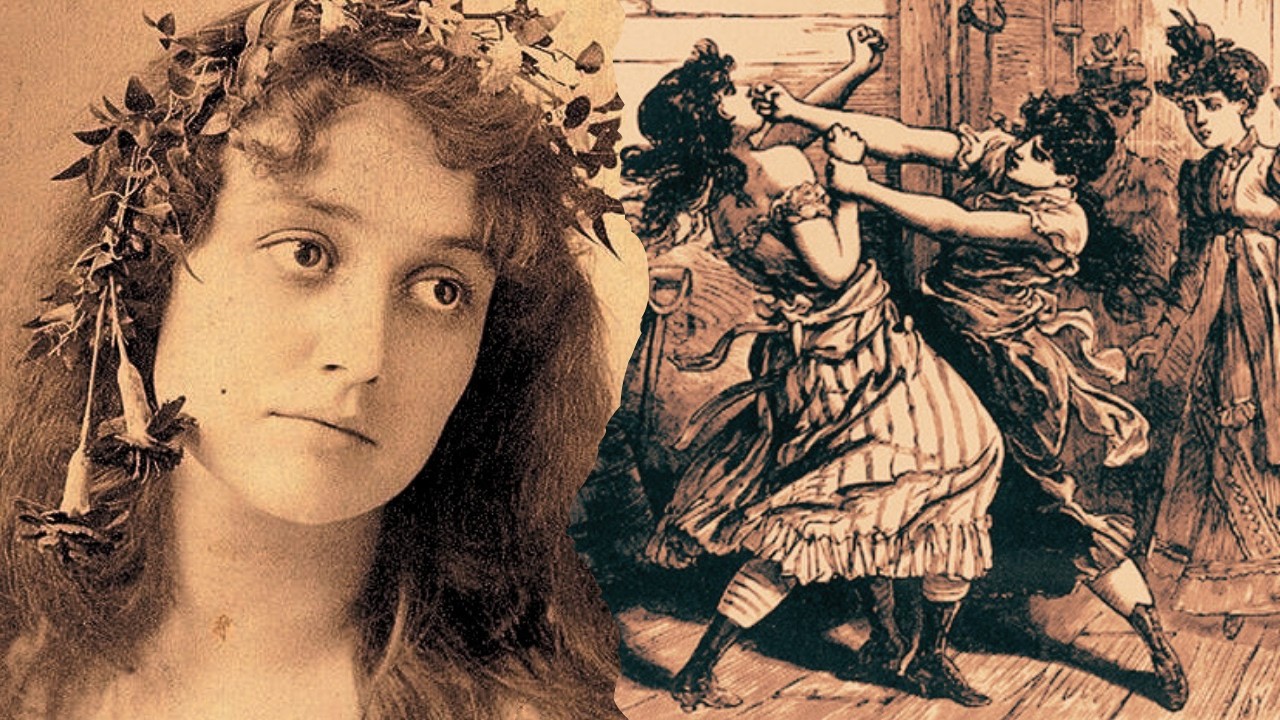
The second shot missed. Three of Alice’s girls rushed from the parlor, grabbed their madam, and dragged her out of the open street to safety. The shooter was Adda Clark, known around El Paso as Adda the Grasshopper, and she stood over the scene with a bone-handled bulldog revolver still in her hand. She had just put a bullet in the most profitable part of her rival’s anatomy, and within hours she would turn herself in to face a charge of attempted first-degree murder.
The whole affair had started, as these things so often did, over a girl. A decade earlier, El Paso had been a dusty border town of roughly seven hundred souls. Then the railroad came through, and the population exploded past ten thousand in the space of ten years. With the boom came crime, and with the crime came a reputation that earned El Paso the nickname of the six-shooter capital of the world.
President Benjamin Harrison, passing through on a visit, reportedly called it Sin City. Like most western towns of the era, it was really two towns in one. On one side stood the decent part: legitimate businesses, churches, schools, and the families who kept to them. On the other side lay the Tenderloin District, where a man could find temporary love, get blind drunk, gamble away his wages, and quite possibly his life.
Within the Tenderloin sat the Utah Street Reservation, where hundreds of soiled doves plied their trade in a dense cluster of brothels and cribs. Prostitution was not legal in El Paso. The city maintained laws against what it called wanton women. But there was a workaround.
As long as a madam and her girls paid a weekly fine of around ten dollars, the authorities left them alone. That ten dollars went straight into the police department’s coffers. Everybody got paid, and everybody got laid. Not all the women were equal.
There were levels to the game. At the bottom stood the crib girls, the street walkers of their day, who advertised their services in public thoroughfares and took their clients to tiny, miserable dens called cribs. A man could have one for as little as fifty cents. Many of these women could not speak English, and most of them worked against their will.
Sex trafficking was common in those days, and the crib girls lived lives of desperation watched over by pimps and fences. Above them were the saloon girls, who met their customers in the barroom proper and then took them in the back or upstairs. These women, too, had often been lured to town under false pretenses with the promise of legitimate work, only to be turned out and forced onto their backs. Leaving came at your own peril.
At the top of the hierarchy stood the parlor houses, proper establishments run by madams of standing within the district. The fancier the house, the cleaner the girls and the more money a man could expect to spend. The Chez Ami in Deadwood was the type. Alice Abbott ran that kind of establishment on Utah Street, what is now South Mesa, and she ran it well.
Alice Abbott, known to everyone as Fat Alice or Big Alice, came to El Paso by way of Louisville, Kentucky, born sometime in the early to mid-1850s. She stood six feet tall and weighed, by the estimates of the day, anywhere from 190 to 230 pounds. Whether anyone actually knew her weight, or merely guessed at it, is the kind of detail lost to history. A surviving photograph shows a dark-haired woman with a thin mouth and a somewhat plump face, built stout enough that she could lift heavy objects as well as any man.
She had gotten her start as a regular working girl, but by the mid-1880s she had risen to run her own place. Across the street, Adda Clark ran a rival house. The two madams had not always been enemies. Adda had once worked for Alice, and there is evidence the two may have been lovers.
Whatever they had shared was long dead by the spring of 1886. The trouble began with a prostitute named Bessie Colvin. Bessie was not just one of Fat Alice’s top earners; she was one of the most popular working girls in all of El Paso, and she knew it. She and Alice had been arguing over money for the better part of a year.
On the evening of April 18th, 1886, it all came to a head. Bessie marched out through Alice’s parlor, announcing to anyone who would listen that prime cut would soon be found across the street. She was going to work for Adda Clark. Alice did not take it well.
She sent two of her other girls over to Adda’s place to collect Bessie. They came back empty-handed. Alice decided to handle it herself. She marched across the street and began banging on Adda’s door, demanding to be let in.
Adda was not having it. She cracked the door open just far enough to tell Alice to go kick rocks. Alice ripped the door clean off its hinges and came barreling inside, smashing her fist into Adda’s face on the way in. Adda was holding a gas lighter at the time, the kind used to ignite street lamps and ceiling lights.
They were heavy instruments, made of brass, and not something you wanted slapped across the face. Adda swung it at Alice. Alice deflected the blow and rammed her fist into Adda’s mouth, sending the smaller madam reeling across the floor. Then she grabbed Bessie by the wrist and tried to drag her out of the house.
Adda ran to her quarters, retrieved a bone-handled bulldog revolver, cocked it, and aimed it at Alice. She told her to get the hell out. Alice charged. “I’ll kill the damn bitch,” Adda hollered, and squeezed the trigger.
The bullet went into Alice’s money maker. “My God, I’m shot,” Alice bellowed as she staggered out of the cathouse and collapsed in the street. The . 44 slug had struck her in the pubic arch.
The El Paso Herald, reporting the incident the following day, either accidentally or tongue-in-cheek, referred to it as her public arch, a sly allusion to her profession. The pubic arch is the notch formed in the inferior rami of the two conjoined pubic bones as they diverge from the midline, which is to say, in plain terms, the very bottom of the pelvis. The bullet passed just to the right of the bone and went clean through. It was a long time before Alice Abbott was back on her feet, and an even longer time before she was back on her knees making money.
Adda turned herself in and was charged with attempted first-degree murder. She had a good lawyer. Less than a month later, a jury found her not guilty on grounds of self-defense. It was a reasonable verdict, all things considered; Alice had torn the door off its hinges and come in swinging.
Still, one has to wonder how many of Adda’s customers sat on that jury. The feud did not end there. On July 12th, 1888, just over two years after the shooting, Adda’s brothel burned to the ground. According to some, it was Alice who struck the match.
The claim rests on a single source, an El Paso Community College publication called Borderlands, whose authors, Sunshine Mendez and Olga Joan Valles, wrote that it was later determined that Fat Alice had hired some drunks to set fire to her enemy’s house. But the evidence had gaps, and Alice and her hired bunch were acquitted. In time, a rich client came along and built Adda a brand new parlor. The man’s wife divorced him over it.
He and Adda went on to live as husband and wife without ever officially marrying. There was another fire in 1905, and this time Adda barely survived. She died a few years later, in 1908, from complications related to the smoke she had inhaled. Alice continued running her business in El Paso until February of 1890, when she leased her brothel to another madam named Tilly Howard.
On April 7th, 1896, Alice Abbott died of a heart attack. As for Bessie Colvin, the Helen of El Paso, history loses her entirely. No birth record, no death record, no grave. The only reason anyone knows she existed is that she was fought over as though she were a piece of property.
The last thing the record shows is this: after the gunfight, after all the drama and the bullets and the trial, Bessie Colvin went back to work for Fat Alice. What remains of these women survives largely in a single artifact: Alice Abbott’s personal photo album. Within it are portraits of her girls, annotated in her own hand with nicknames. One she called the bastard of the road.
Another she labeled the Missouri whacker. A third she dubbed lover boy Mabel Jones. Around some of the girls she drew hearts, symbols that many take to identify the women who, at one point or another, doubled as Alice’s lovers. Even Adda had a heart drawn around her picture.
But Alice had also marked it out with a big red X and left a note underneath, calling Adda, in so many words, a whore. One final curiosity: the bulldog revolver Adda used to shoot Alice was the same model of pistol used to assassinate President James Garfield. The only difference was the caliber. The gun that killed Garfield was chambered in .
442, while the one that put Alice Abbott in the street was a . 44. The women of the Utah Street Reservation were practically invisible in 1886, and they remain largely invisible now. Most of them lived miserable lives, lives of pure desperation, whether from addiction, trafficking, extreme poverty, abuse, broken homes, or some combination of all of it.
Very few were in that line of work because they wanted to be, and a great many of them died young. Every single one of them was somebody’s daughter. Even today, no one knows how many women are in the same position. As recently as 2023, the National Trafficking Hotline fielded reports involving nearly 17,000 potential victims, and that was just the ones who picked up the phone.
Bessie Colvin left no trace because she was invisible in life. The only testament to her existence is the fight her two madams waged over her, the bullet one of them took for her, and the photograph album where she may still smile, unnamed, under a heart drawn in ink.
