In the autumn of 1777, in the forests and farmlands north of Albany, an army that had never lost a major battle against the British marched into a trap of its own making. Its commander believed that discipline, firepower, and the mere sight of a British column would be enough to scatter any force of American farmers and militiamen. He was wrong. What followed was not just a defeat.
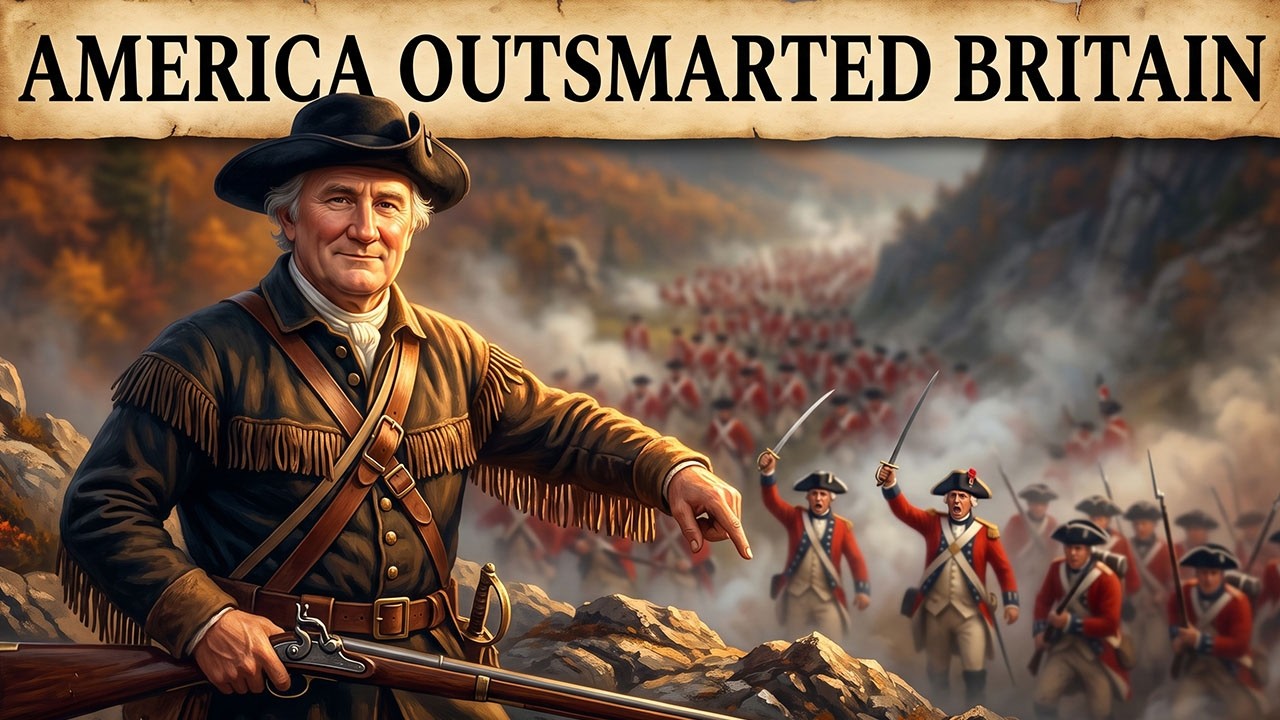
It was the collapse of an entire strategy, the humiliation of one of the British Empire’s most confident generals, and the moment that convinced a foreign superpower to gamble openly on American independence. By the spring of 1777, the American rebellion had dragged on for nearly two years without a decisive result. British forces held New York City and had brushed aside Washington’s army in a string of engagements around it. Yet the countryside remained defiant, and the Continental Army, though battered at Long Island, White Plains, and Fort Washington, refused to disappear.
In London, the ministry of Lord North and the American Secretary, Lord George Germain, searched for a single stroke that could end the war in one campaign season before French gold and French muskets could turn a colonial revolt into a European war. The plan that emerged was ambitious in its geometry, almost theatrical in its symmetry on a map. General John Burgoyne, a man as well known in London for his plays and his gambling debts as for his soldiering, and nicknamed Gentleman Johnny by his own troops for his taste for good wine and fine company even on campaign, proposed to drive south from Quebec along Lake Champlain and the Hudson River corridor, while a second, smaller column under Colonel Barry St. Leger swept east from Lake Ontario through the Mohawk Valley, gathering loyalists and Iroquois support along the way.
Both columns would converge on Albany, where they were meant to link with General William Howe’s main army marching north from New York City. If it succeeded, the plan would sever New England, the rebellion’s most committed and best organized region, from the Mid-Atlantic and Southern colonies, cutting the insurgency in two along the great water highway of the Hudson and starving it of men and supplies from either side. It was, on paper, an elegant plan. In practice, it depended on a piece of coordination that never happened.
Germain’s instructions to Howe, drafted in London, were vague enough to be read two ways, and by the time they reached New York, Howe had already committed himself to an entirely different campaign: a seaborne strike at Philadelphia, the seat of the Continental Congress, which he believed would deliver a symbolic victory worth more than marching through the wilderness to meet Burgoyne. No one in London confirmed otherwise. Burgoyne’s army, which departed Saint-Jean on Lake Champlain in June 1777, numbered close to 8,000 combat troops: British regulars in their red coats, German mercenaries hired from the Duchy of Brunswick and the Principality of Hesse-Hanau under General Friedrich Adolf Riedesel, several hundred loyalist militia eager to reclaim confiscated estates, and a shifting body of several hundred Native American warriors, mostly from Iroquois nations allied with the Crown, recruited as scouts and skirmishers. His artillery train was extraordinary for a wilderness campaign—more than 130 pieces of ordnance, many of them heavy siege guns entirely unsuited to forest roads.
His baggage was heavier still. Officers packed for the campaign as though for a garrison posting in England, hauling crates of wine, silver plate, and in one now famous case, an officer’s mistress and her entire wardrobe carried along in a private carriage. It was an army built for a parade ground campaign of maneuver and siege, not for the tangled, roadless forests of upstate New York, and that mismatch would define everything that followed. The invasion began with a triumph so complete it seemed to confirm every one of Burgoyne’s assumptions.
Fort Ticonderoga, the supposedly impregnable American stronghold guarding the southern approach to Lake Champlain, fell without a serious fight in early July after Burgoyne’s engineers, working through a single night, hauled cannons up Sugar Loaf Hill, a height overlooking the fort that American commanders had judged too steep and too remote to bother fortifying. When dawn revealed British guns staring down into their own works, the garrison under General Arthur St. Clair abandoned the fort overnight rather than face a bombardment they could not survive. News of the fort’s fall reached London to public celebration.
King George III is said to have burst into the Queen’s apartments shouting that he had beaten all the Americans. It reached the Continental Congress to genuine panic. St. Clair, blamed unfairly for a decision that had almost certainly saved his army, would later be formally, if belatedly, cleared by court-martial.
For a brief moment in July 1777, it seemed Burgoyne’s gamble would pay off exactly as drawn on the map in London. Then the country itself turned against him. South of Ticonderoga, the road to the Hudson was barely a road at all—a narrow corridor through dense forest and swamp that retreating American troops, under the methodical direction of General Philip Schuyler, systematically destroyed behind them. Hundreds of trees were felled across every trail, bridges were burned, streams were dammed to flood the low ground into impassable marsh.
What should have taken days took the better part of a month. Burgoyne’s army, dragging its heavy artillery and its mountain of officers’ baggage, covered barely a mile a day through the ruined wilderness, while scouting parties and work crews strained under constant threat of ambush from militia units who knew the ground intimately and needed no roads at all. Worse followed, and it came from Burgoyne’s own side. In late July, a raiding party of his Native American allies killed and scalped a young Loyalist woman named Jane McCrea, who was engaged to a Loyalist officer serving in Burgoyne’s own army.
The killing arose, by most accounts, from a dispute over a promised reward rather than any military purpose at all. Intended by nobody as a political statement, the killing nonetheless horrified the countryside on both sides of the conflict. Newspapers as far away as Philadelphia printed lurid accounts of the murder within weeks. Militiamen who had stayed home now picked up their muskets in outrage.
Farmers who had watched the war from a cautious distance decided, almost overnight, that it had come to their own doorstep. Burgoyne’s Native American allies, meant to intimidate the countryside into submission, were instead recruiting soldiers for the rebellion—and by August, disillusioned by the slow, grinding pace of the campaign and the dwindling promise of plunder, many of those same allies began quietly slipping away from the army altogether, taking Burgoyne’s best source of forward reconnaissance with them. By mid-August, Burgoyne was desperately short of horses, wagons, and food, his supply lines stretching back hundreds of miles through hostile territory to Canada. He dispatched a raiding force of roughly 800 men—mostly German dragoons marching on foot, since he had no horses left to mount them, alongside loyalist militia and a small detachment of Native American scouts—toward Bennington in the New Hampshire Grants, where scouts reported a lightly guarded rebel supply depot stocked with cattle, horses, and provisions.
It was a trap of a very different kind than the one Burgoyne had set at Ticonderoga. Nearly 2,000 New Hampshire and Vermont militia hastily assembled under General John Stark, a blunt veteran commander who reportedly told his men before the battle: “There are the redcoats and they are ours, or this night Molly Stark sleeps a widow. ”
In the battle that followed on August 16, 1777, Stark’s militia surrounded and annihilated the raiding column in a series of coordinated attacks from several directions at once. A second relief column sent by Burgoyne to rescue the first arrived just in time to be routed as well, by militia reinforced with Continental troops under Seth Warner.
Burgoyne lost nearly a thousand men he could never replace, deep in hostile country with no realistic line of retreat and no hope of resupply from home. At almost exactly the same moment, roughly 100 miles to the west, St. Leger’s column—the second eastern jaw of Burgoyne’s planned pincer—stalled at the siege of Fort Stanwix, defended stubbornly by a garrison under Colonel Peter Gansevoort. A relief force of Tryon County militia under the aging General Nicholas Herkimer marched to break the siege and walked into a devastating ambush at Oriskany on August 6th, one of the bloodiest engagements of the entire war relative to the number of men involved.
Herkimer himself was mortally wounded, yet continued to direct the fighting from beneath a tree, propped against his own saddle, calmly smoking a pipe as the battle raged around him. Though the ambush inflicted terrible losses on the relief column, it also badly weakened St. Leger’s own Native American allies, whose villages had supplied many of the warriors killed at Oriskany. Weeks later, a Continental relief force under Benedict Arnold—still, at this point in the war, one of the most aggressive and trusted field commanders in the entire Continental Army—broke the siege of Fort Stanwix without a battle at all, through a piece of audacious deception.
Arnold spread false rumors of an overwhelming American advance through a mentally unstable local loyalist named Hon Yost Schuyler, whom his officers had captured and convinced to cooperate by threatening the life of his brother. Schuyler ran into St. Leger’s Native American camp raving about an approaching force as numerous as the leaves on the trees, and the alarmed warriors, already unsettled by their losses at Oriskany, began deserting en masse. St.
Leger, his native support evaporating around him, had no choice but to abandon the siege and retreat to Canada. The eastern jaw of Burgoyne’s pincer had simply vanished without a single major battle being fought for it. Burgoyne was now entirely alone, and Albany was still more than 30 miles away through country that grew more hostile with every passing week. While Burgoyne struggled through the wilderness, the army that would eventually stop him was itself undergoing a transformation.
Command of the so-called Northern Department had passed, amid considerable political controversy, from Philip Schuyler—whose scorched-earth delaying campaign had done more to wreck Burgoyne’s timetable than any single battle, but who was deeply unpopular with the New England militia he depended on—to General Horatio Gates, a former British officer of modest background who had emigrated to Virginia and thrown in his lot with the rebellion. Gates was cautious and methodical, more comfortable with defensive engineering and paperwork than with the kind of battlefield daring that had made men like Arnold famous. His critics, then and since, have questioned whether he possessed real tactical skill at all. But in the autumn of 1777, caution was exactly what the moment required.
On the advice of a young Polish military engineer named Thaddeus Kosciuszko, who had volunteered for the American cause and would go on to become one of its most celebrated foreign officers, the Americans fortified a low bluff overlooking the Hudson River Road called Bemis Heights. Kosciuszko’s earthworks were built with real sophistication: a strong main line studded with artillery redoubts, positioned so that any British advance along the river road would have to pass directly beneath American guns, while the only alternative route inland ran through dense, broken forest that stripped away every advantage of European linear tactics. Gates would later joke, somewhat ungraciously, that if Kosciuszko’s fortifications held, the credit would be Kosciuszko’s, but if they ran, the blame would be his. Gates’s army swelled rapidly through September as news of Bennington and Fort Stanwix spread across New England and New York.
Militia companies that had sat out the summer, uncertain whether this invasion was worth the harvest they would miss, now marched in by the hundreds, drawn by the sense—rare so far in the war—that this was a fight they might actually win. By late September, Gates commanded something close to 9,000 men: a mixed force of hardened Continental regulars, seasoned militia, and Daniel Morgan’s famous corps of Virginia riflemen, 500 hand-picked marksmen armed with long rifles far more accurate, if slower to load, than the smoothbore muskets carried by most infantry of the era. Burgoyne’s army, by contrast, was shrinking and starving even as it prepared for the fight of its life. The Baroness Friederike von Riedesel, wife of the German general and one of several officers’ wives who had accompanied the campaign, kept a diary through these weeks that survives as one of the most vivid eyewitness accounts of the entire Saratoga campaign.
She recorded soldiers reduced to eating half rations, horses dying for want of forage, and a growing, unspoken sense among the officers that the campaign had already gone disastrously wrong long before a single major battle had been fought. Cut off from Canada, his Native American scouts deserting in growing numbers now that the campaign no longer promised easy plunder, and with no word at all from Howe or from London, Burgoyne faced a stark choice. He could not sit still in enemy country and starve. He had to attack, and he had to win decisively—or the campaign, and quite possibly his army, was finished.
On September 19th, Burgoyne split his weakened army into three columns and advanced toward the American lines through the dense woods and scattered clearings around a farm belonging to a family named Freeman. It was exactly the kind of ground his army was worst suited for: broken, wooded, thick with underbrush, offering no room for the disciplined linear volleys that European armies spent years training to deliver, and offering every advantage to skirmishers and riflemen who knew how to use cover. Gates, true to his cautious instincts, wanted to stay entirely behind Kosciuszko’s earthworks and let the British exhaust themselves attacking a fortified position. Benedict Arnold, commanding the American left wing and never a man inclined to patience, argued furiously that the army should meet the British in the open forest instead, where American riflemen and skirmishers could bleed the advancing columns long before they ever reached the fortified line.
Gates reluctantly allowed a limited force forward—far smaller than Arnold wanted—built around Morgan’s riflemen and Henry Dearborn’s light infantry, with additional regiments fed into the fight only as the day wore on. What followed was a battle unlike anything most of the British regulars had experienced in Europe. Morgan’s riflemen, concealed in the tree line, methodically picked off British officers whose distinctive uniforms, swords, and mounted positions made them unmistakable targets at ranges where the smoothbore muskets carried by ordinary infantry were nearly useless. Within the first minutes of contact, nearly every officer in the leading British company was killed or wounded—a level of loss that briefly threw the whole advance into confusion.
The fighting surged back and forth across Freeman’s farmstead for nearly four hours, the clearing changing hands again and again as fresh regiments were fed piecemeal into the fight on both sides. Artillery pieces were captured, recaptured, and captured once more until neither side could say with confidence who actually held the ground. Burgoyne’s second-in-command, General Simon Fraser, and reinforcements from Riedesel’s German Brigade, arriving late in the afternoon, finally stabilized the British line as darkness fell—but only barely. By the time the fighting ended, the British held the field in the narrowest technical sense, but they had suffered roughly 600 casualties to fewer than 300 on the American side, and gained not one step closer to Albany.
It was, by any honest reckoning, a defeat dressed as a victory. Arnold, who had fought with characteristic recklessness near the front of the action, returned to camp that night convinced that a full American assault the following morning could destroy Burgoyne’s exhausted, half-starved army outright. Gates disagreed, unwilling to abandon the security of the earthworks for an open attack, and a bitter, increasingly personal argument broke out between the two generals over the following days—not helped by the fact that Gates’s official report to Congress barely mentioned Arnold’s role in the fighting at all, crediting the day’s action almost entirely to Morgan and to his own generalship. Gates, furious at what he considered Arnold’s insubordination and determined to claim sole credit for the campaign, formally stripped him of his field command.
Arnold remained in camp without a command for the next 18 days, seething, reportedly threatening to ride to Congress and demand a court-martial to clear his name, while the two armies settled into an uneasy, watchful standoff barely a mile apart. Those 18 days were far kinder to the Americans than to the British. Militia continued to swell Gates’s ranks by the hundreds, drawn by news of the fighting at Freeman’s Farm, until his army numbered close to 11,000 men—more than enough to surround Burgoyne’s position entirely if it chose to. Burgoyne’s force, by contrast, shrank steadily through disease, desertion, and the slow starvation of quarter rations, dwindling to barely 6,000 effective men.
He gambled everything on a slim hope. A letter had reached him, smuggled through enemy lines hidden inside a hollow silver bullet that the courier swallowed rather than risk capture, promising that General Henry Clinton would launch a diversionary strike up the Hudson from New York City to draw American attention and open a path north. Clinton did launch that raid in early October, storming Forts Clinton and Montgomery in the Hudson Highlands in a genuinely impressive piece of soldiering, but it came weeks too late and was aimed at the wrong objective entirely—more interested in punishing the rebellion than in actually relieving Burgoyne—and word of it reached Burgoyne only after his fate had already been sealed. No reinforcement and no rescue was ever coming.
Burgoyne’s men were reduced to a pound of flour and barely any meat per day by early October. Their horses were so weakened by lack of forage that the army’s mobility had collapsed entirely. He had, in truth, only two options left: attack again while his army still had the strength to fight at all, or surrender without ever forcing the issue. On October 7th, he chose to attack, sending out a reconnaissance in force of some 1,500 men drawn from his best remaining British, German, and Loyalist troops to probe the American left flank and test whether a full assault toward Albany was still even possible.
It was, in effect, a second Freeman’s Farm, and it ended in disaster far more quickly than the first. American forces under Morgan and General Enoch Poor struck the exposed British column from three directions almost simultaneously, killing General Simon Fraser—shot from his horse, according to several accounts, by one of Morgan’s riflemen specifically ordered to target him after Morgan reportedly told the marksman, “That gallant officer is General Fraser. I admire and honor him, but it is necessary he should die”—and driving the survivors back toward their fortifications in confusion within barely an hour of fighting. Fraser, one of the few genuinely capable senior officers left in Burgoyne’s army, died the following day and was buried that evening inside the Great Redoubt itself, in a hastily dug grave under continuing American artillery fire that scattered dirt across the mourners as the funeral service was read.
Baroness von Riedesel’s diary describes the scene in harrowing detail: the small burial party standing exposed on the hilltop as cannonballs whistled overhead. It was at this moment, with the British reeling, that Benedict Arnold—still formally without any command at all, having been stripped of his post after Freeman’s Farm—mounted his horse anyway and rode out onto the battlefield uninvited. Gates, watching from his headquarters, is said to have sent an aide to recall him. Arnold either never received the order or simply ignored it, galloping past his own bewildered soldiers, who cheered him on regardless of his lack of formal authority.
He rallied American troops in a series of increasingly reckless charges against the British defensive works, at one point riding alone between the lines under fire from both sides at once, culminating in an assault on the Breymann Redoubt, a fortified position held by German troops under Colonel Heinrich von Breymann that anchored the critical northern end of Burgoyne’s defensive line. As the redoubt fell to the American attack, Arnold was shot through the same leg he had already wounded two years earlier during the failed assault on Quebec. His horse, struck by the same volley, collapsed on top of him, pinning the leg beneath it. He would carry a permanently shortened leg for the rest of his life as a result—a lasting physical reminder of the battle that made him, for a brief moment, the single most celebrated soldier in America.
The fall of the Breymann Redoubt broke Burgoyne’s line entirely. His army retreated that night under cover of darkness to the village of Saratoga, a few miles north, harassed at every step by American militia and Continental detachments, who now seemed to appear from every direction at once, cutting off one route of retreat after another. Surrounded on high ground above the village, starving, and with every avenue of escape sealed by an American army now roughly twice his own size, Burgoyne convened a council of war among his remaining officers. There was by this point genuine and open discussion of whether the army might simply abandon its guns and baggage and attempt to cut its way north through the forest in small parties—a plan judged in the end almost certainly suicidal, given the exhaustion of the men and the number of American troops now blocking every road.
On October 17th, 1777, Burgoyne formally surrendered his entire remaining army—nearly 6,000 men—to Horatio Gates. It was the first time in the war, and the first time in living memory for most Europeans, that an entire British field army had laid down its arms in open surrender. The terms of surrender, negotiated carefully by Burgoyne, were unusually generous. Rather than becoming prisoners of war in the ordinary sense, his men were designated the Convention Army and promised passage home to Britain on condition they never again served in North America during the war.
Congress, however, distrustful of the promise and furious over perceived British bad faith in other matters, refused to honor the arrangement. The Convention Army instead spent years in captivity, marched first to Boston and later, as supply concerns mounted, all the way to Virginia, where many German and British soldiers alike eventually settled permanently in America after the war rather than ever seeing home again. News of the surrender crossed the Atlantic slowly, carried by sail for weeks, but its effect, when it finally reached Paris in early December 1777, was immediate and electric. Benjamin Franklin, who had spent nearly two frustrating years in the French capital as an American commissioner trying to secure open support without much success, later recalled the near disbelief with which the news was received in French court circles.
The French government under the Count de Vergennes had watched the rebellion for two years with cautious, largely covert interest, smuggling gunpowder and muskets through third parties while carefully avoiding any step that might provoke open war with Britain before they were confident the Americans could actually win. Saratoga changed the calculation entirely. Here, for the first time, was concrete proof that American arms could not merely survive against a British army in the field, but destroy one outright in open battle and force its unconditional surrender. Within weeks, formal negotiations began in Paris.
Within months, on February 6th, 1778, France signed the Treaty of Alliance, formally recognizing American independence and committing money, arms, and eventually a full battle fleet and expeditionary army to the American cause. Spain and the Netherlands would follow France into the war against Britain within a few years, transforming what had begun as a colonial rebellion into a genuinely global conflict stretching from the Caribbean to India. The aftermath for the men who had made Saratoga happen was, in almost every case, bitter. Burgoyne returned to Britain to a court of inquiry rather than a hero’s welcome, his reputation destroyed.
He never again received an active field command, though he continued to write plays with considerable success for the rest of his life. Horatio Gates, briefly the most celebrated general in America—and even discussed by some in Congress as a potential replacement for Washington himself—saw his reputation collapse just three years later at the Battle of Camden in 1780, where his army was routed so completely that he reportedly fled the field on horseback and did not stop riding for nearly 200 miles. Benedict Arnold, denied proper credit for Freeman’s Farm and Bemis Heights alike, despite having arguably won the battle more than any other single man on the field, nursed a grievance over the slight for years, compounded by mounting debts, further perceived snubs from Congress, and a leg wound that never fully healed—a bitterness that would culminate three years later in his infamous attempt to betray the fortress at West Point to the British, and with it his permanent transformation from the hero of Saratoga into the most notorious traitor in American history. Saratoga did not go according to plan for either side.
Burgoyne had gambled everything on a march that depended on cooperation he never received, and Gates had spent much of the campaign trying to avoid the very fighting that ultimately won it, carried instead by an insubordinate general who held no formal command at all by the time the decisive blow was struck. The battle turned less on grand strategy than on terrain, on starvation, on supply lines stretched too thin across hostile wilderness, and on the reckless courage of a man acting entirely against his orders. In that sense, it marked a turning point that neither London nor Paris could afford to ignore. An army built largely of farmers, riflemen, and hastily assembled militia had proven it could not merely resist an empire, but defeat one outright in open battle and compel an entire British army to surrender.
The war for American independence had found its foreign ally. Britain had lost its best chance to end the rebellion in a single campaign, and the long road to Yorktown, still four years away, had finally begun. Saratoga also marked a quieter shift in how wars would be fought. European armies of the era were built around close-order lines of musket-armed infantry trained to stand shoulder to shoulder in open fields and trade volleys at close range, with skirmishers playing only a supporting role around the edges of the real fighting.
At Freeman’s Farm and again at Bemis Heights, that model broke down almost completely. Daniel Morgan’s riflemen, fighting from cover in loose, irregular order and picking targets individually rather than firing on command, inflicted damage on Burgoyne’s officer corps that no equivalent number of line infantry could have matched, at ranges where standard muskets simply could not reach. It was not yet a full revolution: rifles were slow to load and useless in a close-range bayonet melee, and Continental commanders like Washington still relied on conventional linear tactics for most of the war’s set-piece battles. But Saratoga offered an early, unmistakable proof that marksmanship, terrain, and irregular tactics could neutralize the advantages of a professionally drilled European army—a lesson that would echo through American military thinking for generations afterward.
No one on either side could ignore what had happened in those Hudson Valley woodlots. An improvised army of riflemen and militia had outfought and outlasted one of the most experienced field armies in the British Empire, and in doing so, had changed the shape of the entire war.
