The arrow took Thorvald Eriksson beneath the arm, finding the gap where the mail could not reach. He pulled the stone point from his own flesh and looked at it, understanding everything in that instant. “This arrow will cause my death,” he said. The son of Eric the Red, brother of Leif the Lucky, was dead within hours.
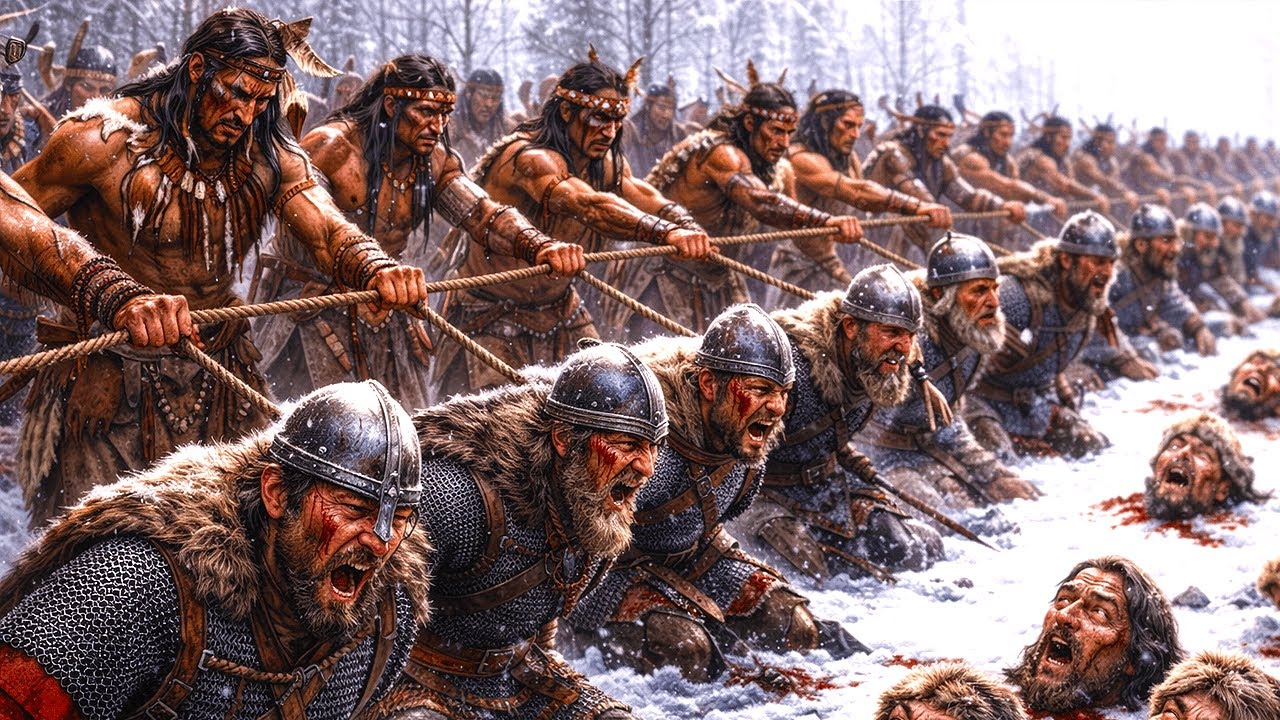
His prophecy held, but it was only the beginning of what those forests would take from the Norse. To understand what happened on those shores, one has to understand who these men were. In the year 1000, Europe trembled at a single word: Viking. From the burning churches of London to the ransomed walls of Paris, the longships meant death.
Their expansion seemed unstoppable. Iceland fell, Greenland fell, and the Atlantic itself could not contain their ambition. Three names wrote this chapter. Leif Eriksson, called the Lucky, a recent convert to Christianity, had discovered Vinland almost by accident.
His brother Thorvald sought glory to match that legacy. And Thorfinn Karlsefni, the wealthy merchant prince, saw gold where others saw only grapes. They called the people they found skraelings, wretched ones. The sagas used the word with contempt, yet these wretches would accomplish what no European army could.
Modern archaeology suggests they were Beothuk hunters, possibly ancestors of the Delaware, maybe both. What matters is that they knew their land the way the Vikings knew the sea. Vinland represented everything Norse expansion craved. Timber for ships, which Greenland lacked entirely.
Grapes for wine, worth more than gold in medieval Europe. Fertile soil, abundant game, and iron bog deposits for weapons. The sagas describe butterflies thick as snow and salmon leaping into nets, winters as mild as a Norwegian spring. Greenland survived on two things: European trade and hope that somewhere across the western sea lay resources to sustain their precarious existence.
Vinland validated that hope. Establish permanent settlements there, and Norse dominance could last for centuries. Fail, and Greenland itself might wither. The natives had watched these pale strangers before.
When Leif first landed, they observed from the forest edges, studied the iron tools, counted the numbers, marked the habits. Where the Vikings saw empty wilderness, the natives saw a homeland under threat. What the Vikings found across the Atlantic shattered every assumption they held about warfare. Their tactical superiority meant nothing.
Their steel advantage was minimized. Their battle formations were useless. The landscape itself fought against them. Trees provided endless cover, rivers allowed rapid movement, and forests that were a maze to foreign eyes became highways for native feet.
The psychological element proved crucial. Vikings conquered through fear, their reputation preceding them. But here there was no reputation, no fear, only strangers in strange boats, outnumbered and far from home. The intimidation that worked from Ireland to Russia meant nothing to people who had never heard Norse names.
Most critically, the Vikings excelled at set-piece battles: shield walls on open ground, cavalry charges across plains, naval engagements in fjords. Forest warfare, ambush tactics, guerrilla resistance, these were not in their playbook. They had entered an arena where every rule they knew was wrong, where armor became burden, where formations became targets, where bravery became foolishness. The first recorded encounter came when Vikings discovered nine natives sleeping under overturned canoes.
Eight died before they could rise. One escaped into the forest. That single survivor changed everything. Within hours, every native group within fifty miles knew about the pale strangers who killed without warning.
Thorvald commanded that first contact. Seeing their hide clothing and stone weapons, he sneered at the skraelings. The arrogance proved fatal. As his men celebrated their easy victory, Thorvald noticed movement on the water.
Skin boats, dozens of them, approaching fast. He ordered the shield wall, but there was no time. The arrow came from nowhere, described in the sagas as guided by fate itself. It curved around Thorvald’s shield and found the gap beneath his arm where armor could not protect.
A stone point, crafted by primitive hands, felled the son of Eric the Red. “I have gotten a good land in my grasp, though I’ll enjoy little benefit from it,” he gasped. Within hours, he was dead. This death changed everything.
Where the Vikings expected easy conquest, they found determined resistance. Where they anticipated primitive savages, they encountered tactical sophistication. The natives had spent generations perfecting forest warfare. Every child learned to move silently through undergrowth.
Every hunter could vanish into green shadows. Every warrior knew that patience trumped aggression. Karlsefni arrived the following year with his massive expedition. He knew about Thorvald’s death but dismissed it as bad luck.
Thorvald had been careless, aggressive, foolish. Karlsefni would be different: cautious, diplomatic, smart. He brought trade goods alongside weapons. His strategy was to establish peaceful relations first and use force only if necessary.
History pivoted on that decision. Karlsefni chose a defensive position near the coast, high ground with clear fields of fire, longhouses built for defense, sentries posted day and night. He would not repeat Thorvald’s mistakes. But the natives had learned from that encounter too.
They knew the Viking weapons now, understood their tactics. Most importantly, they knew Vikings could die. Dawn broke over Karlsefni’s settlement with deceptive peace. On the first day, canoes emerged from the morning mist like ghosts.
The Vikings scrambled for weapons, raised shields, knocked arrows, but the natives did not attack. They stared, both sides frozen in mutual assessment. Then, as silently as they appeared, the canoes withdrew. On the third day, the natives returned bearing furs.
Trade began. Karlsefni made a decision that seemed brilliant: he offered milk from their cattle. The natives had never tasted it before. Their wonder at this strange white liquid broke the tension.
Laughter replaced suspicion. For precious moments, history teetered toward peace. Natives brought pelts worth fortunes in European markets. Vikings offered milk and red cloth, exotic treasures to native eyes.
No common language, but pointing and gestures sufficed. Children peered from behind their mothers. Warriors lowered weapons. Perhaps Vinland could be shared after all.
Then the sagas go silent on a crucial detail. A young native, fascinated by Viking steel, reached for an axe. Its weight, balance, edge, all alien perfection to someone who knew only stone. A Viking moved to stop him.
Hands grabbed. The struggle lasted seconds. The axe fell. Blood sprayed across trade goods.
Whose blood, the sagas differ. Viking or native, accident or attack. What matters is this: trust died in that moment. The native grabbed the axe and ran.
His people vanished into the forest within heartbeats, leaving behind a corpse and shattered peace. Hour by hour, the Vikings fortified frantically. Longhouse doors were reinforced. Weapons were distributed to every adult.
Shields hung on walls for quick access. Women were taught basic combat stances. The settlement transformed from trading post to military camp. Karlsefni knew what was coming.
The only questions were when and how many. In the forest shadows, native councils convened. The death demanded response, but these were not simple revenge seekers. They were strategists who had defended this land for generations.
Elders spoke of the Viking weaknesses observed during trading: their armor slowed them, their formations required open ground, they relied on sight rather than sound, they knew nothing of forest ways. Then came the vanishing. No natives appeared for days. Viking patrols found nothing but silence.
This psychological warfare worked perfectly. Every snapping branch became an enemy. Every bird call might signal attack. Sleep came fitfully.
Nerves frayed. Warriors jumped at shadows. The waiting itself became a weapon. But the forest was not empty.
Viking patrols found signs for those who could read them: broken arrows left deliberately in paths, footprints that appeared and vanished, fresh tree marks that counted Viking numbers or mapped attack routes. The evidence mounted. They were surrounded by an enemy they could not see. On the fourth night, Karlsefni sent ten of his best warriors deep into the forest to find the native camps, to negotiate or intimidate, whatever worked.
They returned at dawn, pale and shaken. They had found nothing but had felt eyes everywhere. One swore he had been touched in the darkness. Another heard breathing beside him all night.
The forest itself seemed hostile. As the fifth dawn approached, sentries noticed something impossible. The forest edge, clearly visible moments before, seemed closer. Not moving, just closer.
Then they realized the truth. It was not the forest moving. It was what came from it. Hundreds of skin boats materialized from hidden coves, moving in perfect coordination.
No war cries, no horns, just silent approach. The Vikings had expected screaming charges like European enemies. This disciplined advance chilled the blood more than any battle rage could. These were not savages.
These were professionals who had turned their homeland into a weapon. Dawn exploded into chaos. Hundreds of canoes swept from three directions simultaneously: ocean approach, river flanking, forest emergence. The Vikings counted thirty boats, then fifty, then stopped counting.
Each carried five to eight warriors. Simple mathematics turned terrifying: at least three hundred attackers against thirty armored Vikings and one hundred thirty settlers. The first volley darkened the morning sky. The Vikings raised shields instinctively, forming the wall that had never failed them.
From England to Russia, the shield wall meant victory: overlapping wood and iron, each man protecting his neighbor, spears bristling outward like a human hedgehog. Arrows struck with sounds like hail on rooftops. But then physics went wrong. Arrows began curving around the shields.
The natives used shorter bows, firing high trajectories. Arrows fell from above, finding gaps between shields and helmets. A Viking screamed, an arrow through his foot. Another gasped as a point found the neck gap in his armor.
The unbreakable wall began breaking. The natives showed their first tactic: false retreats. A group charged the Viking lines, threw tomahawks, then fled toward the forests. Young Vikings, blood hot with battle fury, pursued.
“Hold the wall! ” Karlsefni screamed, but warrior instincts overwhelmed discipline. Five Vikings chased twenty natives into the tree line. The trap snapped shut instantly.
Those twenty became sixty as concealed warriors rose from the undergrowth. The five found themselves surrounded, separated, doomed. Close combat erupted, exactly what the natives wanted. In open ground, Viking axes devastated.
In thick forest, their long handles caught on branches. Heavy armor exhausted their wearers. Meanwhile, natives danced through familiar terrain, tomahawks finding every armor gap. In the center, young Bjorn faced his first real combat.
Nineteen summers old, trained since childhood, he thought himself ready. The native warrior who faced him looked no older. They circled in a clearing barely six feet wide. Bjorn swung his axe, a killing stroke in practice yards.
But here, the weapon embedded in a tree. In that heartbeat of vulnerability, the tomahawk found his temple. Within the first hour, eight Vikings were dead and twelve wounded. Only four native casualties were confirmed.
The kill ratio that should have favored steel was not happening. Worse, Viking casualties were permanent. Native losses seemed to regenerate as the forest disgorged fresh warriors. The forest maze claimed more victims.
Pursuing Vikings became lost within fifty yards of camp. Every tree looked identical. Sounds echoed deceptively. Men who had navigated trackless seas could not find their way back.
They called for help, revealing their positions to native hunters. One by one, isolated Vikings fell to arrows from invisible bows. Then came the second native tactic, one of terrifying innovation: treetop archers. While the Vikings searched at ground level, death came from above.
Warriors had climbed trees in darkness and waited. They rained arrows straight down where shields could not protect. Helmets deflected some, but shoulders, feet, and hands were all vulnerable from this angle. The Vikings had never conceived of three-dimensional battlefield tactics.
Then came the moment that should have turned the tide. Ragnar Ironside, Karlsefni’s champion, went berserk. The legendary fury of the berserker, where pain vanished and strength doubled, took him. He charged alone into the native ranks, axe whirling, seemingly invulnerable.
Bodies fell around him. The native lines wavered. But the forest does not respect berserkers. Ragnar pursued fleeing natives into undergrowth, his fury making him careless.
He did not see the rope stretched between trees. When he fell, twenty tomahawks found him simultaneously. The natives had studied Viking combat methods and developed counters. Even berserker rage had limits.
Bodies accumulated with shocking speed. The settlement became a charnel ground. Vikings dragged wounded comrades behind buildings. Women emerged to defend their children, knives against tomahawks.
But the native numbers seemed infinite. For every warrior who fell, two emerged from the forest shadows. Then came the impossible that became legendary. Karlsefni’s bull, brought for breeding stock, broke free from its pen.
The massive beast, maddened by battle sounds and the scent of blood, charged through the combat zone. To the Vikings, this was livestock. To natives who had never seen cattle, this was a demon. The bull’s appearance shattered native momentum.
Warriors who had faced armored Vikings without flinching fled from this bellowing monster. Its horns caught one warrior and tossed him like a child’s doll. The psychological impact was instant and devastating. What other demons did these strangers command?
Karlsefni seized the moment. “Form up! Shield wall! Back to the longhouse!
” The Vikings retreated step by step, dragging their wounded, shields locked. The bull’s rampage bought precious minutes. Native attack coordination collapsed as warriors dealt with this supernatural threat. Some tried to kill it, others fled.
Commands in different languages added to the chaos. The temporary advantage let the Vikings reach defensive positions. The longhouse, built for this possibility, had firing slots and reinforced walls. Women passed water to exhausted warriors.
The wounded received basic treatment. Weapons were redistributed. But the respite was brief. Outside, the natives regrouped with frightening speed.
Night brought no relief. Native warriors knew darkness like an old friend. Vikings, exhausted from daylight battle, faced fresh assaults. Fire arrows began falling.
The wooden longhouse, their shelter, became a potential death trap. Bucket brigades formed. Women and children fought flames while men held the walls. Dawn revealed the full horror.
Viking dead: eleven. Wounded: nineteen. Combat effective: maybe twenty. Native casualties were impossible to count, but their numbers had not decreased.
If anything, more canoes dotted the water, more shadows flitted between the trees. The mathematics of annihilation became clear. The final assault came with disciplined coordination. The natives had spent the night planning.
No more piecemeal attacks. This time, simultaneous pressure from all sides. Fire arrows increased. Tomahawk throwers worked in teams, one to make the Vikings raise shields, another to exploit the opening.
The noose tightened inexorably. Karlsefni faced the hardest decision of his life. Stay and die heroically, or retreat and live with shame. But shame meant nothing to dead men.
And these were not just warriors. Women and children would die too. The merchant prince proved his wisdom. “To the ships!
”
The retreat became a fighting withdrawal. The Vikings formed a hollow square, civilians in the center, fighting toward the beach. Every step cost blood. Natives pressed from all sides, sensing victory.
The hundred yards to the ships felt like miles. Men who had conquered half of Europe found themselves running from people they had dismissed as primitives. The rearguard action fell to the bravest. Five Vikings volunteered to hold while the others boarded.
They knew it meant death. Their names deserve remembering: Thorgeir, Snorri, Grimolf, Thorhall, Kettle. They stood shield to shield, buying time with their lives. Songs should honor their sacrifice, but even the sagas struggled to glorify retreat.
The Vikings abandoned everything they could not carry in one trip. The forge, representing months of labor, was left standing. Precious iron tools scattered in the dirt. Half-built structures that would puzzle archaeologists centuries later.
Iron nails, worth fortunes in Greenland, were trampled into mud. The anvil, carried across treacherous seas, was abandoned. Whetstones, cooking pots, even weapons dropped by wounded men. Each item represented dreams of permanent settlement.
Now they would just wait, slowing the escape. The natives would collect these treasures as proof of their victory. On the beach, the final tragedy struck. As the last longboat pushed off, an arrow whistled from the tree line.
It caught the helmsman in the throat. He toppled backward, blood spraying across Karlsefni’s face. The boat spun rudderless while men scrambled to take control. Even in victory, the Vikings remained targets.
Even escaping, death followed. Native victory celebrations erupted as the longboats vanished into the morning mist. Warriors who had hidden fear behind battle masks now danced on blood-stained beaches. They had done the impossible: defeated iron with stone, expelled invaders without surrendering land.
Women emerged from forest sanctuaries. Children touched abandoned Viking weapons with wonder. Elders nodded approval at young warriors who had proved themselves. The death count told a stark story.
Vikings: fifteen confirmed dead, twenty-three wounded, with several more dying during the voyage home. One-third of their fighting force eliminated. Natives: the numbers are disputed by the sagas, but likely fewer than twenty killed. The technological advantage had meant nothing.
Stone Age weapons in skilled hands had crushed Iron Age invaders. The psychological impact proved even more devastating than the physical casualties. These Vikings had grown up on stories of invincibility. Their fathers conquered England.
Their grandfathers terrorized France. They themselves had planned to add America to Norse dominions. Instead, they fled like whipped dogs from enemies they had dismissed as wretches. The wounded spoke in whispers during the voyage home.
“They fight like forest spirits,” one said, an arrow still embedded in his shoulder. Another, delirious with fever, screamed about eyes in the trees. Strong men who had laughed at death now jumped at creaking ropes. The new world had broken something fundamental in Viking confidence.
They had met their masters, and the masters wore fur instead of steel. Karlsefni made his decision before they reached open ocean. “This land wants us dead,” he told his council. No debate followed.
Everyone had seen enough. Vinland’s riches were not worth Viking blood. Let others chase that dream. The survivors would return to Greenland with lives, if not honor.
For the natives, the immediate consequences were profound. They now possessed iron tools, weapons, and knowledge. Viking tactics had been observed, countered, defeated. The defensive template was established.
Future invaders would face people who knew European warfare and how to defeat it. The abandoned settlement became a classroom where native warriors studied their enemies’ methods. Power dynamics shifted among native groups. Those who had fought gained prestige.
Warriors wore Viking artifacts as trophies. The battle sites became sacred ground. Stories spread through trade networks: the pale strangers could be beaten. Unity against invaders became cultural memory.
Norse items transformed into sacred objects. Karlsefni’s abandoned sword became a chief’s symbol. Broken Viking shields decorated longhouses. Iron fragments were worked into ceremonial pieces.
These were not just trophies. They were reminders, physical proof that the ancestors had faced demons from across the water and triumphed. Within a generation, every Norse hall knew the tale: how Karlsefni the wealthy became Karlsefni the wise by retreating, how stone defeated steel, how the new world rejected its would-be conquerors. The skalds struggled with the narrative.
How do you glorify defeat? They focused on individual heroism while acknowledging collective failure. The truth was too important to hide. European expansion was delayed by five hundred years.
Consider the implications. If the Vikings had established permanent settlements, if they had brought more colonists, if they had adapted to forest warfare, history shifts completely. Columbus would have discovered a continent already carved into Norse kingdoms. Native populations would have faced European diseases centuries earlier.
The demographic collapse would have happened in 1100, not 1500. Modern archaeological evidence confirms the saga accounts. L’Anse aux Meadows reveals Viking buildings exactly where the stories placed them. Carbon dating gives the year 1021 precisely.
Tree rings do not lie. Artifacts match the descriptions. Even the forge remains abandoned as the sagas claimed. Science validates oral history.
The battles happened. The Vikings fled. The natives won. Why did they win?
Because warfare is not just about weapons. It is about will, knowledge, adaptation. The natives possessed what the Vikings could not acquire: perfect unity between warrior and terrain. Every tree was an ally.
Every shadow offered advantage. You cannot conquer a people who are the land they defend. The Vikings understood oceans. The natives understood forests.
In Newfoundland, the forest trumped the ocean. The parallel lessons echo through time. Afghanistan earned the title graveyard of empires using similar principles. Soviet technology and American firepower both failed against defenders who merged with their landscape.
Vietnam taught identical lessons. Technological superiority means nothing when every step might be your last, when the land itself seems hostile, when defenders need only patience while invaders need everything. In those forests, roughly three hundred native warriors accomplished what no European army could. They stopped the Vikings cold.
The Atlantic Ocean became wider that day, not physically, but psychologically. For five hundred years, it remained a barrier the Norse would not cross. When Europeans finally returned, they came in different ships, with different weapons, with different diseases. But they faced the descendants of warriors who had already won this war once.
History pivoted in a Newfoundland forest. And the pivot point was a stone arrowhead in Viking flesh, proving that sometimes the old ways are stronger than the new.
