On the 20th of October 1968, on a tiny Greek island barely two miles long, the most famous widow on Earth married one of the richest men alive. Rain fell on Scorpios that afternoon, and roughly 250 reporters were kept at the water’s edge, straining for a glimpse of a ceremony that lasted only about ten minutes. When word reached the outside world, it landed like a scandal, a betrayal, and a fairy tale all at once. To half the planet, it looked like a love match, a woman finally choosing happiness.
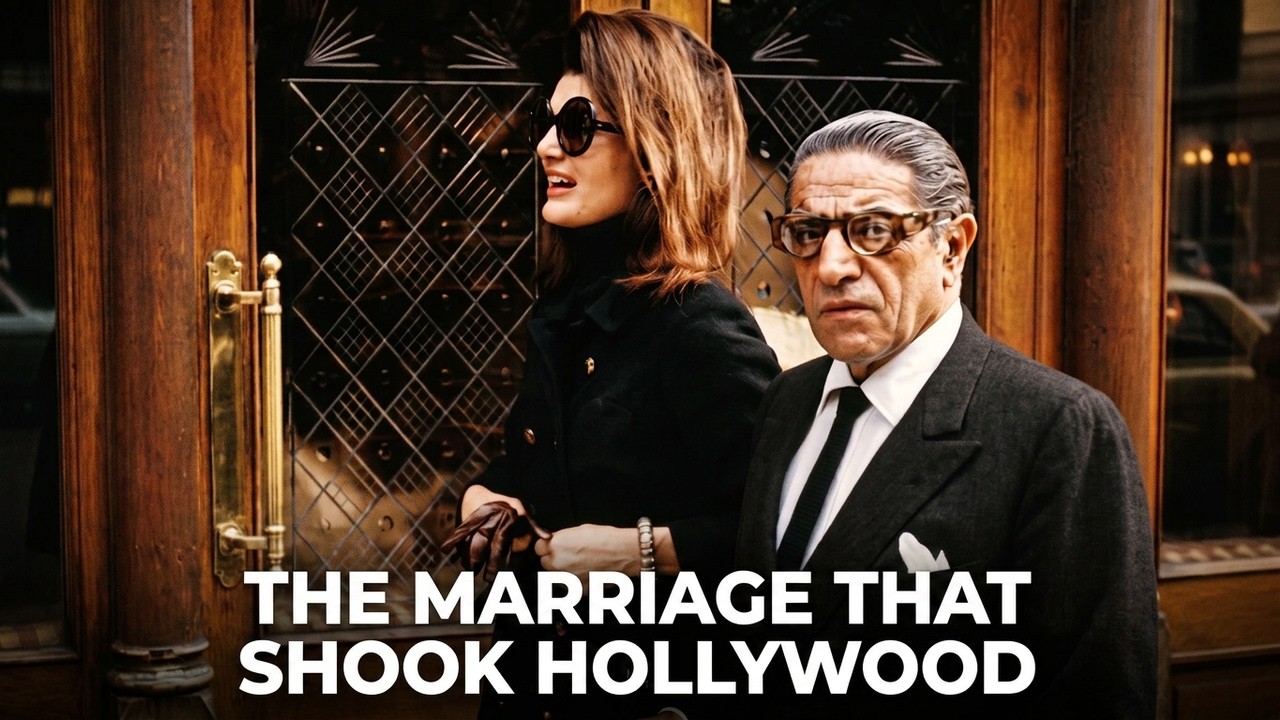
To the other half, it looked like a tragedy dressed as a wedding. What almost nobody understood that day was how much sat underneath it: a nation’s grief that had not healed, a fortune large enough to reshape countries, two young children watching their mother remarry, and a private contract that no journalist would see for years. Its clauses guarded money, property, and the terms of two separate lives. The world kept asking the wrong question, whether this was love or greed, when the real puzzle was quieter and stranger: how does a marriage that looked to millions like sanctuary after unthinkable pain curdle into one of the loneliest unions in modern memory?
To grasp why Jacqueline Kennedy married Aristotle Onassis, the man many saw as an interloper, one must trace her journey from the day her first world was shattered on live television to the solace she sought in his promise of protection. On the 22nd of November, 1963, a little after 12:30 in the afternoon, the presidential motorcade turned onto Elm Street in Dallas. In a matter of seconds, Jacqueline Kennedy went from First Lady to a widow watched by the entire planet. She was 34 years old.
She was still wearing the pink Chanel suit, and she refused to change out of it, saying she wanted them to see what they had done. For four days, the country stopped. An estimated 175 million Americans watched some part of the funeral on television, and the image that fixed itself into memory was the veil, the black lace, the two small children, and the widow who did not weep in public. She walked behind the coffin, she lit the eternal flame, and she held the country together by holding herself together.
One week after the assassination, she gave an interview and told the writer that her husband’s presidency had been like Camelot, a brief shining moment that would not come again. It was her phrase, her framing, chosen with care. She built the myth herself because she understood that legends outlast facts. What none of them saw was the cost of being turned into a monument, the way public sainthood can wall a person off from an ordinary life.
But behind the veil at the funeral stood a man most Americans had never heard of, and he had already made himself quietly indispensable. Aristotle Onassis was not born into any of this. He came into the world in Smyrna, a wealthy Greek port on the coast of what is now Turkey, into a comfortable tobacco trading family. Then in September 1922, the city burned.
Members of his family were killed, and the teenage Aristotle fled with almost nothing. He landed in Argentina at 17, reportedly with only a few hundred to his name, and took work as a telephone operator. He listened to the calls of men far richer than he was, and he learned their language, their deals, their appetites. Within a few years, he was importing tobacco and building his first small fortune, one transaction at a time.
From tobacco, he moved to ships, buying half a dozen freighters during the Depression when nobody else wanted them, at prices that would later look like theft. By middle age, he owned an airline, banks, and eventually that island in the Ionian Sea. By the 1950s, he commanded a private fleet flying flags of convenience, moving oil for the very governments that distrusted him, and his fortune ran into the hundreds of millions. Money on that scale buys ships and islands, but Onassis wanted something it could not yet buy, and he had already chosen it.
In 1962, he bought the island of Scorpios, a few hundred acres of scrub and olive, for roughly $110,000, and turned a bare rock into a private kingdom no journalist could reach without an invitation. The centerpiece floated offshore: the Christina, a converted Canadian frigate rebuilt into a 325-foot palace with a swimming pool whose mosaic floor rose on hydraulics to become a dance floor. Every deck was a stage, every dinner a lure built to pull the powerful into his orbit. Winston Churchill sailed on that yacht in his final years.
So did Greta Garbo. The introduction came through family. Jackie’s younger sister, Lee Radziwill, had drifted into Onassis’s circle in the early 1960s, drawn to a man who could make the whole Mediterranean feel like a personal favor. In 1963, still grieving the loss of a newborn son, Jackie was invited to recover aboard the Christina.
What no one photographed was how easy the two of them were together, the widow and the Greek, oddly matched and oddly at home. He listened, he asked questions and remembered the answers, and he handed her jewels without a speech attached. The introduction carried a cost that had nothing to do with money: Lee had wanted him for herself, and that jealousy would poison a sisterhood for the rest of their lives. Jackie was not free to follow her own heart, because a bullet in Los Angeles was about to make the decision for her.
Just after midnight on June 5th, 1968, in the kitchen of the Ambassador Hotel, Robert Kennedy had just won the California primary. Minutes after he left the ballroom, a gunman opened fire, and by the next day, the second Kennedy brother was dead. For Jackie, it was something colder and more personal. She had buried a husband shot in the head less than five years earlier, and now the man who had helped her through that grief was gone the same way.
Caroline was ten years old, John was seven, and the surname they were born into suddenly felt less like an inheritance and more like a mark. “If they’re killing Kennedys,” she told a friend, “then my children are targets. ”
In the weeks after Robert’s funeral, Jackie’s thinking hardened into something practical. She reached a conclusion that would have seemed unthinkable to the woman the world thought it knew: the only way to make Caroline and John safe was to take them out of the country entirely.
She needed distance, and she needed protection money simply could not buy on its own. Onassis offered all of it at once, a private island, a fleet of ships, security she could never assemble alone, and a fortune large enough to build walls around three lives. The objections came from every direction. Bobby Kennedy had pleaded with her only months before his death, warning that a marriage to Onassis could cost the family the political future they were still trying to salvage.
The church came at her harder: by canon law of the time, marrying a divorced man made her a public sinner. Old friends called to talk her out of it. She listened, she thanked them, and she kept moving toward the man they all despised. There was one voice she couldn’t dismiss so easily: Rose Kennedy.
Jackie didn’t argue theology. She went to Rose directly, quietly, and asked for something closer to permission than approval. What passed between them was never fully recorded, but the outcome was that Rose, to the astonishment of the wider clan, gave her a kind of blessing. She would later write with striking calm that she wanted Jackie to have a full life, that she’d been alone too long, and that a woman of 39 had every right to happiness.
And so the families settled their quarrel over faith and memory, believing that was the real battle being fought. But while they argued, lawyers on two continents were negotiating a very different kind of agreement. It rained on Scorpios the morning of October 20th, 1968. The ceremony was held in the tiny whitewashed chapel of Panagitsa, a building so small that only around twenty guests could fit inside.
Onassis kept hundreds of reporters at bay with a private navy of boats and armed crew. Caroline and John, then ten and seven, stood near their mother. The children of both families were folded into a ritual most of them didn’t understand, in a language none of the Americans could follow. By the next morning, she had a new name, and the world couldn’t stop saying it: Jackie O.
The reaction was immediate and merciless. In Rome, a newspaper described her as the widow who broke America’s heart. The American press painted her as a woman who had traded the memory of a martyred president for a private island and a checkbook. She was called greedy, cold, calculating.
Onassis got the mirror image of that verdict: to the columnists, he wasn’t a husband, he was a thief. The world assumed she had married for love or for money. Both guesses missed what actually bound them together. Because before the crowns and the rings, before Scorpios, there was paper.
Long before the wedding, lawyers on both sides had drafted an agreement that by the accounts that later surfaced ran to something like 170 separate clauses. It set terms for money naturally, but it went far beyond that. There were provisions about where each of them would live, how much time they were obliged to spend together, and how much they were free to spend apart. There were reportedly clauses about separate bedrooms, about Jackie’s independence, about the exact shape of a life neither of them intended to fully share.
In practice, the marriage looked almost exactly like the contract that governed it. It ran as two lives moving on parallel tracks, occasionally crossing, rarely merging. Jackie kept her center of gravity in New York, where her children were in school. He kept his empire in Paris and Athens.
For a while, that space between them read less like coldness and more like a kind of mutual relief. The distance suited them at first, until the bills started arriving. Jackie shopped the way other people breathe. Estimates of her yearly spending ran to more than a million dollars, at a time when a million dollars still meant something close to a fortune.
Onassis was a man who counted everything, who knew the price of a barrel of oil down to the last decimal. At first, he laughed and called it the price of having her. But the laughter did not last a year. The absences stretched longer.
The weeks apart that had once felt like freedom now felt to him like being married to a schedule instead of a woman. And all the while, another woman had never truly left his side. Before there was Jackie, there was Maria Callas, the greatest soprano of her age, the woman Onassis loved with an intensity he never quite managed to feel again. They had met in the 1950s, both married to other people, and burned through those marriages to be together.
When he chose Jackie in 1968, he humiliated Callas in front of the world. But Callas stayed near, and as the shine came off his new marriage, Onassis found his thoughts drifting back to the woman he had discarded. They began meeting again in Paris, quiet dinners at first, then something harder to explain away. They were seen at Maxim’s, the restaurant where he and Callas had always gone.
For a time, each woman pretended not to know about the other, and then the pretense broke. Jackie held the name, the marriage, the legal claim to the man and his fortune. Callas held the part of him that still turned toward Paris at the end of a hard week. It was a humiliating equilibrium for everyone in it, and yet it held, until death entered the family and shattered it.
There was one person in Aristotle Onassis’s life who stood entirely outside the arithmetic of contracts and mistresses: his son Alexander, born in 1948, the heir to everything. Onassis watched him with a pride he rarely showed anyone, already imagining the day the whole fleet would answer to him. On the afternoon of January 22nd, 1973, Alexander boarded a small Piaggio seaplane at Athens airport. Seconds after takeoff, the plane banked hard to the right, dipped, and cartwheeled across the runway.
Alexander was pulled from the wreckage with catastrophic head injuries. He was 24 years old, and on January 23rd, the machines were switched off. Onassis, a man who had bent governments and rivals and whole industries to his will, sat at the bedside of his only son and could do nothing at all. He refused to believe the crash was an accident.
He poured money into private investigators, convinced the plane had been sabotaged, and offered a reward of one million dollars for proof of foul play. No sabotage was ever found; the investigation pointed to reversed aileron cables, a maintenance error. But a man who has lost everything he built for needs a reason larger than an accident, and when none came, his mind reached for something older and darker than evidence. He began to count backward, tallying the misfortunes that had piled up since a certain date, and his thoughts kept landing on the woman he had married.
She had been unlucky before he ever met her, marked by one violent death already, and now death had come again. Slowly, privately, he arrived at a conviction he could not shake: that Jackie carried misfortune with her, that she was a shadow over his blood. He started to see his wife not as a prize but as a curse. After the funeral, something in Onassis went dark and stayed there.
He grew cruel in small, deliberate ways. He mocked her spending in front of guests, cut short her plans, left her waiting for him in cities she had flown to alone. Then he started to leak. Suddenly, Greek and French papers filled with unflattering items about Jackie, her extravagance, her chill, whispers that could only have come from inside the marriage.
Behind the scenes, he was already instructing lawyers. Jackie had no idea a divorce was being drafted for her. He wanted out, and he wanted it to cost him as little as possible. The prenuptial contract had already capped her claims, and now he pushed his attorneys to tighten every clause.
Every weapon he had used to win her, the money, the lawyers, the newspapers, he now aimed squarely at getting rid of her. But before the papers could be filed, the man himself began to fail. It began with his face. His eyelids started to droop, heavy and unwilling.
The doctors gave it a name he had never had to fear before: myasthenia gravis, a disease that slowly severs the signal between nerve and muscle. His eyelids sagged so badly that he could not keep them open, and to face the world, to read a contract, to look a rival in the eye, he took strips of tape and fixed his own eyelids up by hand. The tycoon who had commanded fleets grew thin and unsteady, and the men around him began speaking in the hushed tones people use near something that is ending. In February 1975, they flew him from his estate to the American Hospital of Paris.
His myasthenia gravis had spread to his heart and lungs, and pneumonia had settled in on top of it. His daughter Christina was there keeping watch. His sisters came. But the wife, whose name was on the marriage contract, had already gone back across the Atlantic.
Jackie had visited earlier, then returned to New York on the advice of his own doctors, who told her his condition was stable and might hold for weeks. On March 15th, 1975, Aristotle Onassis died in that Paris clinic, 69 years old. Jackie was in New York when he died. And the woman who kept vigil outside his room was not his wife.
Maria Callas had loved Onassis for the better part of a decade before Jackie ever entered the story, and in the last stretch of his life, it was Callas he drifted back toward. The wife was an ocean away, occupied with the ordinary machinery of her separate life. The other woman grieved nearby, holding a role no document had ever granted her. When the reading of his will finally came, it settled every question about what this marriage had really been.
Onassis and Jackie had signed a prenuptial agreement in 1968, a 170-clause document that read like a merger, not a marriage. Jackie waived any claim to the bulk of his estate. Instead of a widow’s automatic share, she was to receive a fixed annual allowance and separate sums for her children, with the great engine of his wealth, the ships and the holding companies, passing to his daughter Christina. What followed wasn’t grief so much as a standoff.
Christina wanted Jackie gone cheaply and quietly, and Jackie’s people understood that a fight over Greek shipping law could last years. The stalemate ran for roughly 18 months before the numbers finally moved. In 1977, the two sides settled, and Jackie reportedly walked away with a substantial sum in exchange for agreeing to relinquish every future claim against the estate. It was a fraction of the billions, but it also made her, in that moment, independently wealthy in a way she had never once been.
Christina Onassis was 24 when her father died, and she inherited a fortune that most estimates placed north of 500 million dollars. Her mother had died the year before under circumstances that were never fully explained. Her brother was gone. Her father had followed.
In the space of a few years, the family had emptied out around her. She married four times, and each union seemed to arrive faster and end harder than the last. The one lasting thing she managed was a daughter, Athena, born in 1985. In November 1988, at a friend’s estate outside Buenos Aires, Christina Onassis died of a heart attack.
She was 37. Jackie, by contrast, spent her widowhood rebuilding a life on her own terms for the first time in decades. In 1975, she walked into the offices of Viking Press and took a job as a consulting editor for ten thousand dollars a year. She rode the elevator like anyone else, read manuscripts at her desk, and asked to be judged on the books she brought in rather than the name she carried.
Over nearly two decades at Viking and then Doubleday, she edited more than 100 titles. And there was Maurice Tempelsman, a Belgian-born diamond dealer, quietly brilliant with money, who became her companion through the late 1970s and eventually shared her Fifth Avenue apartment. There was no third wedding, no contract, no dynasty pulling at her name. Jackie outlived Onassis by 19 years.
She died in New York in May 1994 of cancer, 64 years old, with Maurice at her side and her two children close. The Onassis shipping fortune passed down through Christina to her daughter Athena, a granddaughter Aristotle never lived to meet. Today, the foundation Aristotle built still gives its prizes, and the apartment on Fifth Avenue, where Jackie finally lived on her own terms, has long since changed hands.
The dynasty he assembled to outlast him outlasted almost everyone in it.






