The sharp iron object came flying at him out of nowhere. It struck the Kaiser below his left eye, leaving a gaping wound an inch and a half long. The blood poured down his face, and the chief of the Naval Ministry, standing nearby, braced for an eruption. Wilhelm II, the Emperor of Germany, was not a man known for calm.
He was famous for his temper, his wounded pride, his explosive reactions to the slightest insult. But now, as the blood streamed down his cheek, he showed no reaction at all. He did not seem to feel the impact. He did not seem to notice the wound.
Everyone around him saw it before he did. The official later recalled the scene with a kind of stunned wonder: it was a blow that could have been devastating, had it struck the temple or the eye. Instead, the object turned out to be nothing more than a fish plate, and the assassin little more than a madman. But the question lingered, unanswered, unsettled: what kind of man was this, to feel nothing when death came for him?
Wilhelm was the last emperor of Germany, and from his very first breath he was marked for struggle. Frederick William Victor Albert, known to the world as Kaiser Wilhelm II, was born into the very heart of Europe’s royal families. His mother, Victoria, Princess Royal, was the eldest child of Queen Victoria of the United Kingdom. Wilhelm himself was the eldest of his grandmother’s staggering forty-two grandchildren.
Any other royal might have counted such a lineage as a blessing. For Wilhelm, it became a curse, a web of jealousy, resentment, and impossible expectations that would eventually drag an entire continent into war. His troubles began before he even drew his first breath. During his mother’s labor, the doctor realized the baby was in the breech position.
In those days, that was a potential death sentence for both mother and child. The delivery was traumatic for both, and though they survived, they were not unscathed. When Wilhelm finally emerged, he was eerily silent. His lips were blue.
He was hypoxic, fading fast. The doctor, desperate to revive the infant, ignored the protestations of the parents and spanked the newborn repeatedly, until at last a weak cry escaped his pale lips. But the price was terrible. In his efforts to remove the breech baby, the doctor had torn the infant’s brachial plexus, the nerves connecting the shoulder to the spinal cord.
The injury caused Erb’s palsy, leaving Wilhelm’s left arm paralyzed and six inches shorter than his right arm for the rest of his life. Other wounds were less visible but no less damaging. At just four years old, Wilhelm attended the wedding of his uncle Bertie in England, dressed in a full Highland costume complete with a small dirk. Any four-year-old might grow restless during a long ceremony, but what Wilhelm did next was anything but normal.
He became so unruly that his eighteen-year-old uncle, Prince Alfred, told him to quiet down and behave himself. Wilhelm responded by drawing his dirk on Alfred. The stunned prince attempted to subdue the royal rugrat, only to have the little monster bite him on the leg. It was a preview of a belligerence that would define his reign.
Yet one person refused to see it. His grandmother, Queen Victoria, the matriarch of nearly every crown in Europe, never had a bad word to say about her eldest grandson. To her, Wilhelm was a clever, dear, good little child, the great favorite of her beloved Vicki. Wilhelm’s mother always blamed herself for her son’s deformity.
Nevertheless, she insisted that the future Kaiser appear strong and capable, no matter the cost. She forced him to learn to ride a horse. In his poor condition, he fell off repeatedly, only to have his mother hoist him back into the saddle, weeping and in pain. The ordeal drove a wedge between mother and son, and it only got worse.
His tutor indoctrinated him in the Prussian way of autocratic rule, and under that influence Wilhelm pushed back openly against his parents, particularly his mother’s liberal British values. As he grew older, he came to suspect that his parents were more British than German, and thus could not be trusted. His deformity haunted him for his entire life. He had to pose strategically in paintings and photographs to conceal his left arm, often resting it on the hilt of a sword or holding a cane.
For this, he placed all his blame on his mother. “An English doctor killed my father,” he fumed, “and an English doctor crippled my arm, which is the fault of my mother. ”
At twenty-one, nearing the crown, Wilhelm joined the First Regiment of Foot Guards. It was there, amid the strict, authoritarian, hyper-masculine armed forces, that Wilhelm finally felt at home.
“I really found my family, my friends, my interests, everything of which I had up to that time had to do without,” he later recalled. His position as a lieutenant had a drastic impact on his personality. Despite his poor temper and awkward social manners, Wilhelm had once been polite and agreeable. But once he donned his marshal’s uniform, which he almost never took off, he adopted the swagger and brisk tone of a Prussian officer.
Still, he had a softer side. In his youth, Wilhelm fell in love with one of his maternal first cousins, Princess Elizabeth of Hesse-Darmstadt. He gushed that she was exceedingly beautiful, in fact the most beautiful girl he ever saw. At just sixteen, he vowed that if he lived long enough, he would marry her when she came of age.
Even as he grew up, he did not change his mind. While attending Bonn University, Wilhelm often snuck away to visit Elizabeth under the guise of spending time with his Aunt Alice, all while writing countless love poems to her. Fate, however, had something crueler in store. In 1878, Wilhelm finally mustered the courage to ask his younger cousin for her hand in marriage.
For reasons that may never be known, Elizabeth turned him down flat. She later married into the Russian imperial family instead, compounding his existing jealousies. He fulfilled his wish to marry when he became engaged to Princess Augusta Victoria of Schleswig-Holstein, known as Dona. His family objected to the match, since although she was a princess, her father was merely a duke, not an actual sovereign.
But Wilhelm had at least one powerful person on his side: German Chancellor Otto von Bismarck. The Iron Chancellor supported the match for his own political reasons. He had for years been fueling Wilhelm’s alienation from his parents, hoping that when Wilhelm ascended to the throne, he would be far more amenable to Bismarck’s political goals. Between Wilhelm’s insistence on Dona and Bismarck’s machinations, the marriage went ahead.
The relationship between Wilhelm and his parents would never be the same. Wilhelm and Dona had a happy marriage for the forty years between 1881 and Dona’s early demise in 1921. Together they had seven children: six sons and a daughter. And there was one thing that always brought them together: Dona loathed Wilhelm’s mother almost as much as he did.
Given what happened next, Bismarck was about to seriously regret endorsing their marriage. In early 1888, Wilhelm’s father, Frederick III, finally ascended to the throne. There was just one problem: he was severely ill. After just ninety-nine days as Kaiser, Frederick succumbed to throat cancer, paving the way for Wilhelm II to claim what was his.
The German Empire was his. Unfortunately, there was one man standing in his way. From the second the Imperial Crown touched his head, Wilhelm was determined to rule as well as reign. For Bismarck, who had been Chancellor under Wilhelm’s two predecessors, this was a departure.
Bismarck had hoped his years of influencing Wilhelm would make him easy to manipulate as Kaiser. Almost as soon as he ascended to the throne, Wilhelm clashed with the Iron Chancellor. Wilhelm considered Bismarck’s foreign policy too weak and too careful. The new Kaiser imagined a more muscular German Empire.
“That young man wants conflict with Russia and would like to draw his sword straight away if he could,” Bismarck lamented. “I shall not be a party to it. ”
He would not have to be. After Bismarck attempted to undermine Wilhelm by forming a new coalition, the new Kaiser met with the Iron Chancellor at his estate.
No one knows exactly what the two hotheads said to each other, but the explosive outcome left little to the imagination. Wilhelm stormed out of the meeting in a huff, while Bismarck wrote a blistering letter of resignation. There would be no one standing between Wilhelm’s erratic behavior and an unsuspecting continent. From the outset, the half-German side of him was at odds with the half-English side.
He was wildly jealous of the British, wanting to be British, wanting to be better at being British than the British were, while at the same time hating them and resenting them because he could never be fully accepted by them. Unless, that is, he could build a better Navy. As a child, Wilhelm had confided to his uncle, the Prince of Wales, that what he wanted more than anything was a fleet of his own someday. So when the British Navy upstaged his meager German Fleet at Queen Victoria’s Diamond Jubilee, the new Kaiser became determined to outdo his cousins, sparing no expense to outshine them.
Despite his envy for the British side of his family, Queen Victoria always treated him with courtesy. The same, however, could not be said about his other British relatives, in particular his uncle Bertie, the future King Edward VII. Bertie refused to pay Wilhelm the proper respects even after he became Kaiser, prompting Wilhelm to refer to him as “the old peacock. ”
But even bigger family feuds and scandals loomed, some that even threatened his reign.
Shortly after he ascended, Wilhelm’s sister Sophia of Prussia married the heir apparent to the throne of Greece, but she caused a stir when a year later she announced she would be converting from Lutheranism to Greek Orthodoxy. The shocking move infuriated Wilhelm. No one could have predicted how dramatically he would overreact. Upon hearing about Sophia’s intention to convert, a heavily pregnant Dona summoned her.
She conveyed to Sophia that Wilhelm would not tolerate her conversion and said that he would go as far as to ban her from Germany. When Sophia replied coolly that it was not any of her business, Wilhelm’s wife completely lost it. Sophia’s cool defiance sent Dona into an apoplectic fit. Her hysterics were so intense that she went into early labor with her youngest son, Prince Joachim.
Wilhelm wrote to their mother, saying that if his infant son did not survive, his blood would be on Sophia’s hands. The boy survived. Wilhelm, however, should have been more concerned about his own life. In March 1901, during a visit to Bremen, he almost had his number punched in the attempt on his life, the one that left him bleeding from the face without feeling a thing.
The attempt aside, bigger scandals were just around the corner that Wilhelm could not ignore. Between the years 1906 and 1909, Wilhelm’s administration became embroiled in a scandal that nearly toppled the crown from his head. The journalist Maximilian Harden published scandalous accusations of gay activity involving ministers, courtiers, and army officers in Germany. The most disastrous accusation, however, was a lot closer to home.
Harden’s biggest target was Wilhelm’s closest friend and adviser, Prince Philip zu Eulenburg. As the scandal raged in the papers, Wilhelm’s closest allies found themselves embroiled in trials and shameful resignations. Some even took their own lives. But when Eulenburg had to resign over the scandal, it proved to be more than Wilhelm could take.
After Eulenburg’s resignation, Wilhelm experienced a nervous breakdown. The dramatic reaction has led many historians to believe that the last German Kaiser was a deeply repressed gay man who never came to terms with his feelings for Eulenburg. Even before that scandal ended, however, Wilhelm cooked up another one. In 1908, Wilhelm gave an interview to the London-based newspaper the Daily Telegraph.
During the interview, he attempted to improve the already strained Anglo-German relationship, but his usually prickly personality, erratic behavior, and emotional outbursts got the better of him. What ensued was an antagonistic rant against the English that brought Europe one step closer to all-out conflict. During the interview, Wilhelm made comments such as, “You English are mad, mad, mad as March hares. ” He then went on to blame the French and the Russians for attempting to coax Germany into a conflict and asserted that Germany’s naval buildup was aimed at Japan, not Britain.
The fallout from the Daily Telegraph crisis was worse than Wilhelm could have imagined. Powerful people in Germany demanded his resignation. While he remained defiant and retained his crown, his once unshakable confidence took a severe hit, spiraling him into a depression from which he never fully recovered. With the fatal attack on Archduke Franz Ferdinand, Europe burst into all-out conflict, and the battle lines were drawn along the roots of Wilhelm’s family tree.
The Kaiser, ever jealous, blamed it all on his cousins. “To think that George and Nicky should have played me false! ” he lamented. “If my grandmother had been alive, she would never have allowed it.
” Nevertheless, he was determined to make his cousins respect him. In August 1914, with the fighting freshly underway, Wilhelm made a bold and confident prediction. He proclaimed, “I am firmly confident that with the help of God, the bravery of the German Army and Navy, and the unquenchable unanimity of the German people during those hours of danger, victory will crown our cause. ”
His optimism, or bravado, was short-lived.
Just three months after his confident declaration, he convened his cabinet to deliver grim news: Germany could not win. But that was not the worst part. Despite this realization, he allowed the fighting to continue for another four brutal years, giving rise to a less than flattering epithet. Just when his country needed him most, Wilhelm retreated into the shadows.
The historian John Röhl described this time in Wilhelm’s reign: “The man who in peace had believed himself omnipotent became in conflict a shadow Kaiser, out of sight, neglected, and relegated to the sidelines. ”
But he could not escape the consequences of what he had started. By late 1918, when it became obvious that Germany was going to lose, support for Wilhelm had completely collapsed, both inside and outside its borders. Finally, when President Woodrow Wilson insisted that Germany do away with the monarchy before any peace negotiations could begin, Wilhelm had no options left.
He agreed to step down. And his year only got worse. The same year the world hobbled through the last of the fighting of World War I, the devastating Spanish Flu pandemic took hold. Kaiser or not, Wilhelm was not immune.
He contracted the flu and fell terribly ill. Even as he recovered, his hold on power continued to slip away. Given what happened next, succumbing to the flu would have been a kindness. Wilhelm’s reign officially ended on November 9, 1918, when he abdicated after losing the support of his last allies.
He boarded a train crossing into the Netherlands, effectively going into exile. His departure marked the end of the German Empire and the centuries-long rule of the House of Hohenzollern. But he was not in the clear yet. With all the carnage from World War I, the victors wanted someone’s head on a pike, figuratively.
In a striking display of familial disdain, King George V of England wrote of his cousin Wilhelm, branding him “the greatest criminal in history. ” Despite his harsh words, George V opposed calls to hang the Kaiser. Fortunately for Wilhelm, Europe was wary, and there was little appetite for further bloodshed. Although British authorities formally requested his extradition to face justice, they secretly urged the Dutch to refuse the extradition order.
The Netherlands, seeking to avoid entanglement in post-conflict retribution, happily complied. Wilhelm purchased Huis Doorn, a palatial manor in the Netherlands, where he stayed for the remainder of his life. Remarkably, the Weimar Republic allowed him to take an extraordinary amount of personal belongings: twenty-three railway wagons of furniture, twenty-seven filled with various packages, one with a car, and another with a boat. But not every member of Wilhelm’s household adjusted to civilian life as easily as he did.
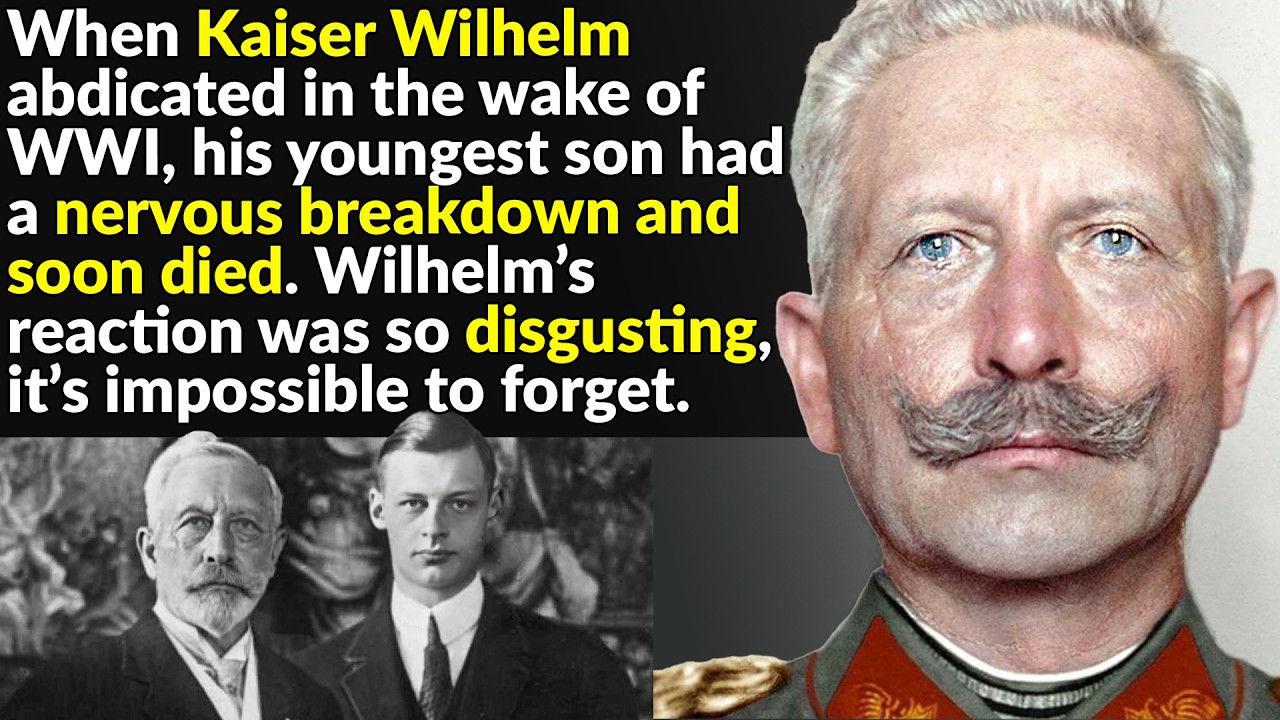
His youngest son, Prince Joachim, fell into a deep depression following the loss of his titles and status. After his wife divorced him, Joachim made the tragic decision to end his own life. Somehow, Wilhelm made it all about himself. He received the news of his son’s demise with anger instead of sadness.
Furious, he lamented that the boy should have done this to him and especially to his mother. His half-hearted attempts to conceal the nature of Joachim’s demise from Dona failed, and she passed from grief shortly thereafter. But a deposed Kaiser is never single for long. Only months after his first wife’s passing in 1921, Wilhelm found love again.
He received an unexpected birthday greeting from the son of the late Prince Johann Georg Ludwig Ferdinand August Wilhelm of Schönaich-Carolath. Wilhelm fell for the boy’s mother, Princess Hermine Reuss of Greiz, whom he invited to Doorn. By the end of 1922, the sixty-three-year-old former Kaiser had tied the knot with the princess, some thirty years his junior, despite protests from everyone around him. In all fairness, she seemed to have a calming effect on him.
For the last twenty years of his life, Wilhelm maintained a semblance of his former regal lifestyle. He entertained guests of high social standing and kept abreast of European affairs. He even grew a beard and allowed his iconic mustache to droop, adopting a style reminiscent of his cousins King George V and Tsar Nicholas II. Wilhelm hoped that the rise of the Third Reich might restore his family to power.
However, after the Night of the Long Knives, he said, “We have ceased to live under the rule of law, and everyone must be prepared for the possibility that the Third Reich will push their way in and put them up against the wall. ” But Wilhelm was nothing if not changeable. When the Third Reich began racking up early victories at the outbreak of World War II, Wilhelm changed his tune. After the Netherlands surrendered, he wrote to the Führer: “I congratulate you, and hope that under your marvelous leadership the German monarchy will be restored completely.
” Utterly bemused, Hitler commented to his valet, “What an idiot. ”
As the Third Reich continued to score victories across Europe, Wilhelm sent more telegrams to Hitler, all without response. Feeling jilted, he wrote to an American journalist, bragging that the brilliant leading generals in this conflict came from his school; they fought under his command in World War I as lieutenants, captains, and young majors. But by that time, bluster was all the deposed Kaiser had left.
In June 1941, the former Kaiser succumbed to a pulmonary embolism. Surprisingly, the Third Reich respected his wishes that his body not be taken back to Germany until and unless the monarchy was restored. Wilhelm was buried in a mausoleum on the grounds of Huis Doorn, where German monarchists still gather today to pay their respects. In the end, it was Kaiser Wilhelm II’s all-consuming jealousies and turbulent temper that drove Europe into one of the bloodiest conflicts in its history.
As one historian wrote, Wilhelm was desperate for applause and success. As Bismarck said early on in his life, he wanted every day to be his birthday. He was romantic, sentimental, and theatrical, unsure and arrogant, with an immeasurably exaggerated self-confidence and desire to show off.
