Beneath the stone floors of Westminster Abbey, two queens of England have lain in the same vault for more than four centuries. Elizabeth I, the last Tudor monarch, was buried on top of her half-sister Mary I. The arrangement has often been read as a final insult, a Protestant queen literally overshadowing her Catholic predecessor even in death. The truth of why their coffins rest the way they do is more complicated, and it says far more about royal politics than about sisterly vengeance.
Mary Tudor died at St. James’s Palace on 17 November 1558, at the age of forty-two, after a reign of just over five years. Her rule had been defined by a fierce determination to return England to Roman Catholicism after the Protestant reforms of her father, Henry VIII, and her younger half-brother, Edward VI. Her marriage to Philip of Spain had produced no living heir, and her health had deteriorated under the strain of a false pregnancy, likely caused by an ovarian cyst or cancer.
Because she died childless, the crown passed to Elizabeth, the Protestant daughter of Henry VIII and Anne Boleyn. The two sisters had never trusted one another. During Mary’s reign, Elizabeth was suspected of involvement in Protestant uprisings, was imprisoned in the Tower of London in 1554, and spent much of her sister’s rule under watch. Yet despite this history, Elizabeth arranged a dignified funeral for Mary.
The queen’s body was embalmed, wrapped in lead, placed in a wooden coffin, and buried on 14 December 1558 in a vault on the north side of the magnificent Lady Chapel built by their grandfather, Henry VII. No grand tomb was erected over the grave, and Mary lay unmarked beneath the abbey floor for the next forty-five years. Elizabeth’s reign was far longer and more celebrated. She ruled from November 1558 until March 1603, defeating the Spanish Armada, presiding over an extraordinary flowering of literature and drama, and restoring Protestantism to England.
She never married and left no heir. When she died at Richmond Palace on 24 March 1603, the Tudor dynasty came to an end. The crown passed to James VI of Scotland, son of Mary, Queen of Scots, who became James I of England, uniting the two kingdoms under a single monarch. Elizabeth’s funeral took place at Westminster Abbey on 28 April 1603.
Thousands lined the streets as her coffin, draped in purple velvet, was drawn on a carriage by four horses. A lifelike effigy of the queen lay on top. She was not immediately buried beside Mary. Her lead-wrapped body was first placed in the vault of Henry VII, beneath his great monument, as a temporary measure while her own tomb was being prepared.
James I commissioned a large marble monument for Elizabeth in the north aisle of the Lady Chapel, carved by the sculptor Maximilian Colt. It was originally far more colourful than it appears today, with painted robes, gilded details, and a natural skin tone on the queen’s face. When the monument was completed in 1606, Elizabeth’s coffin was moved from Henry VII’s vault and lowered into the vault beneath her new tomb. Mary’s coffin already occupied the space, so Elizabeth’s was placed directly on top of it.
The sisters have remained in that position ever since. The simplest explanation for the arrangement is practical. Mary was buried first, so her coffin naturally took the lower position. Elizabeth died forty-five years later and was added after her, with coffins stacked because of limited space.
There is no reliable evidence that placing Elizabeth above Mary was a deliberate act of Protestant vengeance. By the time the decision was made, Elizabeth had been dead for three years. The choice rested with James I and carried a political purpose. James was in a delicate position.
His mother, Mary, Queen of Scots, had been executed on Elizabeth’s orders in 1587, yet he owed his English crown to Elizabeth’s death without an heir. He could not afford to insult her memory, so he honoured her with a magnificent tomb. At the same time, he was the son of a Catholic queen and wanted to soften the religious bitterness inherited from the Tudor era. Laying the two half-sisters together presented them as members of the same royal family rather than eternal enemies.
The Latin inscription on the monument expresses this hope, translating roughly to: partners in the throne and grave, we sisters Elizabeth and Mary lie here, hoping for one resurrection. The words carry weight because the sisters followed different forms of Christianity. Mary, a devout Catholic, burned around three hundred Protestants as heretics during her reign, earning her the nickname Bloody Mary. Elizabeth rejected papal authority and reestablished the Protestant Church in England, placing increasing restrictions on Catholics, especially after the pope excommunicated her.
The tomb inscription sought to transcend those divisions, suggesting that despite their religious differences, the queens shared the same Christian hope and the same grave. Still, the visual message is clear enough. Elizabeth’s monument dominates the burial site. Mary has no separate statue.
Visitors see Elizabeth, not her sister. The physical arrangement was finally confirmed during an examination of the vault in the nineteenth century, when investigators found the two lead coffins stacked on top of each other, Elizabeth’s above Mary’s. That discovery reinforced the image of Elizabeth overshadowing her sister even in death, but it was simply the result of the order in which the sisters died and were placed in the vault. The fate of another Tudor ruler was far less peaceful.
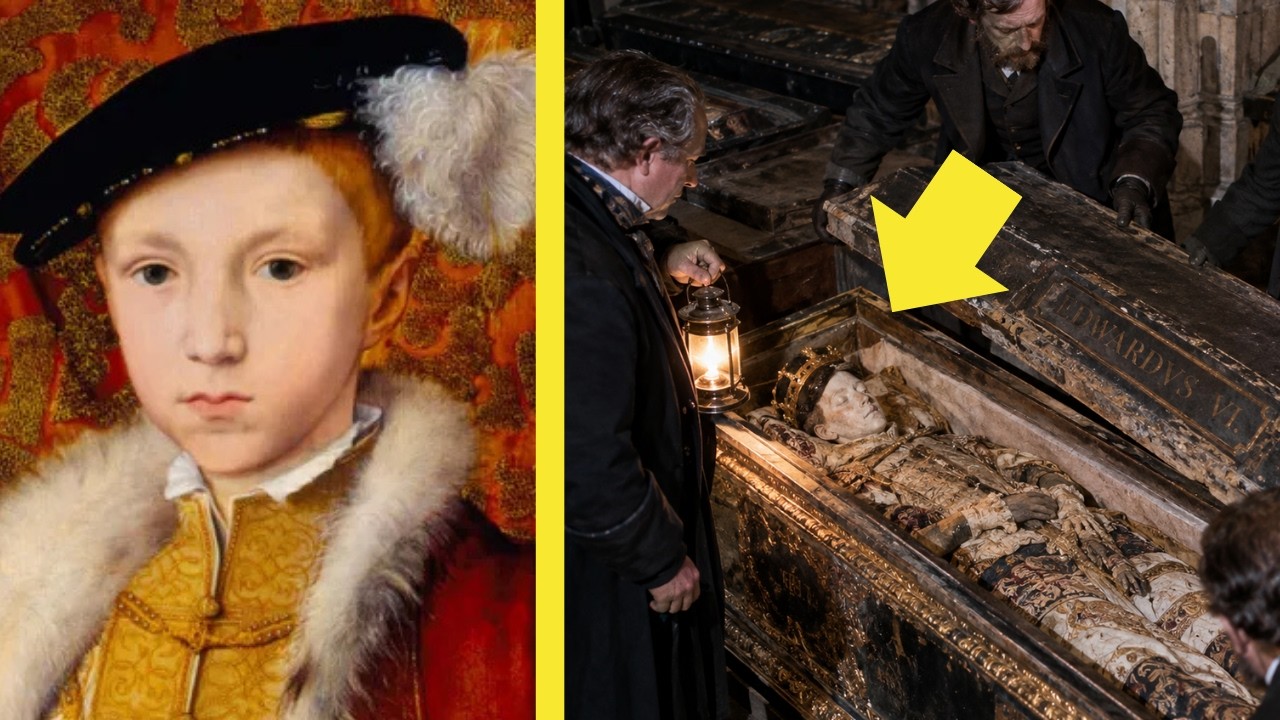
Edward VI, the long-awaited son of Henry VIII and Jane Seymour, was born in October 1537, a sickly child who never inherited his father’s formidable physique. Crowned king at the age of nine in 1547, he was guided by his regents, first his uncle Edward Seymour, Duke of Somerset, and later John Dudley, Duke of Northumberland. Edward’s health had always caused concern, but no one expected his death to come so soon or to plunge England into chaos. His final illness began in January 1553 as what seemed to be a cold.
By February, rumours were spreading that the king was seriously ill. Modern historians believe he was suffering from tuberculosis, which would explain his persistent cough, weight loss, night sweats, and gradual decline. Some theories suggest a secondary infection, perhaps pneumonia or measles, further weakened him. Whatever the exact cause, by spring 1553 the fifteen-year-old king was dying.
His death was not just a personal tragedy but a political disaster. He was unmarried, childless, and the succession threatened to pass to his Catholic half-sister Mary. Edward, who had spent his reign pushing England firmly toward Protestantism, feared Mary would undo all his reforms. Guided by Northumberland, he drew up what he called his device for the succession, bypassing both Mary and Elizabeth to name his Protestant cousin, Lady Jane Grey, as his heir.
Jane was young, highly educated, and a committed Protestant, and she was married to Northumberland’s son, which raised suspicions that the duke was manipulating events for his own gain. By early June 1553, Edward was clearly dying. His coughing fits were so violent that servants could hear them outside his room. Ambassadors at court wrote openly of his condition, with the French envoy noting that the boy king was so thin he appeared to be skin and bone.
By the end of June, Edward could no longer sit upright. His fingernails turned black, his skin discoloured, and his breathing became shallow, symptoms consistent with the advanced stages of tuberculosis. He died on the evening of 6 July 1553 at Greenwich Palace, aged fifteen. According to one account, possibly embellished, his final words were a prayer asking the Lord to have mercy on him and to protect the chosen people of England.
The news of his death was kept secret for two days to allow Northumberland and the council to prepare for Lady Jane Grey’s proclamation and to prevent Mary from rallying support. Edward was buried in Westminster Abbey, in the Henry VII Lady Chapel, in a small vault beneath the altar. In the nineteenth century that vault was opened. The lead coffin found inside was described as torn, deformed, and corroded.
The wooden outer coffin had partially disappeared, and the original coffin plate had been loosened and rolled upward. Most disturbingly, the skull of Edward VI had been separated from the body and disturbed, meaning his face had been exposed to the air of the royal vault. Someone had entered the vault, removed the wooden casing, and looked inside, even uncovering the young king’s face. The vault has never been opened again.
Jane Seymour’s story is different. She was the only one of Henry VIII’s six wives to die as queen, giving birth to the son Henry had desperately wanted. She died at Hampton Court Palace in October 1537, twelve days after the birth of Edward, probably from puerperal fever, a bacterial infection that killed countless women before modern medicine. She was about twenty-nine.
Henry was devastated and withdrew from court for weeks. Of all his wives, historians believe she was the one he loved most, because she succeeded where the others had failed. Her funeral was one of the grandest of the sixteenth century. Her body was embalmed, her internal organs were buried separately in the royal chapel at Hampton Court, and her remains were wrapped in rich fabrics and placed in a lead coffin.
The funeral procession left Hampton Court for Windsor Castle on 8 November 1537, accompanied by hundreds of mourners. A lifelike wax effigy of the queen lay atop the coffin, allowing the public to see their queen one last time. In a poignant detail, twenty-nine noblewomen walked behind the coffin, one for each year of her life. Jane was buried beneath the floor of the choir in St George’s Chapel at Windsor Castle.
When Henry VIII died in January 1547, he made clear his wish to be buried beside her rather than any of his other wives. Today they lie together beneath a simple black marble slab, one of the most modest royal tombs in England. Henry had intended a grand Renaissance monument, but it was never completed. Unlike many other royal remains, Jane’s coffin has never been disturbed.
For nearly five hundred years she has rested in the same spot, a rare link to the Tudor court that remains entirely untouched. Henry’s own coffin was not so fortunate. Buried in a lead coffin that was damaged over time, likely when the heavy coffin of Charles I was placed in the same vault in 1649, his remains were exposed to centuries of decay. The vault was rediscovered in 1813, and the lead coffin, in poor condition, was identified as Henry’s.
Although his body has not been scientifically examined, the most active and foul-smelling stages of decomposition ended centuries ago. The sealed vault and the lead coffin contained the process, so no smell escapes into the chapel above. Visitors stand near Henry’s grave without sensing anything at all. Anne Boleyn’s fate after death was even harsher.
After her execution on 19 May 1536, on charges of treason and adultery that modern historians regard as exaggerated or fabricated, her body was treated with almost no ceremony. There was no royal funeral, no great tomb. Officials found a simple elm chest originally used to store arrows and modified it into a coffin. Her severed head was placed beside her body, and she was buried in secret in the Chapel of St Peter ad Vincula within the Tower of London, near the high altar.
No marker was placed on her grave, and within a generation the exact location was forgotten. During the reign of Queen Victoria, restoration work in 1876 raised the old stone floor of the chapel, revealing the remains of many executed Tudor figures. One coffin was identified as Anne’s. The remains were those of a slight, middle-aged woman with small bones and delicate hands, and the head was clearly separated from the skeleton, consistent with execution by beheading.
The identification was based primarily on the burial location, which matched contemporary accounts. Investigators placed her remains in a new oak coffin and reburied them beneath the chapel floor with far more dignity than she had received in 1536. Victoria ordered commemorative stones to mark the identified graves. Today a marble plaque marks the spot.
The coffin has never been opened again, and modern proposals to use DNA testing have not received official approval. Catherine Parr’s body endured the strangest fate of all. The sixth wife of Henry VIII, she outlived him and remarried Thomas Seymour, the ambitious brother of Jane Seymour, shortly after his death. Pregnant for the first time at thirty-six, she gave birth to a daughter on 30 August 1548.
The birth seemed to go well, but within a week she developed puerperal fever. She died on 5 September 1548. Her daughter, Mary Seymour, disappeared from the historical record in infancy. Catherine was buried in a lead coffin beneath the floor of St Mary’s Chapel at Sudeley Castle in Gloucestershire, wrapped in layers of waxed linen.
During the English Civil War, Sudeley Castle was sacked and the chapel fell into ruin. Catherine’s grave was forgotten for over a century. In 1782, a lead coffin was discovered beneath the ruined chapel floor. When it was opened, the witnesses saw something extraordinary.
Despite being dead for 234 years, Catherine’s body was remarkably preserved. Her face was nearly intact, her hair visible, her skin still attached to her body. The combination of the sealed lead coffin and the waxed linen had created ideal conditions for preservation. But the moment fresh air entered the coffin, centuries of careful preservation began to fail.
Her skin blackened and shrank, and her tissues began to decompose almost immediately. Instead of protecting the coffin after this discovery, it became a curiosity. Over the following years it was opened again and again by visitors, antiquarians, and local dignitaries. Some took pieces of her clothing as souvenirs, others cut locks of her hair.
Each opening caused further deterioration. Stories from the eighteenth and nineteenth centuries claim that one attempt to rebury the coffin ended with it being accidentally placed upside down. By 1817, when authorities decided to reexamine the remains before moving them to a safer place, only a skeleton remained. The remarkable preservation had been destroyed by the very people fascinated by it.
In the nineteenth century, Sudeley Castle was restored, and the ruined chapel was rebuilt. The architect Sir George Gilbert Scott designed a fine Gothic Revival monument, crowned by a marble effigy of Catherine lying peacefully with folded hands. In 1861 her remains were reburied beneath this monument. She is the only one of Henry VIII’s wives whose grave remains in its original location, and after centuries of disturbance, she finally rests in peace.
Margaret Beaufort never held the crown herself, but she was its architect. The only child of John Beaufort, Duke of Somerset, she was descended from John of Gaunt, the third son of Edward III, though the Beaufort family’s legitimacy had been questioned. Married at twelve to Edmund Tudor, she gave birth to her only child, Henry Tudor, at just thirteen, a birth so difficult it left her unable to have more children. Edmund died of plague before his son was born.
As the Wars of the Roses tore England apart, Margaret, a loyal Lancastrian, used every tool available, marriages, diplomacy, and political alliances, to protect her son’s claim to the throne. She married twice more, finally to Thomas Stanley, whose betrayal of Richard III at the Battle of Bosworth Field in 1485 helped secure her son’s victory. Henry Tudor became Henry VII, ending the wars by marrying Elizabeth of York, uniting the warring houses. Margaret, refusing the title of queen mother, which would have competed with her daughter-in-law, chose instead to be called my lady the king’s mother.
She acted almost as a co-ruler, attending royal councils and managing finances, and she was a major patron of the church and education, founding Christ’s College and St John’s College at Cambridge. She lived to see her grandson, the future Henry VIII, become heir to the throne after the death of his elder brother. Margaret died in June 1509, shortly before her grandson’s coronation, at the age of sixty-six. She was buried in the south aisle of Henry VII’s Lady Chapel in Westminster Abbey, beneath a magnificent black marble tomb topped by a lifelike effigy made from her death mask.
The inscription records her as mother of Henry VII and grandmother of Henry VIII, listing her charitable foundations. Unlike many other Tudor royal tombs, there is no record that Margaret Beaufort’s grave was ever opened. She was not a queen regnant, so there was no particular interest in examining her remains. After five hundred years, it is likely she still lies wrapped in her waxed linen shroud, possibly preserved remarkably well within her lead coffin.
She rests close to her descendants, near Henry VII and Elizabeth of York, and not far from her granddaughters Elizabeth I and Mary I, who share a single vault, and her great-grandson Edward VI, who lies undisturbed in his own small crypt. Her body, unlike so many of theirs, has probably never been disturbed at all.
