The operator’s hand was already on the winch lever when the wind shifted. James Carlisle had spent the morning cutting line with his dozer against a grass fire in the hills above Groveland, California, a blade’s width of bare earth meant to stop the flames. Now the fire had outrun his machine. There was no time to think, no calculation left to make.
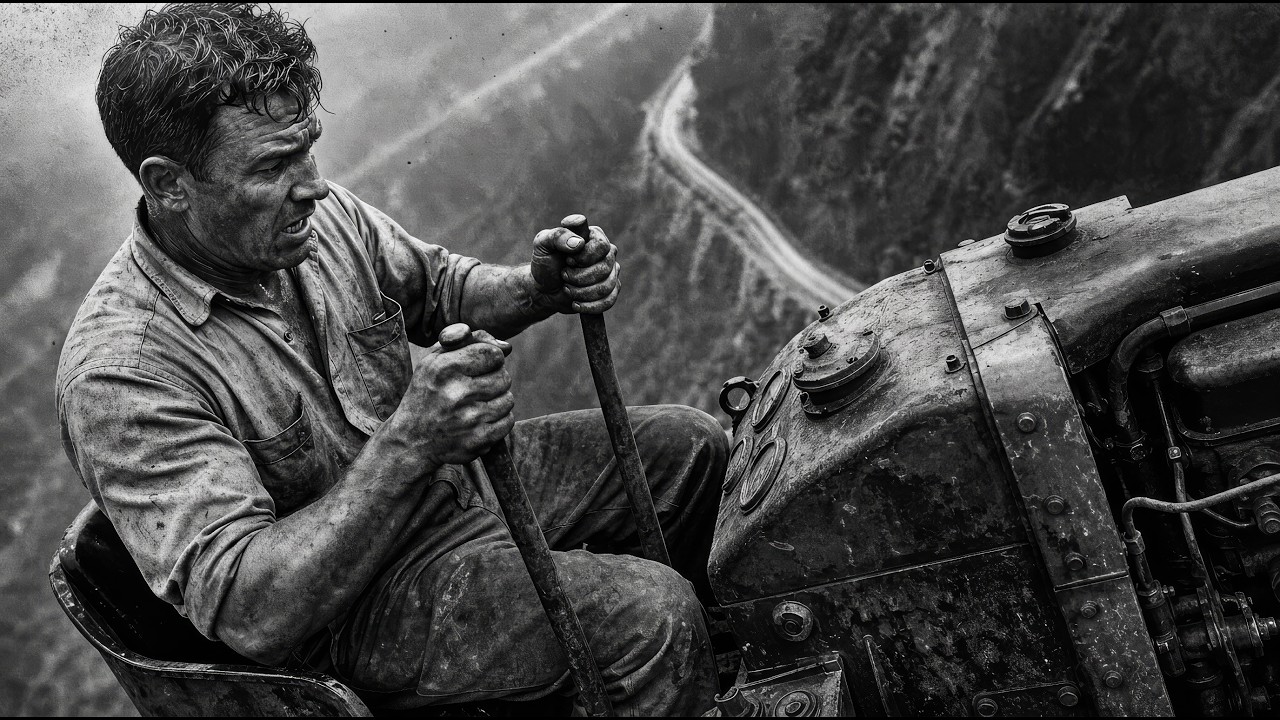
He abandoned the dozer and ran. He covered two hundred yards of that hillside before the flames caught him. Crews pulled him out and got him to the hospital in Sonora with burns over most of his body. He fought for ten days.
On July 2, 1964, he died. The fire did not kill James Carlisle. The machine did not roll over him, no cable snapped, no limb fell. He died because the seat he sat in gave him nothing between himself and the ground.
No cab, no canopy, no frame. He ran because there was nothing to stay for. And this is the part that should stop you. Fire was not even the most common way that seat killed a man.
Through the 1940s and 1950s, thousands of operators climbed onto machines with no cab, no seat belt, and nothing above their heads. The ways those machines could kill were already written into insurance ledgers before anyone climbed aboard. Over the years that followed, the seat claimed its men one way at a time, and the whole time the industry knew how to stop it. A simple piece of bent steel pipe, a roll cage, sat on a shelf for more than a decade while the industry looked the other way.
Start with the seat itself, because the seat is where every one of these stories begins. On a crawler tractor of the late 1940s and 1950s, the operator sat on a pressed steel pan, sometimes with a thin cushion, bolted more or less directly to the frame of a machine that weighed anywhere from ten thousand to over thirty thousand pounds. There was no suspension worth the name. Every rock the tracks climbed, every stump the blade struck, traveled up through the frame, through that steel pan, and into the man’s spine.
Above his head, there was open sky. Behind him, on most cable machines, sat a winch drum wrapped in steel rope. In front of him, a blade held up by that rope, and nothing else. The machines themselves are names some of you remember with your hands as much as your ears.
The Caterpillar D6, D7, and D8. The International Harvester TD-14, TD-18, and TD-24. The Allis-Chalmers HD series. Different paint, different levers, same seat.
And that seat asked for a full working day of ten or twelve hours, in July heat radiating off the engine, and in January wind with nothing to break it. From men who mostly considered a coat and a hat sufficient personal protective equipment. Because in that era, it was. Now put a price on that seat.
In July of 1950, the Bureau of Labor Statistics recorded union wage scales for the building trades across American cities. In Atlanta, a bulldozer operator running a machine of forty horsepower or more earned $1. 75 an hour. A man on a smaller machine, under forty horsepower, earned $1.
50. The common laborer working on the ground beside that same machine earned about $1. 65. Ten cents an hour.
That is what separated the man on the seat from the man with the shovel. Eighty cents over a full day. Four dollars over a week. And yet the seat was the prize.
Because the ladder did not stop there. The same wage tables show what waited above. Crane and dragline operators in Atlanta earned $2. 25 that year.
By 1955, the men running cranes and derricks on steel erection in New York City earned $4. 05 an hour, the highest journeyman rate in the entire federal survey of the building trades, above the bricklayers, above the electricians, above everyone. The dozer seat was the first rung on the only ladder in construction that led to the top of the entire wage scale. A young man took that seat because of where it could take him.
But the same government that recorded those wages was recording something else. Through the 1930s and 1940s, the death rate for all American workers had fallen to around thirty-six or thirty-seven per hundred thousand each year. In construction, the rate ran between 150 and 200 per hundred thousand, roughly five times as high. In 1951 alone, American workplaces killed around sixteen thousand people.
For comparison, construction today runs at about 12. 9 deaths per hundred thousand workers, and the entire American construction industry now loses just over a thousand men and women in a year. In 1951, the country lost that many workers roughly every three and a half weeks. The men of that era worked under odds twelve to fifteen times worse than their grandsons face, and no position on the site gathered more of those odds into one place than the seat of a cable dozer.
Killer number one was the ground itself. A crawler tractor looks unshakeable, low and wide and heavy. And on flat ground it nearly is. But the work was almost never on flat ground.
The work was cutting benches into hillsides, pushing fill over the edge of an embankment, walking a machine across a side slope with the blade loaded. On a side slope, the physics turn against the operator with almost no warning. The uphill track rides over a rock or a stump. The downhill track drops into soft material, and a machine that felt planted a second earlier begins to rotate around its downhill edge.
Past a certain angle, there is nothing any operator can do. Thirty thousand pounds of steel goes over. The old hands had exactly one card to play in that half second. And it came from the cable system itself.
Drop the blade. A blade slammed into the dirt on the downhill side could catch the machine, dig in, and hold it like an anchor. Experienced men worked side slopes with a thumb resting near the release for precisely that reason. But remember how the cable system worked.
The blade came down by gravity alone, and gravity takes time. A hydraulic blade could be powered down in an instant. A cable blade fell. And on a machine already rotating, the race between a falling blade and a falling tractor was a race the tractor sometimes won.
And when it went over, there was nothing between the man and the machine. No rollover frame, no canopy, no belt holding him in the seat. Some men tried to ride it down. Some tried to jump clear.
State investigators who studied these accidents in later decades found the same pattern again and again. The operator is thrown from the seat on the first quarter turn, lands on the slope, and the machine follows him. A dozer rolling down a grade does not stop where the man stops. The sad truth is that jumping and staying were both bets, and the house held most of the cards either way.
The edge of a fill was its own trap. An operator pushing material over the lip of an embankment worked by feel, easing forward until the blade load spilled over, then backing away. But fresh fill has no strength at the edge. The material the last pass dumped is loose, and under the weight of the tracks, it can shear away without a sound.
Investigators have documented operators who backed to the edge of a hillside path they had used all morning, felt the soft dirt give way under one track, and rode the machine over as it rolled to the bottom. Farm tractor studies from the same era tell us how these overturns ended. When researchers later examined one hundred rollovers in Nebraska, every death on that list came from a machine without a protective frame. Killer number two hung in the air behind the operator’s head.
On a cable dozer, the blade was not held up by hydraulic cylinders. It was held up by wire rope wound onto a drum, run up over sheaves on a steel frame, and down to the blade. Caterpillar called its unit the cable control. LeTourneau, who had pioneered the system back in 1928, called his the power control unit.
On most of these machines, the logic was the same. The operator pulled the lever to wind cable in and raise the blade. The center position held the brake. Pushing the lever paid the cable out and the blade came down by gravity and gravity alone.
There was no down pressure. There was no way to power the blade into the ground. There was only weight and falling. That single fact shaped everything about the work, and it shaped how men died.
A wire rope under constant load wears strand by strand invisibly inside the wraps on the drum. When it parted, two things happened at once. The blade dropped instantly wherever it was onto whatever was under it, and the free end of the rope came alive. The old operators had a phrase for it.
A parted cable end, they said, goes wilder than any bullwhip you ever saw, and it could take a hand off or worse. Men learned never to stand between the nose of the machine and the blade, and never to lean over a cable under tension, because the rope gave no warning that mattered. The only warning came the night before, if a man went looking for it. Careful operators ran a gloved hand along every foot of rope at the end of a shift, feeling for the first broken strands, the fine steel whiskers that meant the cable was starting to die.
It was slow work at the end of a long day, and skipping it saved twenty minutes. The men who never skipped it tended to be the ones who got old. One veteran operator who learned on these machines as a young man in the 1950s later described his first mistake on a cable blade. Near the end of a push, he eased the blade down to trim the top of his pile, not realizing the blade was hanging over open air.
The blade dropped. He panicked, hauled back on the winch lever, and the cable snapped. What followed was not an injury. It was hours of punishment rethreading heavy wire rope down through the machine, up through the sheave blocks at the front, while the whole crew waited and the foreman watched.
He was seventy-eight years old when he wrote that story down, and he said he remembered the lecture like it was yesterday. On a cable machine, one careless second cost you an afternoon if you were lucky. If you were not lucky, it cost considerably more. Killer number three struck before the day’s work even began.
A big diesel crawler of that era did not start with a key. The main engine was started by a second, smaller gasoline engine mounted alongside it, called the pony motor. On the smaller Caterpillar models, the D2 and the D4, the pony itself was started with a pull rope or a hand crank, bare-handed in whatever weather the morning offered. The ritual went like this.
The operator climbed up in the dark, opened the fuel valve, set the choke, and started the pony on the bigger machines with a hand crank or a pull rope. Then he engaged a pinion gear that meshed the little engine into the flywheel of the big diesel and let it grind, warming the iron, building oil pressure, turning the cold engine over until compression and heat finally brought it to life. On a mild morning, that might take a few minutes. In real winter cold, men reported cranking sessions of twenty to thirty minutes before the diesel would fire.
The danger lived in that crank. A gasoline engine with the spark set wrong does not simply fail to start. It kicks back, snapping the crank handle backward through its arc with the full force of compression, and it gives no warning at all. The rule every old hand taught every new one was simple.
Never put any part of your body in line with the arc of that crank. Men who wrapped a thumb around the handle instead of laying it alongside learned why the injury had its own name in that era. Broken thumbs, broken wrists, broken forearms, all before the machine had moved an inch. And the cold that made the cranking longer also pushed men toward shortcuts, priming with raw gasoline or worse, with ether next to a hot exhaust manifold.
The starting ritual was the one hazard an operator faced twice a day, every day, on the coldest mornings of the year, which is exactly when his hands worked worst. These were the same machines that had punched the Alaska Highway through frozen wilderness in 1942, and the men who ran them there fought that pony motor at forty below. Killer number four came from above, and it had the darkest name in the trade. In land clearing and logging road work, the greatest danger was often not the machine at all.
It was the timber. A dozer shoving into a dead snag or pushing over a green tree sends a shock up through the trunk. And what comes down is not always the tree. Loose limbs, broken tops, whole dead spars hung up in the canopy shake free and fall without a sound a man can hear over an open exhaust stack.
The loggers called them widow makers, and the name was earned. The operator sitting in the open with his eyes on the blade and his ears full of diesel never saw them coming. In California alone, logging killed 457 men during the 1950s. And the cat skinner cutting road below the timber shared that ground with every one of those hazards.
It was in the woods of the Pacific Northwest that the first homemade answers appeared. Heavy plate and pipe welded over the seat by loggers who had buried too many friends. The industry called them brush cabs. Nobody required them.
Somebody’s welder just decided he was done waiting. Killer number five was the machine itself in the quietest moments of the day. Getting on, getting off, standing beside it. The record here is unusually specific, because one of these deaths happened in front of a television news camera crew’s reporting chain.
On October 26, 1958, on a freeway construction job in downtown Fort Worth, Texas, a thirty-one-year-old operator named Al Jack Thompson was thrown over the front of his bulldozer, became entangled, and was crushed to death by his own blade. He was from the town of Azle, just northwest of the city. That account comes from a Fort Worth television news report preserved in the Texas archives. And it is one of the very few operator deaths of that decade we can still put a name and a date to.
Not because these deaths were rare, but because they were so common that most of them never made the news at all. The mechanism behind deaths like Thompson’s shows up over and over in accident investigations. A machine parked on a grade with a worn brake band. An operator who steps down in front of his own track to check the blade.
A moment of slack attention around thirty thousand pounds of idling steel. State investigators studying dozer fatalities found operators run over by their own machines after a parking brake failed, or thrown under the tracks while climbing on or off over greasy steel with no handholds worth the name. The seat was dangerous, but so was every step between the seat and the ground. Those were the five fast ways.
But there was a sixth toll, and it collected slowly. The seat sat directly over the frame, and the frame carried every impact of the tracks into the operator’s body for ten or twelve hours at a stretch. Medical researchers studying heavy equipment operators in later decades documented what those years of whole-body vibration actually did. Compressed spinal discs, chronic lower back damage that ended careers in a man’s forties.
And two feet from the operator’s head on most of these machines stood an open exhaust stack with no muffler worth mentioning, hammering his ears at levels no rule limited and no protection softened. Talk to the surviving operators of that generation today, and the pattern is almost universal. The hearing went first, then the back, then the hands. The seat did not have to roll over to take something from a man.
It collected from every operator, every shift, whether the day went right or wrong. The dozer seat was the only position on the site where simply doing the job perfectly for years was itself a slow injury. And every part of that toll, the fast deaths and the slow collections alike, had a price that was known in advance. It was printed in the manuals of the workmen’s compensation system.
Here is how that system worked, and it is worth understanding, because it is the closest thing we have to the industry’s own honest opinion of that seat. Every occupation in America was assigned a classification code by the insurance rating bureaus. Excavation work carried its own code. So did iron and steel erection.
So did clerical office work. For each code, the bureaus set a manual rate, a price the employer paid for insurance on every hundred dollars of payroll, and that rate was built directly out of the bodies. Actuaries tallied the deaths and the crushed limbs in each classification, translated them into expected losses, and printed the result as a premium. They had no shortage of raw material.
Through the 1950s, American workplaces were killing between thirteen thousand and sixteen thousand people every year. And federal statisticians recorded that a construction worker was roughly three times as likely to suffer a disabling injury as a factory worker, and nearly five times as likely as the average American on any job. A clerk cost his employer a few cents of insurance per hundred dollars of wages. The hazardous manual classes ran into whole dollars.
In New York in the late 1940s, the rating system priced one high-hazard classification at around eight dollars per hundred dollars of payroll. And excavation and grading sat in the contracting group, among the most expensive classes in the entire book. Think about what that means. Before a single track turned on a new job, an accountant somewhere had already written down, in dollars and cents, how much death and injury the earth-moving crew was statistically going to produce, and the contractor had already paid for it.
The system did not ask whether men would be hurt on that seat. It asked only how much the hurting would cost, and it settled the bill in advance. Settlement paid. Claim closed.
Next job. So the seat paid a dime more than a shovel, and the insurance man priced it like a hazard class. And yet, and this is the part the statistics cannot explain, the men fought for it. To understand why, you have to understand who the man on that seat was.
The trade called him a cat skinner, and the name tells you everything about where he came from. A generation earlier, the man who drove a mule team with a whip was called a mule skinner. When the crawler tractor replaced the mule team on the grades and in the woods, the driver kept the name. The whip hand became the winch hand.
It was not a job title. It was an inheritance. And nobody handed it to you. A young man started as a grease monkey or an oiler, crawling under machines at the end of the shift with a grease gun, servicing every fitting on the undercarriage while the operators went home.
He watched. He listened. He learned what a slipping clutch sounded like, and what a fraying cable looked like. And after enough seasons, somebody let him make his first passes on a real machine.
What he learned up there could not be written down. The old hands said they ran the machine by the seat of their pants, and they meant it literally. The vibration coming up through that steel pan told a good operator what the blade was cutting before his eyes did. Rock felt different from clay.
A load about to stall the engine felt different from a load the machine could carry. Veterans of that era could hold a grade within an inch, working entirely by feel, on a machine with no gauges for any of it. And the men who watched them work still talk about it the way people talk about watching an artist. Modern machines spend a great deal of computing power trying to give that feedback back to the operator through sensors and screens.
And veterans who ran both eras will tell you the screens still do not say what the seat of a cable machine said for free. That was what the seat really paid. Not the dime. The dime was an insult, honestly.
The seat paid in standing. On a 1950s job site, the operator was the man the whole crew waited on. The man the foreman could not replace by walking to the hiring hall. The man whose hands were the difference between a road and a mess.
In an economy full of jobs where a man was a pair of arms, the cat skinner was a craftsman, and every laborer leaning on a shovel in that dozer’s dust knew exactly which one of them he would rather be. The seat was dangerous the way the top of the ladder is high. That was not a flaw in the bargain. That was the bargain.
Which brings us at last to the piece of bent pipe. Because the most damning fact in this entire story is not how these men died. It is how easily almost all of them could have been saved, and how long everyone waited. The idea could hardly have been simpler.
Weld a frame of heavy steel pipe over the operator’s seat, strong enough to hold the machine’s weight if it rolled, and put a belt on the man so the frame stays between him and the ground. That is a rollover protective structure, and it is not space-age engineering. It is a roll cage, the kind of thing any competent shop could fabricate. And the record shows the industry knew it.
Roll protection devices were being manufactured for Allis-Chalmers tractors as early as 1947. Through the 1950s and early 1960s, the United States Patent Office issued eight separate patents for tractor roll guards. In 1959, engineers at John Deere built roll bars with seat belts, tested them, and then shelved the project for years. The solution existed.
It sat on the shelf. The proof of what it could do came from Sweden. Swedish manufacturers began offering protective frames as an option on new tractors in 1954, and the market delivered its verdict immediately. Buyers would not pay extra for their own survival.
Sales of the optional frames went nowhere, a pattern safety researchers would later give a polite name: optimistic bias. The quiet conviction of every man on every machine that the rollover happens to somebody else. So in 1959, Sweden stopped asking. Every new tractor sold in the country had to carry an approved protective frame by law, the first mandate of its kind in the world.
And then the numbers came in. In the years that followed, Swedish authorities tracked forty rollovers of frame-equipped tractors. Forty machines over, one man dead. Before the law, the country’s fatal overturn rate had run around twelve to seventeen deaths per hundred thousand tractors each year.
Within a generation, it fell below one. American researchers later reached the same conclusion from the other direction. When a protective frame is combined with a seatbelt, the chance of the operator dying in an overturn drops by 99 percent. It is one of the most effective safety devices ever put on any machine, anywhere.
So what did the United States do with that knowledge in 1959? For the ordinary contractor and the ordinary operator, essentially nothing for thirteen more years. American manufacturers did not offer rollover structures even as an option until 1966. Federal law did not require them on construction equipment until 1972.
But inside that long silence sits the detail that gives the whole game away. In 1960, the United States Army Corps of Engineers began requiring heavy protective canopies on the crawler tractors working on its own projects. And by 1967, its safety manual spelled the standard out in cold engineering language. The canopy over the operator had to support twice the weight of the machine, with at least fifty-two inches of clearance between the deck and the roof.
Read that again. The federal government looked at this seat, decided its own operators would not sit on it unprotected, and wrote the specification twelve years before the same government required that protection for everyone else. A few states moved on their own. California wrote canopy rules for tractors ahead of the federal deadline, rules strong enough that Washington later simply grandfathered them in.
And the California rules protected against more than rollovers. They named a hazard the loggers knew well: the gill poke, a limb or a sapling that spears through the open front of a moving machine and pins the man to his own seat. It took a state regulation to admit in writing what every cat skinner in the woods already carried in the back of his mind. As for the manufacturers, they did not make protective structures standard equipment on their machines until 1985, a full generation after Sweden proved the case.
But if you ran a dozer for an ordinary dirt contractor in 1963 in most of America, the pipe that would have saved your life was legal to leave off. And it usually was left off, because it cost money and blocked a little visibility. And the rollover, of course, was going to happen to somebody else. Those were the two arguments repeated on every job in the country.
The canopy posts got in the way of the operator’s sight lines, and the frame added cost to a machine that already strained a contractor’s credit. Both arguments were true as far as they went. Neither one survived five minutes of honest arithmetic against a widow’s pension. But honest arithmetic was never asked to attend the meeting.
Nearly all of the Interstate Highway System, forty thousand miles of it, was graded by men sitting on unprotected seats in exactly those years, inside exactly that gap between what was known and what was required. Which brings us back to a fire road above Groveland, California, on the 22nd of June, 1964. James Carlisle worked for the California Division of Forestry, cutting line with his dozer against a wind-driven grass fire in the Tuolumne County hills. The fire would burn close to two thousand acres in eight hours.
Somewhere on that line, the wind shifted, and the flames ran at his position faster than any crawler could move. Carlisle made the only choice left. He abandoned the machine and ran, and he covered two hundred yards of that hillside before the fire overtook him. Crews got him out and got him to the hospital in Sonora with burns over most of his body.
He fought for ten days. On July 2, 1964, he died. Researchers combed through newspaper archives and accident commission records trying to put verified names to the men that seat killed. And after all of it, Carlisle and Thompson are nearly the only two we can state with certainty.
Sit with that for a moment. In a decade when construction was killing Americans at five times the national rate, the individual men on the dozers died so routinely, in so many small places, that history barely bothered to write their names down. James Carlisle is not part of this story because his death was unusual. He is part of it because his death was recorded.
Within a few years of that fire, the era this story describes was ending. New machines came with hydraulic blades instead of cables, factory cabs instead of open sky. And after 1972, with that simple frame of steel pipe standing over every new seat, the operator’s job was still skilled and still not entirely safe. But the particular bargain the cat skinner made, the best seat on the site at the worst odds in the industry, that bargain is gone.
The men who took it graded the highways we drive, cleared the land under the suburbs we live in, and cut the fire lines that held. Most of their names are lost. What they built is not.






