The hunters heard the woman’s voice before they saw anything. It drifted through the flooded timber along Swan Creek, clear as a church bell, singing a melody none of them recognized. The words sounded foreign, perhaps French or Spanish. Reverend John Samuelson, who had joined the rescue party searching for survivors stranded by the worst flooding the Ozarks had seen in years, stopped mid-stride and listened.
When the men called out, the singing stopped abruptly. All that remained was the rush of water and wind through the pines. Parker’s hunting dog refused to move toward the sound. The animal cowered and whimpered, behaving in a way Parker said he had never witnessed before.
Then the dog snapped its rope and fled toward town. Two days later it was found hungry and exhausted, as if it had been running the whole time. The men decided to investigate the property from which the voice seemed to come. They knew it belonged to the Blackwood twins, Isaiah and Elijah, two Union veterans who had returned from the war and retreated deep into the forest.
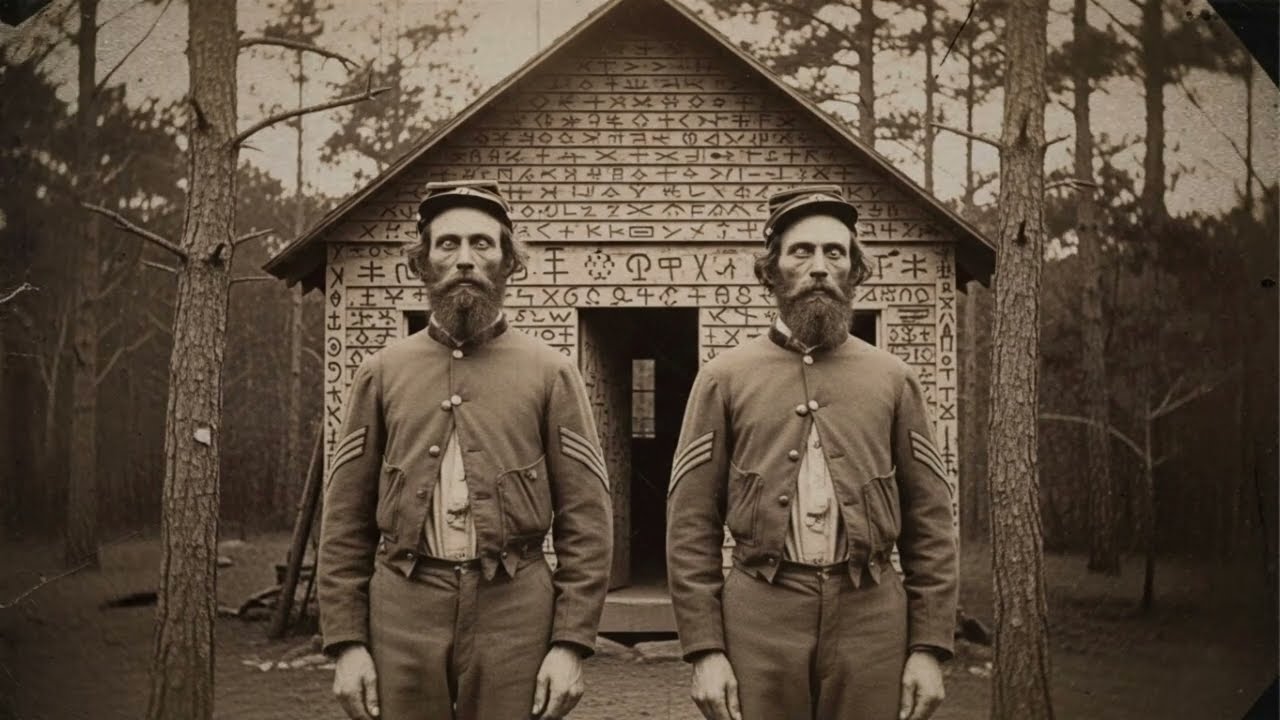
What the hunters found at the cabin would be recorded in Reverend Samuelson’s diary and later corroborated by the sheriff’s report. The structure stood in a small clearing, built with unusual care. The logs were evenly cut and joined with precision. But what drew the eye was the carvings.
Every inch of the exterior was covered in intricate symbols, designs, and what appeared to be writing in an unknown script. “The effect was unsettling,” Samuelson wrote. “Every inch of exposed wood was carved with these symbols, giving the impression that the cabin itself was watching us. Several men made the sign of the cross.
” The guide, a man named Williams, refused to approach the structure, saying the markings reminded him of something his Cherokee grandmother had warned him about. Sheriff Thomas Winthrop’s report added further detail. The symbols appeared as continuous lines encircling the entire structure with no clear beginning or end. Some resembled variants of symbols used in surveying or astronomy, though disturbingly distorted.
Others matched nothing in any known alphabet or numbering system. More troubling was what surrounded the cabin. Dozens of crude figures constructed from twisted branches, animal bones, and scraps of fabric stood arranged in concentric circles facing inward. According to Sheriff Winthrop’s official report, dated April 17, 1867, these constructions appeared to be human figures in various postures of distress.
Some contained personal items—buttons, hairpins, a child’s shoe—of unknown origin. The figures were arranged with mathematical precision: twenty-four in the outermost circle, sixteen in the next, then eight, and finally four pressed against the cabin wall. This exactness suggested deliberate placement rather than random arrangement. The hunters called for the Blackwood brothers and received no answer.
After some deliberation, three men, including the sheriff, entered the cabin. The interior was described as meticulously organized, but contained several inexplicable elements. Most significant was a room that appeared prepared for a woman. It held a carefully made bed with clean linens, a dressing table with a silver-handled hairbrush whose bristles still held long black hairs, and several dresses hung neatly on wooden pegs.
According to tax and census records, neither brother had ever married. Sheriff Winthrop’s report noted, “The women’s garments appear to be of a quality unusual for this region; fine stitching in silk and fine cotton. Several items bear the monogram E. L.
” No local seamstress recognized the needlework. The most disturbing discovery came in the cabin’s underground cellar. The sheriff’s report stated they found a diary written in what appeared to be two nearly identical hands, written alternately. Most of the writing was indecipherable, either in code or, as Reverend Samuelson suggested, the product of deranged minds.
The readable passages described how the brothers had found her on their way home from the war. Isaiah and Eliza Blackwood had enlisted together in 1861, twenty-two years old, both listing their previous occupation as “woodsman. ” They served in the 24th Missouri Infantry, fighting for the Union. Their commanding officer noted in his field journal that they kept to themselves, whispering only to each other, which made the other soldiers uneasy.
The enlistment forms, filled out in nearly identical handwriting, recorded that their right shoulder blades bore the same birthmark. The coroner’s notes would later describe them as “unnaturally alike in physical constitution. ”
In the fall of 1865, the brothers returned to find their family home abandoned. Their father had died of pneumonia in 1862.
Their mother, Sarah, had died under stranger circumstances six months later. The First Baptist Church of Forsyth’s burial records stated simply that her funeral was conducted in her absence because her remains could not be recovered. Reverend Joseph Miller’s personal correspondence from April 1863 recorded that neighbors had grown concerned by smoke coming from the chimney at unusual hours, investigated, and found the house empty. Footprints led toward the forest but stopped abruptly near Stone Creek.
A search party found nothing further. The brothers’ only sister, Mary, had married and moved to Springfield before the war. In a letter discovered after her death in 1912, she had begged them to sell the property and leave. “The place was never kind to us,” she wrote.
“Please leave that darkness behind. ”
The brothers ignored her request. They abandoned the family cabin near the property boundary and built a new structure deeper in the valley, about three miles from the nearest road. The 1866 tax assessment noted the new dwelling and added a personal observation: “The owners appeared changed since our previous meeting.
Unsettlingly identical in speech and manner. Denied entry to the new structure for proper assessment. ”
Isaiah’s military medical records from July 1864, after the Battle of Westport, showed he had been briefly hospitalized for mental exhaustion and recurring nightmares. His physician noted that Isaiah spoke of voices coming from the trees and insisted that something had been following them home.
Three days later, another entry recorded: “The patient’s twin brother arrived today. Their mutual behavior seemed unusual. Extended silences during which they appeared to communicate without speech. When asked separately about the patient’s condition, both gave identical answers.
”
The brothers grew increasingly reclusive. Seth Morris, owner of the general store in Forsyth, said they came to buy supplies only every two or three months. In an 1868 newspaper interview, Morris stated, “They always came together, spoke to no one else, paid with old foreign-style gold coins. ” When asked how they were doing, they would only say, “We are no longer alone,” accompanied by an odd, identical smile.
“They stopped cutting their hair and beards,” Morris continued. “After a time, you could not tell which was which. Sometimes I felt I was seeing the same person twice, as if by some trick of a mirror. ” The store ledger showed a strange pattern of purchases: increasing quantities of wax, silver wire, fine cloth by the bolt, women’s hairpins, and scented soap.
A final entry from January 1867 noted, “Customer requested unusual quantities of salt and iron nails. When questioned, stated that boundaries must be maintained. Paid in Spanish gold coins dated 1783. ”
In the spring of 1867, the flooding that had brought the hunters to Swan Creek changed everything.
The White River rose fifteen feet above normal, sweeping away homes and forcing evacuations from low-lying areas. After the hunters encountered the singing voice and discovered the cabin, the sheriff’s report described finding the diary. The entries told a strange story. According to the fragments, the brothers had encountered the woman near the Missouri-Arkansas border while returning from the war.
She appeared lost and disoriented, speaking an unfamiliar language. They brought her to their forest, believing she needed protection. An entry from November 1865 read, “She speaks more clearly now, though her accent remains strange. She claims no memory of a life before finding us.
When asked her name, she smiles and says we may call her Eleanor. Last night, thinking we slept, she sang to herself. The melody bent the candle flames toward her, though there was no wind. ”
Another entry, possibly written by the other brother, described how Eleanor had explored the woods and returned with wildflowers that do not bloom in this region.
She knew the names of trees they had never seen. When asked where she found them, she said, “Just beyond. ” The entry noted, “At that exact spot, the memory of the forest is different. ”
The writings became increasingly disordered.
There were mentions of how her song changed the trees, and how she walked at night but left no footprints in the morning. One entry read, “We dreamed the same dream again. She stood between two ancient trees, weaving their branches together. When she saw us watching, she said, ‘Soon you will understand the pattern.
‘ We woke at the same instant, both speaking her name. ”
A particularly unsettling passage described how Eleanor asked them to carve her symbols. “She says, ‘These will hold the boundaries in place. ‘ We work now in perfect rhythm, our hands moving together.
Sometimes I cannot remember which brother I am. Each day this seems less important. ”
The last readable entry, written only three weeks before the hunters’ discovery, read, “We understand now. She was never lost.
She was waiting. This forest was always hers. We are hers now. Yesterday she asked if we would follow her deeper.
We answered in one voice. How could we refuse? She is remaking us, or did she find us as we are? The distinction blurs, like our reflections in still water.
”
The brothers themselves were never found. The hunters searched the surrounding area thoroughly. Sheriff Winthrop organized a broader search with local trackers and dogs in the following weeks. His final report from June 1867 noted that the only possible clue was a set of two identical footprints leading from the cabin into the deep woods.
The tracks ran side by side for nearly half a mile before disappearing abruptly at the edge of a limestone outcropping. The report included a detail not mentioned in newspaper accounts: at the point where the footprints vanished, they found a woman’s silver hairpin twisted into a strange shape matching the symbols carved repeatedly above the cabin door. The dogs refused to approach the object, growling and retreating when brought near. The sheriff’s report concluded that the Blackwood brothers had either fled the area or fallen victim to some misfortune in the remote regions of their property.
Given the disordered state of their writings and the unusual modifications to their dwelling, it was possible that the psychological wounds of war had caused mental deterioration and potential self-harm. A concealed addendum to the report, discovered during a 1967 research project, revealed that Sheriff Winthrop had taken additional measures after the investigation. He had consulted with Reverend Samuelson regarding the disposal of artifacts from the Blackwood property. “We agreed that certain items, particularly the diary and personal effects from the woman’s room, should be secured away from public exposure.
These items are now locked in the church vault until consultation with proper authorities. ” Church records showed that a fire destroyed significant portions of the First Baptist Church in 1871, with everything salvaged from the vault. The only intact item recovered from the rubble was the silver hairpin from the disappearance site. It remained with Reverend Samuelson’s family until 1934, when it was donated to the county historical society.
It was later lost due to a cataloging error in the 1950s. The case might have faded into obscurity, lost among the countless tragedies of the postwar period, if not for events in the same valley over the following decades. In 1879, a family named Harrington purchased the Blackwood property, apparently unaware of its history. County records showed they intended to establish a small homestead for raising cattle.
They cleared additional land and built a new house about a quarter mile from the original Blackwood cabin, by then in ruins. According to an article in the Springfield Republican from October 1880, the Harrington family abandoned the property in less than a year. Jacob Harrington refused to give a specific reason, only saying the land was not meant to be lived on by anyone else. Local gossip, documented in several personal letters preserved at the county historical society, suggested that Mrs.
Harrington had become convinced someone was singing outside their windows at night. Their seven-year-old daughter had begun talking to someone in the forest that no one else could see. A personal letter from Mrs. Catherine Harrington to her sister in Kentucky, dated August 1880, contained more disturbing details.
“The singing is now heard every night. Jacob claims he does not hear it, but I know he does. He has started drinking heavily, which he never did before. Last night their daughter Emma disappeared from her bed.
We found her at dawn, sleeping peacefully at the edge of the woods. She said the woman in the forest had shown her where the brothers sleep. When I asked which brothers, she said the ones who look alike. But they do not look alike anymore.
They are becoming something else. ”
The letter continued, “I found Emma’s doll yesterday, the one her grandmother made for her. The face had been carefully altered with stitching, made to look exactly like another doll I had never seen before. When I asked Emma about it, she said, ‘Eleanor needed two for her collection.
‘ We are leaving as soon as Jacob can arrange the sale. Some places should be left empty. ”
The property remained abandoned until 1897, when a timber company purchased it. Their operations lasted only four months.
Company records, discovered during the 1967 research project, included reports of numerous incidents, equipment failures, and unexplained accidents. Several workers refused to return to work after reporting hearing a woman calling their names from within the trees. The foreman’s daily log documented increasing problems. “April 18, 1897.
Third saw blade broken this week. The metal shows signs of unusual stress, as if exposed to extreme cold, though the weather is mild. ” An entry from April 30 read, “Two workers did not return to camp last night. A search party found them wandering aimlessly this morning, separately, both claiming they had followed the sound of singing.
Both appeared disoriented and could not explain where they had been. Medical examination revealed identical unusual marks on both their right shoulders. ” A May 7 entry noted, “Work halted for unexplained reasons. Equipment failures.
Six men have now requested transfers. Reports of a woman’s voice at night continue. Two more men report seeing twin figures watching the camp from the edge of the woods. They withdrew into the trees when approached.
”
The final entry, dated May 15, 1897, read simply, “Operations ceased due to unsuitable conditions. Equipment to be transferred to Johnson’s property. Recommend no future logging attempts be made in this valley. ” An inventory document attached to the company records listed abandoned equipment at the site as unrecoverable, including six saw blades described as “twisted in a Mobius pattern, cause unknown.
” Also listed was a logbook whose entries appeared to have been repeatedly erased and overwritten in different hands, rendering them illegible. The most thorough evidence would come from Dr. William Parsons, a Springfield physician who became interested in the Blackwood case in 1902. His extensive notes, preserved in the Missouri Historical Society archives, detailed his investigation into what locals had begun calling “the Singing Woods.
” Dr. Parsons interviewed several elderly residents who remembered the Blackwood brothers. A statement from Margaret Wilson, then seventy-eight, offered a different perspective on the twins’ return from the war. Wilson insisted the brothers had stopped at her family’s farm seeking food and rest on their way home.
“They were not alone,” she stated. “There was a woman with them, though they behaved as if she were not there. They did not introduce her, did not speak to her. She was a strange sort of beautiful, tall, with black hair to her waist, and her eyes seemed to change color in the light.
She did not eat with us, only stood by the window humming softly. My father later said he thought the woman might be Indian, possibly Cherokee, but she looked like no native I had ever seen. ”
Wilson continued, “The strangest thing was that the brothers watched her constantly, as if they were afraid she would vanish. They left before dawn.
My younger brother said he saw them walking down the road, the woman in front, the brothers a few paces behind, as if pulled by an invisible thread. ” Wilson added a detail that Parsons found particularly significant. “My brother claimed that sometimes, when he looked quickly, he saw only one brother, not two. But then he would blink, and there would be both again.
” When he told their father, he was scolded for making up stories. Dr. Parsons attempted to find records of the mysterious woman or any documentation of her existence. Census records from surrounding counties showed no missing woman matching her description.
Military records made no mention of a female companion traveling with the Blackwood brothers after their discharge. The physician’s investigation led him to interview James Cooper, a former Confederate soldier who claimed to have encountered the Blackwood brothers during a minor skirmish near the Arkansas border in late 1864. Cooper’s account, recorded in Parsons’s notes, described a strange scene. “At dawn, there was a thick fog over the field.
We were retreating and I became separated from my unit. That is when I saw them, Union boys, twins, standing over something. They did not see me. They were too focused on what they had found.
”
Cooper continued, “It looked like a burial mound, ancient, like the Indian mounds found throughout this region. But it had been recently disturbed, either by shell fire or deliberately dug into. The twins were helping someone climb out of a hole in the mound. A woman.
Her clothing was unlike anything I had ever seen, not modern. Her movements were strange, as if someone learning to walk again. I did not stay to see more. There was something about the scene that frightened me more than any battle.
”
Dr. Parsons’s investigation took a more troubling turn in the summer of 1903 when he visited the site of the original Blackwood cabin. By then, the structure had completely collapsed, leaving only a foundation and scattered rotten timber. Parsons wrote in his journal, “The carved designs on many of the fallen logs are still visible, remarkably preserved despite exposure to the elements.
I have taken impressions of several and sent them to Professor Thornton at the university for analysis. ”
Parsons noticed something unusual about the forest surrounding the cabin site. The trees grew in an unusual configuration, forming nearly perfect concentric circles around the cabin foundation. Based on local botany, these trees could not be more than thirty years old.
Yet their arrangement suggested they had been deliberately planted where the wooden figures once stood. More curious still, each tree appeared to have grown twisted, with trunks spiraling clockwise in the outer rings and counterclockwise in the inner rings. Parsons described a constant feeling of being watched during his three-day investigation. On the second night, he recorded, “I was awakened around three in the morning by a sound like singing.
A woman’s voice, distant but clear. The melody was haunting, unlike any folk song I know. I followed the sound for perhaps a quarter mile before realizing I was disoriented in the dark. When I finally returned to my camp, I discovered my compass was no longer functioning properly.
The needle spins continuously, finding no true north. ”
The next morning’s entry noted, “This morning I found footprints around my tent. Two identical pairs of bare feet, same size, same walking pattern. The prints circled the tent completely, then headed into the deep woods.
What is most troubling is that the ground was soft from recent rain, yet the prints showed no signs of weight, as if whatever made them had no substance. ”
His final entry from July 17, 1903, read, “I have found a trail of broken branches leading deeper into the valley. The path appears deliberately marked, too consistent to be animal movement. I will follow it after breakfast to see where it leads.
I cannot shake the feeling that I am being invited somewhere. ” A hurried addendum at the bottom of the page read, “Heard the singing again, closer this time. Through gaps in the trees, I saw someone moving, a woman in white, though she vanished when I blinked. More concerning, I have now seen the brothers.
They stand at the edge of the woods, watching. Their appearance is exactly as described in the historical accounts, unchanged by time. When I called out, they retreated in perfect unison, matching each other’s movements exactly. I now understand this is not a matter of regional folklore but something far more extraordinary.
I must document what is happening here. ”
Three days later, Dr. Parsons was reported missing when he failed to return to Springfield. A search party found his campsite intact, with all of his belongings present except his worn clothing and his diary.
The last few pages of the diary had been torn out. Despite an extensive search involving more than fifty people, no trace of Dr. Parsons was ever found. The Taney County sheriff’s report concluded that he had likely fallen into one of the numerous sinkholes or caves that dotted the Ozarks.
The case was officially closed in September 1903. However, a note in the margin of the report, in a different hand, read, “Third disappearance associated with the Blackwood property. A pattern is emerging. ”
One member of the search party, Daniel Heywood, later claimed to have found something significant during the search, though this information was not included in the official report.
In a letter to his brother from August 1903, Heywood wrote, “We found a clearing that I have never seen in these woods. Perfectly circular, perhaps thirty feet across, where nothing grows. No trees, no brush, not even grass. Just bare earth.
In the center were two saplings planted so close together that they had grown into each other, forming a single twisted trunk that split again into two identical crowns. ” At the base of this strange tree, they found a fountain pen, possibly belonging to the missing doctor. Most unsettling was the discovery that the bare earth of the circular clearing contained an unusual substance—a fine white powder that several men identified as lime, commonly used in preparation for burials. The land remained uninhabited for decades and eventually became part of the Mark Twain National Forest in the 1930s.
Forest Service records from that period contained several incident reports filed by rangers working in that sector. An August 1938 report detailed how Ranger James Cooper became separated from his partner during a routine patrol. When he was found three days later, Cooper was severely dehydrated and disoriented. According to the medical evaluation, he repeatedly mentioned hearing a woman singing and insisted that the Blackwood brothers still wandered those woods.
Cooper’s official statement, taken after his recovery, described the incident. “We were marking boundaries near the old Blackwood property when we heard a sound like someone singing, but I could not understand any words. My partner Evans said he heard nothing. While Evans continued working, I went to investigate.
The sound seemed to lead me deeper into the valley. ”
Cooper’s account continued, “I lost track of time. It grew dark, but I kept following the voice. At times I thought I saw someone ahead of me, a woman in white.
Eventually, I reached a clearing I had never seen before, though I had patrolled this area for three years. In the center was the strangest tree I have ever seen, two trunks grown together that separated again at the top. That is when I saw them, two men standing on either side of the tree, exactly alike. They wore old-fashioned clothing from the last century, but the cloth looked new.
Their faces were unnaturally identical, and they moved in perfect unison, as if connected. ”
The most disturbing part of Cooper’s account was what happened next. “They spoke to me, both at exactly the same time, in the same voice. They said, ‘You can hear her too.
That means you are part of the pattern now. ‘ Then they smiled, exactly the same smile, and gestured behind me. I turned, but there was nothing there. When I turned back, the men were gone.
For the next two days, I tried to find my way out of the woods, but the paths that should have been familiar led nowhere. I kept returning to the clearing with the twisted tree. ” Cooper requested a transfer to another district shortly after the incident. The request was granted.
A supervisor’s note in his personnel file read, “Ranger Cooper has previously been reliable. The incident has unsettled him. A leave for medical treatment is recommended, followed by reassignment to visitor center duties rather than solo patrols. ”
The most thorough investigation of the Blackwood case occurred in 1967, when Professor Allen Thornton of the University of Missouri led a research team to the area to document local folklore.
Thornton had found references to the Blackwood incident in his grandfather’s papers. This was the same Professor Thornton who, decades earlier, had received the impressions of the cabin symbols from Dr. Parsons. Thornton’s notes revealed his personal connection to the case.
“My grandfather’s analysis of the Blackwood cabin symbols was never published. After receiving the impressions from Dr. Parsons in 1903, he became increasingly obsessed with their meaning. His personal papers show that he believed the symbols were not like any known mathematical or cartographic system, but rather a type of boundary marker.
He maintained that they depicted transitions between different states of reality rather than locations in physical space. ”
The team spent six weeks in the area, collecting oral histories and searching for physical evidence. Their findings were compiled into a two-hundred-page report titled “Patterns of Belief and Incident in Ozark Isolation Communities, 1865-1925. ” The report was never published.
According to university records, the research was discontinued due to budgetary constraints and methodological concerns. However, the notes of one team member, a graduate student named Elizabeth Chen, told a different story. Her personal diary, donated to the university archives after her death in 1982, described how the research team encountered increasingly inexplicable events during their stay. Equipment malfunctions, team members becoming inexplicably disoriented in familiar terrain, and unexplained sounds being recorded.
Chen wrote, “We have all heard it now, that singing. It comes just before dawn, always from a different direction. Professor Thornton insists it is a psychological response to the stories we have collected, a kind of group suggestion. But last night, I recorded it.
When I played the tape this morning, instead of singing, we heard something that sounded like two men speaking together, repeating the same sentence over and over. ‘She is still waiting. ‘”
Chen’s journal documented the team’s discovery of a location matching the circular clearing described in historical accounts. “We found the exact place described in Ranger Cooper’s 1938 report.
A perfect circle where nothing grows. In its center stands that strange twin tree, now fully mature. The two trunks grow completely intertwined for about seven feet before splitting into two identical canopies. Professor Thornton estimates the tree is about one hundred years old, dating its origin to shortly after the Blackwood brothers disappeared.
”
An entry from June 12, 1967, described a troubling incident. “Davis and Miller were mapping the clearing today when they both reported seeing someone watching them from the trees, a woman in white. When they approached, she retreated into the forest. After following her for a few hundred yards, they realized they had somehow become lost.
It took them three hours to find their way back to camp, though the clearing was less than half a mile away. ”
According to Chen’s diary, the research team’s work was abruptly halted after an incident at the site of the original Blackwood cabin. While taking soil samples, they found a small tin box containing two identical military identification tags belonging to the Blackwood brothers and a silver locket. Inside the locket was a braided lock of hair.
Chen noted, “The strangest thing is that the items looked new. No corrosion, no tarnishing, as if they had been placed there recently rather than a hundred years ago. ” An inscription on the inside of the locket read, “E. L.
From two to one, becoming many. ” When opened, it revealed a tightly braided strand of hair in three different colors—two identical shades of brown intertwined with a strand of black hair. According to Chen’s account, that night three members of the team reported seeing a woman standing at the edge of their camp, though each described her differently. “Miller saw her as young, perhaps twenty.
Davis described her as middle-aged. Professor Thornton insisted she was elderly. Yet all three identified her as the same person. ” The team departed the next morning.
Chen’s final entry noted, “Professor Thornton has collected all of our materials, notes, recordings, photographs, artifacts. He says everything must be properly cataloged at the university, but I saw him speaking with Sheriff Davis this morning. Something about forest service regulations and respect for the dead. I do not think our discovery will ever be published.
”
Chen added a personal observation. “Before we left, I returned briefly to the clearing with the strange tree. I wanted to take one last photograph. Later, when I developed the film, I noticed something in the background, half-hidden among the ordinary trees at the edge of the clearing—two figures standing side by side, watching.
Enlarged, their features are indistinct, but their posture and size appear identical. What is most troubling is that they appear to be wearing Union Army uniforms, though the quality of the image makes positive identification impossible. ”
The materials collected by Thornton’s team were indeed archived at the University of Missouri. Access was restricted until 1987, when most items were opened to researchers.
However, several significant items, including the recordings, identification tags, and the locket, were listed as misplaced during an archive reorganization. An October 1968 university administrative memorandum referenced the decision to restrict access to the collection. The memo stated, “Given the unusual nature of these items and Professor Thornton’s concerning behavior following the expedition, appropriate measures have been taken. The recorded materials in particular should be secured.
Professor Thornton’s request for medical leave is hereby granted. ”
Medical records showed that Professor Thornton was hospitalized for six weeks following the expedition, diagnosed with acute stress reaction with paranoid features. The physician’s notes indicated that Thornton repeatedly expressed concerns about boundaries weakening and events repeating. “Patient reports hearing singing at night and claims to see twin men watching him through the window, though his room is on the third floor.
”
The last documented incident related to the Blackwood case occurred in 1968. Forest Ranger Thomas Blackwell, who had no relation to the Blackwood brothers, filed an unusual report after a routine patrol. He described finding fresh footprints of two men walking side by side through a remote section of the forest. The tracks led him to a small clearing, where he discovered a crude shelter recently constructed from branches and leaves.
Inside, Ranger Blackwell reported finding a handwritten note pinned to a tree with what appeared to be an antique military knife. The note read, “She sings the forest into different shapes. We have followed her voice through the turning of the years. Whoever finds this, turn back.
Those who hear her song, she collects. ”
Blackwell’s report included the observation that the shelter contained personal items inconsistent with modern camping equipment. Among the items were a military canteen of Civil War design, two identical ceramic cups with no manufacturer’s marks, and a woman’s hairpin of unusual design. Most unsettling was the discovery of a diary dated from 1865 to 1967, written alternately in what handwriting experts would later identify as two nearly identical hands.
Only three pages of the diary remain in the Forest Service archives, the rest removed for unstated reasons. The surviving pages contain fragmented entries. “June 14, 1923. We visited the doctor again today.
She still follows his voice, though she can no longer remember his name or purpose. Eleanor says she will soon join the pattern, like the others who heard her song. Our transformation continues. Some days I cannot remember which brother I once was.
Each turning of the season makes this less important. ”
“October 30, 1951. The boundaries grow thin where she walks. The forest remembers differently in its own measure.
Today we watched a lost hunter pass within ten feet of us and see nothing. Eleanor says only those who hear her song can perceive what truly dwells in the woods. We are becoming like her now, present yet invisible, except to those she chooses. ”
“April 3, 1967.
The researchers have come. They ask questions of the townspeople, collect stories, take measurements. Eleanor is curious about them. She stood at the very edge of their camp last night, examining each one.
Three of them saw her, though each perceived her differently. She says one carries the blood of the old professor who studied the symbols. The pattern repeats. We have prepared a gift for their finding.
”
Blackwell’s report indicated that he collected the diary as evidence and planned to return with additional rangers for further investigation. No follow-up report was ever filed. According to Forest Service personnel records, Blackwell requested a transfer to another district the following week. The request was granted.
In an interview with a journalist researching disappearances in 1985, Blackwell declined to discuss the incident in detail, saying only, “Some parts of that forest are on no map, and perhaps that is for the best. What I found there, what I saw afterward, does not match with ordinary reality. ” Pressed further, Blackwell added, “The brothers are not missing, and neither is the woman. They are still there, but the forest around them is not the same forest we walk through.
”
The journalist’s notes, published in a regional magazine in 1986, included an additional comment from Blackwell. “After I filed my report, I dreamed of them for weeks. The twins standing on either side of a twisted tree, and the woman between them, singing. I began to hear her song even when I was awake, especially toward dawn.
That is when I requested the transfer. Some songs are not meant to be followed. ”
The site where the Blackwood cabin once stood now lies within a designated wilderness area of the Mark Twain National Forest. Although there is no formal restriction on entry, official hiking trails deliberately avoid the valley.
Forest Service maps mark the region with symbols reserved for impassable terrain, but local guides consistently refuse to lead groups there. Less widely known is a 1972 internal Forest Service memorandum establishing an informal policy regarding the area. “Our rangers are advised to patrol Sector 7B, the former Blackwood property, only in pairs. Annual observation of the site should be maintained, but no permanent markers or equipment may be installed.
Previous attempts to place automated wildlife cameras in this sector resulted in one hundred percent equipment failure within forty-eight hours of installation. Reports of unusual auditory events should be documented but not released to the public, in accordance with USFS policy regarding potential mass hysteria. ”
A supplemental note added in 1976 stated that the circular clearing and the unusual twin-trunked tree should be considered natural phenomena. “Any additional structures sighted in this area should be documented as to location by rangers, but not investigated without a support team.
Under no circumstances should personnel follow unexplained sounds or voices, particularly female singing. Visual contact with persons matching the historical descriptions of the Blackwood brothers should result in immediate transfer of any ranger for psychological evaluation. ”
Hikers occasionally report hearing singing in that part of the forest, particularly in the early morning or just after sunset. Those familiar with the area’s history refer to the phenomenon as “the Singing Forest” or sometimes “the Brothers’ Path.
” Parents in nearby communities still warn children not to follow unfamiliar melodies heard among the trees. A 1992 study by the University of Missouri folklore department documented forty-seven distinct accounts of encounters with what locals call “the Singer” or “the Brothers. ” These reports span from 1867 to 1991, with remarkable consistency in the descriptions despite no apparent knowledge of previous accounts among witnesses. The study noted several patterns in these encounters.
Most occurred at dawn or dusk, with a few reported during full moons. The woman was typically seen first, often partially hidden among trees or mist. The twins were usually observed standing perfectly still at a distance, wearing clothing described as “strange” or “old-fashioned” but in perfect condition. In seventy-eight percent of accounts, witnesses reported hearing singing before seeing anything.
Witnesses described widely varying melodies. Several reported a strange temporal distortion, where encounters that seemed brief actually lasted several hours. Nearly all witnesses became disoriented after the experience, with sixty-two percent requiring assistance to find their way out of the forest. Perhaps most troubling was that seventeen of those reporting encounters experienced significant life changes in the following months.
Eight changed careers, five moved to new towns, and four began creative projects whose inspiration they could not explain. Two individuals eventually returned to the forest and were never seen again. The most recent documented account came from Harold Jenkins, a ninety-two-year-old lifelong resident of Taney County, recorded during a local history project in 1966. When asked about the Blackwood brothers, Jenkins became visibly uncomfortable.
After some hesitation, he recounted a story told by his grandfather, who had been part of the original 1867 search party. “My grandfather said they did not tell everything in the official report. What they found in that cabin was worse than what was reported. There was a room whose walls were covered in paper—hundreds and hundreds of drawings of the same woman’s face, drawn over and over with slight differences, as if trying to perfect some detail.
”
Jenkins continued, “And the diary they found, grandfather said some of its pages had two different versions of the same event written side by side, as if the two brothers experienced the same moments differently. Toward the end, the handwriting began to merge into a single style. ” The most unsettling part of Jenkins’s account was what his grandfather claimed to have found in the cabin’s loft. “He told me they found a map painted on deerskin.
It showed the valley, but all the familiar places were in the wrong positions. The river ran backward. Where the valley should have been, there were mountains. And across the entire map, in various places, were drawn small figures of people.
Pairs of identical figures at different points, all facing toward a central location marked with a symbol no one recognized. ”
Jenkins’s final comment was perhaps the most chilling. “Grandfather told me that for many years afterward, people would sometimes see the brothers in the woods. Always at a distance, always together.
They would be seen walking between the trees, following something or someone that remained hidden from view. The last reported sighting was in 1914, nearly fifty years after they first disappeared. They had not aged a day. ”
In 1998, a team from the anthropology department at Washington University conducted ground-penetrating radar surveys in the area, ostensibly as part of a larger study of pre-Columbian settlement patterns.
Their published findings made no mention of the Blackwood case, focusing instead on evidence of ancient habitation. However, an unpublished appendix obtained through a Freedom of Information request in 2008 contained a curious annotation. “Survey, Area 17, coordinates withheld, revealed anomalous readings inconsistent with known geological formations. Ground-penetrating radar indicates a circular structure approximately thirty meters in diameter, extending at least ten meters below the surface.
Dating incomplete. The perfect circularity suggests artificial construction, possibly a pre-Columbian ceremonial site. Additional research was not possible due to equipment malfunction and adverse conditions. Notably, audio recordings made during the survey contained unexplained acoustic artifacts, producing rhythmic patterns resembling voices, though no team member reported hearing unusual sounds during the survey.
Recommendation: additional investigation with improved equipment. ”
No follow-up research was ever conducted. The principal investigator, Dr. Marion Weber, refused all interviews regarding the project and left the university the following year for a position in New Zealand.
When contacted by email in 2010, she responded with a single line. “No, some boundaries should not be mapped. Some songs should not be recorded. ”
The Blackwood case officially remains an unsolved historical disappearance, attributed by most historians to the harsh realities of postwar trauma and frontier isolation.
The decades of reported singing, sightings, and disappearances are generally dismissed as the growth of local folklore around an intriguing mystery. Yet today, forest rangers still quietly advise visitors not to hike alone in certain parts of the Ozarks. Locals still occasionally report seeing two identical men moving silently between the distant trees. And sometimes, especially after heavy rains when the White River runs high, people still claim to hear a woman’s voice, singing in a language no one recognizes.
In 2005, a digital audio recording made by campers captured what sound analysts described as fragments of two male voices. They spoke in perfect unison, with identical phonetics, something impossible for human speech. The words were difficult to make out, though some believe they were, “Arise, she is remaking us all. ” The recording location was approximately one mile from the original Blackwood property.
A 1969 Forest Service memorandum about trail development contained a brief reference to the case. In the margin, in handwritten note, read simply, “Reroute Trail 22 to avoid Blackwood Valley. Too many accidents. ”
In 1975, a surveyor working to update property boundaries reported finding an unusual tree in the valley—two separate trunks that had grown together before separating again.
At its base, he found a small carved wooden box containing two identical gold wedding rings. The inscription inside each ring was so worn as to be nearly illegible. Both appeared to read, “E. L.
” with dates possibly reading 1865. The surveyor submitted the rings with his report. They were transferred to the county historical society but disappeared from the collection by 1980. The last person known to have handled them, a graduate student tasked with cataloging artifacts, wrote in her final project submission before leaving the program, “So, sometimes I dream of a woman singing in the woods.
She knows my name. “






