The sheriff’s horse would not take the final stretch of the Notch Road, and Silas Redcliffe was not the sort of man to quarrel with an animal. He got down, hitched the rein to a laurel, and told Deputy Enoch Bledsoe to do the same. They covered the remaining distance on foot, the reek of wet April soil heavy all around them, and when they came into the clearing they saw the cabin door was shut. That by itself was strange.
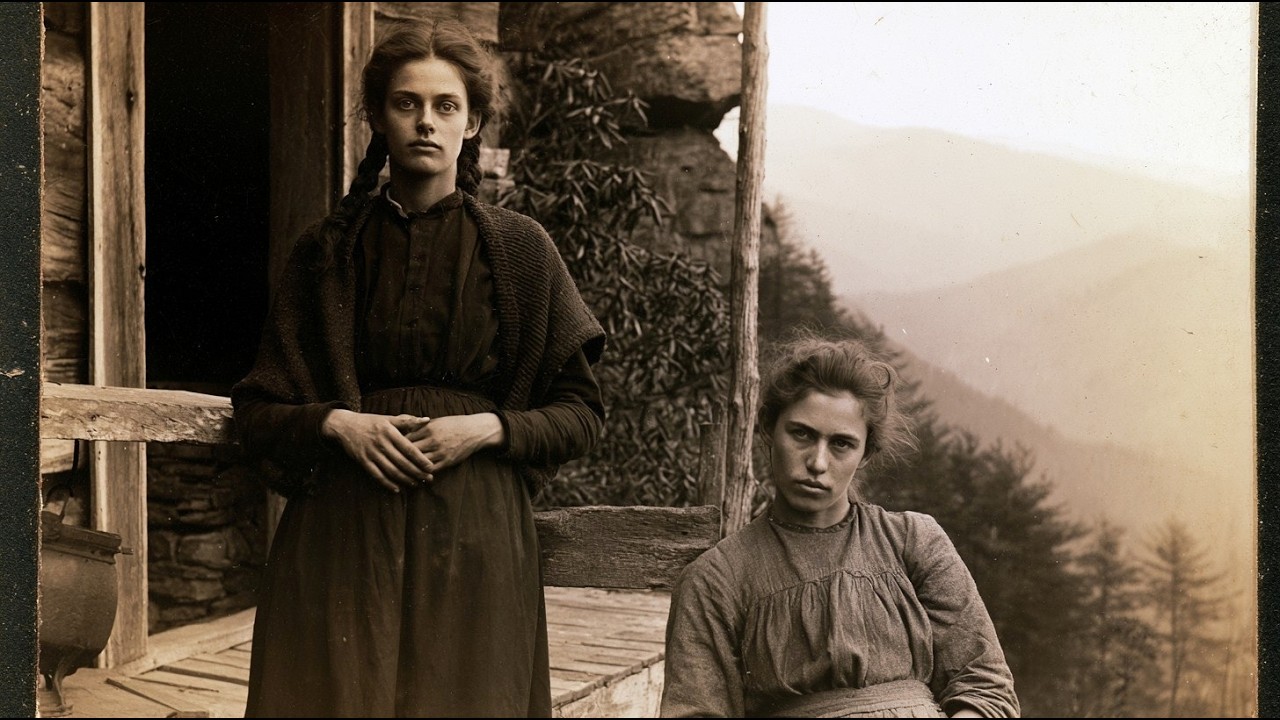
In Letcher County in 1897, no one locked a door, since there was nothing to lock it against. A shut door was a declaration, and this one had plainly been made. Redcliffe knocked. Nothing.
He knocked once more and called the names Mercy and Tabitha Otwell. From within came one single noise that Bledsoe would swear to for the rest of his days: a chair being hauled across a floor. No steps. No voice.
The sheriff knocked a third time and said he had not come to cause difficulty, only to inquire about reports he had received regarding their neighbors. The door swung open. Mercy Otwell filled the gap. She looked, Redcliffe would note afterward in his official report, like a woman who had gone a week without sleep.
Her hair hung loose. Her eyes were that same pale, cold gray he recalled from a funeral the year before. She did not meet his gaze. She stared past his shoulder, up the road, at something behind him.
Then she spoke, and he set her words down exactly: they had been expecting him, only not this soon. He asked where her sister was. Tabitha, she said, was resting. He asked whether he might speak with her.
No, Mercy said, and she was sorry for it. He asked what was the matter. She studied him for a long moment, then came out onto the porch and drew the door shut behind her. In a quiet, measured voice she told him that something had gotten in.
Redcliffe asked what she meant by that. She told him her family had kept to a certain way of doing things for a very long time. Her mother and her grandmother had known it. The ground above the spring house was never left unattended.
Her father, in the final year of his life, had come to see the care as superstition, and so he gave it up. He climbed the hill in November of 1889 to prove there was nothing to be afraid of. That was the reason he never returned. Since that month, she and Tabitha had kept the care with double the exactness their mother had taught them.
Their mother had passed in 1893, and after that the two of them kept it by themselves, and it held. The minister’s visit, she said, was not what had caused any of this. She wanted the sheriff to understand that. But the visit had been noticed.
Something had used it as a doorway. Something had trailed him back down the mountain. And after three weeks, it had returned. This time, she said, it had come with company.
Redcliffe did not laugh. He had served eleven years as sheriff of Letcher County, long enough to know that when a woman like Mercy Otwell speaks to you in a quiet, measured voice on her own porch, you do not laugh. He asked what she wanted him to do. She wanted him to go back down the mountain.
She wanted him to tell the widow Ora Threadegill to burn the sage she had been given, and to keep a lamp lit for the next three nights. She wanted him to tell Uriah Threadegill not to walk his upper line at dusk until mid-June. She wanted him to leave Minister Corrin be, and to tell him, if it could be managed without alarming him, to burn the notebook he had been writing in. She and Tabitha, she said, would see to the rest.
She said it the way a woman speaks of ordinary chores. Redcliffe said he could not simply walk away. If there was a problem, he was the man whose duty it was to solve it. Mercy Otwell looked at him then and said, very softly, that this was not his kind of problem, and that his help would only make matters worse.
His revolver, she said, was a bell. She had no time to explain what she meant, and she was sorry for that. And then she said the last thing she ever said to him on that porch: if he stepped into the cabin, he would see something he would carry with him for the rest of his life. She was not asking him the way a suspect asks a sheriff.
She was asking him the way a neighbor asks a neighbor not to come inside. He did not go in. Bledsoe wanted to. Bledsoe was twenty-nine years old and had something to prove.
Redcliffe, who had spent eleven years watching twenty-nine-year-olds try to prove themselves, laid a hand on his chest and spun him around. They walked back to the horses. They rode down. As they passed the widow Threadegill’s cabin, Redcliffe dismounted and knocked, and told her about the sage.
She went in without a word, came back out carrying the bundle in a pair of fire tongs, and dropped it into her stove. When they passed Uriah Threadegill’s yard, the sheriff called out the message. Uriah lifted a hand from his porch and did not rise. When they reached the sawmill at last light, Bledsoe reined in and said, in a voice Redcliffe had never heard from him before, that he had heard singing on the road behind them for the past mile.
The sheriff said he had heard it as well. Bledsoe asked what they meant to do about it. Redcliffe said to keep riding. The road fell silent after that, and stayed silent.
The account of what took place inside the Otwell cabin does not come from the sheriff, because the sheriff never set foot in it. It comes from two sources. The first is Mercy Otwell’s own telling, given three weeks later, seated at the kitchen table of the widow Ora Threadegill. The second is Minister Elphinstone Corrin’s notebook, which broke off mid-sentence on the ninth day and was never completed.
Mercy described twenty-two days of something dwelling in the house. Twenty-two mornings of waking in a cabin that was no longer wholly theirs. Twenty-two nights of hearing something settle into a chair behind a wall. She did not use the word haunted, not at first.
But when she finally did, Ora Threadegill wrote it down, struck it out, and wrote it again, because she wanted the account to be accurate. Mercy said the cabin was occupied, the way a country is occupied by a force that was not invited and cannot, at that moment, be removed. In the first week she tried the simple things her mother had left her. She washed the floor with vinegar and salt.
She turned every mirror in the house to face the wall. On the third night she buried a piece of iron beneath the threshold. None of it helped. On the fifth night she sat holding her mother’s old handkerchief, and for the only time in her life she asked her mother aloud what she should do.
She got no reply. What reached her instead was a noise from the kitchen, the very noise her mother’s shoes had always made on those boards. She did not need to look to know the kitchen stood empty. She did not move from where she was.
She returned the handkerchief to the drawer, and from that night forward she quit asking. Mercy did as her mother had instructed. She set a candle in each of the front room’s four corners and stayed with them until they guttered out. Night after night through that first week she did this with Tabitha, and nothing came of it, and she started to hope, warily, that she had been mistaken.
On the eighth night Tabitha roused her at about three in the morning and whispered that somebody was seated in their father’s chair. Mercy looked. The chair held no one. Yet it was moving back and forth, unhurriedly, in a room where no air stirred.
Mercy crossed to it and laid her hand on the armrest, and the motion ceased. The wood felt warm, she said, as though a man had only just risen from it. Tabitha started to weep, softly and without stopping, in a manner that did not resemble Tabitha at all. Mercy settled her sister back into bed and occupied the chair herself until morning.
It never rocked again. But close to dawn she felt a hand come to rest, very lightly, on her head, remain there, and then vanish. She did not raise her eyes. The following night the ladle traveled from its place on the kitchen shelf to the center of the floor.
The night after, every door in the cabin swung open together, front and back and both bedrooms, at precisely a quarter past four in the morning. Mercy went through the house and shut them. Tabitha trailed behind her. On the fourth night, Mercy woke to discover Tabitha out in the yard in her nightgown.
Tabitha had no idea how she had come to be there. A woman, she said, had urged her to step outside and look. She could not recall the woman’s face, but the voice had been one she knew. Mercy led her back in and secured the door with a wooden board her father had cut for that very purpose, untouched since 1889.
She kept watch in the front room the whole night with her father’s hunting rifle laid across her knees, not from any belief that the rifle would do good, but because grasping it let Tabitha, in the room beyond, believe all would be well. Ora Threadegill, giving testimony to the sheriff a month afterward, said Mercy recounted all of this to her in a calm, even voice, and shed no tears. At one point she apologized for consuming so much of Ora’s afternoon. Ora told her to hush and poured her another cup of tea.
Then Ora posed the question that counted. Up to that point Mercy’s telling had been day-by-day and exact. On the ninth day, Ora observed, something shifted. Mercy stared down into her cup for a long while and said, very softly, that on the ninth day the presence in the cabin quit pretending to be their father.
Ora Threadegill was sixty-eight years old and not a woman who frightened easily. That night she damped down her stove, barred her door, and sat by the window with a burning lamp until daybreak. She had known Sylvania Otwell. She had known Absalom.
She had cradled the infant Tabitha the day after the mother died and had never asked what took her, because in that valley nobody asked, and because she understood the answer would not be the name of any illness. For forty years Ora had spoken well of the family at the top of the hill and had never once considered fearing them. The family at the top of the hill, as Ora saw it, was the reason nothing had ever come undone. The Otwells were the wall.
And on the ninth day of whatever had gotten into the cabin, according to Mercy’s careful and fearless account, the wall was in trouble. Mercy told Ora what occurred on the tenth night. She was outdoors knocking ash from the stove when she saw the treetops along the ridge above the spring house bend, one after the next, in a slow procession descending toward the cabin. There was no wind.
She went inside. She barred the door. She woke Tabitha. She lit the four candles in the four corners.
She lit a fifth candle, the one her mother had said to light only in the worst case, and placed it at the center of the table. She and Tabitha sat facing each other, hands clasped across the table, and waited. Mercy would not tell all of what happened that night. She said the thing went around the cabin once, on the outside, and paused at each of the three windows.
At every window it produced a sound against the glass, like a fingernail dragged very slowly along it. Tabitha’s hand grew cold in hers. Mercy kept her eyes from the windows. The fifth candle died at the third window, and did not relight.
Mercy said this mattered. Then the circling ceased. After a long while, from up the hill, they heard a far-off, sorrowing cry. It was neither a scream nor a call.
It was the sort of cry a person makes when they grasp something they did not wish to grasp. Tabitha gripped her hand and whispered, in a voice she would afterward use with no one but Ora, that the cry had come in their father’s voice. Mercy gripped back. Neither spoke.
The candles burned down. Morning arrived, and the cabin belonged to them once more. That day Mercy saddled the old mule, set Tabitha on it, and walked her down the mountain herself. She left her sister weeping, softly and steadily, in the front room of the widow Ora Threadegill’s house.
Ora asked where she was headed. Mercy said she was going back. Ora asked when she would return down the mountain. Mercy said, in the wording the sheriff would later set down and underline without remark, that she would come down once the care was finished.
And should it not be finished, Ora was to keep Tabitha as her own for as long as Tabitha required keeping. A folded note lay in the drawer of the small table beside their mother’s chair, telling Tabitha where the little money was. Then Mercy walked out. She went back up the road.
That was the last time anyone saw Mercy Otwell alive in Weetbrock Hollow. That was the seventh of May, 1897. The sheriff came back on the ninth, with Bledsoe again. This time Bledsoe carried a rifle, which Redcliffe permitted, and afterward said permitting it had been a fool’s move.
The horses would not even make the flat place. They halted half a mile short, lathered and shaking as though they had been run, and the two men covered the last mile and a half on foot in the rain. When they came to the cabin, the door stood open. The front room was in perfect order.
Four candles occupied the four corners of the hearth, each burned down to a stub. The fifth, on the table, was gone entirely, and its wax had spilled past the table’s edge, hardening into a pale, even pool across the floorboards. The stove held no heat, though it had not been cold for long. Someone had used it within the last two days.
A kettle sat on the stove, and the kettle contained water, and the water was clear. Redcliffe moved through the cabin. Both beds had been made. Beside Mercy’s bed, on the small table, her Bible lay open at the ninetieth Psalm.
Tabitha’s copper hairbrush rested in her drawer. Their mother’s shawl was folded at the foot of the other bed. Nothing was missing. Nothing had been broken.
Bledsoe, a hunter all his life, stepped out the back door and climbed a hundred yards up the hill behind the cabin. Twenty minutes later he returned and stated, in words the sheriff wrote down without comment, that he had found the spring house standing open and empty. Behind it, in the woods, he had come upon a patch where the leaves lay turned face down in a circle roughly the width of a wagon wheel. At the center of the circle there was nothing.
The ground inside it had been swept clean. He was willing to head back whenever the sheriff was. They went back down. Two men on spent horses in the last light of a spring afternoon, the younger carrying a rifle he had not fired and now grasped that he never would, the older riding ahead without a word.
In his journal, which he kept until the end of his life and left to his wife, Bledsoe wrote that the ride down that day altered him in a manner he could not put into words. He wrote that he rode the narrow road knowing the world was wider than the county, and the county was wider than the courthouse, and that there were things in the woods above the sawmill for which the courthouse had no papers. He wrote that at the sawmill, when Silas Redcliffe reined in his horse and told him to keep riding, he grasped for the first time what a sheriff was for. A sheriff’s job, he wrote, was not mainly to arrest thieves.
It was to stand between the county’s people and the things they could not handle, and to make the small decisions in time, the decisions that spared the county from ever learning what those things were. He wrote that Silas Redcliffe made the right decision that day, and that he, Bledsoe, at twenty-nine, had lacked the courage to make it, and was glad the sheriff had ridden in front of him. Redcliffe filed a report. He wrote that the two women were missing.
He avoided the word vanished. He avoided the word abduction. In his own hand he wrote that Mercy and Tabitha Otwell, sisters of Weetbrock Hollow, had not been seen since the seventh and ninth of May respectively; that the search of the cabin turned up no sign of a struggle; that the cabin and outbuildings had been left in good condition; that the spring house was empty; and that the road above the sawmill had been closed, by his order, to traffic until its condition improved. That final line, odd as it looks at first, is the one the county held on to.
The road was never opened again. In 1922, when the state surveyed a new route linking farms to markets, a young engineer came to Letcher County to examine the pass. He met with the sheriff, a different man by then, Silas Redcliffe’s nephew, who had taken office in 1916. The engineer went home.
The road was rerouted. On present-day maps the Notch Road appears as a dotted line marked private. No private owner is on record. Ora Threadegill kept Tabitha in her home for the remainder of her life.
From the day her sister left her at Ora’s door, Tabitha did not speak, except once. She helped in the garden. She sat by the fire in the evenings. At times she sang, very softly, a tune Ora did not recognize and did not ask about.
She lived quietly in Ora’s spare room until Ora’s death in 1911, and afterward in that same room in the house of Ora’s niece, who took her in as family and asked nothing. Tabitha died in 1934 of an old woman’s cough, at sixty-five, in a bed turned to face the east because she had requested, in a written note, that it be turned. That note is the only writing she left behind in the thirty-seven years between the day her sister walked away from Ora’s door and the day she died. It read, in an old, precise hand: please turn the bed toward the east so I can see her when she comes down.
The single occasion she spoke during those thirty-seven years came in 1902. She was thirty-three. One morning Ora entered her room and found her sitting up in bed, awake, her eyes fixed on the window. Ora asked whether she was all right.
Without turning her head, in a steady voice as though she had spoken every day of her life, Tabitha answered that Mercy had finished her care. Ora asked what Mercy had done. Tabitha said Mercy had finished her care and was still up there, and did not want to come down, and that Ora should send no one up. Ora asked how she knew.
Tabitha said she had woken up knowing. That was all. She lay back down. She did not speak again for thirty-two years.
Minister Elphinstone Corrin departed Letcher County in June of 1897. He wrote to his friend in Cincinnati that he could no longer continue with a clear conscience. He gave no reason. He accepted a small parish in central Illinois and died there in 1914 of pneumonia, at fifty-eight.
His notebook, which ended at the ninth day, passed to a nephew, who handed it to a historical society in the 1940s. It is now held in a file in a Chicago archive. The last complete entry, from the eighth day, records that he had seen a woman at the head of the gap. He knew she was a woman.
He knew she was neither the older sister nor the younger. He knew she was watching him, and that she was smiling, and that she stood where no woman could stand, because the ground behind her did not exist. The mountain behind her simply stopped. Then the notebook ends.
The ninth day is one line: God help me. Then a blot. Then nothing. Silas Redcliffe remained sheriff of Letcher County until 1915.
He never discussed in public what took place at Weetbrock Hollow. In a private letter to his wife, written four years before he died, he said he thought about the Otwell porch at least once a week. He said that over the course of his life he had done many things he was proud of, and a few he was not, and that what he felt surest of was this: not going into the cabin when Mercy asked him not to was the finest decision of his career. He said he had no idea what Mercy was about to do that day, but that as he stood on the porch and looked at her face, he understood she was about to do something on behalf of all of them.
Not for his sake. Not for her sister’s. For the sake of the whole valley. And his task that day, he wrote, was to stay out of her way.
The road above the sawmill was never opened again. The cabin, so far as anyone can tell, is still there. Hunters in Letcher County claim they have gone up in deer season and seen it. Other hunters claim they have not.
Both may be telling the truth. Those who say they have seen it say it looks kept up. They say the paint on the front door is fresh. They say the porch has been swept.
They say the remains of four candles still sit on the four corners of the hearth, and a fifth still rests on the table, and the wax is still on the floor, a pale, smooth pool shaped like a palm. They also say, and these are the hunters who do not go back a second time, that the cabin’s back door, the one facing the spring house, is always open. And if you are quiet at the right hour and the wind is right, coming down off the hill, you can hear from somewhere above the spring house a low, steady humming. A tune nobody quite knows, but everybody thinks they have heard before.
An old hunter by the name of Raven Coulter, in the 1940s, sitting in the sawmill store with enough drink in him to loosen his tongue, said he heard the humming and knew, without knowing how, that Mercy Otwell had been humming it since the seventh of May, 1897, and would go on humming it at the head of that gap until the thing she had gone up to meet grew tired of being held. He said he did not believe it would tire. He said he believed Mercy had agreed to that, in her own quiet, careful way. Asked why she would do such a thing, he said that a woman who has tended something her whole life knows it better than anyone else.
And when the tending gets hard, the one who tends well is the one who knows the price of letting go. Mercy Otwell, he said, understood on the seventh of May what the letting go would cost the whole valley. And she, a woman who had spent her life making tea for the dying, had set the price. The county buried Tabitha Otwell in 1934, in the church cemetery below the hollow.
The minister, Dewitt Marshbanks, wrote her name in the register. He wrote it in ink, and he did not tear the page. At the graveside, in a sermon recorded in the church minutes for that Sunday, he said that a woman who had waited thirty-two years for her sister to come down from the mountain had earned a place in the record, and that whatever names had been struck from the previous minister’s register in the 1890s, he did not intend to know or to correct, but Tabitha Otwell’s name would be written in his book and would stay there. There is a small, plain stone in the churchyard.
It reads: Tabitha Otwell, 1869 to 1934, sister. That is all. No mother. No father.
Only sister. The county records go quiet after 1955, the last recorded incident, when a deputy stopped a car full of hunters trying to walk the closed road. He found them badly shaken and asked that they be brought to the county seat and interviewed there instead of on the road, which he said he did not personally care to remain on any longer than necessary. That interview never happened, as far as anyone knows.
The deputy drove them down. He filed a brief report. He requested a transfer to another county the following week, and the request was granted. The hunters gave three separate accounts of what they had seen on the closed road.
None of the accounts matched. One said he saw a woman walking. One said he saw a light in the window of a cabin where there was no cabin. The third said nothing at all, refused to confirm or deny anything, and repeated only that the road above the sawmill was of a strange nature, that he could not describe that nature in greater detail, and that he wished to go home.
That last man, Elwood Cassinberry, forty-eight, left Letcher County that same month and never came back. He was, according to the records, the last person to attempt the Notch Road. The road does not appear on any county map printed after 1962. The land it crosses is listed in the state assessor’s office as unbuildable.
There is a note in the margin of the assessor’s book, in an old hand nobody has bothered to identify, which reads plainly: no survey. That note has been copied, word for word, into every edition of the book since 1922, and nobody in the county offices can say who first wrote it. Ora Threadegill wrote, in the last page of her small journal, which she kept and left to her niece, that she had come to believe there were two kinds of people in the world. There were those who tended things, and there were those who benefited from the tending.
She wrote that most of us live our lives as the second kind without knowing it, and die grateful for a quiet valley, never asking once who stands above us in the dark, keeping watch. That journal is still in the family. The page is not torn.
