The decision reached the Erie Railroad’s board in the summer of 1906, and it was not the kind of recommendation that could be approved without argument. The engineering department had surveyed a crossing on the main line through Orange County, New York, about five miles west of the Hudson River town of Cornwall, where the tracks passed over Moodna Creek Valley on a structure that had become a chronic problem. The crossing was an iron truss bridge set on timber trestle bents, originally built in the 1870s and partially rebuilt since. The engineers had measured it, studied its condition, and read the maintenance records with the precision of men who had calculated exactly what it cost the Erie to keep it running each year.
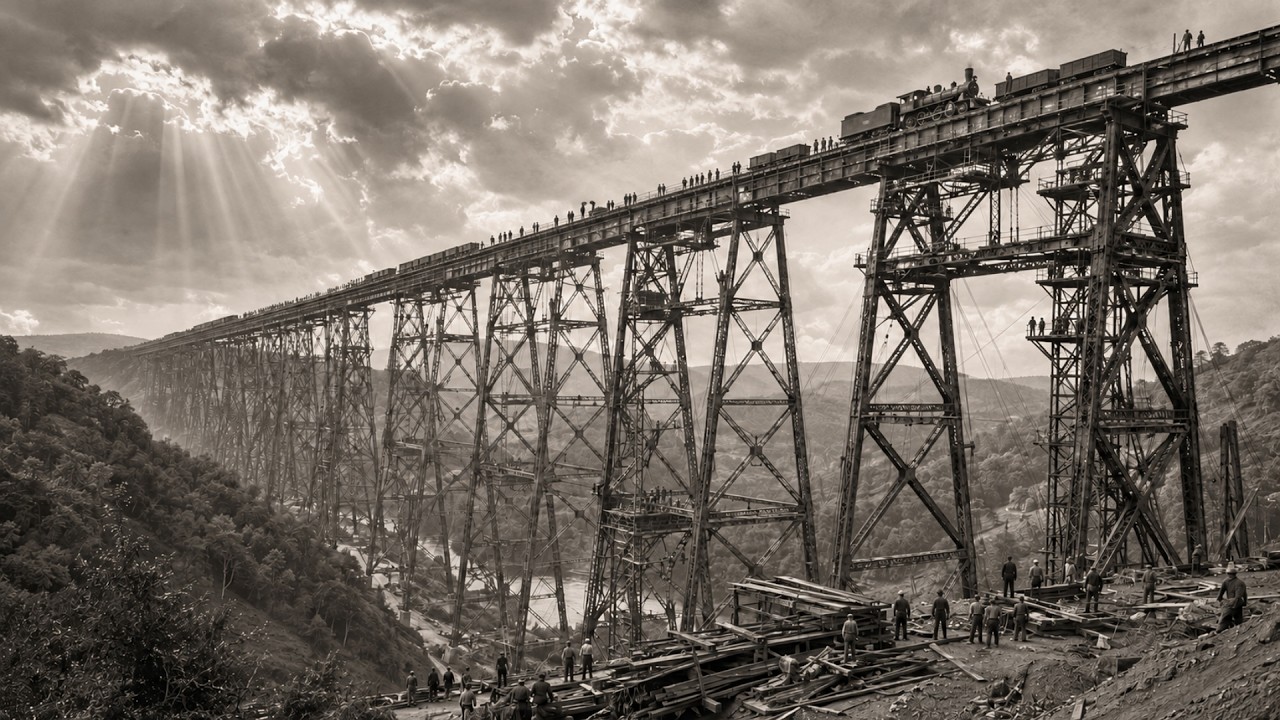
That cost was higher than any comparable crossing in the division. The iron was corroding. The wooden bents, rotting in the valley’s dampness, had to be replaced annually. And the load rating of the structure was far below what the Erie’s freight locomotive roster demanded in 1906.
That last fact was what turned the bridge from a maintenance problem into a construction project. A load rating below operating needs meant that every heavy freight train had to observe restrictions while crossing: slow down, break the train into sections, use procedures that stretched the time it took to get over the valley. On a railroad, time was money, in a direct and calculable way. Every minute lost to slow running at Moodna was a minute that freight was not moving at full speed toward its destination.
Multiplied across every freight train that crossed in a year, these minutes appeared year after year as a line item in the division’s operating reports, a specific, identified cost. And the Erie Railroad of 1906 was a company that could not afford to ignore identified costs. It had spent most of the previous thirty years in financial trouble. Receivership in 1875, receivership again in 1893, and a reorganization in the late 1890s that made the company solvent on paper but left it unable to live comfortably within its own income.
The Erie’s main line ran from Jersey City to Chicago, a competitive route through one of the most productive industrial regions in the country. Every dollar wasted on infrastructure inefficiency was a dollar the Erie could not spend competing with the New York Central and the Pennsylvania for the freight moving through that corridor. When the engineering department finished its survey and submitted its recommendation to the board, the recommendation was to rebuild the crossing in reinforced concrete. In 1906 that recommendation required proof, because reinforced concrete was still new as a material for large railroad bridges, and its long-term performance had not yet been demonstrated by decades of service.
What it had was a short-term record, and that record was positive. Concrete arch bridges built in the United States in the late 1890s and early 1900s had survived without the maintenance burden of iron and timber. They did not rust. They did not rot.
With the right mix and design, concrete grew stronger with age instead of weaker. The arch shape was naturally efficient under compression, and a railroad bridge was exactly that kind of load. By 1906 the cost of concrete construction was falling relative to other materials, because American cement production had grown with the industrial expansion of the previous decade. The Erie’s engineers made this case.
The board approved the project. What was authorized was a structure spanning the full width of the Moodna Valley, roughly 3,200 feet. Fourteen reinforced concrete arch spans rose to a maximum height of 193 feet above the valley floor, the span lengths proportioned to the profile of the ground below. At the center of the crossing, where the valley was widest and the piers tallest, the arches were longest; toward the abutments at either end, the valley walls rose and the piers shortened.
The whole structure curved slightly to follow the alignment of the Erie’s main line. To put the height in perspective, 193 feet is taller than an eighteen-story building. The tallest pier at Moodna, photographed from the floor of the valley, does not look like an ordinary railroad bridge pier. It looks like the foundation of a dam.
A freight train passing over it rides nearly 200 feet above the ground. The engineer in charge was the Erie’s chief bridge engineer, working within the company’s engineering department. In that era, the practice of railroad bridge design kept authority in the hands of the railroad’s own office rather than an independent consultant, and his name appears in the Railway Age reports on the project. His calculations survive in the Erie’s internal correspondence from the construction period.
The men who built the structure he calculated are traceable only through payment ledgers and the accident register. I have found them nowhere else. What I know about those men begins with where they came from. By 1906, the Italian immigrant community in the Hudson Valley was substantial and had been growing since the 1880s.
Italian laborers had come north from New York City along the river towns at the turn of the century, following railroad construction and masonry work. Settlements of Italian immigrants had formed in Newburgh, Middletown, Port Jervis, and other Orange County towns through railroad grading, tunnel work, and stone quarrying in the 1890s. The Hudson Valley held some of the largest natural cement deposits in the country, and the mills at Rosendale, Kingston, and Ulster that processed that rock employed several thousand workers by the early 1900s, a notable share of them Italian. Many of the men who built the Moodna Viaduct lived within twenty miles of the work site.
Others came up the Erie’s main line through labor agents in New York City. Wages on the job were strictly graded by skill. A common laborer earned $1. 50 to $1.
75 a day. A skilled formwork carpenter, the man who could build the precise timber falsework that shaped a concrete arch, made $2. 50 to $3. 00 a day.
A shift foreman in charge of a pour crew earned $3. 25 to $3. 75. The spread existed because each level of work demanded something different.
Common labor required a body that could carry weight and hold an eight-hour shift in uncomfortable, dangerous conditions at height. Skilled carpentry required the ability to read engineering drawings and translate them into cut timber at exact angles and dimensions. Foremanship required coordinating both and holding a work schedule under adverse conditions. The difference between laborer and skilled carpenter was about sixty percent.
The difference between laborer and foreman was roughly double. The Erie applied the same logic engineers had used for this scale of concrete work and was willing to pay the difference because in concrete of this size, a badly built arch or a mismanaged pour did not merely slow the work. It created a flawed structural member that would carry rail loads for the next century. The engineers were paying for exactness.
They were getting it. Before a single yard of concrete could be poured for the Moodna arches, a different kind of structure had to rise inside the valley. It was called falsework, or centering. It was a timber scaffold from the valley floor up to the underside of each planned arch, following the curve of the arch exactly, designed to carry the entire weight of the wet concrete.
Falsework of this scale was not a minor item. It was the first major construction phase of the project, and in some ways the most technically demanding, because the geometry of the falsework determined the geometry of the finished arch. A concrete arch does not forgive geometric error. The load-bearing thrust lines from the deck through the arch to the abutments are calculated for a specific arch shape.
A shape that deviates beyond acceptable tolerance carries load differently and, in some cases, badly. The Moodna falsework carpenters were working to tolerances of fractions of an inch over spans hundreds of feet long, at heights up to 193 feet above the valley floor at the central crossing. The falsework rose from timber foundation pads set in the valley floor, through bents and frames built on timber piles, climbing higher toward the center of the valley until its top reached the level of the planned arch soffit. A man working at its summit stood nearly 200 feet above the ground.
There were no safety nets. There were no harnesses or safety belts. A fall from the upper falsework at Moodna was death. The accident records show that falls happened.
The concrete arrived by rail. The Erie main line ran directly past the construction site, which was a logistical advantage of building a railroad viaduct on a railroad. Cement from the Rosendale and Kingston mills came south in Erie freight cars, was unloaded into the mixing operation at the site. For the pours before 1907, the mix was done largely by hand in batch boxes, a laborious process in which men shoveled cement, aggregate, and water together into a uniform mixture.
For later pours, mechanical mixers were set up on the approach grade where Erie freight cars could be spotted to unload directly into the mixer hopper. A single Moodna arch could not be poured in pieces over time. Concrete takes its final structural form as it cures, and a cold joint — the point where new wet concrete meets old cured concrete — is a structural weakness unacceptable in a primary arch member carrying rail loads for the next century. The Moodna pours ran until they were finished.
That meant if daylight was not enough, the work went on at night. On a site with no electric supply in 1907, night work meant carbide lamps mounted on the falsework frames and open torches set around the work area. Men stood 150 feet up, leveling and compacting concrete by lamplight. The turning seasons imposed another constraint.
Construction beginning in the spring of 1907 stretched inevitably into autumn, and autumn in the Hudson Valley brought temperatures below what natural cement concrete needed to cure. Natural cement, the local material of the Hudson Valley, gained strength more slowly than the Portland cement that was taking over the American construction industry, and it was far more sensitive to cold while setting. If a pour froze before gaining adequate strength, the concrete would be structurally defective, possibly invisible from the outside, but revealing itself over decades of load. The Erie’s engineers mandated protection for late-season pours.
The procedure was to cover the concrete surface with straw and burlap within hours of pouring, hold it in place with weights overnight, and watch it. Men carried straw bales up the falsework on their shoulders to the arch structure, and while the concrete was still warm from the hydration process, they laid the straw and weighted it down. It was hard work on high falsework in dark October nights, for a wage of $1. 50, which is what the work paid.
The Erie’s construction accident register for the Moodna Viaduct, preserved in the corporate records, documents the deaths and serious injuries of the 1907 and 1908 construction period. The entries use the institutional language of railroad construction management of the time — specific about lost work days, less clear about lost lives. A falsework collapse in the eastern arch section in late summer 1907 is recorded only as a scheduling delay and a loss of material. The entry notes how many men were involved.
It gives the names of several workers. Most of the names in the construction casualty list are Italian. Three of them I can give you, because the accident register is not just statistics. Giacomo Ferraro, age 31, from the province of Avellino, listed as a concrete finisher on the eastern arch section from April 1907.
His name appears regularly in the weekly payroll ledger until the project ended. The accident register notes a serious hand injury during a pour on the eastern section in July 1907. Three weeks later he was back on the payroll. After the project finished in November 1908, his name disappears.
I have found no trace of him anywhere else. Emilio Rossi, age 24, from the province of Treviso, listed as a common construction laborer. The register lists him in connection with the falsework collapse on the eastern section in August 1907. The entry describes his injury as serious.
His name does not appear in the payroll records after that date. The register does not say where he was taken or whether he recovered. Pietro Marcone, age 38, from the province of Cosenza, listed as a shift foreman on the western arch section from June 1907. His name appears in the weekly payroll as foreman at $3.
25 a day from that month through October 1908. His signature appears as certifying foreman on three daily pour records for the western arch. It is a careful signature, the hand of a man who learned to write in Italian and was writing English with deliberate attention to every letter. His name is in the construction records.
It is not in any engineering journal. These three men came from the north and the south of Italy. They worked in the same valley, on the same structure, in the same years. The structure is still there.
No plaque bears their names. There is no plaque at all. The Moodna Viaduct was opened in 1908. As each span’s concrete gained enough strength to carry its own weight and the loads above it, the falsework was removed arch by arch.
Removal required a controlled procedure. The timber falsework was lowered in stages using screw jacks, so that each arch took up its load gradually rather than suddenly. If the concrete had not actually reached its design strength, the arch would reveal it — sometimes audibly. The men working the jacks listened to the sounds of the concrete as the load transferred.
They knew what a new arch should sound like. None of the Moodna arches failed under the falsework removal. In late 1908, the first Erie freight train crossed the complete viaduct. The old iron truss bridge, with its load restrictions and its thirty years of annual appearance in the divisional operating reports as a cost item, was dismantled.
The Moodna crossing became a structure that, by the nature of its material, did not require the yearly maintenance of the bridge it replaced. The Erie publicized the completion in the engineering press. Railway Age covered it. Concrete construction journals covered it too.
The engineering magazines gave credit to the engineers, in the way engineering magazines do. As a record of engineering decisions, that is correct. The Italian laborers who poured the concrete are not named in those journals. The carpenters who built falsework 193 feet above the valley floor to fractions of an inch are not named in those journals.
The men who spent October night shifts laying straw over fresh concrete so the chemistry would finish properly are not named in those journals. The men who worked the jacks and listened for cracks in the new arches are not named in those journals. The Erie Railroad merged with the Delaware, Lackawanna and Western to form the Erie Lackawanna in 1960. The Erie Lackawanna went bankrupt in 1972 and was folded into Conrail in 1976.
Conrail was broken up in 1999. The former Erie main line through Orange County passed to Norfolk Southern. Today the Moodna Viaduct carries Norfolk Southern freight trains across the same valley, on the same concrete arches poured in 1907 and 1908. The concrete structure has outlasted four corporate owners.
It has outlasted every other bridge on the Erie main line from that construction generation. Standing at the edge of the Moodna Valley, looking at the viaduct, I see more than the geometry. Fourteen arches crossing the valley. The piers rising from the valley floor.
The deck above. It is an ordered structure, and it is so vast that photographs do not convey it, because there is nothing next to it in the valley to give scale until a train crosses and the train looks small against the mass of concrete. When I think of those October night shifts, men standing on the falsework in the dark laying straw over fresh concrete for $1. 50 a day, because that is what the work paid and they needed the money — that is the full explanation of their presence.
It is also the full explanation of why the arches were made properly and why the viaduct still carries freight trains in the twenty-first century. The foremen’s names can be partially recovered. The common laborers under them survive only as daily entries and multiples of wages. The arches they poured are still in service, without interruption.
The train crosses the valley. The concrete does not move. That is the work I came to tell you about.
