The smoke reached the child first. That was how it always went, the way the old ones told it—children coughed before the adults understood what the coughing meant. Inside the cave, the air thickened with the sting of burning sage and reed, and a woman pressed an infant against her chest, fingers shaking as she fumbled with the wet fiber cord that held the child to her. Outside, beyond the orange wall of flame licking up the rock at the cave mouth, men moved in the dark, feeding the fire, waiting.
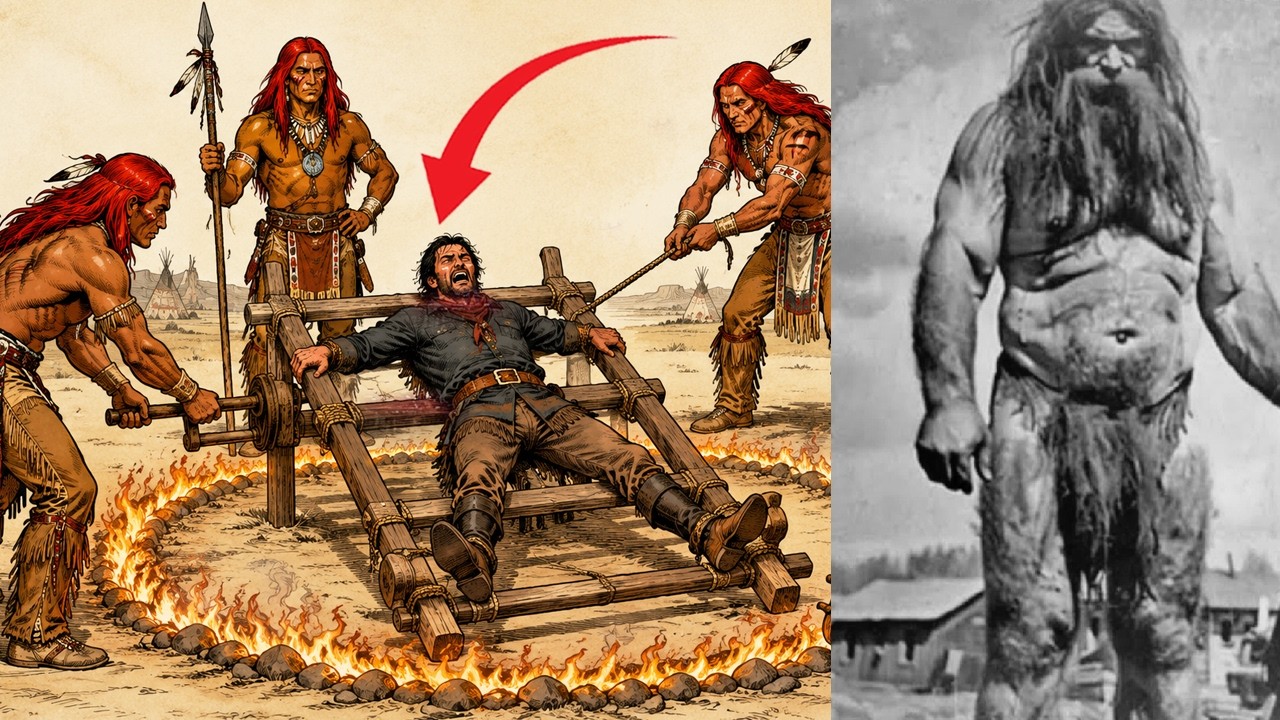
They had come to make sure no one walked out of this place alive. The people sealed inside that cave were the last of the Si-Te-Cah, the Two-Leaders, a people other tribes would remember for centuries as monsters. In the stories told around winter fires, they had red hair, they ate their captives, and they were giants. Every version of that story ends the same way: on one long night, a whole people erased.
Not scattered, not driven out, not beaten in the way wars are usually won. Erased. Every man, woman, and child who had ever answered to that name gone by sunrise, sealed inside a rock shelter no wider than a modern living room by a burning wall of brush that turned the air itself into a weapon. But the first question nobody asks properly is what the Paiute actually meant by “red hair.
” The woman who first put the story on paper, in the year 1883, never says red hair. She never says giants. Those words come later, from other mouths, in other rooms, with very different motives. And the second question follows close behind: if a race of eight-foot red-haired cannibals really did roam the Great Basin, and if the Paiute really did wipe them out in a single cave, then where are the bones?
More than a hundred years of archaeology at that cave has produced thousands of artifacts—duck decoys woven from reeds, human graves, and one stubborn problem the myth-makers cannot explain away. Not a single skeleton over six feet has ever been found. Long before the miners came, before the archaeologists came, before the word Nevada existed, an old Paiute woman sat with a young girl named Thocmetony, “Shell Flower,” the name her family used before the world learned to call her Sarah Winnemucca. The old woman told the girl a story about a cruel people who had once made the Paiute afraid.
She did not describe towering monsters. She described a tribe, a neighbor, an enemy, a people who lived and fought and bled just as the Paiute did. The Si-Te-Cah were, in Paiute memory, a real people—not monsters, not a separate race. They lived in the marshy flats around the shallow lakes where tall green reeds grew thick enough to hide a canoe and conceal a moving family.
They ate what the water gave them: fish, ducks, waterfowl, the starchy roots of the reeds themselves. They had mothers who wove baskets with patterns unique to their families. They had children who learned to swim before they learned to run. And they had a habit the Paiute could not forgive—killing captives and eating them.
That habit turned a neighbor into a nightmare. The Great Basin was not the West of green valleys and easy rivers. It was a country where the lakes shrank and vanished in a dry year, where the reed beds were life itself, and where the difference between a tribe that ate and a tribe that starved could be a single wetland. When two peoples want the same marsh, sooner or later someone bleeds for it.
The Northern Paiute were not a single army. They were bands, extended families moving through territory older than any written history, hunting rabbit and antelope, gathering pine nuts high in the mountains in the fall. They were not warlike by inclination. In their own oral traditions, they had to be pushed.
And the Si-Te-Cah, if the stories are true, pushed them again and again, taking what they wanted and leaving the Paiute to bury their dead. In a time no calendar records, in a season no chronicle preserves, the bands began to talk to one another about the Two-Leaders—about what would have to be done, about how a people could be stopped before they took everything. Everything that is known about the Si-Te-Cah passes through one book written by one woman in one specific year: 1883, *Life Among the Paiutes: Their Wrongs and Claims*. Sarah Winnemucca Hopkins was thirty-nine when she published it.
Born around 1844, the daughter of a Northern Paiute leader, Chief Winnemucca himself, she had grown up watching her world break apart under the boots of miners, soldiers, and settlers who did not know her language and did not care to learn it. She learned English, learned to write it well. She worked as an interpreter for the same United States Army that in other years had killed her people. She lectured in the parlors of Boston to horrified white audiences about what was being done in the deserts they had never seen.
And in the middle of that memoir—the first extended book written in English by a Native American woman—she stopped and told an older story, a story her elders had told her, a story about a cave. The elders who gave her that story are nameless now, but they were people who had grown up in the Humboldt Sink country, people who had walked the ledges above the dry lake bed and pointed and said, “There, that is the cave. ” They knew the exact rock formation where the story ended. Picture the place: not the Nevada of neon signs and highway exits, but the old Nevada, a dry lake bed that once held a shallow inland sea ringed by pale hills.
In the side of one of those hills, a wound in the rock, a shelter opening east above the sink, reachable only by a hard climb up loose talus. The Humboldt Sink. The cave now called Lovelock. In its opening, a person can stand upright; deeper in, the ceiling comes down and the air changes.
The Si-Te-Cah, if the Paiute account is literal, had made this cave a refuge. The Paiute knew it, had known it for years. In a country where a defensible cave above a dry sink is a rare and precious thing, they knew what it meant that their enemy had fallen back to it. It meant the Two-Leaders were finished on open ground.
It meant they were making a last stand. Inside Winnemucca’s book there is a scene she does not narrate as a scene, but which is there in outline. The bands have come together—not one Paiute leader, but several, from several territories. They have gathered on the flats below the sink, talking about what to do next.
They have been fighting the Si-Te-Cah for years. They have buried too many of their own, and they know where the last of the enemy has gone. The weight of the dead presses them toward a decision they cannot take back. To leave the Two-Leaders in that cave is to let them come out again next summer, next winter, next year, and take more children.
To attack the cave head-on, up that talus slope into a defended mouth, is to lose more warriors than the tribes can afford. There is a third option, an older one, one the Paiute do not describe with any pride. You do not go in after them. You seal the mouth.
You bring brush and reeds and dry sage from the flats below. You pile it, and you set it burning. The smoke does the rest. Whether the choice was made by one man or by a council, in a night or a week, will never be known.
But in Winnemucca’s careful English sentences, the decision survives in a single line: “Our people together with other tribes fought them a long time and at last drove them into a cave and killed them all. ” She writes it plainly, the way you write a hard truth you do not want to decorate. She does not call it justice. She does not call it a massacre.
She calls it what her elders called it: a long time, and at last. A Paiute woman in 1883, publishing a book to defend her people from extermination by white settlers, quietly records that her own people once exterminated another tribe in a cave. She is not writing propaganda, not writing a monster story. She is writing history the way her elders taught her, with the ugly parts still inside.
The coalition that formed against the Si-Te-Cah was, in Paiute memory, unusual. It required bands to set aside their own quarrels, a shared understanding of a shared threat. In a culture where each family group was its own political unit, that kind of unity was not casually given. Their weapons were not rifles.
There were bows of juniper and sinew, arrows tipped with obsidian chipped from mountains a hundred miles away, clubs of hardwood, spears. And above all, fire—the most devastating weapon a people without gunpowder can wield against an enemy in a hole. The war did not begin with the cave. It began with the raids.
The Si-Te-Cah did not simply take food; they took people. They struck Paiute camps in the pre-dawn hour when the fires had burned down and the guards were tired, and they carried captives back into the reed country. What happened to those captives is where the story turns dark. In the version the Paiute preserved, the captives did not come home.
They were killed, and the elders said they were eaten. Whether the cannibalism was literal—whether the Si-Te-Cah systematically consumed human flesh as part of their food economy—or whether it is what one hungry people accuses another hungry people of when the wetlands run dry, is a question that cannot be settled. What matters for the story is that the Paiute believed it, and fear fed on fear until it became something larger than the truth. The Humboldt Sink is a closed basin.
Water flows in, water does not flow out. When the lakes shrink, the reed beds shrink with them, and every duck and every fish and every starchy root becomes a resource worth killing for. This was not a war over pride. This was a war over calories.
The first time a Paiute leader went to another band’s chief and said, “We cannot fight these people alone,” that was the beginning of the end for the Si-Te-Cah. His name is lost. In Great Basin culture, coalitions did not form easily; each band controlled its own territory, its own water, its own pine nut groves. To ask one band to leave its country and fight a war on someone else’s marsh required a debt, a marriage, or a shared fear.
In the case of the Si-Te-Cah, the elders remembered it was fear—the kind of fear a mother feels when her child does not come back from the reeds. The raids and counter-raids, the years of loss, the slow building of the alliance may have taken decades, even generations. The oral tradition telescopes it into a single narrative arc. What follows—the final act—is not the whole war.
It is only the last days of it. The Paiute did not attack the cave first. They attacked the marshes. They burned the reed beds.
They killed the men they found in the open. They pressed the Si-Te-Cah band by band, family by family, toward the one place their enemy still believed was safe: the ledge above the sink, the mouth in the cliff. From the Si-Te-Cah side, the picture was clear. The marsh was on fire.
Relatives were dead in the shallows. The Paiute held every high ground in sight. And someone—an uncle, a father, a chief—pointed at the cliff and said, “There. If we make it there, we can hold it.
There is water in a pool below. There is one path up. If we sit inside, they cannot come in without dying. ” They ran.
They climbed the talus with children on their backs. Some accounts remembered by Paiute elders suggest hundreds made the climb; others suggest a smaller band, a last remnant. It will never be known. They got inside, sat down in the cool dark, and for a moment thought they might live.
Down on the flats, the coalition worked. They cut brush, cut sage, gathered armfuls of the same reeds their enemy was named for—the reed-eaters buried under the very plant that had fed them—and carried it load by load up the slope to the mouth of the cave. It would have taken hours, quiet, methodical work. Winnemucca’s elders later said of what happened next that the tribes piled brush at the entrance and set it on fire.
That is the entire military description she preserves. Nine words. A whole people ended in nine words. The Si-Te-Cah inside could hear it all: dry brush dragged over stone, men speaking low in a language most of them understood, flint striking iron.
Then the first crackle. Then the light. Dry sage catches fast; dry reeds faster. Within moments the pile at the cave mouth was a wall of flame six feet high, then eight, then higher, licking up the black rock, curling smoke into the cave in long gray ropes that rolled along the ceiling before they came down to breathe with.
The men inside charged the mouth—it is the only thing a warrior does when a wall of fire appears between him and daylight. Some made it into the flame. Some made it through. And everyone who came through met an arrow.
The Paiute had arranged themselves in a half circle around the base of the slope, close enough to see any figure that broke through the burning wall, far enough back to be out of the worst of the heat. Their bows were already drawn. Any Si-Te-Cah warrior who came out came out silhouetted, blinded, on fire himself, into a rain of obsidian points. None of them broke through.
Not one. In the accounts the Paiute preserved, every attempt was cut down before it reached level ground. The only sounds from the slope were the roar of the fire and the silence of the fallen. Inside, the survivors did the only thing survivors ever do.
They retreated deeper, away from the mouth, away from the light, into the low ceilings at the back of the shelter, where the air was cooler and, for a few more minutes, cleaner. They crawled into the dark, hoping the smoke would not follow. But smoke does not respect the back of a cave. It rises to the ceiling, and the ceiling at Lovelock slopes downward as you move inward.
The further back they crawled, the lower the ceiling got, the sooner the smoke reached their faces. The people who ran deepest died first. The refuge became a tomb. Children were among them.
The Si-Te-Cah in that cave were not an army; they were a population. Old people, nursing mothers, boys not yet old enough to draw a bow. The Paiute knew it. The elders who later told Winnemucca the story knew it.
Winnemucca, who wrote it down, knew it. That is why she did not decorate the sentence. Every siege has a moment when the people inside understand that no one is coming. The Si-Te-Cah had that moment, probably within the first hour.
There were no other Two-Leader bands left in the country. There was no relief. There was no escape route through the back of the cave, because this place has no back. It is a pocket in the cliff.
Once the mouth is closed, the pocket is a tomb. Outside, the Paiute fed the fire. They had gathered enough brush to feed it for hours. They did not need to storm the cave.
They did not need to lose a single more warrior. They needed only to wait, to keep the wall of flame burning, and to shoot anyone who tried to come through it. The strategy was patience, and patience was merciless. Inside, the sound of it was worse than the smoke.
The roar of a large brush fire in an enclosed space is not a crackle; it is a low, sustained roar punctuated by pops as pockets of moisture in the reeds explode. Underneath that roar, in the last minutes, the sound of children crying. And then the sound of children not crying. The silence that settles over a cave when the breathing stops.
Hold that thought against everything ever said about giants. In 1911, when the first miners walked into this cave and began digging out bat guano to sell as fertilizer, they did not find a mass grave. They did not find piles of eight-foot skeletons. They found a scatter of remains, roughly eight documented burials in total, spread across the layers, every measurable one of them a normal-sized human being.
If the extermination happened the way the Paiute remembered it, most of the bodies simply became part of the floor—dust under dust, silence under silence. The giant myth lets us look away from the actual event, the actual people, the actual suffocation of an actual family group in an actual cave. By turning them into monsters, we do not have to grieve. The horror of Lovelock Cave is not that the victims were giants.
The horror is that they were not. They were families, and they died in the dark. Outside, the fire began to lower on its own. The pile burned down.
The Paiute did not need to rebuild it. There was no sound coming from inside anymore. The work was done, and the silence was absolute. Nobody in the coalition, as far as is known, went into the cave that night.
You do not walk into a place full of smoke and death in the dark. You wait for the morning, for the sun to show you what you have done and what you have paid for. The morning came the way mornings come in the high desert: cold, pale, a slow bloom of pink over the sink. The fire at the mouth was a bed of gray ash and a few red embers.
The rock above the entrance was scorched black. The air smelled of burnt reeds and something else—the smell of a place that was never meant to be opened again. Someone climbed up first. No name is given.
No lone warrior emerges from this story as a hero. That too is telling. This was not a story the Paiute told for glory; it was a story told for warning, a reminder of what happens when the reeds run dry and the patience of a people finally breaks. Historians have argued for a hundred years: did every last Si-Te-Cah die in that cave, or did some slip out before the fire, join other bands, marry into other tribes, and vanish into the Great Basin as ordinary people whose grandchildren would never say the old name aloud?
The Paiute story insists on total extermination. The archaeology cannot confirm it. What can be said is that after this event, whenever it was, the Si-Te-Cah as a distinct people are not mentioned again in any story that survived. They vanish from the ethnographic record.
Their reed baskets rot. Their duck decoys sink into the mud. The marshes they once fought over pass, without argument, to the Paiute. The land forgets the names of the people who bled for it.
Inside the cave, the bodies lay where they fell: nearest the mouth, the warriors who had charged out and been driven back; deeper, the women and children who had crawled toward the ceiling and found the smoke waiting. The Paiute did not bury the dead. Lovelock Cave was not turned into a graveyard with ceremony. The bodies were left inside.
Perhaps a few possessions were taken—the reed sandals, the fiber cordage, the beautifully woven duck decoys the Si-Te-Cah had used to hunt waterfowl. Some of it stayed; some did not. The living took what they needed and left the rest to the dark. The coalition went home, unbraiding itself back into family groups and territories.
The war was over. It had ended, as many wars end, not with a treaty but with a silence—a silence that would hold for centuries, until the world changed and the story was taken from them. For literal centuries, no one went into that cave. Bats moved in.
Guano piled up in slow black layers, meters deep, covering the reed sandals and the fiber cordage. The cliff eroded, the lake dried, the sink turned to a bed of salt and dust. The story in the villages thinned, became something the elders told the young in winter when it was safe to talk about hard things, a warning wrapped in memory. By the time an old Paiute woman told it to her granddaughter Thocmetony, the details were already worn smooth.
No names. No years. Just the shape of the thing: a cruel people, a long war, a cave, a fire, and a silence afterward that had held so long no one alive remembered when it had started. Then one afternoon in 1911, two men named David Pew and James Hart walked into that cave with shovels, looking to make money on bat guano.
They had bought the mineral rights and came to shovel the guano out and sell it to California farmers as fertilizer. They were businessmen in a hard country, and they saw nothing but opportunity in the dark. Three feet down through the black guano layer, they hit something that was not fertilizer: a reed sandal, then a fiber net, then a piece of basketry so fine it looked like it had been made yesterday. Then, in one of the pockets of the cave, bones.
Human bones. The eight documented graves were hidden under centuries of bat droppings, preserved by the dry alkaline air. Pew and Hart were not archaeologists; they were miners in a hurry. They threw the strange objects onto piles outside the cave and kept shoveling.
And they talked—to the general store in Lovelock, to visitors—telling stories about what they had found. In the retelling, as bones always do in retelling, the bones grew. A normal femur became a giant’s thigh bone. A tall man became a monster.
Word reached the University of California, Berkeley, in 1912. A young archaeologist named Llewellyn Loud, born in 1879, trained in the measurement-obsessed style of early twentieth-century American anthropology, arrived at the cave and began doing what the miners had not: he measured, he recorded, he drew maps of where things came from in the layers. He was joined in the 1920s by Mark Harrington. Together they published a monograph simply called *Lovelock Cave*, which became the foundation of everything scientific known about the site.
The 1929 report catalogued thousands of artifacts: the famous duck decoys, cattail reeds woven into hollow bird shapes painted with earth pigments, meant to float on the marsh; baskets, nets, cordage, sandals, tools; and the graves. Approximately eight burials with preserved human remains. Not hundreds. Not thousands.
Eight. And every one of them was measured. The tallest human skeleton ever recovered from the cave is roughly 1. 83 meters—six feet.
A tall man, maybe nothing more. There are no eight-foot skeletons. There are no ten-foot skeletons. There are no giants.
Decades later, a physical anthropologist named Sheilagh Brooks, chair of the anthropology department at the University of Nevada, Las Vegas, went through the giant bones that had accumulated in museum drawers and been referenced in giant-hunter literature. She measured them the way Loud had, and she did something more: she identified them by species. Some of the bones were not human at all. They were cattle.
Domestic cattle. Cow femurs, cow scapulae, mistaken by miners in dim light, and by later enthusiasts in warm imagination, for the leg bones and shoulder blades of a race of vanished giants. Every time a website or a video or a book claims with a straight face that eight-foot red-haired giants once walked the Nevada desert, some percentage of the bones they point to were in fact cows. The bones on the museum shelf were not from a lost race.
They were from livestock. The hair was the other pillar. Some of the mummified remains from the cave preserved hair that in the display case looked reddish—not the deep black of most Native American hair, but a copper tone. That was the visible evidence for the red-haired claim, and it is real: the hair really is that color today, under glass.
But hair does not stay the color it was in life. Over centuries, in an alkaline, dry, chemically active cave environment, black hair oxidizes, proteins break down, pigments shift. Analyses have shown that reddish tone to be a product of post-mortem change and cave chemistry, not a marker of a genetically red-haired population. The people in that cave in life had hair as dark as any of their Paiute enemies.
The red-hair claim has no cited original Paiute-language source. It is an invention of later tellers who needed a monster, not a human being. The transformation happened where any twentieth-century American myth happens: in print. Local newspapers, hungry for frontier strangeness that sells copy, took the miners’ talk and ran with it.
Bones became giant bones. Unusual heights became eight to ten feet. The Paiute story, filtered through settlers who had never heard it directly, acquired the details that made it commercial: red hair, cannibalism as a way of life, a distinct race almost European in flavor, wiped out by the Indians—a phrasing that quietly turned the Paiute from grieving historians into supporting characters in someone else’s monster story. By the mid-twentieth century, this version had eaten the original.
Books were published, radio programs aired, and by the time the internet arrived, the giant version was so much louder than the actual one that the Nevada State Museum, exhausted by tourists demanding to see the giant skeletons, finally posted a sign at the entrance to its display. The sign says, in effect: red-headed giants are a myth. Not a suppressed truth. Not a cover-up.
A myth. An institution had to fight a rumor that should have died in the 1920s. And here is the fact that reframes everything: when you read Sarah Winnemucca Hopkins’s 1883 book, the seed text of the entire legend, the source every giant-hunter cites, she never once identifies the cave in her story as Lovelock Cave. She describes a cave.
She does not name it. The retrospective identification of the cave in Winnemucca’s story with the specific rock shelter above the Humboldt Sink was made later, by non-Paiute readers looking for a place on a map to hang the story on. It is possible—genuinely possible—that the massacre her elders remembered happened somewhere else entirely, and that Lovelock Cave, with its normal-sized graves and its beautiful duck decoys, is simply a Great Basin foraging site that became the site of the legend because a few miners with shovels stumbled into it at exactly the wrong moment in the history of American storytelling. Go back to where this began.
The cave, the smoke, the child coughing, the voices of the men beyond the fire who had come to make sure no one walked out. That story is true. Something like it happened somewhere, to a people the Paiute remembered as the Two-Leaders. They were not giants.
They were not a separate race. They had hair the same color as everyone else’s in life. Their bones, when finally measured, were the size of their killers’. What was done to them was done by hungry human beings to other hungry human beings, in a hard country, in a fight over reeds and water and the right to survive one more winter.
The horror is real. The monsters are not. That, in the end, is the harder thing to sit with.
