In the climate-controlled archive room of the National Museum of American History, on a damp June morning in 2024, Dr. Caroline Webster found the photograph that shattered her carefully constructed professional detachment. For twelve years she had worked as a museum curator, developing what she believed was a necessary emotional distance from the artifacts she handled. It was a survival mechanism.
You could not break down every time you encountered evidence of historical injustice, or you would never get any work done. But this image broke through all of it. The photograph had arrived as part of a large donation from the estate of a prominent Virginia family. The collection included furniture, correspondence, jewelry, and dozens of old photographs—daguerreotypes and paper prints documenting the family’s history from the 1840s through the early twentieth century.
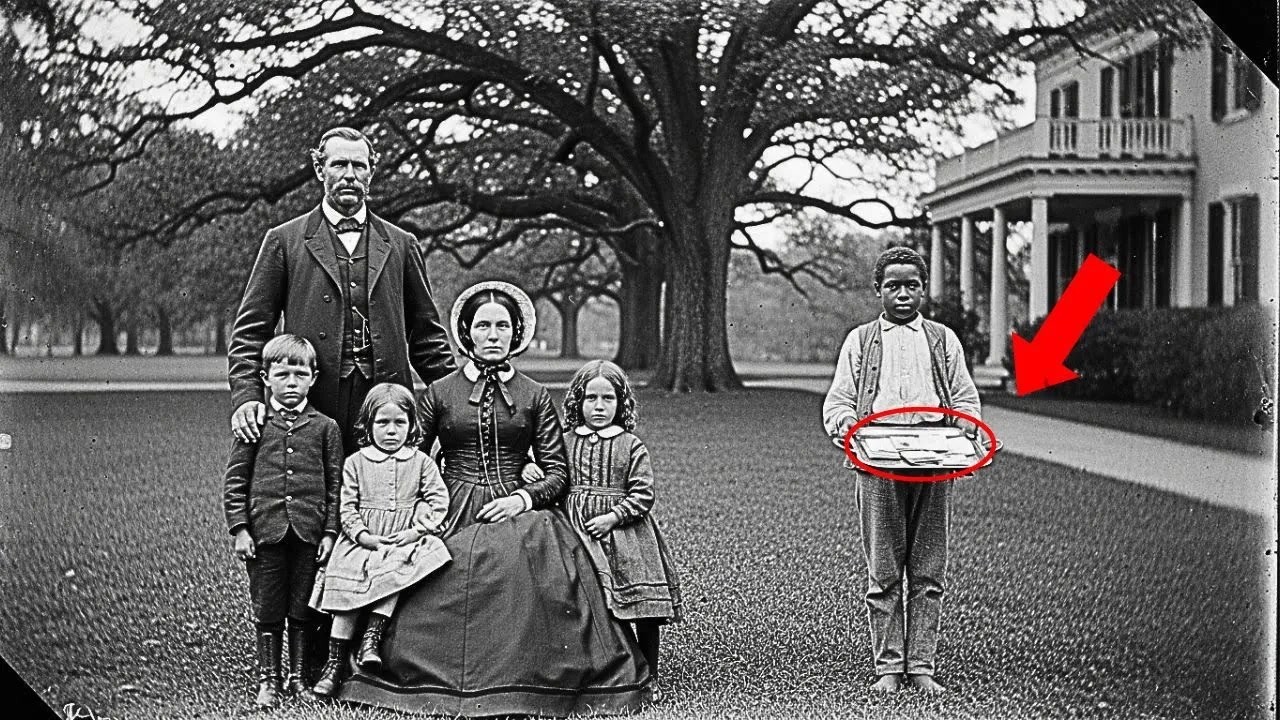
Most were conventional: formal portraits, wedding pictures, documents attesting to the family’s ownership and prosperity. Then Caroline opened a protective case containing a photograph dated May 1857, and her breath caught. At first glance, the image looked like a celebration. It showed a family of six standing in an ornate garden.
A grand red-brick mansion with tall white columns formed the backdrop, its windows reflecting the noonday sun. Flowering shrubs and carefully trimmed hedges framed the scene. Everything in the photograph suggested wealth, stability, and family happiness. The father stood in the center, a man in his forties wearing a dark suit with a silk waistcoat and a gold watch chain, his expression one of satisfaction and pride.
Beside him sat his wife, a woman of about the same age in a silk dress layered with ruffles and lace, her hair styled in the fashion of the 1850s, a slight smile on her face, her hands folded demurely in her lap. Their three children were arranged around them: two boys who appeared to be about ten and twelve, wearing miniature versions of their father’s suit, and a girl of perhaps fourteen in a pale dress with ribbons in her hair. All three children smiled those stiff, formal smiles that came from holding still for the long exposure times required by daguerreotype photography. Everything about the image suggested this was a family celebrating something—a birthday, a holiday, an anniversary, or simply their own prosperity and social standing.
But there was a seventh person in the photograph. Standing behind the family, partially in shadow, was a Black child, no more than eight or nine years old, dressed in plain, unadorned clothing that contrasted starkly with the family’s fine attire. The child’s face was visible but expressionless, carefully neutral in the way Caroline had learned to recognize from studying photographs of enslaved people—a protective stillness designed to show nothing that might invite punishment. The child stood perfectly still, hands extended in front of the body, set slightly apart from the family group as if occupying an entirely different space despite sharing the same frame.
Caroline had seen dozens of similar photographs—enslaved people included in family portraits as evidence of wealth, as living proof of a family’s prosperity and social standing. It was a common and deeply troubling practice in pre–Civil War photography. The enslaved were photographed like pieces of furniture, like property displayed alongside the silver and fine clothing and grand houses. But something about this particular image disturbed her.
There was something in the child’s posture, the way the hands were positioned, suggesting the child was holding something. She reached for her magnifying lens and leaned closer, staring at the small figure in the background. Yes, the child was definitely holding something—something flat, rectangular, perhaps papers of some kind, or a tray? Her pulse quickened.
She needed higher resolution. Caroline carefully removed the photograph from its protective case and carried it to the museum’s digital imaging station, where a high-resolution scanner could capture details invisible to the naked eye without damaging the fragile original. As she positioned the photograph under the scanner, she had no idea that what she was about to discover would haunt her for months, provoke widespread public outrage, and ultimately lead to the revelation of an extraordinary story of courage and resilience. She pressed the start button and waited.
The high-resolution scan took nearly twenty minutes, capturing every detail of the 167-year-old photograph. She watched the progress bar creep slowly across her computer screen, her anticipation building with each percentage point. When the scan finally finished, she opened the file and began zooming in on the child. The enhanced resolution revealed details impossible to see with the naked eye.
The child—whose gender Caroline could not yet determine from clothing and hairstyle alone—was indeed holding something: a silver tray, ornate and luxurious, of the type wealthy families used on formal occasions. The tray caught and reflected the light in the image, its polished surface still gleaming after all these years. But what was on the tray made the blood freeze in Caroline’s veins. Papers.
Legal documents of some kind. She could see the formal layout, the dense text, the official seals. She zoomed in further, adjusting contrast and brightness to make the text as legible as possible. The photograph’s resolution was remarkable for its era, and with modern digital enhancement, she could read portions of the documents.
At the top of the first page, in ornate script, were the words “Bill of Sale. ” Her hands began to tremble. She enlarged the image further and read fragments of the text: “Know all men by these presents that I, Robert Ashford of Henrico County, Virginia, have bargained and sold to James Mitchell of Adams County, Mississippi, a Negro child named Nathan, about eight years of age, for the sum of $650. ”
Caroline leaned back from the computer screen, feeling nauseated.
The event in the photograph was not a birthday or anniversary. It was a sale. The family had deliberately commissioned this expensive, elaborate photograph to commemorate the sale of this child. And they had forced the child himself, Nathan, to hold the documents of his own sale on a silver tray as if presenting a gift at a celebration.
The cruelty was staggering. They had not merely sold an eight-year-old boy, separated him from his family, and sent him hundreds of miles to harsh conditions on a Mississippi cotton plantation—they had documented the transaction in a formal photograph, making the child participate in his own dehumanization. Caroline thought of her own children, safe at home, playing in their rooms, innocent and protected. She remembered them at age eight, still young, needing comfort and reassurance, afraid of the dark.
And she remembered Nathan, age eight, forced to stand in the blazing sun holding the papers of his own sale like livestock while his enslavers smiled for the camera. She read the document more carefully, focusing on different sections. The date of sale was May 15, 1857. The seller was Robert Ashford, the man standing proudly in the center of the photograph.
The buyer was James Mitchell of Mississippi, who was not present in the image but whose signature appeared at the bottom of the bill of sale. Six hundred fifty dollars. That was what they had valued Nathan’s entire life at—about $20,000 in today’s currency, less than the price of a used car. Caroline printed several high-resolution copies of the photograph, including close-ups of Nathan’s face and the documents he was holding.
Then she began the research process on all parties involved in the transaction. She needed to know who Nathan was, where he came from, what happened to his family. She needed to know if he had survived, if he had escaped or gained his freedom, if he had lived to see emancipation. And she needed to learn more about the Ashford family—their history, their wealth, how they had built their prosperity on the bodies of enslaved people like Nathan.
She spent the rest of the day in the archive, pulling records and making phone calls to historical societies in Virginia and Mississippi. The National Museum had extensive resources and connections, and she used them all. By evening, she had assembled a preliminary timeline of Ashford family operations. Robert Ashford owned a plantation called Riverside in Henrico County, Virginia, on the outskirts of Richmond.
In 1857 he held forty-three enslaved people, ranging in age from infants to the elderly. The plantation grew tobacco primarily, though Ashford also hired out some of his enslaved people to nearby factories and construction projects for additional income. The 1850 slave schedule—a census document that listed enslaved people by age, sex, and color but not by name—showed that Ashford owned a male child recorded that year, age one, Black. That child would have been eight years old in 1857, almost certainly Nathan.
But that was all Caroline could find in the Virginia records. Nathan’s trail went cold after the sale. She would need to search Mississippi records to learn what happened to him after he arrived at his new owner’s plantation. That research would require time, resources, and access to non-digitized archives.
As Caroline prepared to leave the museum that evening, she took one last look at the photograph on her computer screen. Nathan’s face, devoid of expression, his small hands holding the silver tray. The smiling family surrounding him, celebrating their transaction. She saved the files, backed them up in multiple locations, and deposited the original photograph in the museum’s secure vault.
Tomorrow, the real work of uncovering Nathan’s story would begin. Tonight, she would go home to her children and hold them, profoundly grateful they lived in a different world. Caroline arrived at the museum early the next morning, carrying a cup of coffee and a determination bordering on obsession. She had barely slept, her mind consumed with questions about Nathan.
What happened to him after he reached Mississippi? Did he survive the brutal conditions of cotton plantations? Did he ever reunite with his family? Did he have descendants who might be alive today, knowing nothing of this photograph that had documented a painful moment in their ancestor’s life?
She began by contacting Dr. Marcus Johnson, a historian at the University of Mississippi who specialized in the history of slavery and the cotton economy of the antebellum South. Marcus had published extensively on plantation records and had access to archives throughout the state. When Caroline explained what she had found, Marcus immediately agreed to help her search for Nathan’s trail in Mississippi.
“Send me everything you have,” Marcus said over the phone. “The buyer’s name, the date, the location. I’ll start reviewing plantation records, sale documents, and anything that might indicate Nathan’s arrival or later life there. ”
While Marcus worked on the Mississippi side, Caroline focused on Virginia.
She needed to understand Nathan’s life before the sale: who his parents were, whether he had siblings, how his daily life had been on the Ashford plantation. Slave schedules did not include names, but other documents sometimes did—plantation records, estate inventories, court records related to enslaved people. She spent days in the archive, going through boxes of documents relating to the Ashford family. Robert Ashford was meticulous in his record-keeping, maintaining detailed ledgers of his property, including birth records, work assignments, and valuations.
Reading those documents was deeply disturbing. Human beings reduced to line items in inventories, their lives and bodies documented with the same careful precision one might use for livestock or farm equipment. Finally, on the third day of searching, Caroline found Nathan’s birth record in a plantation ledger from 1849. “Negro child born to our house servant, Dina, on February 12.
Child healthy. Named Nathan at Dina’s request. Father unknown. Child valued at one hundred dollars.
” Nathan’s mother’s name was Dina. She was a house servant, meaning she worked inside the main house rather than in the fields, and she had been permitted to name her child—a small mercy granted by some enslavers. The notation “father unknown” was heartbreaking. Either Dina had been assaulted by a white man and refused to disclose it, or her child’s father had been another enslaved person sold away before Nathan’s birth, or Ashford simply had not bothered to record the information.
Caroline searched for more references to Dina in the records. She found work assignments showing Dina was a cook and laundress, that she was considered valuable and trustworthy, that her monetary value had increased over the years as her skills developed. There were notes about her health, about minor illnesses and recoveries, about her productivity. Then, in the 1857 ledger, Caroline found an entry that made her heart pound.
“Negro woman named Dina, about 32 years of age, sold to the estate of the late Thomas Warren, Richmond, Virginia, to settle debts. Date of sale April 20, 1857. Price $800. ”
Dina had been sold just three weeks before Nathan.
Mother and son were separated within weeks of each other, sold to different owners in different locations. Nathan lost not only his home and everything familiar—he lost his mother first, then was sent hundreds of miles away with no hope of ever seeing her again. The cruelty was systematic and deliberate. Robert Ashford had needed money.
The records showed he was deeply in debt, struggling to maintain his plantation under economic pressures. So he sold his most valuable property. He separated a mother from her child, destroyed her family, then commemorated one of those sales with an elaborate photograph, forcing the child to participate in documenting his own exploitation. Caroline’s phone rang.
It was Marcus, calling from Mississippi. “I found him,” Marcus said without preamble. “Nathan arrived at the Mitchell plantation in Adams County in June 1857. The plantation records show his arrival, his age, his name.
They put him to work immediately, first as a water carrier for the field workers, then in the cotton fields themselves once he was strong enough. ”
“Did he survive? ” Caroline asked, her voice barely audible. “That’s the remarkable part,” Marcus replied.
“Yes, he survived. Not only survived—he lived until 1902. I’ve found numerous records documenting his life after emancipation. Caroline, this is an extraordinary story.
Nathan not only survived—he did something incredible with his freedom. ”
Caroline gripped her phone. “What did he do? ”
“He bought children,” Marcus said.
After the war ended and he was freed, Nathan worked as a laborer and saved every penny he could. Then he began using that money to purchase the freedom of enslaved children. Even after slavery officially ended, there were still children held in various forms of bondage—apprenticeships that were disguised slavery, debt peonage, illegal captivity. Nathan spent decades finding these children and buying their freedom.
His records showed he freed at least forty-two children between 1865 and 1895. Caroline felt tears streaming down her face. “He remembered,” she whispered. “He remembered he was eight years old when he was sold, and he devoted his life to making sure no other children remained enslaved.
”
Marcus continued: “There’s more. I found a memoir written by one of the children Nathan freed, published in 1920. The memoir describes meeting Nathan and describes his motivations. According to the memoir, Nathan said he had been forced to hold the papers of his own sale while his enslaver celebrated.
He said that moment never left him, that his entire life he could still feel the weight of those papers in his hands. So he decided to collect different papers—freedom papers, documents that freed children instead of enslaving them. He said he wanted to feel the weight of freedom in his hands. ”
Caroline sat in silence, overwhelmed by the profound courage and transformation of Nathan’s life.
The child forced to hold his own bill of sale became a man who held dozens of freedom papers. The weight of shame transformed into the weight of liberation. While Marcus continued researching Nathan’s post-emancipation life in Mississippi, Caroline became determined to learn what had happened to Dina, Nathan’s mother. The record said she had been sold to the estate of Thomas Warren in Richmond to settle debts.
That was a starting point, but Caroline needed to know more. Had Dina survived? Had she ever learned what happened to her son? Did they ever reunite?
She contacted the Library of Virginia and the Valentine Richmond History Center, explaining what she was looking for. Several archivists agreed to help, moved by the story and committed to recovering these lost histories. It took nearly two weeks of searching through estate records, auction documents, and property transfers before they found the thread. The Thomas Warren estate had been settled in 1857 to pay the deceased man’s substantial debts.
All property, including the enslaved people, had been sold at public auction. The auction records from May 1857 listed Dina, a Negro woman of 32 years, a skilled cook and laundress, as purchased by a Richmond businessman named Edward Morrison for $800. Morrison owned several properties in Richmond, including a hotel, a tobacco warehouse, and a boarding house. Estate records showed he used enslaved labor in all his businesses.
An 1860 inventory listed Dina as working in his hotel. Dina worked in the Morrison household as head cook. Caroline found scattered references to Dina over the next few years—notations in Morrison’s business ledgers, tax records detailing his property, insurance policies covering his enslaved workers. Dina appeared consistently, always described as a skilled and valuable worker.
But there was no mention of Nathan, no indication Dina ever learned what had happened to her son after his sale. Then the Civil War erupted. Richmond became the Confederate capital, and the city was transformed by war. Morrison’s business records became sparse and chaotic.
The hotel continued operating, serving Confederate officers and government officials, with Dina still working in the kitchen, according to scattered records. In April 1865, Richmond fell to Union forces. The city burned and chaos reigned for weeks. Many records from this period were destroyed or lost, but Caroline found a brief notation in a Union Army quartermaster’s report from May 1865.
The Morrison house had been seized for use as temporary headquarters, and a number of laborers who had been enslaved there were freed. The list of names included Dina, a cook of about 40 years, employed by the army as a paid worker. Dina had survived the war, witnessed the fall of Richmond, seen the end of slavery, and gained her freedom at age forty after decades in bondage. But what did she do with that freedom?
Did she stay in Richmond? Did she try to find Nathan? Caroline searched the records of the Freedmen’s Bureau, which documented the lives of formerly enslaved people during Reconstruction. The Bureau had offices throughout Virginia, helping freed people find work, negotiate labor contracts, search for separated family members, and adjust to their new status as free citizens.
Finally, in a box of correspondence from the Richmond Freedmen’s Bureau office, Caroline found a letter that made her hands tremble. It was dated July 1865, written in neat, careful handwriting, clearly penned by a Bureau clerk on behalf of someone who could not write themselves. “To Whom It May Concern: I am seeking information about my son Nathan, who was sold away from me in May of 1857 when he was eight years old. He was sold to a man named James Mitchell, who I was told owns a plantation in Mississippi.
I do not know if my son is alive or dead. I do not know if he remembers me, but I am free now and I am looking for him. If anyone has information about a young man named Nathan, about sixteen years old, who was brought to Mississippi from Virginia in 1857, please send it to the Freedmen’s Bureau office in Richmond, in care of Dina. I will not stop looking for him until I find him or until I know what happened to him.
A mother does not forget her child. ”
The letter was signed with an X, Dina’s mark, and also signed by a Bureau clerk named Samuel Peters. Caroline sat back, tears streaming down her face. Eight years after losing Nathan, Dina was still searching for him.
She had survived slavery, survived the war, gained her freedom, and immediately begun looking for her son. Did she ever find him? Did Nathan, working in Mississippi to buy the freedom of enslaved children, know his mother was searching for him? Caroline called Marcus again.
He had been reviewing Nathan’s papers, documents kept by the family of one of the children he had freed and donated to a small historical society in Natchez, Mississippi. The collection included the freedom papers, correspondence, financial records, and journals Nathan had kept during the later years of his life. “I found something,” Marcus told Caroline when she called. “A letter.
It’s from 1866, addressed to Nathan, routed through several Freedmen’s Bureau offices. Caroline, it’s from Dina. His mother found him. ”
“Read it to me,” Caroline said, her voice breaking.
Marcus began: “My beloved son Nathan, I do not know if you remember me. You were eight years old when you were taken from me. You are seventeen now, nearly a man. I am writing this letter with the help of a kind teacher here in Richmond who is teaching freed people to read and write.
I am learning too, slowly, but not fast enough to write this myself yet. So I tell her what to write and she writes it down. I have been searching for you since the day we were freed. I wrote to every Freedmen’s Bureau office in Mississippi.
I asked everyone I met if they knew a young man named Nathan from Virginia. Finally, someone knew. A man who had worked on the Mitchell plantation remembered you. He told me you are alive, that you survived, that you are free now.
My heart, which has been broken for nine years, began to heal when I heard this news. I do not know if you remember me. I used to sing to you when you were small. I taught you to count and to pray.
I held you when you were afraid of storms. The day you were taken, you cried and reached out your hand to me, and I could not save you. I have carried that moment with me every day since. The weight of not being able to protect you, of not being able to keep you safe, has been so heavy.
But you are alive. You are free. And I will come to you. I am saving money from my work here, and as soon as I have enough for the journey, I will come to Mississippi.
I will find you. I will see your face again. Please wait for me. Please know that I never forgot you, that I never stopped loving you, that you have been in my heart every day.
Your mother, Dina. ”
Marcus’s voice was thick with emotion as he finished reading. “There’s a note in Nathan’s journal from December 1866. It just says: ‘My mother is alive.
She is coming. God has answered my prayers. ‘”
Caroline asked: “Did she make it? Did Dina reach Mississippi?
Did they reunite? ”
“Yes,” Marcus said. “I found passenger records showing Dina traveled by steamboat from Richmond to Natchez in March 1867. And there’s an entry in Nathan’s journal dated March 15, 1867: ‘Today I saw my mother’s face for the first time in ten years.
I am eighteen years old, almost a man, but when I saw her, I became a child again. We held each other and wept. She is older, her hair is gray, but her eyes have not changed. She knew me immediately.
She said I had grown tall, but my eyes had not changed. We have so much time to make up for. She will live with me here. We will never be separated again.
‘”
Caroline was openly crying now. After everything—after the forced separation, after Dina’s sale, after Nathan being photographed holding his bill of sale, after nine years of not knowing whether the other was alive or dead—they had found each other. Dina had traveled hundreds of miles to reach her son. Nathan had waited, survived, gained his freedom, and been present when his mother finally arrived.
Marcus continued: “There’s more. Dina lived with Nathan for the rest of her life. She helped him in his work of freeing enslaved children. The memoir I mentioned earlier, written by one of the children Nathan freed, describes meeting Nathan and Dina.
The author writes that Dina treated every child Nathan brought home as her own grandchild, that she cooked for them and mended their clothes and made sure they knew they were valuable and loved. She died in 1878 at about 53 years old. Nathan buried her in Natchez and had a headstone made that reads: ‘Dina, Beloved Mother. She Never Stopped Searching.
She Never Stopped Loving. ‘”
Caroline sat in silence, absorbing everything Marcus had told her. The story that began with such cruelty—an eight-year-old child forced to hold the documents of his own sale while his enslaver celebrated—had transformed into something profoundly beautiful. Nathan and Dina had refused to let slavery have the last word.
They had searched for each other, found each other, and spent the rest of Dina’s life together, healing the wounds of slavery and helping others recover from them. “We have to tell this story,” Caroline said finally. “The photograph is painful, but the full story is about resilience and love and the refusal to be broken. People need to know what Nathan and Dina did.
”
“I agree,” Marcus replied. “I’ll keep researching. I’ll see if I can find records of all the children Nathan freed. I want to identify as many of them as possible.
And I’ll tell their stories too. ”
Over the next month, Caroline and Marcus worked together from different states, collaborating via email, phone calls, and document sharing. They built a comprehensive narrative of Nathan’s life: from his birth in 1849 through his sale in 1857, his years of enslavement in Mississippi, his emancipation, his reunion with Dina, and his decades of relentless work freeing enslaved children. They managed to identify records for thirty-eight of the forty-two children Nathan had freed.
Each child had a story, a name, a date, a life changed by Nathan’s determination and sacrifice. The first child Nathan freed was a girl named Sarah, documented in records from 1865. She was ten years old, held under a fraudulent apprenticeship contract by her former enslaver, who claimed her parents had abandoned her—though Marcus found evidence her parents had simply been sold to different plantations before the war and had been unable to find her afterward. Nathan paid $50, a huge sum for a newly freed man, to purchase the apprenticeship contract and helped Sarah find her way to the Freedmen’s Bureau office where her parents had registered their search.
Another child, a boy named Isaac, was freed by Nathan in 1867. Isaac was only six years old, held by a white family who claimed they had adopted the orphan out of charity—when in fact they had kidnapped him from his mother during the chaos of Richmond’s fall. Nathan somehow learned of Isaac’s situation, traveled to Virginia, negotiated, or perhaps purchased, the boy’s release. Nathan’s journal entry about Isaac was brief but moving: “Brought Isaac home today.
He cried for his mother all night. Tomorrow I will help him write a letter to the Freedmen’s Bureau. Every child deserves to be with their family. ”
Marcus found one story particularly affecting: twins, a boy and girl named Jacob and Julia, freed by Nathan in 1870.
They were twelve years old, held on a remote plantation under a system that was slavery in every way but name. The farmer claimed they were working off a debt their deceased parents had owed him, a common form of debt peonage used to keep Black people enslaved after emancipation. Nathan paid off the fraudulent debt in full and brought the twins to live with him and Dina until they were old enough to work and support themselves. Julia, one of the twins, turned out to be the author of the memoir Marcus had found.
She wrote it in 1920 at age sixty-two, providing insight into Nathan’s character and motivations. Caroline obtained a copy of the memoir from the historical society and she and Marcus read it carefully for details about Nathan’s life and work. Julia wrote: “Mr. Nathan was the kindest man I ever knew in my life, but there was a sadness in his eyes that never left him.
He told me once about his childhood, when he was eight years old, sold away from his mother. He said his enslaver forced him to hold the papers of his sale, made him stand there as if presenting a gift at a celebration. He said that moment marked him deeply, that he would never forget the weight of those papers in his hands, or the feeling of being treated as a thing rather than a person. But he said something else too.
He said when he finally held his first freedom paper, the document that freed Sarah in 1865, he felt that weight again, but it was different. It was still heavy, still important, but it was the weight of liberation instead of the weight of enslavement. He said that every time he bought a child’s freedom, every time he held those papers, he was reclaiming something that had been stolen from him. He was transforming the shame of that eight-year-old boy into something powerful and good.
”
The memoir also described Dina. “Miss Dina treated us as if we were her own grandchildren, though we shared no blood with her. She cooked the most wonderful meals and made sure we were clean and fed. She taught us manners and how to carry ourselves with dignity, but most importantly, she taught us that what happened to us did not define who we were, that we deserved love and respect, that our worth exceeded any price.
”
Julia’s memoir revealed that Nathan and Dina had been part of a broader network of emancipated people working to rescue children still held in various forms of bondage throughout the South. They coordinated with Freedmen’s Bureau agents, Black churches, and sympathetic white allies. They shared information about children at risk, pooled resources to purchase freedom or file lawsuits, and provided safe havens for children who managed to escape. Nathan was one of the heroes of this movement, but his personal connection to the work—his own experience of being sold as a child, his reunion with his mother—gave him a particular determination and effectiveness.
Marcus found records showing Nathan traveled extensively throughout Mississippi, Louisiana, and Arkansas, always searching for children in need of help. He worked as a carpenter to fund his rescue efforts, taking any job and saving every possible penny. Dina also worked as a seamstress and cook, contributing her earnings to their shared mission. By 1880, census records showed Nathan owned a small house in Natchez.
Living with him were Dina, now about 55 years old, and three children listed as adopted—children Nathan had freed but who had nowhere else to go. Children who became his family. One of those children was a boy named Thomas, then fourteen years old. Marcus found Thomas’s death certificate from 1941.
He had lived to the age of seventy-five. Thomas became a teacher, married, had children, and spent his career educating Black children in Mississippi during the Jim Crow era. On his death certificate, under father’s name, someone had written: “Nathan Friedman, family name unknown, adoptive father, hero. ”
As Caroline and Marcus realized, they had discovered something extraordinary.
Not just a painful historical photograph, but a complete narrative of trauma, resilience, reunion, and transformation. The image of eight-year-old Nathan holding his bill of sale was devastating, but the story of what Nathan became and what he and Dina did with their freedom was inspiring and essential. They decided to present their findings publicly, starting with an academic article in a journal of American history, followed by a press conference at the National Museum of American History. Caroline arranged with the museum’s conservation team to create a high-quality reproduction of the photograph for display, keeping the original in secure storage.
The academic article was published in September 2024 under the title “The Burden of Freedom: Nathan, Dina, and the Transformation of Trauma in Post-Emancipation America. ” The article detailed their research methodology, presented all the documents they had found, and argued that stories like Nathan’s were essential for understanding both the brutality of slavery and the extraordinary resilience of those who survived it. The academic community’s response was immediate and overwhelmingly positive. Historians praised the meticulous research.
Genealogists offered to help trace the descendants of the children Nathan had freed. Teachers requested permission to use the article and photographs in their classrooms. But Caroline and Marcus knew academic publication was not enough. This story needed to reach a wider audience.
They scheduled a press conference for October 15, 2024, at the National Museum of American History. On the morning of the press conference, Caroline stood in the museum hall looking out at more than a hundred journalists, historians, educators, and members of the public who had come to hear about the discovery. On a large screen behind her, the old daguerreotype was displayed: the smiling White family and Nathan in the background holding the silver tray with the stack of legal documents. Caroline began by describing how she had found the photograph and what her initial analysis had revealed.
Then she explained the process of identifying Nathan and tracing his life. She displayed the documents—the bills of sale, the plantation records, the ledgers, Nathan’s journals, Julia’s memoir, Dina’s letter. Then Marcus took over, describing Nathan’s work buying the freedom of enslaved children. He displayed the list of names, the freedom papers, the records of family reunifications.
He read passages from Julia’s memoir, letting Nathan’s words, preserved through Julia’s memory, speak to the audience. Marcus explained that Nathan had been branded forever by being forced to hold his bill of sale. But he had transformed that branding. He had taken the burden of being commodified and turned it into the burden of liberation.
Every child he freed was a reclamation, a healing, an act of love. Then Caroline displayed photographs of Nathan from later in his life—images from the 1880s and 1890s showing him as a middle-aged and elderly man. In every photograph, Nathan looked directly at the camera with a steady, dignified gaze. The contrast with the eight-year-old child in the 1857 daguerreotype who would not meet the camera’s eye was striking.
“This is the same person,” Caroline said, gesturing between the two images. “But look at the difference. The child who could not look at the camera, who was forced to display his own dehumanization, became a man who faces the camera’s gaze without shame or fear. That transformation is the heart of this story.
”
The press conference made national headlines. Nathan’s photograph, holding his bill of sale, appeared in newspapers, on news websites, and across social media. People were outraged by the cruelty of the original image but inspired by Nathan’s story of resilience and determination. Several reactions caught Caroline’s attention.
A teacher from Atlanta wrote that she had shown the story to her high school history students, many of them descendants of enslaved people, and they had been moved to tears—but also strengthened by Nathan’s example. The teacher wrote that her students understood their ancestors were not merely victims but survivors who had resisted by every means available. A genealogist contacted Marcus to say she believed she was a descendant of one of the children Nathan had freed, a girl named Emma documented in Nathan’s records from 1873. The genealogist had been searching for information about Emma for years and was overjoyed to finally find this piece of her family history.
Most powerfully, Caroline received an email from a woman named Dorothy Hayes, who identified herself as a descendant of Nathan. She had been researching her family history for decades but had found little information about her ancestors before the 1880s. Dorothy wrote: “I grew up hearing family stories about my great-grandfather Nathan who rescued children. We knew he had been enslaved and we knew he did important work after emancipation, but we never knew the details.
Seeing that photograph of him as a child, holding those papers, broke my heart. But then, when I saw what he became, what he accomplished, I felt such immense pride. Thank you for finding this story and telling it properly. ”
Caroline arranged to meet Dorothy the following month.
Dorothy traveled to Washington to see the photograph in person and to meet Caroline and Marcus. Dorothy Hayes arrived at the National Museum of American History on a cold November morning accompanied by three family members: her adult daughter Jasmine, her cousin Marcus (no relation to the historian), and her elderly aunt Gloria, who was ninety-two years old and the keeper of the family’s oral history. Caroline and Marcus greeted them in a private viewing room where the original photograph was carefully displayed alongside other documents from Nathan’s life: his journals, the freedom papers he had signed, Dina’s letter, photographs from his later years. Aunt Gloria approached the photograph slowly, using her cane, her eyes fixed on the image of eight-year-old Nathan.
When she reached the display case, she stood for a long moment in silence, then reached out her hand, not quite touching the glass, as if trying to reach across the years to her ancestor. “That’s him,” she said softly. “That’s Nathan. I see him in my grandson’s face.
I see him in my great-granddaughter’s eyes. ” Then she turned to Caroline and Marcus. “Thank you for finding him. Thank you for telling the truth.
”
Dorothy stood beside her aunt, tears streaming down her face. “I’ve seen photographs of Nathan when he was older. I have copies of some of them at home, but I’d never seen this one. I didn’t know it existed.
To see him as a child, to see what was done to him… ” She couldn’t finish the sentence. Caroline gave them space and time, letting them absorb their emotions and study the documents at their own pace. Eventually, Dorothy asked if they could hear more about Nathan’s life and work.
Over the next two hours, Caroline and Marcus shared everything they knew. They showed Dorothy’s family the list of forty-two children Nathan had freed, explained the rescue network he had worked with, read passages from Julia’s memoir. They described Nathan’s reunion with Dina and the years they had spent together. Aunt Gloria listened intently, occasionally nodding or adding a detail from the family’s oral history that confirmed or complemented what the researchers had found.
“We always knew Nathan did important work,” she said. “My grandmother told me Nathan used to say every child matters, that every child deserves to be free and loved. We instilled that value in our family. We made sure our children knew they came from strength, from people who survived horrors and then turned their survival into service.
”
Jasmine, Dorothy’s daughter, was particularly interested in the children Nathan had rescued. “Do you know what happened to them? ” she asked Marcus. “Did they have families?
Are there descendants who might not know anything about Nathan’s role in their family history? ”
“That’s actually what we’re working on,” Marcus replied. “We’ve identified most of the children and we’re trying to trace their descendants. Some, like Julia who wrote the memoir, we can trace easily.
Others are more difficult because records are incomplete or because families moved frequently after emancipation. But we’re building a database and we hope to reach as many descendant families as possible. ”
Dorothy’s cousin Marcus interjected: “Our family should be part of that effort. We should help find these families and tell them about Nathan.
That’s what he would have wanted—for people to know their history, to understand where they came from. ”
Before the family left, Caroline gave them high-quality copies of all the documents relating to Nathan, so they could share them with other family members, use them in family history projects, and pass them down to future generations. She also provided them with contact information for genealogists specializing in African American family history who could help them trace other branches of their family tree. “There’s one more thing,” Caroline said.
“The museum is planning an exhibition on slavery, family separation, and resilience. We’d like to feature Nathan’s story prominently. Would that be acceptable to you? We want to ensure he and your family are represented with respect.
”
Dorothy nodded immediately. “Yes, absolutely. Nathan’s story needs to be told. The photograph is hard to look at, but people need to see it.
They need to understand what slavery really meant, not just abstractly but concretely and humanly. An eight-year-old child forced to hold the documents of his own sale. That’s what slavery was. But they also need to see what Nathan became, what he chose to do with his freedom.
Both parts of the story matter. ”
The exhibition, titled “Held: Slavery, Family Separation, and the Power of Resilience,” opened at the National Museum of American History on March 15, 2025—exactly 158 years after Nathan’s reunion with Dina. The opening drew more than five hundred people, including descendants of Nathan and of some of the children he had freed, historians, educators, and members of the public moved by his story. The exhibition was designed to tell multiple stories, but Nathan’s was its centerpiece.
Visitors entered through a dark corridor where the daguerreotype was displayed, projected on a large screen. It appeared gradually, allowing viewers to see the smiling Ashford family first before noticing Nathan in the background. Then, as visitors approached, motion sensors activated a zoom effect, bringing Nathan’s face and the documents he was holding into sharp focus. Text panels explained what the image depicted and provided context about enslaved children, family separation, and the practice of commemorating sales with formal photographs.
The next section of the exhibition documented Nathan’s life in slavery: his birth, his mother Dina, his work on the Ashford plantation, the sale that separated him from everything he knew. Documents and photographs from that period helped visitors understand the systematic dehumanization of enslaved people, especially children. Then came the Civil War and emancipation, presented through newspapers, photographs, and personal accounts from formerly enslaved people. This section included Dina’s letter searching for Nathan, Nathan’s journal entry about receiving that letter, and documentation of their reunion.
The heart of the exhibition was a large room dedicated to Nathan’s rescue work. The walls were covered with the names of all forty-two children Nathan had freed, along with brief biographical notes about each child wherever information was available. In the center of the room stood a bronze sculpture of two hands holding a piece of paper. On one side of the paper was inscribed “Bill of Sale,” on the other, “Freedom Paper.
” The sculpture represented Nathan’s transformation: how he had taken the burden of his enslavement and turned it into the burden of liberation. Interactive displays allowed visitors to explore Nathan’s rescue network, read passages from Julia’s memoir, and view photographs of Nathan from later in his life. Video interviews with Dorothy Hayes and other descendants provided contemporary perspectives on Nathan’s legacy. The final section of the exhibition addressed the lasting impact of slavery on African American families, the millions of people still searching for their ancestors, the ongoing genealogical work to reconnect family lines, and the continuing process of historical recovery and healing.
It emphasized that Nathan’s story, while extraordinary, was one of thousands of similar stories waiting to be uncovered and told. The opening ceremony began with a welcome address from the museum director, who spoke about the importance of confronting difficult history and honoring the resilience of those who survived it. Caroline and Marcus then gave brief talks about their research process and findings. Afterward, Dorothy Hayes spoke from a podium, the photograph displayed on a screen behind her.
She began: “When Dr. Webster first contacted me about finding this photograph, I had mixed feelings. Part of me did not want to see my great-grandfather in such a degrading position. Another part wanted to protect him, even though he’s been gone for over a century.
But I realized then that Nathan would not have wanted to be protected from the truth. He spent his life confronting the truth, documenting it, and using it to free children who were being hidden and erased. ”
She paused for a moment, looking at the image of eight-year-old Nathan. “This photograph shows what was done to him.
But this exhibition shows what he did with his life despite it. He was forced to hold the papers of his own sale, but he chose to hold dozens of freedom papers. He was separated from his mother, but he was reunited with her, and they spent years together. He was treated as property, but he spent his freedom liberating others.
That transformation—from victim to agent, from helpless child to powerful liberator—is what I want people to remember about Nathan. ”
The ceremony concluded with a musical performance. A choir sang spirituals that enslaved people had sung, including some that Dina had taught Nathan according to his journals. The music filled the museum, connecting past and present, honoring those who had suffered and those who had survived.
After the ceremony, visitors wandered through the exhibition, many lingering for long periods at particular displays. Caroline watched them, noting their reactions—their tears, their anger, their contemplation, their inspiration. Many visitors approached her to share their own family stories, to ask about genealogical resources, to express gratitude for the exhibition. A young Black man, perhaps in his twenties, stood for nearly thirty minutes before the wall listing the names of the children Nathan had freed.
Caroline noticed him taking photographs of the names and writing some of them in a notebook. Eventually, she approached and asked gently if he was finding something meaningful there. He nodded. “My great-great-grandfather was named Isaac.
The family story says he was freed by a man who helped children after the war, but we never knew who that man was or where it happened. When I saw Isaac’s name on this wall with the date 1867 and the note that he was from Virginia and was six years old, I think it might be him. I think Nathan might have saved my great-great-grandfather. ”
Caroline felt a chill.
“Would you like to see the records? We have more detailed documents in our archive. ”
“Yes,” the young man said. “I want to know everything.
I want to know who my people were, where we came from, who helped us survive. ”
Caroline thought this was why the work mattered. Not just to document history, but to connect people to their past, to give them knowledge of where they came from and who had paved the way for their existence. Nathan’s story was being heard, his work honored, his name remembered.
The photograph that was meant to document his dehumanization had instead become the starting point for recovering his full humanity and celebrating the extraordinary life he had built.






