On November 8, 1887, in a hotel room in Glenwood Springs, Colorado, a dying man made one last request. John Henry Holliday, known to the world as Doc Holliday, asked the nurse attending him for a shot of whiskey. She refused. The man who had faced down gunmen, gamblers, and his own failing body for two decades looked down at his bare feet and found something funny in the moment.
His boots were off. He had always figured he would be killed someday with his boots on. “This is funny,” he said, and those were his last words. At ten o’clock that morning, Doc Holliday died at the age of thirty-six, nearly penniless, in a Colorado hotel room.
The character who had become one of the most enduring legends of the American West was gone, but the stories about him were only beginning. To understand how he came to that hotel room, stripped of his boots and his fortune, one has to go back to his beginnings in Georgia, to the illness that shaped his entire life, and to the friendships and feuds that defined his reputation. Holliday was born in Griffin, Georgia, to Henry Burroughs Holliday and Alice Jane McKey Holliday, a family with English and Scottish roots. He was a mama’s boy in the truest sense.
His mother devoted extra attention to him during his youth because of a speech impediment and other health problems, and some said she spoiled him. The bond between them ran deep, which made her death from consumption, a disease he likely witnessed firsthand, all the more devastating. That loss stayed with him and likely lingered in his thoughts when he himself fell victim to the same ailment years later. He pursued education at the Valdosta Institute, where he received instruction in rhetoric, grammar, mathematics, history, and languages, primarily Latin, with some exposure to French and ancient Greek.
In 1870, at nineteen, he left home for Philadelphia. On March 1, 1872, at twenty years old, he earned his Doctor of Dental Surgery degree from the Pennsylvania College of Dental Surgery, now part of the University of Pennsylvania School of Dental Medicine. He graduated five months before turning twenty-one, and the school delayed issuing his degree until he reached the minimum age required for dental practice. Holliday moved to St.
Louis, Missouri, where he worked as an assistant for his classmate, A. Jameson Fuches Jr. Within four months he relocated to Atlanta, joining a dental practice and initially living with his uncle and family. He intended to establish his own practice.
Several weeks before his birthday, dentist Arthur C. Ford advertised in Atlanta papers that Holliday would serve as his substitute during Ford’s attendance at dental meetings. His professional reputation was growing. But trouble was brewing.
After initiating his dental practice, Holliday learned he had contracted tuberculosis, likely from his deceased mother. His Mexican adopted brother was also diagnosed with the disease and later died, so he may have caught it from him as well. Multiple physicians delivered a grim prognosis. Their advice was consistent: move to a drier climate for a chance at prolonging his life.
In October 1873, Holliday packed his belongings and journeyed to Dallas, Texas, the terminal point of the railroad at that time. His motivation to head West wasn’t just health related. There were controversial rumors that Holliday was involved in a shooting on the Withlacoochee River in Georgia in 1873. The first account came from Bat Masterson in his 1907 article on Doc.
According to Masterson, when Holliday was twenty-two, he and some friends went to a swimming hole on his uncle’s land and discovered it had been occupied by a group of Black American soldiers, part of the federal government’s occupation forces in the South. Susan McKey Thomas, daughter of Doc’s Uncle Thomas S. McKey, recounted her father’s version of the incident. They rode in on the Negroes swimming in a part of the Withlacoochee River that Doc and his friends had cleared for their own use.
The presence of the soldiers enraged Doc, and he drew his pistol, shooting over their heads to scare them off. “Papa said he shot over their heads,” she said. Masterson’s story was different. He claimed Holliday pointed a double-barreled shotgun at the soldiers and, as they exited the swimming hole, killed two of them.
Some family members deemed it prudent for Holliday to leave the state following the incident, but others contested these accounts. Historian Gary Roberts, renowned for his 1997 biography Doc Holliday: The Life and Legend, searched for contemporary evidence of this event for a long time without success. Alan Barra, an author focusing on Wyatt Earp, also searched for evidence corroborating the incident and found no credibility in Masterson’s story. What is known is that Holliday arrived in Dallas with his dental credentials and set to work.
He teamed up with Dr. John A. Seeger, a friend of his father’s. Their collaboration earned them recognition at the annual fair of the North Texas Agricultural, Mechanical, and Bloodstock Association at the Dallas County Fair, winning awards in multiple categories including best set of teeth in gold, best in vulcanized rubber, and best set of artificial teeth and dental wear.
They operated their office along Elm Street between Market and Austin streets. This partnership dissolved on March 2, 1874. Holliday then opened his own clinic at the Dallas County Bank at the corner of Main and Lamar streets. In the vast expanse of the West, Holliday emerged as an eccentric character, a southern gentleman whose penchant for gambling set him apart.
Educated and often misunderstood, his unconventional lifestyle didn’t always endear him to locals. His brooding demeanor, perhaps a consequence of his prolonged battle with tuberculosis, was further complicated by the solace he sought in alcohol and later the pain-relieving elixir laudanum. Yet he was no simple loner. Amidst the harshness of the frontier, he cultivated enduring friendships with a Colorado newspaper man and saloon proprietors scattered throughout the West.
Holliday always kept in touch with the people he knew growing up in Georgia. That network of friends would matter in his final days, when his gambling friends and saloon owners helped pay his bills as he lay dying in that Colorado hotel room. The scene in the movie Tombstone showed Wyatt Earp at his bedside, but Earp was not there at all. Physically, Holliday was about five feet ten inches tall and weighed about 160 pounds.
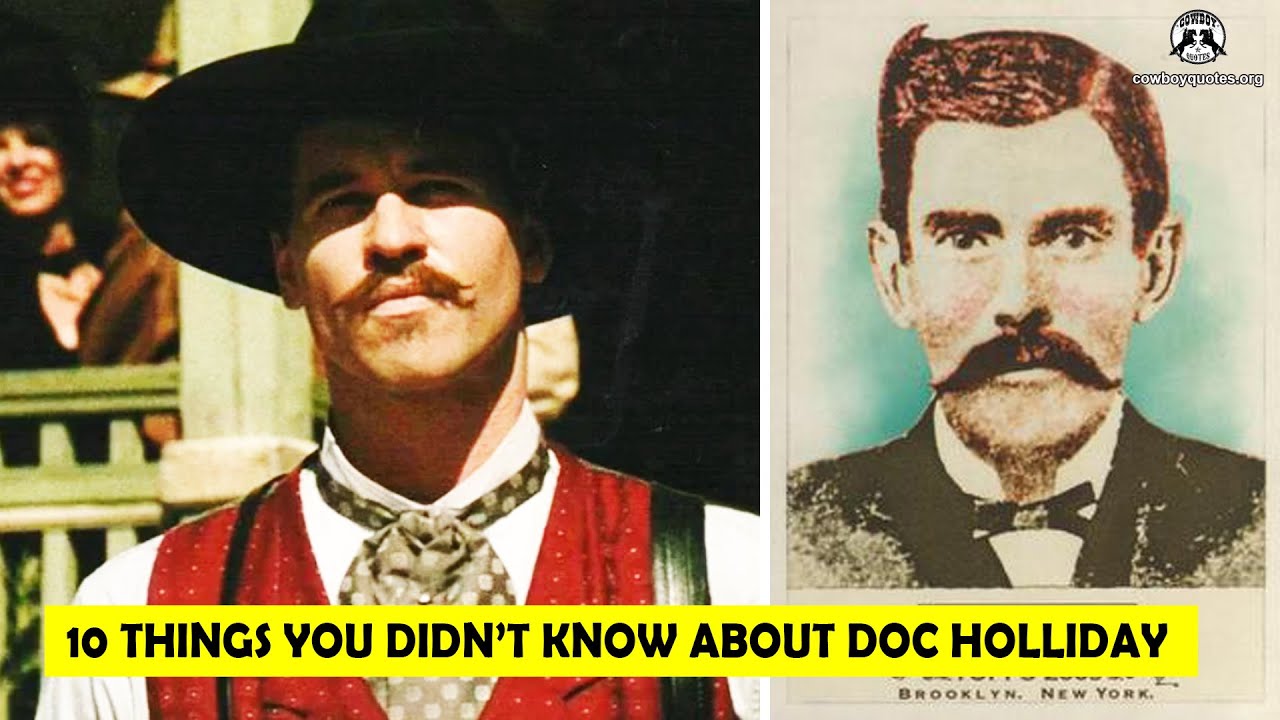
Virgil Earp’s wife Allie said so when she first met him. He had blonde hair, platinum blonde when first meeting him, not the black hair most surviving and probably edited photos show. Wyatt described him as “long, lean, and ash blonde. ” Several photographs of uncertain origin are often attributed to Holliday, some claiming they were taken by C.
S. Fly in Tombstone while others assert they originated in Dallas. Notably, Holliday resided in a rooming house situated in front of Fly’s photography studio. Facial features can be deceptive, with similarities observed between individuals who may appear radically different from certain angles.
For this reason, most museum staff, knowledgeable researchers, and collectors require precise provenance or a documented history of an image. Among authenticated images of Holliday are his graduation photo from the Pennsylvania School of Dental Surgery in March 1872 at age twenty and another from Prescott, Arizona, in 1879 at age twenty-seven. Several other images, including a Tombstone photo from 1882 and another with a bowler hat, lack provenance and face authenticity challenges. Holliday did not have a death wish.
Throughout much of his adult life, he grappled with consumption, frequently embarking on journeys to locations he believed could alleviate its symptoms. His actions have sometimes angered Roberts, who said he wished Holliday had died sooner. “He is portrayed in most accounts as a fatalist, somebody who knew he was going to die from the disease and in a sense gave up on life so that he didn’t care whether he lived or died,” Roberts said. “I think it was certain that he knew that he was going to die eventually from it.
He knew enough about consumption that he knew he would not have a long life. I expect that explains some of the melancholy and some of the cynicism that you see from him. But there’s too much evidence, too many instances where it becomes very clear that he wanted to live. ”
His extensive travels span from leaving Georgia to venturing into Dodge City, Kansas; Las Vegas, New Mexico; Leadville, Colorado; Arizona; and later Montana, underscoring his quest for a more comfortable living environment.
Even before the Leadville shooting, Roberts noted that Holliday had begged law officials and friends to intervene to stop it all, expressing a desire to live. His journey eventually took him to Glenwood Springs, Colorado, famous for its supposedly restorative hot springs, where he breathed his last. His trip there from Leadville via the perilous Independence Pass lasted eighteen hours on a stagecoach, a daunting undertaking for someone as sick as he was. Doc decided to go to Glenwood Springs not to soak in the hot springs but to find Indian medicine in the steam cave, the last hope to cure his advanced tuberculosis.
In a quest perhaps for absolution, he sought the counsel of Father Downey, the founding priest of St. Stephen’s Catholic Church, known to be a friend to the dying man. Throughout his life, Holliday was known by many of his colleagues as a feisty, even-tempered Southern gentleman. In a newspaper interview, he was once queried about his conscience, to which he reportedly replied: “I coughed that up with my lungs years ago.
” Big Nose Kate, his enduring companion, recalled his reaction after the OK Corral gunfight. She recounted his return to the room, sitting on the bed and weeping, expressing “that was awful, awful” as he grappled with the aftermath. Bat Masterson had several interactions with Holliday during his life, and the two men disliked each other. Their tolerance for each other was only due to their friendship with Wyatt Earp.
In an article, Masterson depicted Holliday, stating that while he never did anything to entitle him to a statue in the Hall of Fame, Doc Holliday was nevertheless “a most picturesque character on the Western border in those days when the pistol instead of law determined issues. ” Masterson added that Holliday “had a mean disposition and an ungovernable temper, and under the influence of liquor was a most dangerous man. ” Physically, Masterson claimed, Doc Holliday was a weakling who could not have whipped a healthy fifteen-year-old boy in a go-as-you-please fistfight, and he quickly pulled out his gun in response to threats. In a March 1882 interview with the Arizona Daily Star, Virgil Earp told a reporter: “There was something very peculiar about Doc.
He was gentlemanly, a good dentist, a friendly man, and yet outside of us boys I don’t think he had a friend in the territory. Tales were told that he had murdered men in different parts of the country, that he had robbed and committed all manner of crimes, and yet when persons were asked how they knew it, they could only admit that it was hearsay and that nothing of the kind could really be traced up to Doc’s account. ”
The relationship between Holliday and Wyatt Earp was not quite the inseparable companionship that legend suggests. They first encountered each other in 1877 while traversing Texas, a mere four years before the famous 1881 gunfight at the O.
K. Corral in Tombstone, Arizona, where they stood shoulder to shoulder. After the shootout at Tombstone, and after they completed their bloody revenge against those who ambushed Earp’s brothers, Holliday and Earp decided to leave each other. There are even indications of a strained relationship in Albuquerque a few years later.
According to a letter authored by former New Mexico Territory Governor Miguel Otero, an incident unfolded at Fat Charlie’s, The Retreat restaurant in Albuquerque during a meal when Holliday said something about Earp becoming a “damn Jew boy. ” Earp became angry and left. At the time, Earp was residing with influential businessman Henry N. Jaffa, who served as the president of New Albuquerque’s Board of Trade.
Jaffa was Jewish, and based on Otero’s letter, while at Jaffa’s house, Earp honored Jewish tradition by touching the mezuzah upon entering his house. According to Otero’s letter, Jaffa told him Earp’s woman was a Jewess. Earp’s anger at Holliday’s racial slur may suggest that the relationship between Josephine Marcus and Wyatt Earp was more serious at the time than is commonly known. Doc Holliday was reputed to have killed more than a dozen men in various conflicts, but many historical researchers have concluded that, contrary to popular legend, Holliday only killed one to three men during his lifetime.
His life and colorful personality have been portrayed in many books and by famous actors in many films and television series. The 1993 film Tombstone significantly contributed to shaping his modern persona, largely due to Val Kilmer’s iconic portrayal. Kilmer’s delivery of two memorable lines, especially the declaration “I’m your huckleberry” when confronting the antagonist Johnny Ringo, has left a lasting impression. According to Roberts, the phrase was popular during that era, conveying the meaning “I’m the one you’re looking for” or “I’m the man for the job.
” In a pivotal moment later in the film, Holliday once again uses the phrase, though Roberts notes that this particular scene lacks historical validation. Kilmer titled his recent memoir I’m Your Huckleberry. During the O. K.
Corral confrontation, witnesses reported that Frank McLaury gained a momentary advantage over Holliday and taunted “I got you now, you son of a bitch,” pointing a gun at him. Holliday’s historically accurate retort, “You’re a daisy if you do,” essentially translates to “good for you if you do. ” In some versions it is reported as “you’re a daisy if you have got me. ” According to Roberts, the meaning remains consistent.
McLaury did not have the upper hand, and Holliday emerged unscathed while McLaury met his demise. The love story of Big Nose Kate and Doc Holliday began in a fitting locale for two Wild West legends: a saloon. Their paths crossed at John Shanssey’s Saloon in Fort Griffin, Texas, around 1877. Kate was drawn to Holliday’s audacious sophistication, while he was captivated by her alluring beauty, intellect, and independence.
Both shared fiery tempers. For better or worse, over the years their relationship ebbed and flowed. They quarreled, parted ways, possibly married, reunited, and quarreled again. Holliday once complained to Wyatt Earp after a spat with Kate: “You know, I had to quiet her, Wyatt.
I just hit her gently over the head with the butt end of my gun. Had to quiet her. ” Still, they were a beautiful couple in the lawless days of the Wild West. During an arrest in Fort Griffin, when Holliday faced charges possibly for stabbing a cheat or violating gambling restrictions, Kate showed her mettle.
She discreetly ignited a fire in town, diverting attention. Then, brandishing two pistols, she confronted Holliday’s guards and orchestrated his escape. Riding on stolen horses, they reached Dodge City, vowing to forsake prostitution and gambling, promises that proved short-lived. Fatefully, Kate introduced Holliday to lawman Wyatt Earp and his brothers, a decision she later regretted, lamenting: “The Earps had such a power I could not get Doc away from them.
”
By 1880, Holliday and Earp found themselves in the turbulent Wild West town of Tombstone, Arizona. Kate resided nearby in Globe, running a hotel. Despite the tumultuous nature of their relationship, she awaited Holliday in his room after the legendary gunfight at the O. K.
Corral. However, they broke up again when, in a drunken stupor, Kate played a role in implicating Holliday for murder. But when the dentist died of tuberculosis at age thirty-six in Colorado in 1887, she decided to return to him, showing her deep feelings for him. Contrary to movie portrayals, Doc did not kill Johnny Ringo, a member of the cowboy gang.
In fact, Kate ran away with Ringo for a period. In Doc’s eventful life marked by numerous instances of self-defense, he adopted a unique approach, targeting his assailant’s shooting arm to disarm them and inflict a nonfatal yet painful wound. Although Doc eventually died penniless at age thirty-six in Glenwood Springs, during his short life he owned a dental clinic, a saloon, and even a silver mine at one point. He shared living quarters with Frederick Walker Pitkin, who would later become the governor of Colorado.
In 1879, especially when there was an order to extradite Doc to Arizona to face charges of murdering Frank Stilwell, Pitkin refused on the grounds that the paperwork had technical errors. Other facts linger around his life. Margaret Mitchell, famous for Gone with the Wind, was related to Doc Holliday. Doc passed away on November 8, 1887, and it’s intriguing to observe that Margaret Mitchell was born thirteen years later on the same date in 1900.
Doc harbored romantic feelings for his cousin Mattie Holliday, who later became a nun. Despite her religious commitment, the two maintained a correspondence throughout their lives. In the end, Doc Holliday’s reputation as one of the most fearsome characters in the Wild West still endures. Actors such as Kirk Douglas, Stacy Keach, Val Kilmer, and Dennis Quaid have portrayed him.
Roberts noted that in most depictions, Doc Holliday stole the show. “In the realm of the Wild West, Wyatt Earp and Doc Holliday are inseparable, akin to a timeless pairing like guns and holsters, whiskey and shot glasses, or cowboys and horses,” Roberts said. “Wyatt Earp portrayed as the hero and steadfast lawman takes center stage in the narrative. But Doc is the individual who adds color.
People like the guy who tells it like it is and doesn’t back down and stands up for right. But the person who is the most intriguing is the charming, surly, quick-tempered, loyal, educated one. ” His body, worn out by consumption and a life lived at full speed, had finally given out.
His boots were off, and he was gone, leaving behind the stories, the contradictions, and the legend that would outlive him by more than a century.
