Midday in Rome, somewhere in the fifth century BC, and a bound man is being walked up the southern slope of the Capitoline Hill toward the lip of a cliff. Below, in the open expanse of the Forum, the crowds have halted to look on. He has served three times as consul of Rome.
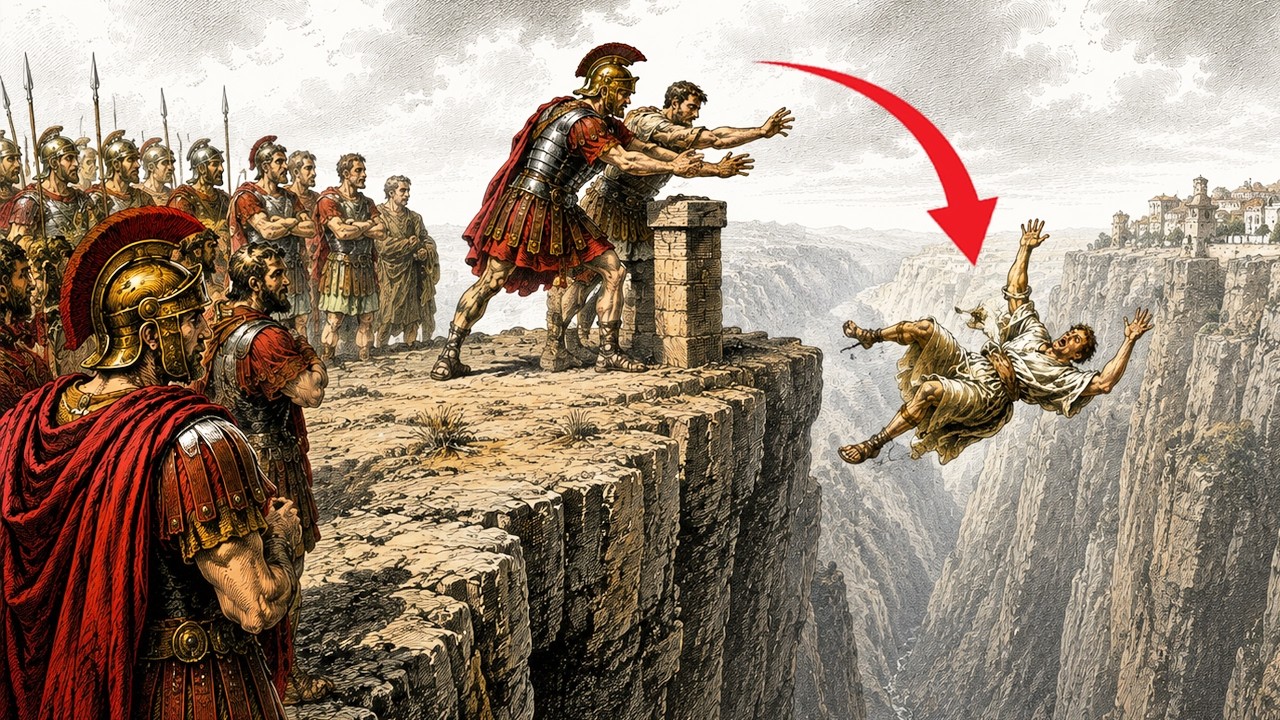
He has occupied the highest office the state can offer, and in the next ninety seconds he will be raised off the ground, carried the last few steps to a pale, rocky brink, and pitched headlong into the air. The fall below him measures roughly eighty feet—the height of an eight-story building—ending on broken rock. You are in the Forum. You can see him at the edge.
Every senator, every merchant, every slave balancing a basket on his head has frozen mid-task to watch. This is no hidden execution. It is spectacle, and Rome has constructed a stage for it that will remain in service for the next five centuries. From the first recorded case in 485 BC to the final one in AD 43, Rome will cast its enemies from this cliff for 527 years.
That outlasts the United States, outlasts the Ottoman Empire. Twenty generations of Romans came of age watching bodies drop from the same ledge, absorbing in silence precisely what it signified. Rome possessed gentler methods of killing. In the prison at the base of this hill, ordinary criminals were quietly strangled in a darkened room, their corpses hauled out with a hook.
Yet certain prisoners were denied that end. Certain ones were led from that prison, past the onlookers, up the slope to be thrown. Who were they? And what made this particular death so fearsome that Rome chose it over silence?
The rock has a name. It is called the Tarpeian Rock, after a young woman who was crushed to death on this very spot by the enemies she had sought to aid. Her tale is why the rock exists, and by the end you will grasp not only how Rome executed its traitors, but the darker question underneath: why a civilization that gave the world law, poetry, and the very concept of the republic kept a cliff at the center of its capital simply to memorialize one word—betrayal. Let us return to the start, to a young woman on a hill in Rome’s earliest days.
Rome at this stage is scarcely Rome. It is a scattering of hills, a few thousand souls, a king, and a fortress. The fortress sits atop the Capitoline Hill, the very hill from which our condemned consul will one day be hurled. And within that fortress, in this opening chapter, dwells a young woman named Tarpeia.
She is the daughter of the garrison commander, Spurius Tarpeius. In certain tellings she is a Vestal Virgin, a girl schooled since childhood to tend Rome’s sacred hearth, bound by oath to purity and loyalty. Beyond the fortress walls, an army has been encamped for weeks. They are the Sabines—not monsters, not invaders from some far-off land, but Rome’s neighbors: farmers, shepherds, and warriors from the hills just to the north, commanded by their king Titus Tatius, a man who has pressed into Roman territory over a feud that started with the abduction of a bride.
Many of them are young men who have spent a month sleeping on cold ground, far from home, at the close of a war that began—if the Roman version is to be trusted—with the theft of their women. They are hungry. They are weary. And they are studying the fortress walls for a weakness.
Tarpeia becomes that weakness. No one knows her motive. Some Roman writers claim she was lured by the glitter of Sabine gold. Others say she fell in love with their king.
What is certain is that she stole out of the fortress and proposed a bargain to Titus Tatius. She would unlock the gate for them. In exchange, she demanded—and this is the phrase Roman children would grow up reciting—what they wore on their left arms. She meant their golden bracelets.
She intended to grow wealthy. But when the Sabines pour through the gate she has opened, they honor the bargain in the most literal and savage manner conceivable. They wear their shields on their left arms as well. And so they hurl their shields upon her.
She is crushed under the weight of what she requested. Some accounts hold that she was buried on the hill. Others say her body was flung from that very cliff. Either way, the ledge on the southern face of the Capitoline carries her name: the Tarpeian Rock.
And here something remarkable occurs. Rome does not erase her. Rome does not bury the tale. Rome engraves it into the geography of the city itself.
So that every traitor after her dies in the same place where the first one died. Because to the Roman mind, a traitor did not merit death just anywhere. A traitor merited death here, precisely here. To understand why, and what ran through the minds of Romans as they threw a man from that ledge, you must look upward.
Directly above the cliff, the Romans would eventually raise the most important building in their world. Sometime in the sixth century BC, Lucius Tarquinius Superbus, the seventh and final king of Rome, launched one of the most ambitious construction projects in the young city’s history. He flattened the summit of the Capitoline Hill. He demolished the old Sabine shrines.
And on the platform he created, he started building the Temple of Jupiter Optimus Maximus—Jupiter the Best and Greatest—the holiest structure in the entire Roman world. Once finished, it commanded the city’s skyline for centuries, and its position sat directly, physically, and deliberately above the execution cliff. Consider what this means. The supreme religious authority in Rome, the god of the state, the god of victory, the god every consul swore by before assuming office—his house was built directly over the cliff from which traitors were thrown.
When the condemned man stands at the edge, the temple of the king of the gods is at his back. The last thing he passes on his way up is the threshold of the Temple of Jupiter. Every step of that walk carries a message. This is no accidental architecture.
This is theology converted into topography. Here is what ought to astonish you. The distance from the platform of the Temple of Jupiter to the brink of the Tarpeian Rock is not a mile. It is not even a hundred yards.
It takes only seconds to cover the distance. The Romans placed the dwelling of their gods so near the precipice of traitors that a gift could be carried from one to the other with no trouble at all—glory and shame at the very heart of the city, divided by nothing more than a courtyard’s breadth. They meant for you to sense that the rock was never used carelessly. It was used according to law.
A dedicated panel of judges, the quaestores parricidii, investigators of murder and grave offenses, determined who would be sent to the cliff. Common murderers, common thieves, common felons were handled in the Carcer, the state prison at the base of the same hill, where they were strangled in a dark stone room known as the Tullianum. Dionysius of Halicarnassus, writing in the era of Augustus, recounts the early custom under Romulus, the founder of Rome, noting that certain thieves were hurled from the rock. Even in Rome’s mythic origins, the cliff was already at work.
The first firmly established historical case, the first man Roman historians could identify with actual dates and actual charges, arrives in 485 BC. His name is Spurius Cassius Vecellinus. He is no petty lawbreaker. He is a patrician, a three-time consul, a man who struck treaties with foreign powers, commanded armies, and occupied the highest rank in the Roman state until only the year before.
He is in his forties or fifties, at the height of his career. A man who has spent his whole life within the machinery of Roman power and grasps it better than nearly anyone alive. And what he does next will cost him his life—not for any crime you would anticipate, but for the offense of generosity toward the wrong people. Cassius puts forward an agrarian law.
He argues that public land ought to be distributed. A portion to Rome’s poor, a portion to Rome’s allies. To a modern listener, this sounds like routine policy. To the nobles of Rome in 485 BC, it sounds like something far more sinister.
It sounds like a man purchasing the loyalty of the masses. It sounds like a man positioning himself as king. And in a republic that had, within living memory, cast out its final king, no accusation is worse than that. The Senate turns on him.
Consider the timeline. Rome had driven out its last king merely twenty-five years before Cassius’s trial. The wound of monarchy was still raw. Every senator in that chamber grew up hearing what the tyrants had done to their fathers who endured it.
A generous man, to their minds, was a dangerous man. And a dangerous man in Rome had a very particular destination awaiting him. The trial is no trivial affair. It takes place before the people themselves, the populace, the citizens of Rome assembled to watch one of the leading men of their state defend his life against the charge of perduellio, treason against the republic.
Whether Cassius spoke in defiance or pleaded, whether he asserted his innocence or stood by his reforms, we cannot say. Livy, writing centuries afterward, gives us the outline of the trial, not the words. But the outline is what counts, because Cassius faces a choice, and everyone in that assembly knows it. He can give up the land law.
He can lower his head. He can beg, and there is a chance, however slight, that a man of his stature might survive in exile. Or he can stand by what he proposed. He can maintain that granting land to the poor is not tyranny but justice.
He can compel the state to execute a former consul in public, and let the record show what Rome does to those who attempt to aid the common people. Whether this scene unfolded exactly as later historians described it, whether he spoke one memorable line or said nothing whatsoever, lies beyond our capacity to know. But the emotional reality of that moment is beyond question. Spurius Cassius did not yield, and that is why he is ascending the hill a few days later.
The formula the sources preserved is chillingly bureaucratic. Murderers, traitors, false witnesses, and thieving slaves convicted by the quaestores parricidii—that is the wording—were hurled from the cliff to their deaths. Cassius belongs to the first category. His body will fall from the same edge where Tarpeia perished, and with him the historical record of the Tarpeian Rock formally begins.
But Cassius is only the first name. Across the following five centuries, more will follow him down that road. Some will be criminals, some conspirators, and some—perhaps most disturbing of all—will be men who once saved Rome, punished for the offense of being too beloved by the wrong crowds. To grasp what happened at the Tarpeian Rock, set aside the modern picture of execution—the sudden fall, the professional killing.
This was slower, older, and more ceremonial. It started at the foot of the hill at the Carcer, a low, bleak stone structure that still stands in Rome today, in ruins. Should you visit, you can descend into the lower chamber, the Tullianum, and stand in the same gloom where the condemned awaited their sentence. When the sentence was praecipitatio, the casting down, the condemned were not put to death inside the prison.
They were led out into the daylight. Bound, escorted by the lictors, the official attendants of Roman magistrates, who bore the bundles of rods and axes that symbolized the state’s authority to punish. Then they begin the ascent of the hill, past the Forum where senators, merchants, and washerwomen pause to gawk, past the Rostra, the speaker’s platform where they may themselves have once addressed the people. This was no private walk.
It was a procession, a public ritual intended to guarantee that every citizen witnessed what befell the men who betrayed Rome. Picture the sound of it. Your footsteps on the paving stones, the clink of your chains, the murmur of the crowds behind you. Some faces you know—a neighbor, a colleague, a friend’s wife.
None of them speak. They all watch. The Roman sun on the back of your neck. If it is summer, you feel the heat of the stones through your sandals.
In winter, the wind against the exposed face of the Capitoline is sharp enough to bring tears to your eyes. And ahead of you, the road curves upward toward a temple whose columns you can already make out against the sky. Here is a detail most modern accounts omit. The condemned man was almost certainly fully conscious the entire way.
He was not drugged, his eyes were not covered, he was aware of everything. The walk itself, the exposure to the gaze, the humiliation, the recognition of faces in the crowd, was part of the punishment. Death at the cliff was the ending. The walk was the story.
There is no more agonizing, stranger, or purely Roman tale than that of Marcus Manlius Capitolinus. Around 390 BC, an army of Gauls under a chieftain named Brennus did the unthinkable. They sacked Rome. Almost the entire city fell.
Just one stronghold refused to fall: the Capitoline citadel, the very hill beneath our feet, the final defensive point in the whole Roman world. One night the Gauls tried a quiet assault up the slope. They came within a breath of succeeding. It was not a sentry who roused the defenders.
It was Juno’s sacred geese, and their panicked cries reached one man, Marcus Manlius, a soldier who had fought across Italy and understood in his gut what the loss of that hill would mean. He ran to the wall and hurled the first Gaul over the edge. He saved Rome. In return he received the name Capitolinus, meaning “son of the Capitoline.”
He was Rome’s hero in the flesh. Then, a few years on, he repeated the error Cassius had made. He saw the common people, his own fellow citizens crushed by debt and sold into slavery for missing payments, and he tried to help. He cleared some of their debts out of his own purse.
He denounced the cruel treatment of the poor. And by doing so, he started to appear to the nobles not as a hero but as a man purchasing himself an army of devoted followers. A king in waiting, in other words. Read that again.
The man who flung a Gaul off the Capitoline Hill to save Rome was flung off that same hill by Rome inside a decade. The ground he had defended turned into the stage for his execution. The Romans did not overlook this irony. They arranged it.
Manlius was brought to trial. The first assembly, convened within sight of the Capitoline, could not bring itself to convict him. His monument, the hill he had saved, stood visible to the jurors and softened their verdict. So the trial was relocated.
It resumed outside the city, on ground that held none of his glory. There, beyond sight of the capital, the vote turned against him. He was marched back into Rome, up the hill he had defended, and cast from the Tarpeian Rock. His house on the Capitoline was torn down.
His family was barred for generations from using his first name, Marcus. Rome set out to scrub him from memory. With Cassius and Manlius, the pattern takes shape. The Tarpeian Rock is not simply a place for ordinary enemies.
It is reserved for a very particular kind of enemy—the Roman who grows too popular with the poor, the commander too beloved by his troops, the reformer who upsets the balance of the state. It is a cliff set aside, above all, for the crime of ambition. And across the next three centuries it will be used again and again on men whose only fault was being loved by the wrong people. Modern historians, sifting through Livy and Dionysius and other sources, tally roughly fifteen documented cases of the rock being used or threatened between the Second Punic War and the age of Claudius.
Fifteen cases we can name. The true number across five centuries is surely larger. Many cases appear only in passing. Soldiers who fled during Hannibal’s invasion of Italy were hauled back and thrown from it.
Slaves caught in unmistakable theft were thrown. False witnesses who lied under sacred oath were thrown. And each of them walked the same route up the hill, past the crowd, to the ledge beneath the temple. But everything described so far—the walk, the crowd, the edge—is only the public spectacle.
It is only the machinery. To grasp the dark reason Rome sustained this practice for five hundred years, you must stand at the edge itself and see what unfolded in the final seconds of a traitor’s life. The precise location of the execution edge on the Capitoline Hill is still debated today. Varro, the great Roman scholar of the first century BC, placed it near the Temple of Jupiter.
Dionysius of Halicarnassus said it lay on the southeastern face above the Forum. Modern archaeologists suspect the name Tarpeian Rock may have described a broader stretch of cliff rather than one single ledge. What no one disputes is the height from the edge down to the rocks below. It is a drop equal to eight stories onto uneven, unforgiving stone.
Stand at that edge in your mind. The rock is pale, worn, split in places. Beneath you the Roman Forum spreads out. The temples, the Senate house, the market stalls, the winding streets, the smoke of a hundred cooking fires.
From this height you can see the entire city you grew up in. If it is noon, you can see the people gazing upward. You can see them waiting. Then hands come to rest on your shoulders.
They belong to the executioners, usually public slaves assigned to the task. Men who do this work not from cruelty but because it is their job. They say nothing to you. They do not need to.
The fall itself lasts a little more than two seconds. In those two seconds a human body speeds up from stillness to nearly forty miles per hour. There is no controlled landing. There is no surviving it.
The rocks at the base are jagged, bare, and crucially in view from the Forum. That last detail is no accident. Rome could easily have walled off the foot of the cliff. Rome could have removed the body quickly.
But Rome did neither. The whole point of the Tarpeian Rock was that everyone should see where you fell. Here the darkest logic of the practice becomes plain. Strangulation in the prison at the foot of the hill was quick, private, and above all tidy.
The body was then hauled out with a hook and disposed of without ceremony. The rock was the exact opposite. It was slow, public, and messy. A body dropping eighty feet onto stone does not rest there peacefully.
It is broken. It is on display. And by leaving it visible at the base of the cliff, sometimes for hours, Rome made sure the punishment did not stop at death. It carried on in the memory of everyone who walked past.
There is a Roman concept for which we have no exact English word. The word is infamia—public disgrace, the loss of civic honor—and the Tarpeian Rock was, above all else, a machine for producing disgrace. Its purpose was not simply to kill you. Rome had cleaner ways to kill you.
Its purpose was to guarantee that after you died, no one would ever speak your name with respect again. In the first century BC, the orator Marcus Tullius Cicero, a man who would himself later be killed by the state, though not from the rock, was arguing a case. And midway through his speech he reached for an image everyone in the courtroom would grasp. He warned, in a phrase later writers preserved, that the distance between the Capitol and the Tarpeian Rock was very short.
He was not speaking poetically. He was entirely serious. From the summit of Rome’s glory to the edge of its disgrace was a matter of a few seconds, and every Roman knew it. Consider how strange that is.
Most civilizations keep their holy ground apart from their places of disgrace. The temple sits on the hill, the execution site lies elsewhere, hidden from view. Rome did the reverse. Rome placed both on the same hill.
Rome built the temple of the king of the gods directly above the cliff of traitors, and Rome maintained that arrangement for centuries, even after the practice of hurling men from the rock faded, because the arrangement itself carried the message. Honor and disgrace were not far apart. They were neighbors, divided by a few steps, or a single misstep. By the late Republic, in the century of Cicero, Caesar, and Pompey, the rock was being used more as a political weapon than a routine legal one.
Agitators threatened their enemies with it in speeches. Conspirators, when one of them was convicted, sometimes ended up there. It was the perfect way to strip a Roman of everything he had stood for—when a senator was thrown from that cliff, he was not merely killed. He was officially declared an enemy of the state, ranked lower than an ordinary criminal.
His name was struck from monuments. His family inherited disgrace instead of property. But the rock did not kill only senators. This is what most modern accounts get wrong.
The Tarpeian Rock, in its long history, was an equal-opportunity killer. To understand what Rome was really aiming at with this cliff, you have to look at the executions history almost forgot. Because among the famous names, the consuls, the reformers, the imperial conspirators, there were others. People who left no letters, people whose trials filled no pages.
People whose deaths at the rock were recorded, if at all, in a single legal phrase in a treatise no one reads. And in a way, their stories tell you more about why the rock existed than any senatorial downfall ever could. Sometime in the middle of the Republic, the exact year lost, a slave in Rome was caught stealing. The Latin term is furtum manifestum, theft in which the crime is beyond argument.
The slave is caught with the stolen goods in his hand. He is not from Rome. He may be from Gaul or Greece or Syria or North Africa. He was brought to the city in chains as a child, sold in the market, set to work in a house or workshop.
He is not a political actor. He poses no threat to the state. He has committed, by any modern standard, a crime against property. Under Roman law, a slave was not a person.
A slave was a piece of property capable of speech. Yet Rome chose in this case to end his life not by beating, not in the shadows of his master’s house, but by the same ritual it used for former consuls. The procession walked him up the same hill. He climbed the same steps.
He stood on the same edge. Because for Rome at that moment, the slave who betrayed his master’s trust and the senator who betrayed the republic’s trust had done the same thing. They had both betrayed the system, and whatever kind of betrayal it was, its fate was the cliff. This is the darkest reason.
And this is what most accounts of the Tarpeian Rock miss. Rome did not reserve this cliff for traitors in the political sense we imagine, spies or conspirators or foreign agents. Rome reserved this cliff for everyone whose crime, in Roman eyes, was a betrayal of trust. The soldier who fled battle had betrayed his oath.
The slave who stole had betrayed his master. The oath-breaker had betrayed the gods. The senator who courted the mob had betrayed the Senate. Different crimes, but the same category.
And therefore, the same punishment. During Hannibal’s invasion of Italy, in the Second Punic War in the late third century BC, Rome faced the worst military crisis in its history. Entire armies were annihilated. Soldiers fled in panic.
And when the war finally turned, Rome rounded up the deserters and condemned some of them to death from the rock. Imagine that point of view. You are a farm boy from Campania or Etruria. You were conscripted.
You watched your friends killed by Carthaginian cavalry. You ran. And now, years later, you are climbing the same hill a former consul climbed, to face the same execution at the same edge. This is the message Rome wanted to carve into the mind of every citizen.
The rock did not care who you were. Consul or slave, hero or thief, senator or soldier—if you betrayed trust, the path was the same. That was the promise the Tarpeian Rock offered. And that is why it lasted five hundred years.
The rock fades. It was not destroyed in battle. It was quietly replaced by Augustus, the first emperor, who kept the old titles, the old buildings, the old rituals, but emptied them all of meaning. You might expect, under this new order, that a republican institution like the Tarpeian Rock, the place where the people condemned their enemies, would disappear.
There is no longer a republic to betray. There is only the emperor. Yet the rock does not fade. It continues because the emperor is very happy to use it.
Under Tiberius, the second emperor, the Praetorian prefect Lucius Aelius Sejanus rises to immense power. For years he is the second man in the empire, feared by senators, courted by ambitious families. Then, in AD 31, he falls. Tiberius turns on him.
Sejanus is executed. His allies, the men who rose with him, staked their careers on him, married their daughters into his family, are hunted down. Some are strangled. Some are exiled.
And the sources tell us at least one was condemned to death from the Tarpeian Rock. A man of the empire, condemned by an emperor, killed by a punishment invented for the enemies of a republic that no longer existed. Think about what that means. Rome’s political system had changed completely.
The Senate had been hollowed out. The people had lost their power to vote in trials. The world of the old Republic was gone. But the cliff remained.
Because the message the cliff carried, that betrayal would be met with public disgrace, was a message every regime, republican or imperial, wanted to send. The last recorded execution comes twelve years later. The year is AD 43. The emperor is Claudius, the stumbling, muttering, scholarly surprise who was dragged from behind a curtain to be made emperor by the Praetorian Guard.
Early in his reign, a man was convicted of treason against him. His name is lost. The charges are lost. But the sentence is not.
He is led up the hill. He is marched before the crowds. He is thrown from the Tarpeian Rock. Five hundred and twenty-seven years from Spurius Cassius in 485 BC to this unknown man in AD 43—one cliff, one fall, one message.
After AD 43, the historical record falls silent. The rock does not disappear. It is still there. Still mentioned in speeches, letters, and legal texts, still standing on the southern face of the Capitoline Hill, still visible from the Roman Forum.
Yet something had shifted. The emperor’s enemies were now put to death more and more in silence, indoors, behind the doors of the palace. The empire was learning that killing needs no audience. It can be carried out more efficiently, with less danger of the crowd taking sides, if it happens where no one can watch.
So the rock stops being a place and turns into a memory, a figure of speech. But the rock had already finished its task. For more than five hundred years, it had shaped Rome’s idea of what a traitor was. And the meaning it carved into the geography of the city would survive the Republic, survive the Empire, and in certain ways survive Rome itself.
To grasp that, we have to examine what the rock left behind. Let us go back for a moment to AD 43, to that unknown man on the brink beneath Claudius. He is the last one we know of, and because he is the last, he has turned into a kind of accidental monument. He has no idea.
Standing on that stone, he is not pondering how history ends. He is pondering the fall, who is watching, whether his family will be permitted to bury him. And then he is pondering nothing at all. The Roman custom of hurling traitors from the Tarpeian Rock, born in the eighth century BC, comes to an end with him.
Twenty generations of Romans came of age under this custom. Twenty generations understood what the phrase “the Rock” meant without any need for explanation. Grandfathers told their grandchildren what had befallen a man who broke his word. Then, inside a single lifetime, the practice ceased.
Not because Rome had grown merciful. Rome had not. But because Rome had discovered quieter ways to accomplish the same task. The complete record of the Tarpeian Rock, as far as historians have managed to reconstruct it, covers five centuries of falls.
That figure is surely a minimum. It counts only the cases where a known source in a surviving text tied a particular person to this particular cliff. The true number—counting the deserting soldiers thrown in groups, the slaves whose executions were recorded as a single legal phrase, and the political conspirators forgotten in fragmentary chronicles—was certainly larger, perhaps far larger. We count only those whose falls history took the trouble to write down.
And so, here is the answer to the question we started with. Why did Rome keep up, for more than five centuries, a form of execution slower, messier, and more public than any alternative? Because Rome was not simply trying to kill traitors. Rome could have killed traitors in any number of ways.
Rome was trying to erase them. Strangulation in the Carcer put an end to a life. The fall from the Tarpeian Rock put an end to a life and a reputation. The body was broken publicly, in full view of the crowd, at the foot of the sacred temple, so that the memory of the man became inseparable from the disgrace of his death.
His descendants would carry that shame. His name would be chiseled off monuments. His family was forbidden to use his first name. That was the point.
The killing was the simple part. The humiliation was everything. Understand what this reveals about how Rome thought. In a society with no prisons for long sentences, no televised trials, no newspapers, the state needed a way to fix its authority in the imagination of every citizen.
It had to ensure that whenever any Roman thought of breaking an oath, robbing his master, or conspiring against the Senate, one image came to mind—the image of the cliff. And it needed that image to be so vivid, so specific, so bound to a real place in the real city, that no one could ever forget it. That is what the Tarpeian Rock was. Rome’s memory of what happened to a traitor, cut into the side of a hill.
Consider what became of the men we have met. Spurius Cassius Vecellinus, the three-time consul, the agrarian reformer, the first name in the record, did not merely die. In the years after his execution, later Roman reformers, above all the Gracchi brothers centuries afterward, were compared to him as a warning. His name became synonymous with dangerous ambition.
It was still being used to threaten men more than three hundred years after his death. That is what the rock made possible. Marcus Manlius Capitolinus, the man who saved the Capitoline from the Gauls, was punished even beyond death. His house on the Capitoline, where he first heard the sacred geese, was torn down.
His family, the Manlii, made a formal decision that no son of the family would ever bear the name Marcus again. The name itself was too dangerous. It carried too much of what had become of him. One of Rome’s heroes became, by the will of his own sons, deliberately forgotten.
The unknown slaves, the deserting soldiers, the followers of Sejanus, the last man under Claudius—none of them has a grave you can visit. Most of them have no names in the historical record. Their falls are footnotes. But the cliff they fell from is still there.
If you go to Rome today, you can walk to the southern side of the Capitoline Hill and stand at its base. The rock is a real place. And it is still counting its victims. But the end of the practice was not the end of the story.
Because the Tarpeian Rock—the place, the name, the idea—outlived every regime that used it. And what it became in the centuries after the last body fell is arguably more important than what it was while it was in use. By the late first century AD, the executions had stopped, but the rock was going nowhere. It sat on the southern face of the Capitoline for the next two thousand years, watching the empire rise and fall around it.
When Rome was sacked in AD 410 by the Visigoths, the rock was there. When the Roman Empire collapsed in the West in AD 476, the rock was there. When the popes rebuilt the city, when the Renaissance came, when Napoleon marched through Rome, when the modern city was built layer upon layer over the ancient one, the rock was there. Standing.
Waiting. Empty. Here is something most accounts of the story miss. The Tarpeian Rock you can visit today, the exposed cliff face on the southern side of the Capitoline, is not exactly the edge the Romans used.
Two thousand years of urban development—medieval buildings, Renaissance construction, modern streets—have raised the ground level at the base of the hill by several meters. What was once an eighty-foot drop onto bare rock is now a much shorter fall onto a level of the city that did not exist when Cassius and Manlius were thrown. The killing edge, in the literal sense, has been buried under the rubble of history. You can stand on the cliff, but you can no longer see what a Roman would have seen looking down.
And still, what took place there lives on in the words we use today. When Cicero cautioned that the gap between the Capitol and the Tarpeian Rock was hardly worth measuring, he was doing more than mapping the city of Rome. He was describing the very character of power—how swiftly the honored turn into the condemned, how the very crowd that raises a leader up can, a few weeks later, stand and watch him drop. That notion, dressed in many forms, has been repeated by statesmen, historians, and writers across two thousand years.
Whenever someone remarks on how narrow the divide is between glory and disgrace, they are—knowingly or not—echoing a Roman cliff. For that, in the end, is what the Tarpeian Rock amounted to. It was not a punishment, not truly. Rome had harsher ways to kill.
Nor was it a deterrent. Deterrents operate silently, away from view. It was something odder and grimmer than either. It was a mirror—a mirror of stone and landscape set at the center of the city, impossible to overlook, telling each Roman a single truth about himself.
It said: you are only one poor choice from that ledge. The consul, the slave, the soldier, the hero hurled from his own stronghold, the girl whose name the rock still carries—every one of you. And that mirror is the reason Rome left it standing, untouched, for centuries after the final body dropped. The temple of the gods gazing down on the execution cliff, and between the two, the entire tale of Roman power told in a handful of steps.
Trace it back one final time to the start, to the man with bound hands being marched up the hill in the fifth century BC. He was, as we noted at the outset, a former consul. He had stood at the pinnacle of the state, and within the next ninety seconds he would fall. What you know now, and did not know then, is that the fall itself was not the punishment.
The fall was swift. The punishment was the climb, the crowd, the temple at his back, and the dawning awareness that everything he had built would end on a ledge named for a girl who died before Rome was Rome. The rock was not killing him. The rock was wiping him out.
The Romans grasped something most civilizations let slip. Slaying an enemy is simple. Any system can manage it. But erasing an enemy—making certain that no one speaks his name centuries after he dies except in contempt—that demands ritual.
That demands geography. That demands a cliff at the heart of your city, a temple above it, and a path running between them that every soul in the city can see. That is what the Tarpeian Rock truly was. Not a site of death, but a site of forgetting.
And the fact that we are still discussing it twenty centuries after it ceased to be used is the final quiet evidence that Rome, despite all its brutality, could never quite succeed in making the men on that cliff vanish.
