Christine Granville died in a London hotel, stabbed to death in a narrow corridor by a man she had repeatedly rejected. George Muldowney, a ship’s steward whose obsessive love had curdled into rage, was arrested soon afterward and confessed. The date was June 1952. The woman he killed had once been Christina Skarbek, and in a previous life she had been one of the most daring spies of the Second World War, a favorite of Winston Churchill, decorated with the George Medal and the Order of the British Empire, and celebrated across the Allied secret services as a woman who slipped past the Gestapo with a smile and a lie.
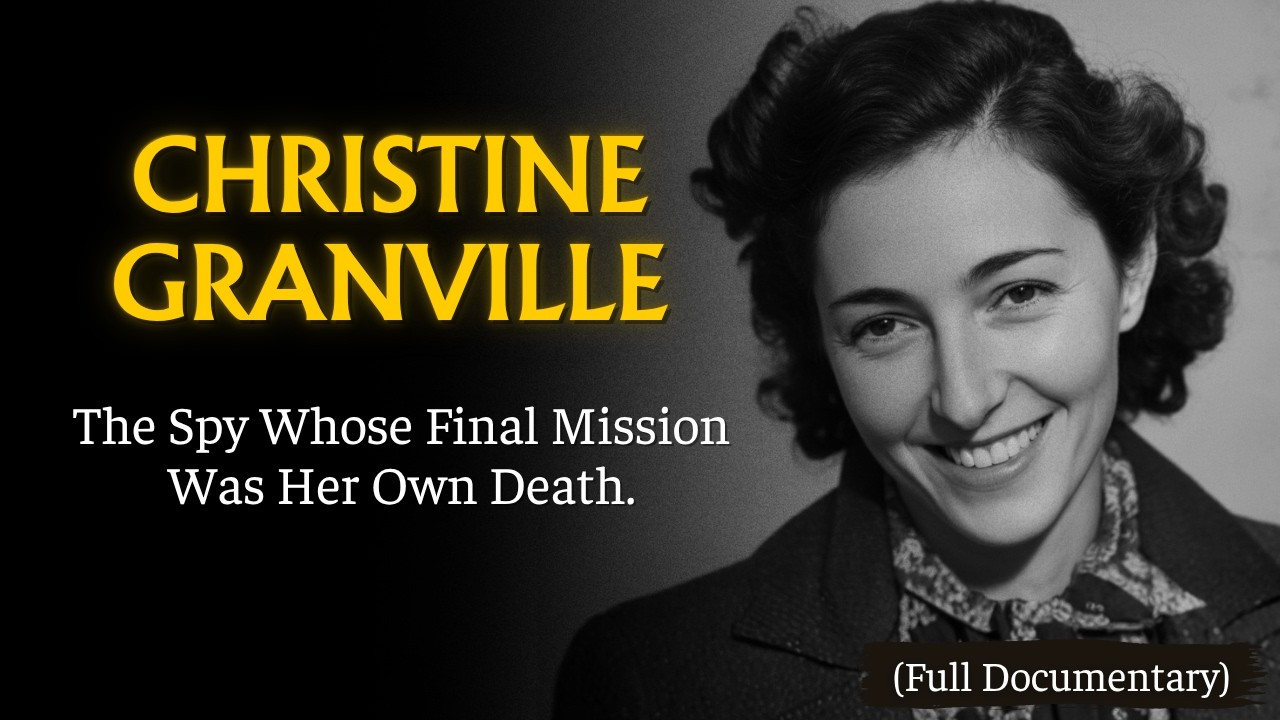
The newspapers gave her passing a few lines. The world had already forgotten her. She was born in 1908 into a Poland that had been erased from the map for over a century, its lands divided among empires. Her father, Count Jerzy Skarbek, was a nobleman whose fortune was wasting away, and her mother, Stefania, was of Jewish descent, a fact that would grow more dangerous as Europe darkened.
The family estate was decaying. Christine learned to ride almost as soon as she could walk, and she learned early that fear was a choice. Stories tell of her placing her bare leg on a hot stove to prove she would not be cowed, a tale that may have grown in the telling but still captures the defiant spirit that shaped her life. Her first two marriages failed, the second taking her to Ethiopia as the wife of a diplomat, but no conventional life could hold her.
She was beautiful, restless, and reckless. Polish independence had returned in 1918, but by the late 1930s the country was caught between Nazi Germany and the Soviet Union. When the German armies smashed into Poland in September 1939, Christine did not flee into despair. She fled toward a fight.
She made her way through Hungary and then to France, and finally to Britain, where she presented herself to the new secret organization that Churchill had ordered into existence, the Special Operations Executive, created to set Europe ablaze through sabotage and subversion. She was among the first women recruited. Her new name, Christine Granville, became her weapon. Training taught her codes, weapons, and disguise, but her real talent was improvisation.
She moved across borders with forged papers and the ability to make anyone believe anything. She crossed the mountains into Hungary and Poland, carrying messages, leading fugitives, and freeing prisoners. One of her most important accomplishments was convincing authorities that captured agents were valuable collaborators rather than enemies, persuading them to release men who would otherwise have died. She smuggled out intelligence about German intentions on the Eastern Front.
She walked through checkpoints armed only with charm, deflecting suspicion with a sudden laugh or a flirtatious glance. Her fearlessness seemed unnatural, and her successes were so consistent that even doubters stopped questioning her methods. In France, she parachuted into occupied territory to support resistance networks. She helped coordinate weapons drops, sabotage, and escape routes, always moving, always smiling, never allowing hesitation to slow her steps.
She carried cyanide in her teeth and came close to using it more than once. Her name spread among the Gestapo, who hunted her without success. By the end of the war, she was one of the most decorated female agents of the conflict. Then victory came, and the war ended, and her world collapsed.
The secret services were dissolved. The networks were dismantled. The agents were dismissed. Christine, who had risked everything, was no longer needed.
Her homeland was swallowed by Soviet control. Britain, which had honored her, offered her no permanent place. She took work as a stewardess on ocean liners, then in hotels and shops. She moved from job to job, country to country, lover to lover.
Her beauty faded. Her loneliness deepened. She had lived so intensely that ordinary life felt like imprisonment, and her restlessness, once her greatest strength in war, became a punishment in peacetime. George Muldowney met her during her years at sea.
He fell in love with her, or believed he did, and his devotion turned possessive. Christine rejected him firmly, but he could not accept it. He followed her, hovered near her, became a shadow she could not escape. Friends warned her, but she had survived the Gestapo.
She did not take him seriously. In the summer of 1952, she was staying at the Shelbourne Hotel in London. On the night of June 15, he confronted her in the dim corridor. What was said is not known.
What happened is certain: he stabbed her, and she died on the floor of the hotel hallway. The police arrived too late. Her grave in London is modest, and the rain that falls on it is the same rain that once fell on the Polish fields of her childhood. Her medals lie in drawers.
Her story faded quickly from public memory. But those who knew her remembered. They remembered the woman who crossed mountains with messages sewn into her coat, who laughed at interrogators, who freed prisoners from death, who refused to bow to tyranny or custom. She lived without compromise, and she died alone, undone not by an empire or an army but by a single man whose love had become destruction.
It was an end unworthy of her life, but her life itself remains extraordinary, a reminder that heroism is rarely tidy, rarely rewarded, and never simple.
