In April of 1945, as the Third Reich collapsed around them, Heinrich Himmler and his wife Margarete spent time together with their daughter at the family’s lakeside residence in Gmund am Tegernsee. They were ordinary days on the surface, a husband and wife and child sharing a final stretch of time as the empire that had defined their adult lives disintegrated. It was the last time Margarete Himmler would ever see her husband alive. Within weeks, the Reichsführer SS, the man who had built the SS from a small bodyguard unit into an apparatus encompassing the Gestapo, the concentration camps, and the machinery of the Holocaust, would be dead by his own hand.
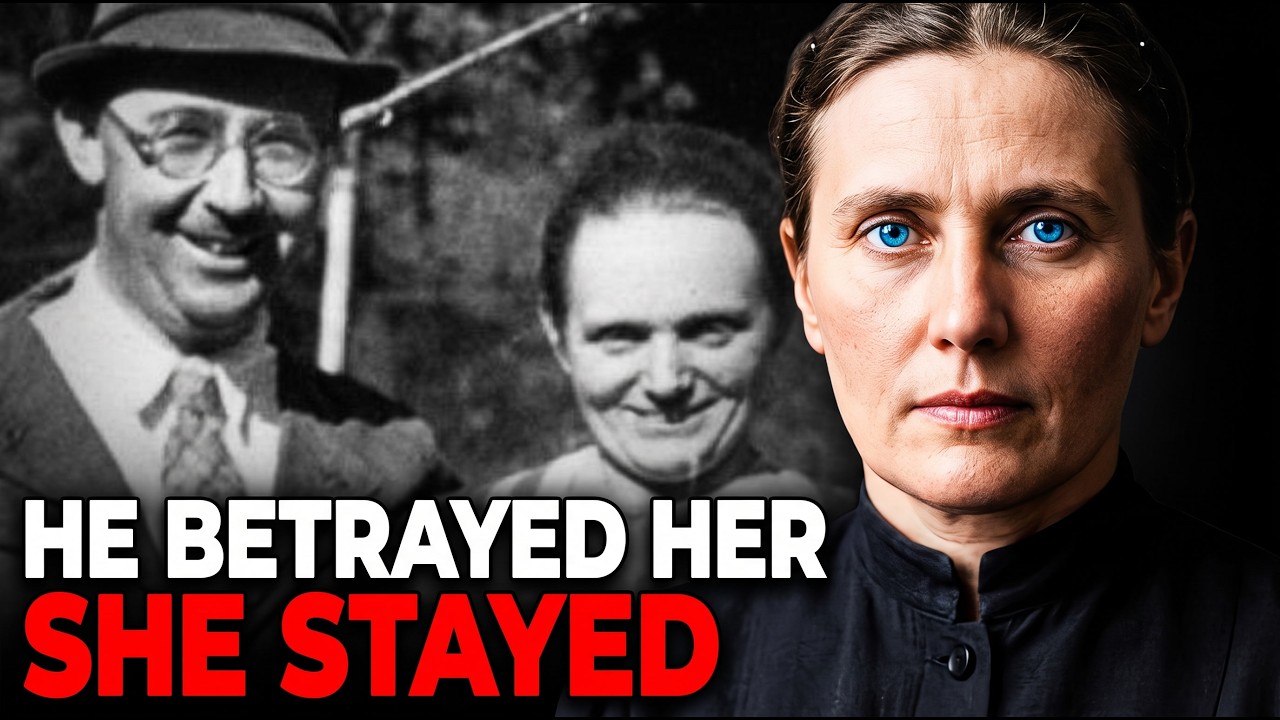
His wife, however, would not follow the path taken by the other women married to the Nazi elite. There would be no cyanide capsule, no dramatic bunker finale, no Nuremberg gallows. Margarete Himmler would simply endure, living out the last twenty years of her life in quiet provincial obscurity, doing laundry in her sister’s household in a small German town. To understand how she arrived at that strange, almost anticlimactic fate, it is necessary to go back to her beginnings.
Margarete Boden was born on the 9th of September 1893 in the small settlement of Gonkartszawie near Bromberg in West Prussia, then part of the German Empire and today the Polish city of Bydgoszcz. She was the daughter of Hans Boden, a landowner of comfortable means, and his wife Elfride, whose maiden name was Popp. Margarete grew up in a household with three sisters, Alfreda, Lydia, and Paula, along with a brother, in a rural, conservative, distinctly Protestant environment far from the political currents that would later define her adult life. In 1909, at the age of sixteen, she began attending a secondary school for girls in Bromberg, an institution that prepared daughters of the landowning and professional classes for lives as wives and mothers, and increasingly in that era, as trained professionals in fields considered suitable for women.
For Margarete, that field would be nursing. When the First World War broke out in 1914, she trained and began working as a nurse, tending to the wounded pouring back from the eastern and western fronts in numbers that overwhelmed Germany’s medical infrastructure. It was grueling, unglamorous work that exposed a young woman to suffering and death years before she could have imagined she would one day be married to a man who would industrialize suffering on a scale the world had never witnessed. Toward the end of the war, she took a further posting at a German Red Cross hospital, continuing in medical service even as the German war effort collapsed and the empire she had been born into dissolved into revolution and a fragile new republic.
Somewhere along the way, likely in the years immediately following the war, Margarete married for the first time. Little detail survives about this first marriage beyond the fact that it was brief, produced no children, and ended in divorce at a time when divorce still carried significant social stigma in Germany, particularly for a woman raised in a conservative Protestant household. With the financial backing of her father, Margarete used the postwar years to establish herself professionally. She became part owner and operator of a small private nursing clinic in Berlin, a business venture that gave her both an income and a measure of independence unusual for a divorced woman in Weimar Germany.
She was by multiple accounts a serious, businesslike, and rather severe woman, someone who valued order, efficiency, and thrift above almost anything else. It was in 1927 that Margarete Boden’s path crossed with that of a rising figure in the National Socialist movement, a bespectacled former agricultural student and chicken farmer named Heinrich Himmler, seven years her junior, who was at the time serving as Gauleiter, or district leader, of Lower Bavaria for the still marginal Nazi Party. The two met during one of Himmler’s lecture tours, and from that meeting they began a correspondence that would blossom slowly and somewhat awkwardly into a courtship. In one surviving letter, Margarete referred to him as “the Landsknecht with the hard heart,” invoking the image of the mercenary soldiers of early modern Germany.
It was a description that suggested she saw in him a kind of stern, soldierly reserve rather than warmth, and one that in retrospect reads as an oddly prophetic assessment of the cold, disciplined, and ultimately murderous bureaucrat her fiancé would become. And yet she was, by her own account, impressed by his romantic style of writing and by what she took to be his sincere feelings for her. For his part, Himmler was drawn to Margarete’s appearance and manner in ways that mapped disturbingly well onto the racial ideology he was already deeply immersed in. She was blonde and blue-eyed, and to his eyes represented something close to his fantasy of Nordic womanhood, even though, as one biographer later observed, there was a width to her face and frame more suited to the heroines of Wagnerian opera than to the slender ideal the Nazi Party would later promote in its propaganda.
The two shared other affinities. Margarete was deeply interested in herbal medicine and homeopathy, subjects that fascinated him throughout his life. Both valued efficiency and neatness to an almost obsessive degree, and both preferred a frugal, parsimonious lifestyle even as Himmler’s political star began to rise. From her future husband, Margarete also absorbed a steady diet of antisemitic rhetoric and conspiratorial diatribes against communists and Freemasons.
In a letter to Himmler dated the 22nd of June 1928, Margarete made viciously disparaging remarks about Bernhard Hauschild, the Jewish gynecologist and surgeon who co-owned her Berlin clinic, exclaiming that Jews were all the same. This was not a woman swept along passively by a fanatical husband. She arrived at the marriage already primed for the ideology that would come to define both their lives. Heinrich and Margarete Himmler were married in July of 1928, but the union was not without friction from its very first steps.
Himmler struggled for a considerable time with how to reveal the relationship to his own parents. Margarete was seven years older than Heinrich, itself a point of awkwardness in a culture with rigid expectations about gender and age in marriage. She was a divorcée carrying the social stain of a failed first marriage, and perhaps most damning in the eyes of the devoutly Catholic Himmler family, she was a Protestant. When the wedding finally took place, not a single member of Himmler’s family attended.
Heinrich’s own groomsmen at his wedding were instead Margarete’s father and brother, standing in for a family that had effectively boycotted the ceremony in protest. Eventually, Himmler’s parents came to accept Margarete’s presence in their son’s life, but they never grew close to her, keeping a careful, permanent distance that persisted for the rest of the relationship. The couple’s only biological child, a daughter named Gudrun, was born on the 8th of August 1929, just over a year after the wedding. Heinrich adored her, nicknaming her Püppi, meaning dolly, and maintaining a closeness with her that stood in sharp, telling contrast to the distance that grew between himself and Margarete.
The couple also took in a foster son, Gerhard von Ahe, the child of an SS officer who had died before the war. Margarete sold her share of the Berlin clinic and used the proceeds to purchase a plot of land in Waldtrudering near Munich, where the couple erected a prefabricated house and attempted with limited success to raise livestock for sale. The endeavor fell mostly to Margarete, since Himmler was constantly absent, consumed by the demands of building the SS. After the Nazis seized power in January of 1933, the family’s fortunes and living arrangements shifted rapidly.
They first moved to Möhlstrasse in Munich, then in 1934 relocated again to the town of Gmund am Tegernsee in Bavaria, where they purchased a house that would remain closely associated with the family for years to come. Later, as Himmler’s power and status continued to grow, he was granted free of charge a large official residence in the affluent Berlin suburb of Dahlem. But the more Himmler’s official duties expanded, the less the couple actually saw of one another. Margarete, left largely alone with their daughter, increasingly took on the role of a woman managing a household and a public image in her husband’s near-permanent absence.
That public image was by nearly every surviving account a disaster. Margarete Himmler tried with genuine effort to fulfill the social obligations expected of the wife of a senior Nazi leader. She made it her particular duty to invite the wives of other high-ranking SS officers to her home for coffee and tea on Wednesday afternoons, attempting to build the kind of social network among Nazi wives that women like Emmy Göring managed to construct with apparent ease. But Margarete’s efforts largely failed.
Despite occupying one of the more prestigious positions available to a woman in the SS social hierarchy as the wife of the Reichsführer SS himself, she remained deeply unpopular among the circle of senior Nazi wives. Heinrich’s own older brother, Gebhard Himmler, offered a blunt assessment of his sister-in-law, describing her as a cool, hard woman with extremely delicate nerves who radiated no warmth at all and spent altogether too much time complaining. And yet Gebhard also conceded that for all her coldness, Margarete had proven an exemplary housewife, one who devotedly loved her husband and remained loyal to him even as the marriage cooled. During the Nuremberg party rally of 1938, tensions between Margarete and the wives of the other senior SS leaders came close to open conflict, with the assembled women refusing as a group to take direction from her despite her formal status as the most senior wife present.
Among her fiercest critics was Lina Heydrich, wife of Reinhard Heydrich, the ruthless chief of the Reich Security Main Office. According to Heydrich’s biographers, Lina harbored what has been described as a violent dislike of Margarete Himmler, a hostility that appears to have been entirely mutual. After the war, in an interview with a reporter from the German magazine Der Spiegel, Lina Heydrich offered her own withering verdict, describing Margarete as a narrow-minded, humorless, blonde-haired woman. Other accounts suggest Margarete also suffered from agoraphobia, a fear of open or crowded spaces that would have made the very social functions expected of her uniquely difficult to endure.
The gulf between Margarete Himmler and a woman like Emmy Göring could hardly have been wider. Emmy Göring, wife of the Luftwaffe chief Hermann Göring, embraced her role as what she liked to call the first lady of the Third Reich with unrestrained enthusiasm, hosting Hitler at glamorous state functions, adorning herself in jewels and furs plundered from the estates of Jewish families, and living amid a personal fortune of mansions, castles, and confiscated art spread across Austria, Germany, and occupied Poland. When her daughter Edda was born in 1938, Hermann Göring ordered a tribute of 500 aircraft to fly over Berlin in celebration, reportedly boasting that he would have doubled the number had the child been a boy. Margarete Himmler’s life offered no such spectacle.
There were no confiscated castles, no personal fortunes flaunted at state banquets, no fleet of aircraft marking the birth of her daughter. Instead, there was a modest prefabricated house on a plot of land in Waldtrudering, a failed effort to raise livestock, and a husband who was almost never home. Margarete’s formal commitment to National Socialism predated her husband’s rise to real power by years. She joined the Nazi Party as early as 1928, the same year she married Heinrich, receiving party membership number 97,252, a relatively low number that placed her among the movement’s earlier adherents rather than the flood of opportunistic joiners who signed up only after the party’s electoral breakthroughs of the early 1930s.
This detail matters because it undercuts any suggestion that Margarete was simply a wife dragged passively into her husband’s political world. She was from the very start of the marriage an ideological participant in her own right. The contrast with Ilse Hess, wife of Hitler’s deputy Rudolf Hess, is instructive. Ilse, like Margarete, joined the Nazi Party early and remained a devoted, unwavering believer in National Socialism for the rest of her life, never renouncing the ideology even decades after the war’s end.
But Ilse Hess became a fixture in the mythology of Nazi loyalty, standing by her husband through his bizarre solo flight to Scotland in 1941 that ended with Rudolf Hess’s capture and lifelong imprisonment. Ilse spent decades after the war campaigning publicly for her husband’s release from Spandau prison, writing a memoir, and cultivating a network of correspondents that included known admirers of Hitler. Margarete Himmler, despite an ideological commitment that was, if anything, more deeply rooted and less dependent on her husband’s influence than Ilse’s, never became any kind of public figure at all, neither during the war nor after it. She generated no memoir, no decades-long public campaign, no recognizable place in the postwar imagination of Nazi wives.
Part of the explanation lies in personality, and part of it lies in circumstance. Margarete’s rigid, humorless temperament made her a poor candidate for the kind of public sympathy that other Nazi wives managed to generate after the war. But unlike Rudolf Hess, whose decades of imprisonment at Spandau turned him into an object of ongoing public fascination, Heinrich Himmler died within days of the war’s end by his own hand before he could ever face the kind of prolonged trial that might have kept his name in newspapers for years afterward. There would be no decades-long campaign for Heinrich Himmler’s release because there was no Heinrich Himmler left to campaign for.
By the middle years of the 1930s, as Heinrich Himmler’s SS grew into the sprawling apparatus of terror that would eventually encompass the Gestapo, the concentration camp system, and the machinery of racial extermination, the emotional core of his marriage to Margarete was already hollowing out. Contemporary accounts describe a household increasingly defined by absence rather than presence, by long stretches in which husband and wife occupied entirely separate spheres of existence connected mainly by correspondence and formal appearances. Margarete busied herself with the management of their properties, raising their daughter Gudrun and their foster son Gerhard largely without the involvement of a father who was rarely present. She maintained her interest in homeopathy and herbal remedies, continued to embrace the frugal, disciplined lifestyle that had first drawn Heinrich to her, and by all appearances settled into a role that was less that of a political partner and more that of an increasingly isolated provincial housewife who happened to be married to one of the most powerful and feared men in Europe.
Margarete’s own writings from this period, preserved in a private diary she kept intermittently from 1937 through the final years of the war, offer a rare and unsettling window into her inner life. Historians who have studied the diary, including Jürgen Matthäus, who published extended excerpts under the title “Es war sehr nett” (“It was very nice”), have noted the almost surreal banality of much of its content. A woman recording details of social visits, minor domestic frustrations, and her husband’s rare periods of leave at home, interspersed with casual expressions of racial contempt and unreflective loyalty to the regime. This combination of mundane domesticity intertwined with genocidal ideology treated as simply unremarkable background noise is in some ways more chilling than the more theatrical fanaticism displayed by figures like Magda Goebbels.
Margarete’s devotion was almost administrative, a matter of quiet, unexamined prejudice folded into the routines of running a household and managing a marriage. Peter Longerich, one of Heinrich Himmler’s principal biographers, has suggested that Margarete likely remained unaware of many of the specific official secrets and planned atrocities that passed through her husband’s hands. But Longerich and other historians are careful to note that ignorance of specific operational details is a very different thing from ideological innocence. Margarete did not need to know the precise mechanics of the Final Solution to have absorbed and expressed in her own words the underlying antisemitism that made such a program possible.
As Matthäus has bluntly put it, she wanted the Jews gone from Germany. Whatever she did or did not know about how her husband was accomplishing that goal, she remained throughout the war a committed National Socialist who benefited enormously in material and social terms from the regime her husband helped build. When Germany invaded Poland in September of 1939 and plunged Europe into the Second World War, Margarete Himmler did not retreat further into private domestic life. Drawing on the nursing training she had first acquired during the First World War, she threw herself into wartime medical administration, helping to operate a military hospital affiliated with the German Red Cross.
Her competence, her organizational discipline, and quite plausibly the simple fact of her marriage to the Reichsführer SS combined to accelerate her rise within the Red Cross hierarchy at a pace few ordinary volunteers could have matched. By December of 1939, only months into the war, Margarete had been placed in charge of supervising the Red Cross hospitals across Military District III, the administrative region covering Berlin and Brandenburg, a position of genuine responsibility overseeing the medical care of wounded German soldiers streaming back from the front. She personally led missions into the territories the Wehrmacht had occupied. In March of 1940, this work took her on a documented business trip into German-occupied Poland, placing her quite literally on the ground in the very territory where her husband’s SS apparatus was already beginning the brutal process of racial reorganization and ghettoization.
What Margarete witnessed on this trip survives in her own words, preserved in her diary. Traveling through Posen, Lodz, and Warsaw, she recorded impressions that leave no ambiguity about the depth of her racial prejudice. “This Jewish rabble,” she wrote. “These Poles, most of them do not look like human beings, and the dirt is indescribable.
It’s an incredible job trying to create order there. ” The casualness of the language is almost more disturbing than its content. For her service to the Red Cross throughout the war, Margarete Himmler eventually reached the rank of colonel, a genuinely significant achievement within the organization’s hierarchy. By February of 1945, with Germany’s defeat now inevitable, Margarete wrote to her brother-in-law Gebhard Himmler in terms that reveal her continuing unshaken faith.
“How wonderful,” she wrote, “that he has been called to great tasks and is equal to them. The whole of Germany is looking to him. ” It is a remarkable statement to encounter from a woman writing in the final months of a war already lost. Even as Margarete continued to express public devotion to her husband’s mission, the personal relationship between Heinrich and Margarete Himmler had by the early 1940s effectively disintegrated.
The unraveling centered on a young woman named Hedwig Potthast, who had joined Himmler’s staff as his secretary in 1936 and who by 1938 had become his mistress. Potthast left her official position in 1941, and the relationship with Himmler continued in a kind of parallel, semi-official arrangement that the SS leadership appears to have tacitly accepted. Himmler fathered two children with Hedwig Potthast, a son named Helge born in 1942 and a daughter named Nanette Dorothea born in 1944. Margarete learned of the affair sometime in 1941.
By then she and Heinrich were already effectively separated in practice if not in formal legal terms. Her response was neither confrontation nor divorce, options that would have created a considerable public scandal. Instead, she made the decision to tolerate the relationship, primarily according to historians who have studied her diaries and correspondence, for the sake of her daughter Gudrun, whose relationship with her father remained close. This arrangement stands in remarkable contrast to how the marriages of other senior Nazi leaders played out under similar strain.
Magda Goebbels’s husband, Joseph, conducted a series of affairs throughout the 1930s and into the war years, most notoriously with the Czech actress Lída Baarová, a relationship so serious that it nearly ended the Goebbels’s marriage entirely and reportedly required Hitler’s personal intervention to resolve. Magda considered leaving Joseph over the affair. Margarete Himmler’s response to her own husband’s far more consequential infidelity, one that produced two children and continued essentially unbroken for the remainder of the war, was almost eerily muted by comparison. There was no dramatic confrontation, no threatened divorce requiring Hitler’s personal intervention.
Margarete simply absorbed the betrayal into the same flat, disciplined, endure-and-continue temperament that characterized so much of her personality. The comparison becomes even more pointed when considering how these two marriages ultimately ended. Magda Goebbels remained married to Joseph through the final catastrophic days of the war. On the 1st of May 1945, inside the Führerbunker beneath the ruins of Berlin, following Hitler’s own suicide the previous day, Magda Goebbels administered lethal doses of morphine to her six children aged between four and twelve before a doctor and dentist present in the bunker crushed ampules of cyanide in each child’s mouth as they lay sedated.
Magda and Joseph then took their own lives as well in the bunker garden. Eva Braun, Hitler’s longtime companion, followed a similarly fatal trajectory, marrying Hitler in a brief civil ceremony inside the bunker in the very early hours of the 29th of April 1945, and then joining him in suicide by cyanide poisoning less than two days later on the 30th of April as Soviet troops closed in on the Reich Chancellery above them. Margarete Himmler’s ending would look nothing like this. She was not present in the Führerbunker.
She did not choose suicide alongside her husband. What happened to Heinrich Himmler in the weeks after that final family gathering is among the more well-documented endings of the senior Nazi leadership. After Hitler’s suicide and Germany’s surrender, Himmler attempted to slip away undetected, shaving off his distinctive mustache, donning an eyepatch, and adopting the false identity of a low-ranking former sergeant named Heinrich Hitzinger. Disguised in this manner, he attempted to make his way south, only to be stopped at a British checkpoint near Bremervörde on the 21st of May 1945 and taken into custody along with two SS adjutants who had been traveling with him.
For two days, his true identity went undetected. But on the 23rd of May, during a routine medical examination at a British interrogation center, Himmler revealed his real name to his captors. Within moments of this revelation, before British officers could properly restrain or search him, Himmler bit down on a concealed cyanide capsule he had hidden in his mouth, collapsing almost instantly. British medical personnel attempted desperately to save him, but it was too late.
Heinrich Himmler was declared dead within roughly fifteen minutes of biting the capsule. His body was buried in an unmarked secret location on Lüneburg Heath, deliberately concealed to prevent the grave from becoming a site of neo-Nazi pilgrimage. To this day, its precise location has never been officially confirmed. It was an ending that denied Margarete the prolonged, internationally publicized spectacle of a Nuremberg trial that would consume the wives of men like Hermann Göring and Rudolf Hess for years afterward.
For Margarete, it meant that whatever reckoning she might have expected to face would unfold not in the glare of an international tribunal, but in the far quieter machinery of Allied denazification courts. Hedwig Potthast, his longtime mistress and the mother of his two younger children, faced her own postwar reckoning. After the war, she lived under a degree of obscurity even more complete than Margarete’s, relocating with her two children and largely avoiding the historical spotlight for decades. Both the wife and the mistress of the Reichsführer SS essentially disappeared from view after 1945.
Within weeks of Heinrich Himmler’s death, as Allied troops swept across Bavaria, Margarete and Gudrun were forced to flee their home entirely. In May of 1945, following the American army’s occupation of the northern Italian city of Bolzano, Margarete and Gudrun Himmler were taken into custody. Their flight south had carried them across the Alps into territory now firmly under Allied control. Following their arrest, they entered a period of internment that would stretch on for well over a year, shuffled between a series of camps in Italy, France, and Germany as Allied authorities attempted to determine exactly what these two women knew and what role they had played.
The interrogations Margarete underwent during this period consistently reached a similar conclusion. Time and again, her interrogators found that she genuinely appeared to have been kept outside the official business of her husband’s position, that she possessed what one assessment described as a small-town mentality persisting throughout her questioning. Not as a co-conspirator in the machinery of the Holocaust, but as a woman whose ideological commitment to Nazism, real and undeniable as it was, had never translated into any operational role in her husband’s crimes. In September of 1945, Margarete underwent a further round of questioning, this time explicitly connected to the broader investigative process feeding into the Nuremberg trials.
Margarete and Gudrun were subsequently transferred to and detained at the Flak-Kaserne Ludwigsburg internment camp. But as the major Nuremberg proceedings moved forward against the men who had survived to stand trial, Margarete Himmler was never among the accused. She had not held political or military office. She had not issued orders, signed directives, or commanded units responsible for atrocities.
Since neither Margarete nor Gudrun was formally accused of any crime, both were eventually released from internment in November of 1946, roughly a year and a half after their initial capture near Bolzano. Upon their release, Margarete and Gudrun found temporary refuge with the Bethel Institution in Bielefeld, a Protestant charitable organization historically dedicated to caring for people with epilepsy, disabilities, and mental illness, one with its own complicated history under the Nazi regime, having had to navigate immense pressure from the euthanasia programs that targeted precisely the vulnerable populations Bethel had long cared for. That an institution with such a history would extend shelter to the widow and daughter of Heinrich Himmler struck many contemporaries as deeply controversial. The arrangement received the explicit endorsement of Bethel’s own executive board, who apparently judged the humanitarian obligation to shelter a released, unaccused detainee to outweigh the discomfort of housing the family of the man whose organization had directly overseen the murder of countless disabled and mentally ill Germans under the T4 euthanasia program.
The arrangement drew international press attention. On the 4th of June 1947, the European edition of the New York Tribune ran a feature under the headline, “Widow of Heinrich Himmler lives like a gentle woman. ”
The formal legal process determining Margarete Himmler’s status continued for years after her release from internment. In 1948, a denazification panel in Bielefeld initially classified Margarete under category 3, designating her a lesser offender subject to a range of civil penalties and restrictions.
Margarete, through legal counsel retained in 1950, moved to challenge this classification, arguing that her early Nazi Party membership had been essentially nominal and that whatever elevated rank she achieved had come through her legitimate service with the German Red Cross. The denazification committee in Detmold, reviewing her appeal, was not fully persuaded, concluding instead that she had likely supported the broader goals of the Nazi Party and endorsed her husband’s actions, even if she had not directly participated in them. Her legal team countered that Margarete could not fairly be held responsible for her husband’s crimes purely by virtue of familial connection, invoking the concept of Sippenhaft, the notion of collective family liability, as an inappropriate basis for her continued punishment. On the 19th of March 1951, this phase of the process concluded with Margarete being reclassified into category 4, designating her a Mitläufer or nominal Nazi sympathizer.
Under this classification, the ruling explicitly held that Margarete was not to be held accountable for the crimes of her husband, even while acknowledging that she and her daughter had materially benefited from Heinrich Himmler’s position and power. This was not the final word. A separate denazification proceeding, initiated at the direction of the Bavarian Minister-President Hans Ehard, focused specifically on the unresolved question of ownership over the Himmler family’s house at Gmund am Tegernsee. This renewed proceeding culminated on the 15th of January 1953 at a final hearing held in Munich, where Margarete was reclassified once again, this time into the considerably more serious category 2, identifying her as an activist, militant, or profiteer, sometimes rendered in the English-language literature as an incriminated person.
This upgraded classification carried genuine tangible consequences. Margarete was sentenced to 30 days of special or punitive labor, stripped of her pension rights, and denied the right to vote. It is worth noting that the sheer duration of Margarete’s legal limbo, nearly eight years from her initial capture to her final classification, was not unusual by the standards of the broader denazification system, which handled millions of cases and frequently took years to resolve even relatively straightforward classifications, let alone one as politically sensitive as that of the Reichsführer SS’s own widow. How does this drawn-out, bureaucratic, multi-year legal odyssey compare to what other Nazi wives experienced in the same period?
The contrast with Lina Heydrich is particularly illuminating. Lena, like Margarete, was arrested and investigated during the denazification process, and ultimately cleared of formal wartime criminal charges within the West German system. But the Czechoslovak Supreme Court, in recognition of her husband Reinhard Heydrich’s direct role as the architect of the brutal occupation of Bohemia and Moravia, tried Lina Heydrich for war crimes in absentia and sentenced her to life imprisonment, a sentence she would in practice never actually serve, since Czechoslovak authorities never secured her extradition. Where Margarete’s battle over her classification was fought quietly through legal appeals and administrative hearings, largely out of public view, Lina Heydrich fought her battles just as much in the press, granting interviews, successfully suing the West German government in 1956 and again in 1959 to secure her widow’s pension, and eventually publishing her own combative memoir in 1976.
The comparison with Gerda Bormann, wife of Hitler’s private secretary Martin Bormann, is starker still. As the Third Reich collapsed, Gerda fled with her eight surviving children to the village of Völkenstein near Bolzano, remarkably close to the very region where Margarete and Gudrun Himmler would themselves be captured only weeks later. Gerda was discovered and interrogated at length by Allied authorities. In the autumn of 1945, she was admitted to a hospital in Merano, Italy, where doctors diagnosed her with cancer.
She died there in the spring of 1946 at only 36 or 37 years old, with some accounts attributing her death directly to the cancer and others to mercury poisoning resulting from her medical treatment. Where Margarete Himmler was granted the years, however difficult and legally fraught, to fight her denazification classification, rebuild some semblance of a private life, and watch her daughter grow into adulthood, Gerda Bormann was denied even that much. It was only from the autumn of 1955, a full decade after the war’s end, that Margarete finally established something resembling a stable permanent living arrangement, moving in with her sister Lydia in the town of Heepen, a district of Bielefeld not far from the Bethel institution where she and Gudrun had first found shelter years earlier. Her adopted son Gerhard also came to live with the sisters in this same household.
It is worth sitting with this image. Margarete Himmler, once married to the second most powerful man in Nazi Germany, once responsible for supervising an entire military district’s network of hospitals, spending the mid-1950s doing ordinary domestic labor in her sister’s household in a provincial German town. The machinery of historical infamy that had once surrounded her name receded year by year into an increasingly distant and for most of the German public increasingly forgotten past. This lack of any documented remorse deserves particular emphasis.
There is no surviving statement from Margarete Himmler renouncing National Socialism. No interview in which she expressed regret for the antisemitic sentiments recorded in her own diary. No public reflection on what her husband’s organization had actually done. She simply went quiet.
Her postwar decades characterized not by confession or reckoning, but by silence. Historians studying her case have generally leaned toward the interpretation that nothing in the documentary record suggests any genuine ideological transformation on Margarete’s part, only a practical, forced accommodation to a changed political reality. Margarete Himmler spent the final years of her life shuttling between the household she shared with her sister Lydia and periods spent with her daughter Gudrun, who by the later 1950s had married a man named Wulf-Dieter Burwitz and settled into an adult life of her own while remaining devoted to preserving her father’s memory. According to a biographical dictionary of figures connected to the Third Reich, Margarete’s final years were spent living with her daughter in Munich, the city where decades earlier she had first established herself as a young clinic owner.
Margarete Himmler died on the 25th of August 1967 in Munich at the age of 73. There was no execution, no drawn-out imprisonment, no dramatic final act comparable to the murder-suicide that ended Magda Goebbels’s life in the Führerbunker. No decades of combative interviews defending her husband’s legacy. Margarete Himmler simply died, an elderly widow in a German city, her passing marking the quiet, almost unnoticed conclusion of a life that had once stood at the very apex of one of history’s most murderous regimes.
In January of 2014, a remarkable trove of letters exchanged between Heinrich and Margarete Himmler surfaced in Israel, having apparently been taken from Germany in the war’s aftermath and preserved in the very country whose Jewish population Heinrich Himmler had done more than almost any other individual to annihilate. The discovery was reported by the German newspaper Die Welt, and the Bundesarchiv, Germany’s federal archive, confirmed the authenticity of the letters after careful expert examination. Among the correspondence was material historians had never previously seen. One particularly chilling letter found Heinrich casually mentioning a planned visit to Auschwitz in the same breath as affectionate domestic language toward his wife, a juxtaposition that captures with unsettling clarity the disconnect traced throughout Margarete’s own diary entries, the folding of genocide into the unremarkable rhythms of family correspondence and daily life.
Margarete Himmler was never accused of the kind of direct personal cruelty toward camp prisoners that defined the case against Ilse Koch, the wife of the Buchenwald commandant, who was tried by an American military tribunal in 1947, sentenced to life imprisonment, had that sentence controversially commuted to four years by the American military governor General Lucius Clay amid a storm of public outrage, and was then retried by a West German court in 1950, which sentenced her once again to life imprisonment. She remained in prison until her suicide by hanging in 1967, the very same year Margarete Himmler died quietly in Munich. Margarete’s complicity was ideological, material, and administrative rather than physically violent. A distinction that mattered enormously both to the postwar legal system and arguably to any fair moral assessment of her case.
Margarete Himmler’s story, precisely because it lacks the dramatic, narratively satisfying arc of so many of the other cases, offers a valuable corrective to any tendency to imagine the postwar reckoning with Nazism as a tidy, comprehensive process that reliably matched punishment to guilt. It did not. Some of the most ideologically committed, most materially privileged women connected to the regime’s worst crimes simply grew old in quiet provincial towns. The historian Jürgen Matthäus, in his extended study of her diary, chose the title “Es war sehr nett,” “It was very nice,” drawing directly from Margarete’s own recurring phrase, one she used again and again to describe social visits, pleasant afternoons, and ordinary domestic satisfactions throughout years in which her husband was simultaneously constructing the machinery of the Holocaust.
There is no evidence in the diary of moral struggle, no sign of doubt or unease about what her husband’s work actually involved. Only the steady, undisturbed rhythm of a woman recording the pleasant and unpleasant details of an ordinary domestic existence that happened to unfold alongside history’s greatest crime. She was to the very end simply a woman for whom it was all, in her own chilling words, very nice.
