On the morning of April 11, 1945, ten days into the bloodiest naval campaign of the Pacific War, a nineteen-year-old former railroad worker climbed into the cockpit of a Mitsubishi Zero at Koya Air Base on the southern tip of Japan. He carried a five-hundred-kilogram bomb and enough fuel for one direction, not two. By that afternoon, he would be dead on the deck of the battleship USS Missouri. And the captain of that ship was about to give an order that, eighty years later, the United States Navy still calls one of the strangest moments of the entire war.
He was one of roughly sixteen kamikaze pilots who lifted off that morning, part of a war machine that by the spring of 1945 had run out of almost everything except young men willing to die. The tactic itself was barely six months old. It had begun the previous October at Leyte Gulf, when Vice Admiral Takijiro Onishi, facing the wreckage of Japan’s carrier air power and convinced that conventional tactics could no longer touch the American fleet, organized the first formal special attack units, deliberately crashing aircraft into enemy ships. Onishi himself would later take his own life after Japan’s surrender, leaving behind an apology to the thousands of young pilots he had sent to their deaths.
By the time the fighting reached Okinawa, those units were being fed pilots barely out of flight school in aircraft that often had nothing left to fly back to, even if their mission failed. Okinawa was where that desperation reached its peak. The battle for the island had begun on April 1, and it was already shaping up to be the costliest of the entire Pacific War. Before it ended in June, kamikaze attacks alone would sink thirty-six American ships, damage another 368, and kill nearly five thousand US sailors, the worst single-battle death toll in the history of the United States Navy.
On that very same day, a kamikaze tore into the destroyer USS Kidd and killed thirty-eight of her crew in an instant. The Missouri would not suffer anything close to that. But what happened aboard her that afternoon had nothing to do with luck and everything to do with what came next. The Missouri, nicknamed the “Mighty Mo,” commissioned less than a year earlier and one of the newest, most powerful battleships afloat, had already had an eventful war by April of 1945.
In February, she had taken part in the first carrier raids on Tokyo itself and the bombardment ahead of the landings on Iwo Jima. In March, she had supported the fighting for that island directly. By April, she was off Okinawa, part of the immense fleet screening the invasion, an invasion so large it remains to this day the biggest amphibious operation ever launched in the Pacific. Just five days earlier, on April 6, Japan had unleashed the first of what would become a series of mass kamikaze waves codenamed Operation Kikusui, or “floating chrysanthemums.
” More than 350 aircraft took part in that first wave alone, aimed mostly at the destroyers and smaller ships screening the fleet. The Missouri, with her heavy armor and dense anti-aircraft batteries, was a harder target than most. That made her, on April 11, a logical one for a kamikaze pilot running short of better options. On picket duty off Okinawa, her radar caught the inbound Zero.
Her gunners opened up with everything they had, including the quad 40mm mounts that had already cut so many kamikazes out of the sky that spring. The fire found him. The Zero staggered in the air, but momentum carried it the rest of the way in, and it slammed into the Missouri’s starboard side, just below the level of the main deck, in a fireball that threw burning wreckage across the ship. When the smoke cleared, the damage was almost nothing.
Not one man aboard the Missouri was seriously hurt. A remarkable stroke of fortune on a day when other ships in the invasion fleet were being torn apart. The pilot, though, was dead. Part of his body, along with debris from his shattered aircraft, had been thrown clear onto the battleship’s main deck, while the rest of the wreckage sank beneath the waves.
For the sailor standing over the body of the man who, seconds earlier, had been trying to kill every one of them, there was really only one instinct: throw him over the side, clear the deck, and get back to the guns. There was still a battle going on. It is hard, from a distance of eighty years, to overstate how little sympathy these sailors had for a kamikaze pilot in April of 1945. Many of the Missouri’s crew were barely out of high school, and for ten straight days they had watched other ships around them get torn apart by exactly this kind of attack.
To them, the body on their deck was not a fellow airman who had simply lost. He was Pearl Harbor. He was Bataan. He was three and a half years of war made suddenly and violently flesh, lying at their feet.
By several accounts, deck hands were already moving to heave him overboard without a second thought. It was, after all, standard enough to simply jettison enemy wreckage and remains in the middle of a battle. That is when word reached the bridge, and Captain William M. Callahan gave an order that nobody on that deck expected.
Callahan did not tell his men to throw the body over the side. He told them to carry it below to sick bay. And he told them that in the morning, once things had settled, the Missouri would hold a burial. Not a disposal of remains.
A burial, with the same ceremony the ship gave to her own dead. The order did not sit well with everyone, and Callahan likely knew it would not. According to accounts later gathered by historians at the Battleship Missouri Memorial, a number of sailors were furious. This was, after all, the same enemy that had struck Pearl Harbor without warning, that had marched American prisoners to their deaths on the road from Bataan, that had spent the last ten days trying to sink every ship in the fleet around them.
Burying him with honors felt to some like an insult to every American who had already died doing the opposite. And yet, through that night, the work went ahead anyway. The ship’s medical staff cleaned and prepared the pilot’s remains for burial. Somewhere below decks, someone the records do not name sat down with a needle and thread and sewed a Japanese flag—the closest thing to the dead man’s own colors that the ship possessed—to serve as part of his burial shroud.
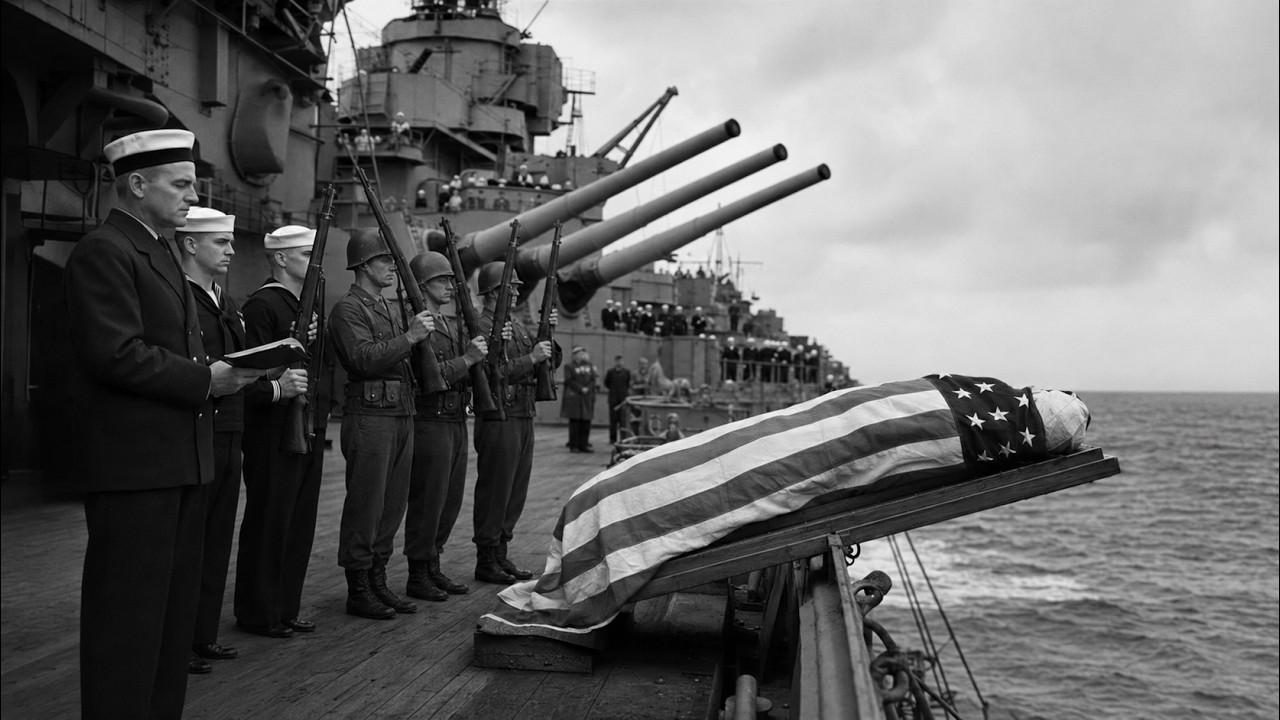
At nine o’clock the next morning, April 12, 1945, in the waters northeast of Okinawa, with the Missouri still at general quarters and the battle for the island raging on land and at sea all around her, the ship’s senior chaplain, Commander Roland Faulk, walked to the fantail. A six-man burial detail carried the flag-draped body to the rail. The ship’s company stood at attention. A bugler raised his horn.
A detachment of Marines lifted their rifles. The chaplain spoke the same words the Navy had spoken over its own dead for generations, committing the body to the deep. And the remains, wrapped in weighted canvas and covered by the flag of the nation that had just tried to sink the ship, slid over the side and into the sea. The Marines fired a salute into the open air above the water.
In every visible respect—the chaplain, the flag, the honor guard, the volley—it was the same funeral the Missouri would have given one of her own sailors. Decades later, Ed Buffman, who had been a teenage gunner’s mate aboard the Missouri that day, remembered how quickly the war simply swallowed the moment back up afterward. “The next day, you’re ready to go back and battle again,” he said. And for most of the crew, that was the plain truth of it.
The fighting did not pause for what had happened on the fantail. Okinawa would grind on for another two and a half months. But the historians who later gathered these memories found something else as well. Some sailors resented the ceremony at the time and never fully came around.
Others, with the years, came to see it as exactly the right thing to have been done—a moment that, however small against the scale of the battle raging around them, they were glad their ship had taken the time to mark. Japanese researchers working from squadron records decades after the war later concluded the pilot was very likely Flight Petty Officer Second Class Setsuo Ishino, though some naval records leave open the possibility it was another pilot from the same group, Kenichi Ishi. Either way, he was one of sixteen young men who flew out from Koya that morning expecting never to return, in aircraft that had nothing left to fly back to. What makes this story so remarkable is not only that it happened, but that, as far as naval historians have been able to determine, it never happened again—not once in nearly two thousand kamikaze sorties flown against the American fleet in the war’s final year.
The burial of the pilot who struck the Missouri stands today as the only documented instance of US forces holding a full military funeral, complete with chaplain, honor guard, and rifle salute, for a kamikaze pilot. And Callahan himself never explained the order. He did not speak of it publicly, then or in the years afterward. The ceremony was simply entered onto the ship’s daily schedule alongside meals, watches, and gunnery drills.
One routine item among many. And the Missouri sailed on toward the next fight off Okinawa. His own family did not learn the full story for more than half a century. Callahan’s grandson, Kerry, has said the family only pieced together what had happened on the Missouri’s deck in 2001, fifty-six years later, and long after the captain himself had died.
What they found in that long silence was a man who, just three years before Okinawa, had lost his own brother, a rear admiral, in combat against the Japanese—and who, even at the height of one of the worst battles the Navy ever fought, drew a line between the enemy his country was fighting and the one dead man now lying in his ship’s care. Whatever reasoning lay behind that order went down with Callahan himself. Only the order, and the ceremony it produced, survived. There is one more thread worth pulling, and it is the kind of detail that, if it appeared in a film, audiences would assume had been invented.
Less than five months after that quiet burial at sea, the USS Missouri lay at anchor in Tokyo Bay. And on her deck, on September 2, 1945, the formal Japanese surrender was signed, bringing the Second World War to its end. The same battleship that had given a single enemy pilot the dignity of a sailor’s funeral became, within months, the stage on which the war itself was laid to rest, in front of the entire world’s cameras. Eighty years on, in April of 2025, American and Japanese officials gathered on that same fantail to mark the anniversary together.
Among them were the mayor of Honolulu and the mayor of the Japanese city of Minamikyushu, from which many kamikaze pilots—Ishino likely among them—had once flown their final missions. A museum official read aloud from a young kamikaze pilot’s farewell letter, written before one of those missions. And the director of the Missouri’s memorial called the burial that had taken place there in 1945 “a remarkable story of compassion and humanity, even in the middle of one of the worst battles of the entire war. ”
It is worth remembering just how worst.
By the time the fighting on Okinawa finally ended in late June, more than twelve thousand Americans were dead, alongside well over a hundred thousand Japanese and Okinawan conscripts, and as many as a hundred thousand Okinawan civilians caught between two armies on the only ground either side had to fight over. Against a toll of that size, one funeral for one enemy pilot is a small thing. It changed nothing about the battle, the campaign, or the war’s outcome. It is remembered anyway.
No medal was ever given for what happened on the Missouri’s fantail that April morning, and no document fully explains it. Nobody who gave the order ever tried to. But in the middle of the worst naval battle the US Navy ever fought, against an enemy that had given his country every reason for hatred, a captain looked down at the body of the man who had just tried to sink his ship and chose to bury him as he would one of his own. It would be easy to read that decision as small against the scale of what surrounded it—a single body on a single morning in a battle that would go on to claim tens of thousands of lives on both sides before it was through.
But it is precisely that scale that makes the gesture matter. The same captain, the same crew, and the same ship that had just survived an enemy bent on their destruction chose, with no one watching and no order from above requiring it, to treat that enemy’s body as they would have treated their own. Whatever else that war had taken from those men, on that one morning it had not taken that.
