In April 2024, a gold pocket watch fetched over one million British pounds at auction. The initials etched into its case were plain: JJA. Three letters that had once belonged to the richest man on the most storied shipwreck in history. That watch ceased ticking in the small hours of April 15th, 1912.
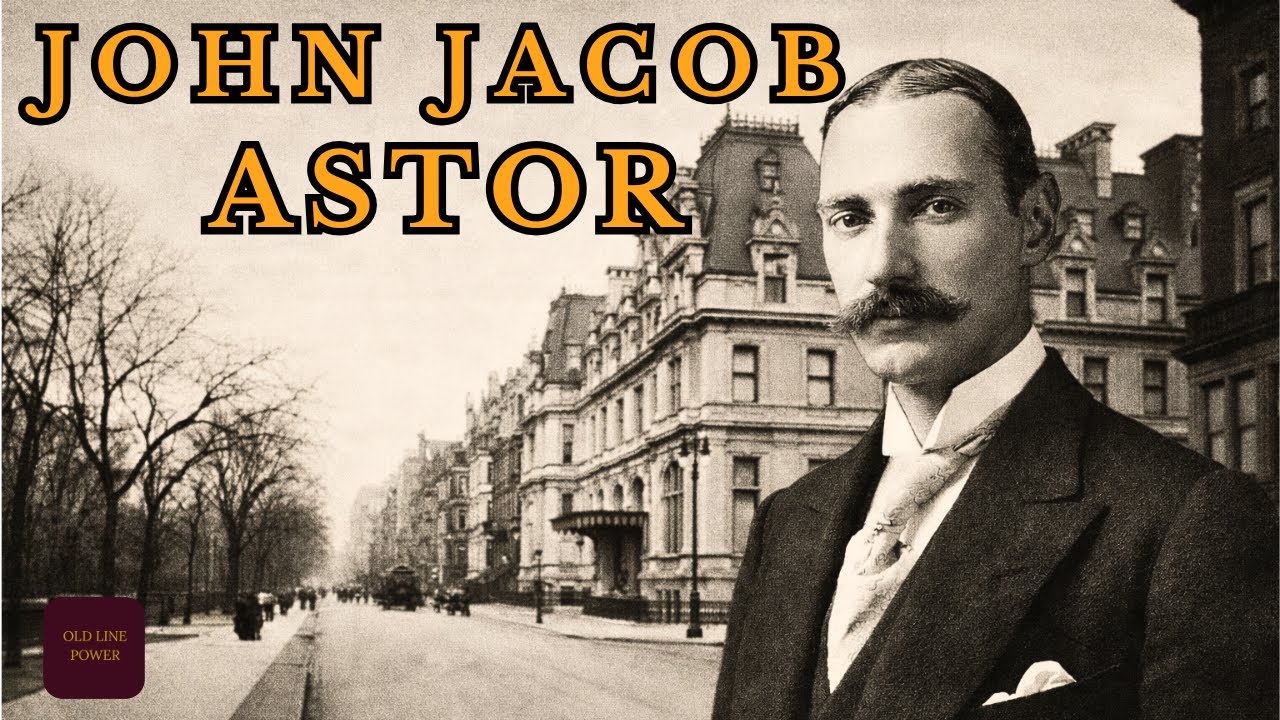
Its owner had just handed his pregnant teenage bride into a lifeboat. He asked whether he might join her. The answer was no. John Jacob Astor IV held a fortune estimated at $87 million.
Converted to today’s money, that comes close to three billion. He could have bought the entire White Star Line outright and still had plenty to spare. He owned hotels that set the standard for luxury. He had invented machines and written novels about the future.
For nearly four decades, his mother had set the rules of American high society. None of that counted in the North Atlantic that night. This is not merely a story about the Titanic. The ship does not appear until the end.
Before that cold April night, there was a dynasty built from nothing by a German immigrant. There was a mother who determined who belonged in New York society and who did not. There was a son torn between expectations and his own unconventional mind. There was a scandalous divorce, a teenage bride, and a wedding that respectable clergy refused to perform.
Let us start where the Astor fortune itself started, with a young man from a German village who crossed the Atlantic carrying little beyond ambition. The first John Jacob Astor reached America with almost nothing: a handful of coins, some flutes to sell, and an ambition that would forever reshape New York City. He was born Johann Jakob Astor in 1763 in the small village of Walldorf near Heidelberg. His father earned a living as a butcher.
The family was respectable but poor. Young Johann showed scant interest in taking up his father’s trade. At sixteen, he left for London to join his brother in the manufacture of musical instruments. Four years later, he boarded a ship bound for the newly independent United States.
The crossing lasted months. On the voyage, Astor met a fellow passenger who dealt in furs. The man explained how beaver pelts fetched high prices in Europe; fashion required them for hats. Astor paid close attention.
By the time he arrived in New York in 1784, he had already resolved to give up the flute business. He began modestly, working for a fur dealer, learning the trade, and building contacts with trappers and Native American suppliers in upstate New York. Within a few years he opened his own shop. His wife Sarah tended the store while he journeyed into the wilderness to bargain directly with trappers.
Astor had two qualities that set him apart from other merchants. First, he grasped that controlling the entire supply chain meant controlling the profits. He did not merely buy and sell furs. He set up trading posts, hired his own agents, and in time owned the ships that carried his goods to Europe and China.
Second, he spotted opportunity before others did. The Jay Treaty of 1794 opened British-held territory around the Great Lakes to American traders. Astor acted at once. Within a decade, his American Fur Company dominated the industry from the Great Lakes to the Pacific Northwest.
The town of Astoria in Oregon still carries his name. He founded it in 1811 as a trading outpost at the mouth of the Columbia River. It became the first permanent American settlement on the Pacific coast. Astor held no sentimental attachment to fur.
When beaver populations fell and European fashion turned toward silk hats in the 1830s, he saw the shift coming. He sold off his fur interests and steered his capital toward something more lasting: land, specifically Manhattan. His brother Henry had pressed him to invest in New York real estate as early as 1799. Astor bought his first parcel of Manhattan property that year.
Over the decades that followed, he accumulated more. He purchased the Richmond Hill estate from Aaron Burr after Burr’s finances collapsed in the wake of the duel with Alexander Hamilton. He bought farmland in what is now Greenwich Village and Midtown. He acquired entire blocks.
Astor seldom developed his properties himself. Instead, he leased the land to others who built homes and businesses upon it. When the leases ran out, usually after twenty-one years, everything on the land belonged to him: the buildings, the improvements, all of it. New York grew precisely as he had foreseen.
Immigration surged. The population pushed northward up the island. Land once deemed too distant from the city center turned into prime real estate. Astor’s holdings multiplied in value without him lifting a finger.
By the 1840s he was the wealthiest person in the United States. Some estimates put his holdings at around $20 million, roughly one percent of the entire American economy at the time. No individual before him had ever amassed such a share of national wealth. When he died in March 1848, newspapers struggled to put a figure on his estate.
He left $400,000 to establish what became the Astor Library, later merged into the New York Public Library. He sent $50,000 back to his hometown of Walldorf for a poor house and orphanage. The bulk of his estate went to his children. His son, William Backhouse Astor, expanded the real estate empire further, constructing hundreds of buildings across New York.
With each generation, the family’s grip on Manhattan tightened. They became landlords to tens of thousands. Their name appeared on hotels, theaters, and apartment buildings throughout the city. But money alone did not guarantee social acceptance in the rigid hierarchies of nineteenth-century New York.
Old Knickerbocker families descended from the original Dutch settlers looked down on mere wealth. To stand at the apex of New York society would require something more. It would require a queen. And in 1853, William Backhouse Astor Jr.
married a woman who meant to become exactly that. Caroline Schermerhorn understood something that mere millionaires did not. Money could buy mansions and jewels and carriages, but it could not buy social acceptance. That required bloodlines, manners, and above all, the right arbiter to decide who belonged.
She meant to become that arbiter. Born in 1830 to one of New York’s oldest Dutch families, Caroline possessed what the Astors lacked. The Schermerhorns traced their American roots to the original settlers of New Amsterdam. They were Knickerbockers, part of the quiet aristocracy that had governed New York society for generations.
When Caroline married William Backhouse Astor Jr. in 1853, she brought respectability to the Astor name. The marriage was practical rather than passionate. William proved more interested in horses, yachts, and time away from home than in social climbing.
He eventually owned the largest private yacht in America and spent months aboard it each year, often in the company of guests his wife preferred not to acknowledge. Caroline smiled and remarked that sea air was beneficial for dear William’s health. If she could not control her husband, she would control everything else. Throughout the 1860s and 1870s, Caroline assembled the machinery of social power.
She built ties with the families that mattered. Her dinners were exercises in exacting formality. She spent heavily on clothing but chose it with restraint, preferring dark shades and magnificent diamonds. The portrait by Carolus-Duran presents a woman of stern dignity.
No softness, no openness, nothing but command. Her closest partner was Ward McAllister, a lawyer born in the South who had remade himself into a professional arranger of society. Between them they shaped the idea that would come to define Gilded Age New York: the Four Hundred. The figure was said to come from how many people could fit in Caroline’s ballroom at her mansion on Fifth Avenue and Thirty-fourth Street.
Whether that origin is true or merely a tidy legend is uncertain. The principle was what counted. By the 1880s New York held thousands of wealthy families. Industrialists and railroad magnates poured into the city, erecting vast houses, staging lavish parties, insisting on recognition.
Caroline’s answer was to draw a boundary. Only four hundred people, she and McAllister announced, genuinely made up New York society. All the rest, no matter how many millions they held, stayed outside. The standards were intentionally imprecise.
Old family ties counted. Correct conduct counted. Knowing the right people counted. Yet in the end, Caroline made the call.
Her verdict stood. Her yearly ball grew into the most eagerly awaited occasion on the social calendar. Staged each year on the third Monday of January, an invitation proved your place among the elect. To be left out meant being forgotten.
Hostesses throughout the city built their whole seasons around it, dreading any clash of dates that might hint they did not count on being asked. The press referred to her simply as the Mrs. Astor. Other women carried the name by marriage.
She carried it by pure willpower. When her nephew William Waldorf Astor tried to install his own wife as the genuine Mrs. Astor, claiming seniority as the eldest son’s eldest son, Caroline paid him no heed at all. In the end William Waldorf surrendered and relocated to England.
Her tactics could be merciless. Families who broke her rules were shut out not only from her ballroom but from every drawing room that counted. One false move could finish a social career for good. For nearly forty years, nothing of consequence occurred in the city’s upper circles without her blessing.
Caroline and William raised five children: four daughters and one son. The daughters made suitable matches into families that satisfied their mother’s standards. The son, born in 1864, was named John Jacob Astor IV for his great-grandfather. As the sole male heir, he would one day inherit not only the family business but the burden of the Astor name itself.
Caroline adored her boy. She called him Jack. She put him in fine clothes and sent him to the best schools. She expected him to assume his place at the head of New York society when the moment arrived.
But Jack Astor was nothing like his mother. She was disciplined and domineering; he was uneasy and inward-looking. She had mastered social ritual; he would rather tinker with mechanical devices and picture futures not yet built. The newspapers could not figure him out.
Here stood the only son of America’s most powerful hostess, heir to one of the continent’s greatest fortunes, and he appeared to care more for gears and pulleys than for ballrooms and dinner parties. Some journalists dubbed him Jack Ass-tor. The cruel pun endured. John Jacob Astor IV was born on July 13th, 1864 at Ferncliff, the family’s country estate in Rhinebeck, New York.
He came as the fifth child and only son. His four older sisters had already taken their mother’s attention. Jack would bear a different weight: the Astor name, the Astor business, the Astor legacy. All of it would land on him.
His schooling took the expected route: St. Paul’s School in Concord, New Hampshire, then Harvard. He passed through these places without distinction, a tall, gawky young man who lacked the easy social assurance that wealth usually brings. Classmates recalled him as quiet, a little odd, more curious about how things worked than about who knew whom.
The social apparatus Caroline had spent decades honing held no appeal for her son. He wanted to build real machines. In 1891, at twenty-six, Jack married Ava Lowle Willing of Philadelphia. She was lovely, cultivated, and socially polished.
Caroline gave her approval. The union looked fitting. Yet even married life could not quiet Jack’s restless mind. Three years after the wedding, he published a novel.
That alone would have caused a stir; Astors managed property, they did not write fiction. But the book itself was stranger still. A Journey in Other Worlds envisioned the year 2000. Spacecraft driven by a force called Apogee journeyed between planets.
Characters explored Jupiter and Saturn. Technology had remade the earth, its climate changed, its continents linked. Critics were baffled. The prose was competent, the science whimsical, the philosophy tangled up with spiritualism.
Yet sprinkled through the pages were forecasts that would later appear prophetic: airships crossing the Atlantic, screens showing moving pictures, a planet warmed by human industry. He followed the book with patents: a bicycle brake in 1898, a pneumatic device for smoothing road surfaces, a vibratory disintegrator able to make gas from peat moss. He helped develop turbine engines. None of these inventions brought him fame.
None of them had to. He possessed more money than he could ever use. What he did not have was purpose. The Spanish-American War supplied it.
When war broke out in 1898, Jack did not merely write a check or show up at patriotic rallies. He funded and outfitted a whole volunteer artillery battery. The unit came to be called the Astor Battery. He gave them the finest equipment his money could buy and arranged for their dispatch to the Philippines.
Then he went further. He sought a military commission for himself. The army made him lieutenant colonel in the United States Volunteers. He served on the staff of Major General William Shafter during the Santiago campaign in Cuba.
He put his yacht, the Nourmahal, at the federal government’s disposal. When the war ended, the army brevetted him to colonel in recognition of his service. For the remainder of his life, he liked to be addressed as Colonel Astor. The title stood for something he had earned rather than inherited.
He came back to civilian life decorated but unfulfilled. The hotels and real estate that made up the family business drew his attention without ever seizing his passion. He kept inventing, investing, managing. He stayed among the richest men in the country.
And his marriage was coming apart. The feud between the Astor cousins was fought out in brick and stone. William Waldorf Astor, Jack’s older cousin, had long chafed at his place in the family. As the son of the eldest son, he believed himself the rightful head of the American Astors.
Caroline thought otherwise. William Waldorf answered with architectural spite. In 1893 he tore down his father’s mansion on Fifth Avenue and Thirty-third Street and raised a huge hotel on the spot. He called it the Waldorf, after the German village where the dynasty had begun.
The building went up right next door to Caroline’s house, throwing shade over her windows and filling her street with the noise and bustle of commerce. It was an insult dressed up as an investment. Caroline would not be beaten. She turned her back on the brownstone and relocated uptown, to a new mansion on Sixty-fifth Street.
Jack, on the other hand, spotted a chance where his mother saw only a wall. In 1897 he demolished Caroline’s old home and put up his own hotel beside his cousin’s. He named it the Astoria. A corridor linked the two buildings, and reporters nicknamed it Peacock Alley: three hundred feet of marble and mirrors where the fashionable crowd strolled every afternoon.
Together, the Waldorf-Astoria grew into the biggest and most talked-about hotel in New York. A thousand rooms, a ballroom that could seat fifteen hundred. Its guests ranged from presidents to foreign dignitaries to anyone able to pay the rates. The cousins, however, never made peace in person.
In time William Waldorf gave up his American citizenship and settled in England, where he bought a title and became Viscount Astor. Even so, the two hotels stayed connected. That hyphen between Waldorf and Astoria stood for a truce neither man would ever admit to aloud. Jack had shown he could keep pace with his cousin.
Now he meant to leave him far behind. The St. Regis Hotel opened on September 4th, 1904, at Fifth Avenue and Fifty-fifth Street. Jack had laid out $5.
5 million on building and furnishing it. His aim was something never seen before: not just a hotel, but a private residence for travelers who wanted the comforts of a finely appointed home. Every detail bore the mark of his engineer’s mind. Each room had a telephone, still a rarity in most buildings.
A fire alarm system linked every floor. Central heating kept guests warm without the mess of separate fireplaces. Most striking of all, Jack devised an air-cooling system that let guests set the temperature of their own rooms. Modern air conditioning did not yet exist.
His answer was to use fans, ice, and ductwork to push cooled air through the building. It worked. He put mail chutes on every floor, a convenience that made headlines in its day. He built a central vacuum system; maids merely plugged their hoses into wall sockets instead of dragging heavy equipment from room to room.
He called for French marble in every corridor and stairway, since he judged Italian marble too ordinary for his taste. The hotel drew exactly the clientele Jack had pictured. Families who stayed for entire seasons, foreign visitors who expected European standards of service, guests who valued innovation as much as elegance. The King Cole Bar, with its celebrated Maxfield Parrish mural, became a meeting place for the people who shaped opinion and policy.
Jack put up one more hotel, the Knickerbocker, which opened in 1906 at Broadway and Forty-second Street. It served the theater district. The tenor Enrico Caruso kept a permanent suite there and was said to hide his personal collection of signed photographs inside its walls. Three major hotels in under a decade, every one profitable, every one carrying the Astor stamp of practical innovation wrapped in quiet elegance.
His mother had ruled the drawing rooms of Fifth Avenue. He had built the rooms themselves. Still, hotels could not hold his attention forever. By the time the Knickerbocker opened, his marriage had fallen apart completely.
Ava had gone to Europe years before. Newspapers guessed at the reasons: affairs, incompatibility. The couple had lived apart so long that the legal end seemed almost a formality. In 1909 Ava came back to New York and filed for divorce.
Such a scandal would have ruined a lesser family. For the Astors, it was only the start. Their mismatch had been plain from the beginning. Ava Lowle Willing came from old Philadelphia money, the sort that traced back to colonial days.
Her ancestor Thomas Willing had been president of the First Bank of the United States. She was twenty-two when she wed Jack in February of 1891. People called her a great beauty of her generation: dark hair, striking features, a commanding presence. Jack was twenty-six, awkward, and so uneasy at social gatherings that he could barely make conversation.
The mismatch showed almost at once. Jack liked quiet evenings and mechanical drawings, while Ava hungered for attention and admiration. She had a sharp wit and a sharper tongue, and she wielded both without restraint. Acquaintances remembered afterward that she ridiculed her husband openly, calling him stupid in front of guests.
Jack trailed behind her at parties, one observer remarked, like a lost dog. She bore him two children. Vincent came in November of 1891, only nine months after the wedding. A daughter, Ava Alice Muriel, arrived more than a decade later, in July of 1902.
The long stretch between the children hinted at what everyone already believed: the marriage existed in name only. By 1896 Ava had settled in London. She took a townhouse on Grosvenor Square and a country estate at Regent’s Park. She moved in circles that included King Edward VII.
Rumors tied her to Winthrop Rutherfurd, a strikingly handsome New York bachelor whose reputed conquests included several prominent wives. Jack stayed in New York, building hotels, filing patents, and mostly raising Vincent by himself. In November of 1909 Ava returned to America and filed for divorce in White Plains, New York. The legal ground was abandonment, though everyone knew the truth was far more tangled.
Four months later, in March of 1910, the state of New York issued the final decree. The financial terms became muddled. Some accounts said Ava got ten million. Newspapers of the day suggested she accepted alimony of roughly fifty thousand a year, a small share of what she had sought.
The exact number is still unclear. Vincent, now eighteen, decided to stay with his father. Young Ava Alice, just seven, went to England with her mother. Jack came out of the divorce publicly humiliated but privately relieved.
At forty-five he was single for the first time in nearly twenty years. His mother had passed away the year before. His son would soon be off to college. The Astor fortune was his, and he had no one to share it with.
By the spring of 1910, Jack Astor was a divorced man nearing fifty, wealthier than nearly anyone alive, and completely alone. That would not last. Madeleine Force was seventeen years old when she first met Colonel Astor. He was forty-six.
The summer of 1910 brought them both to Bar Harbor, Maine, where the well-off fled each August to escape the heat of eastern cities. Jack had been visiting Mount Desert Island for years. Madeleine Talmage Force was newer to these circles. Her family had money, but not the sort that drew attention.
Her father William ran a successful shipping company. The Forces sat in the comfortable upper tier of New York life without quite reaching the top. Madeleine had graduated from Miss Spence’s school in Manhattan that same spring. Tall and graceful, with clear features and an easy manner, she drew people to her without seeming to try.
Friends called her unusually capable. She rode well, handled sailboats with confidence, and spoke passable French from childhood trips to Europe. No one recorded exactly how they first met. What came next was what mattered.
Jack started taking Madeleine out for car rides and on afternoon trips aboard his yacht. The newspapers took note. Come winter, the pair were seen together at dinners he threw at the St. Regis.
Rumors built steadily through the spring of 1911. In April, the papers started printing banner headlines. New York Is Interested in Miss Force, read one. Pretty Girl May Marry Rich Mr.
Astor, ran another. The coverage played up what was plain for all to see: a teenage girl and a man close to thirty years her elder, a fresh divorce, and a debutante younger than his own son. Jack would not be swayed. Neither would Madeleine.
On the first of August 1911, her father William Force stood on the steps outside his office at 78 Front Street in Lower Manhattan. Reporters had massed there, pulled in by rumors that could no longer be held back. Force confirmed the news they had come for: his daughter and Colonel John Jacob Astor IV were to be married. The announcement set off an uproar.
Churchmen around the country denounced the union. Episcopal teaching of the day barred remarriage following divorce. Catholic priests railed against it from their pulpits. The Cincinnati Inquirer labeled the romance one of wicked lust.
Threatening letters reached the Force household, warning Madeleine of violence. The strain left her physically unwell. The Four Hundred shut ranks against her. These were the very families who had once filled Caroline Astor’s ballroom.
They subjected Madeleine to what the press termed the cold shoulder. Wherever she showed up, women looked the other way. Nobody greeted her as a future Mrs. Astor.
Jack answered with his fortune. He is said to have bought a $30,000 engagement ring, close to a million in today’s money. He set up a settlement reported at five million should anything befall him. Yet money could not purchase acceptance, and money could not produce a minister prepared to conduct the service.
They went to the Episcopalians first. It seemed logical; the Astors had prayed in Episcopal churches for generations. But Episcopal rules in 1911 forbade clergy from marrying divorced people whose former spouses were still living. Ava was very much alive, amusing herself in London.
The church doors shut. They turned to ministers of other faiths: Presbyterian, Methodist, Baptist, Lutheran. Each one refused in turn. Some pointed to religious objections to remarriage.
Others simply wanted no part of the spotlight. Weeks slipped by. The engagement had been made public in August. September came with no wedding date fixed and no minister lined up.
At one stage Jack is said to have considered a man by the name of Edwin Strait. Strait had been ordained a Free Baptist minister but had since taken up carpentry as his trade. The press could not resist the detail: the clerical carpenter, they dubbed him. Whatever plan Jack had in mind never came together.
At last a name surfaced. Reverend Joseph Lambert, pastor of Elmwood Temple Congregational Church in Providence, Rhode Island. Lambert was prepared to do it. Certain accounts hinted that Jack offered him a sizable payment, reportedly around two thousand dollars, for his services.
Lambert would not talk about any financial terms, saying only that it was nobody’s business. The wedding was held on September 9th, 1911 at Beechwood, Jack’s seaside estate in Newport. The service got under way in the morning in the ballroom that had hosted countless gatherings during Jack’s mother’s reign. This time it held only a small group.
No crowds, no onlookers, none of the Four Hundred who might turn their backs on the bride. American beauty roses filled the room. They had been Caroline Astor’s favorite flower. Now they adorned her son’s second wedding.
Madeleine’s sister Catherine was maid of honor. At Jack’s side stood his son Vincent, nineteen years old, serving as best man. Vincent was hardly older than his new stepmother. The ceremony was short.
Lambert spoke. Jack and Madeleine exchanged vows. Rings went onto fingers. Within minutes, Madeleine Talmage Force had become Mrs.
John Jacob Astor IV. There was no lavish reception. The newlyweds posed for pictures, took congratulations from the small group, and got ready to depart. Jack’s steam yacht Noma was waiting in Newport Harbor.
Within hours of becoming husband and wife, the Astors were on board and putting out to sea. The minister fared less well. Within weeks, Lambert found himself at the heart of a storm he had perhaps misjudged. Fellow clergy condemned his choice in public; his congregation split.
In November, under two months after joining the Astors, Reverend Joseph Lambert stepped down from his post at Elmwood Temple. He never spoke of what, if anything, Jack Astor had paid him. Back in New York, society went on treating the new Mrs. Astor as an outsider.
The women who had slighted Madeleine before the wedding gave no sign of welcoming her afterward. Jack knew what they were up against. The whispers would not cease. The hostility would not soften.
Only one answer remained: leave. The Astors would take their honeymoon far from anyone inclined to judge them. And when they at last chose to return to America, they would reserve passage on the finest ship afloat. The Noma took them first to Rhinebeck, then south to Bermuda.
In January 1912, they came aboard the Olympic, the largest ocean liner in the world and sister ship to one still being built. The Olympic bore them across the Atlantic to start what the papers would later term their Egyptian tour. Egypt provided everything America could not: distance, anonymity, ancient wonders that made even Astor money look small. They sailed up the Nile.
They saw Cairo. They stood before the pyramids at Giza. For the first time since their engagement was announced, nobody cared who they were or what respectable people thought of their marriage. One American did seek them out.
Margaret Brown was a Denver millionaire whose wealth came from mining rather than old money. Society at home found her vulgar, too loud, too new. The three of them traveled together through Egypt, an unlikely trio tied by their shared standing as outsiders. Jack loosened up in ways Madeleine had never seen.
He pointed out engineering details in ancient structures. He sketched mechanisms. He took photographs. Away from the judgment of the Four Hundred, the awkward man she had married seemed nearly at ease.
Their dog Kitty went with them everywhere. The Airedale terrier had been Jack’s companion for years. At one point during the Egyptian tour, Kitty disappeared. Jack searched in a panic until she was found.
He could not bear to lose her. From Egypt they went on to Paris. The city welcomed wealthy Americans without asking questions about divorce or age differences. They stayed in fine hotels.
They dined in restaurants where no one turned away. For a few months they lived as any rich couple might live, free of the weight of the Astor name. Then Madeleine discovered she was pregnant. The news changed everything.
Jack wanted his child born in the United States, on American soil, as an American citizen. There would be no question of the baby’s legitimacy, no foreign birth certificate to complicate matters of inheritance. The heir to part of the Astor fortune would arrive in New York. They began planning their return.
Madeleine’s state called for cautious journeying. A nurse would be essential. The voyage had to be restful, the quarters first-rate. Jack began making inquiries about booking passage.
A brand-new vessel was being readied for her inaugural crossing. The Royal Mail Steamer Titanic was set to sail from Southampton on April 10th, 1912, destined for New York. She was the biggest ship ever constructed, surpassing even her sister Olympic. The papers declared her unsinkable.
Her first-class accommodations were reputed to be the most opulent at sea. Jack reserved a parlor suite, cabins C62 through C64 on the starboard side. They would come aboard at Cherbourg, France, where the Titanic would pause to take on passengers before venturing into the Atlantic. Traveling with them would be Jack’s valet, Victor Robbins; Madeleine’s maid, Rosalie Bidois; a private nurse by the name of Caroline Endres; and naturally Kitty.
By that point Madeleine was five months pregnant. The pregnancy was going smoothly, though she tired quickly. On April 10th, 1912, Colonel and Mrs. John Jacob Astor came aboard the Titanic at Cherbourg.
A small tender named the Nomadic carried them from the harbor out to the great ship waiting offshore. Madeleine boarded with care, her hand resting on her husband’s arm. The vessel lived up to every promise the newspapers had made: magnificent staircases, polished woodwork, electric lights throughout. Their suite included a private promenade deck where Madeleine could breathe the fresh air without meeting other travelers.
Jack appeared taken with the engineering. He reportedly pointed out details of the ship’s construction to anyone willing to listen. She is unsinkable, he assured fellow passengers. A marvel of modern shipbuilding.
The Titanic had departed Southampton on April 10th carrying more than two thousand people. She paused at Cherbourg that evening to pick up passengers from France, then crossed to Queenstown on the Irish coast the next morning. By noon on April 11th, the Irish shoreline had slipped from view behind her. Ahead there was only open water and five days of sailing.
For the Astors, those days went by uneventfully. The pregnancy had sapped Madeleine’s strength. She passed much of her time in their suite, resting on the enclosed deck attached to their rooms, breathing the salt air in solitude. Jack brought her books and kept her company.
At times he read to her aloud. When she had the energy, they explored the public areas. The ship offered amusements no ocean liner had ever provided: a gymnasium fitted with rowing machines, cycling equipment, and mechanical horses that mimicked riding; a swimming bath of heated seawater; Turkish baths in the Moorish style with steam rooms and cooling chambers; a library filled with recent novels; a barber shop; a darkroom for photographers. Jack admired the engineering.
He inspected the fittings, questioned the officers, and studied the machinery that propelled such an enormous vessel through the sea. The Titanic displaced more than 46,000 tons. Her reciprocating engines and central turbine combined to generate enough power to push her at twenty-one knots. Thomas Andrews had designed her.
He was on board now, jotting notes on small refinements that might be made before her sister ships went into service. The White Star Line’s managing director, J. Bruce Ismay, had also made the crossing, keen to observe how his company’s flagship performed. Captain Edward John Smith commanded the bridge.
He was sixty-two and had served White Star for many years. This was to be his last voyage before retiring; the company had given him their newest and biggest ship as a parting honor. First-class passengers ate in a dining saloon seating more than five hundred. The meals ran to ten or eleven courses.
Dinner went on for hours. It was spectacle as much as nourishment. On the evening of April 14th, Captain Smith joined a dinner party given by the Wideners in the à la carte restaurant on B deck. George Widener and his wife Eleanor had brought along their son Harry, a book collector coming home from a buying trip in London.
Captain Smith sat at their table. By the account of a steward who waited on them, the captain chatted and joked with Mr. Astor over the meal. Jack seemed at ease that evening.
The crossing had gone smoothly. The weather had been kind. In three more days they would arrive in New York. After dinner, several of the men withdrew to the smoking room for cigars and brandy.
The ship’s orchestra performed in the reception area by the grand staircase. A few couples danced. The night was still, unusually still. The sea stretched flat as glass, without even the mild swells that usually came with a mid-Atlantic crossing.
Stars covered the sky from one horizon to the other. The air had grown cold, distinctly colder than on previous nights. Ice warnings had come to the ship throughout the day. Other vessels in the region reported bergs drifting south from the Arctic.
The warnings arrived by wireless, the new Marconi system that let ships communicate across hundreds of miles of open water. Some of these messages made it to the bridge. Others evidently did not. At twenty minutes to midnight, most first-class passengers had gone to their cabins.
The lounges had cleared out. Madeleine had retired early. Jack remained up, reading in their sitting room. Kitty slept close by.
Outside, the temperature had fallen below freezing. The lookouts in the crow’s nest strained to see what lay ahead. They had no binoculars. The sea was so calm that no waves broke against obstacles to give them away.
At 11:40, Frederick Fleet made out something in the darkness straight ahead. He struck the warning bell three times and telephoned the bridge. Iceberg right ahead. The collision roused some passengers and went unnoticed by others.
A grinding tremor passed through the ship, glasses clinked on tables, then silence. Jack had been in the sitting room when he felt it. He put down what he was holding and went to look into it. The corridors were hushed.
A handful of passengers had stepped out of their staterooms, looking bewildered but not frightened. He came upon Captain Smith on the bridge. The captain’s face told him more than any words could. Jack asked him straight out: his wife was unwell, she had gone to bed, should he wake her?
Smith told him he should. They might have to take to the boats. Jack went back to their suite and roused Madeleine as gently as he could. He explained that the ship had hit ice but that the damage seemed minor.
They ought to dress warmly and put on their life belts, simply as a precaution. There was no cause to panic. Madeleine’s maid Rosalie and her nurse Caroline were sent for. The women helped Madeleine into warm clothes while Jack dressed himself.
He located spare life belts and helped secure them. Then they headed for the boat deck. The scene up there was odd. Officers moved with purpose, uncovering lifeboats and readying davits, but most passengers wandered about in bewilderment.
Some wore evening dress with life belts fastened over it. Others had wrapped themselves in blankets and furs. The band was playing somewhere close by. The night air cut through their clothing.
Madeleine shivered. Jack proposed they wait inside the gymnasium, where at least they would be sheltered from the wind. The room was unlocked. They found seats on the mechanical riding machines and sat there in their life belts, waiting.
Witnesses who observed him that night said Jack neither raised his voice nor betrayed any sign of fear. At one moment he came across an extra life belt and sliced it open with his penknife. He wanted to show Madeleine what lay within, what would hold her up if the worst happened: cork. The belt was packed with cork.
Time wore on. The vessel had developed a clear tilt toward the bow. Officers were now filling the lifeboats, summoning women and children. Up on the boat deck, Madeleine spotted a young woman cradling an infant.
The woman was a third-class passenger who had somehow found her way into the first-class sections. She appeared chilled. Madeleine took off her own shawl and draped it around the baby. The woman’s name was Leah Aks.
Her son was named Phillip, though she called him Philly. In time, word spread that lifeboat number 4 was being loaded from a deck one level down. The windows along the enclosed promenade could be opened so passengers might step straight into the boat as it hung from the davits. Jack guided Madeleine down.
Second Officer Charles Lightoller had been wrestling with the windows, built to open but jammed from disuse or the cold. At last they yielded. The lifeboat swayed just outside, bobbing gently as the ship settled. Lightoller called for women and children.
Madeleine’s maid and nurse went through first. Then came her turn. Jack helped lift her toward the window. On the far side, hands reached out to steady her as she climbed into the boat.
Her footing was unsteady given the added weight she carried. Jack braced her from one side while Archibald Gracie, another passenger, helped from the window next to them. After Madeleine was seated in the lifeboat, Jack leaned through the window. He asked Lightoller whether he might join his wife.
She was in a delicate condition, he explained. Surely an exception could be granted. Lightoller refused. No men until all the women and children were loaded.
Those were the orders. Jack did not argue. He did not demand special treatment or invoke his name or his wealth. He merely nodded, leaned through the window, and kissed Madeleine farewell.
He told her not to worry. He would find another boat. They would meet in New York. Then he drew back from the window and watched as the lifeboat started its descent toward the dark water beneath.
It was nearly two in the morning. The Titanic’s bow had sunk so low that the sea was starting to wash across the forward deck. The stern had lifted, baring the propellers to the night air. Jack walked back toward the boat deck.
He was last seen standing with John Thayer, Harry Widener, and Arthur Ryerson near the starboard rail. Some accounts say he lit a cigarette. Others say he assisted with the collapsible boats that the crew was struggling to release. Madeleine’s lifeboat reached the water at five minutes to two.
She gazed back at the ship, hunting for her husband among the figures still visible on deck. She could not locate him. Twenty-five minutes after the last lifeboat pulled away, the Titanic vanished. The stern climbed until the ship stood almost vertical against the stars.
The lights flickered and died. A noise like thunder rolled over the water as everything within broke loose. The hull split. The forward section fell away.
The stern hung suspended, then slipped beneath the surface. Twenty minutes past two, April 15th. More than fifteen hundred people went into the water. The temperature was below freezing.
Those without boats had perhaps fifteen minutes before their bodies gave out. Madeleine survived. Her maid and nurse survived. Jack did not.
The Carpathia arrived at dawn and drew the living from the lifeboats. By nine o’clock, everyone who had lasted through the night was aboard. The ship turned toward New York. A week later, the cable vessel Mackay-Bennett reached the debris field.
Her crew found hundreds of bodies drifting in their life belts. Jack was recovered on April 22nd, designated number 124. Blue serge suit with JJA on the collar, brown boots, a gold pocket watch, diamond cuff links, $2,400 in American currency. The watch had stopped at 3:20.
Most others had stopped at 2:10, when the ship went down. Jack’s had run for another hour. Vincent traveled to Halifax to claim the remains. He was twenty years old and had just become one of the richest men in America.
The funeral was held May 4th at the Church of the Messiah in Rhinebeck, where Jack had served as warden for sixteen years. Dr. Ernest Saunders conducted the service. Madeleine attended in deep mourning.
So did Vincent and Jack’s daughter Ava Alice. The first Mrs. Astor did not come. A special train carried the casket down the Hudson to Manhattan.
At Trinity Church Cemetery on Washington Heights, Jack was laid to rest beside his mother. Caroline, who had ruled society for four decades, now shared her ground with the son whose choices had drawn such disapproval. The newspapers turned him into something he had never been in life: a man beyond reproach. The same voices that had condemned his marriage now extolled his courage.
It was simpler to admire the dead than to accept the living who broke the rules. The will had been signed soon after the wedding. Jack had known what people would say about his young bride. He had tried to protect her.
The document divided an estate valued at roughly eighty-five million. Vincent, as the only son from the first marriage, received the bulk of it: sixty-nine million. The yacht Noma, the Ferncliff estate in Rhinebeck, the business interests, the hotels, the real estate holdings that stretched across Manhattan. Ava Alice, Jack’s daughter, received a trust fund of ten million.
She was ten years old and living with her mother in England. For the unborn child, Jack had added a clause providing three million in trust, to be released when the child came of age. Madeleine’s portion was more complicated. She received $100,000 outright.
She received the income from a five-million trust fund. She received the use of the house at 840 Fifth Avenue and all its furnishings. She received the use of Beechwood in Newport and all its furnishings. She received her pick of automobile from Jack’s collection.
She received five of his horses. All of this carried a condition. If she remarried, she would forfeit everything except the initial hundred thousand. The trust income would cease.
The houses would revert to Vincent. The cars and horses would go. Jack had written the clause to ensure his widow would remain his widow. The Astor name demanded loyalty even from beyond the grave.
On August 14th, 1912, four months after the sinking, Madeleine gave birth to a son in the Fifth Avenue house. She named him John Jacob Astor VI, the boy they would call Jakey. For four years Madeleine lived as the Astor widow. She raised her son.
She ran the households. She was twenty-three, her whole life still ahead of her, and a decision that would shape it. In 1916 she picked William Dick. He had known her since she was a child.
He came from a respectable Brooklyn family. By Astor standards he was not wealthy, but he loved her and he asked for her hand. She accepted. The papers tallied up what she was forfeiting: the trust income, the houses, the automobiles and horses, roughly $3.
5 million altogether. She turned her back on it regardless. Vincent watched his stepmother give up the provisions that had tied her to the family. He held on to the Fifth Avenue house.
He held on to Beechwood. He held on to his disdain for the woman his father had loved. Madeleine wed Dick without fanfare and settled into a humbler life. She bore him two sons.
The marriage survived seventeen years before it ended in divorce. After that she wed again, to an Italian boxer by the name of Enzo Fiermonte. That union ended too. When Madeleine passed away in 1940 at forty-six, she was laid to rest at Trinity Church Cemetery in a plot apart from the Astors.
Her son Jakey inherited the little she had left behind. From his half-brother Vincent, who died childless in 1959, he inherited nothing. The clause had accomplished what it was designed to do. It had forced Madeleine to choose.
Twice she had picked love over money. Whether that made her foolish or brave depended on who was telling the story. Vincent claimed his father’s effects when the body reached New York: the cash, the jewelry, the gold pencil, and the watch. It was a 14-karat Waltham with his father’s initials engraved on the case.
The movement had halted in the Atlantic, locked at the instant the cold finally reached it. Vincent had the mechanism restored. Then he wore the watch himself. For more than twenty years Vincent carried his father’s timepiece.
At twenty he became head of the Astor holdings, running the hotels, the real estate, the investments. He married three times. He gave away much of his fortune to philanthropic causes, uneasy with wealth built on tenements and slums. He never reconciled with his stepmother or his half-brother.
In 1935 Vincent stood as godfather to the infant son of William Dobbin, his father’s former secretary. As a christening gift, he handed the child his father’s watch. Perhaps he wanted it out of his possession. Perhaps he wanted it to go to someone who had genuinely cared for Jack rather than someone who merely shared his blood.
The Dobbin family held on to the watch for six decades. In the late 1990s they put it up for auction. A collector bought it. The watch went to museums, shown behind glass, a relic from the most famous shipwreck in history.
On April 27th, 2024 the watch came back to the auction block. Henry Aldridge and Son in Wiltshire had estimated it might fetch 150,000. Instead, an American collector paid nearly $1. 5 million.
It became the most expensive piece of Titanic memorabilia ever sold, outdoing even the violin that Wallace Hartley had played as the ship went down. The buyer’s name was not disclosed. The watch vanished again into private hands, carrying with it a story that had begun in a German village in 1763 and ended in the North Atlantic 149 years later. Or perhaps it did not end there.
John Jacob Astor IV had been born into wealth he did not create, died in circumstances he did not choose, and became a symbol of an age that was already passing. The Titanic herself became a metaphor for that hubris: the unsinkable ship that sank, the monument to human ambition humbled by an iceberg. But Jack Astor was more than a symbol. He was a man who built hotels and wrote science fiction novels and patented inventions that never quite worked.
He was a man who endured a miserable first marriage and then scandalized everyone by marrying someone who made him happy. He was a man who helped his pregnant wife into a lifeboat, asked politely if he might join her, accepted the refusal without complaint, and then stepped back to wait for the end. The newspapers made him a hero. History made him a cautionary tale.
Neither version captures the whole truth. What remains is a gold watch that once kept time for a man who ran out of it. The hands stopped at 3:20 on the morning of April 15th, 1912, an hour after the ship went down. An hour during which Jack floated in the darkness, the watch still ticking against his chest until it finally stopped.
Some things survive. Some things are lost forever. The difference is often just a matter of what the sea decides to give back.
