On the night of 9 July 1943, Allied forces landed in Sicily, and for the first time in the war the fighting reached Italian soil. Within weeks, the fascist regime started to collapse. Benito Mussolini, who had governed Italy for over twenty years, was removed from power by order of King Victor Emmanuel III and taken into custody. As he was led away, his wife was nowhere to be found.
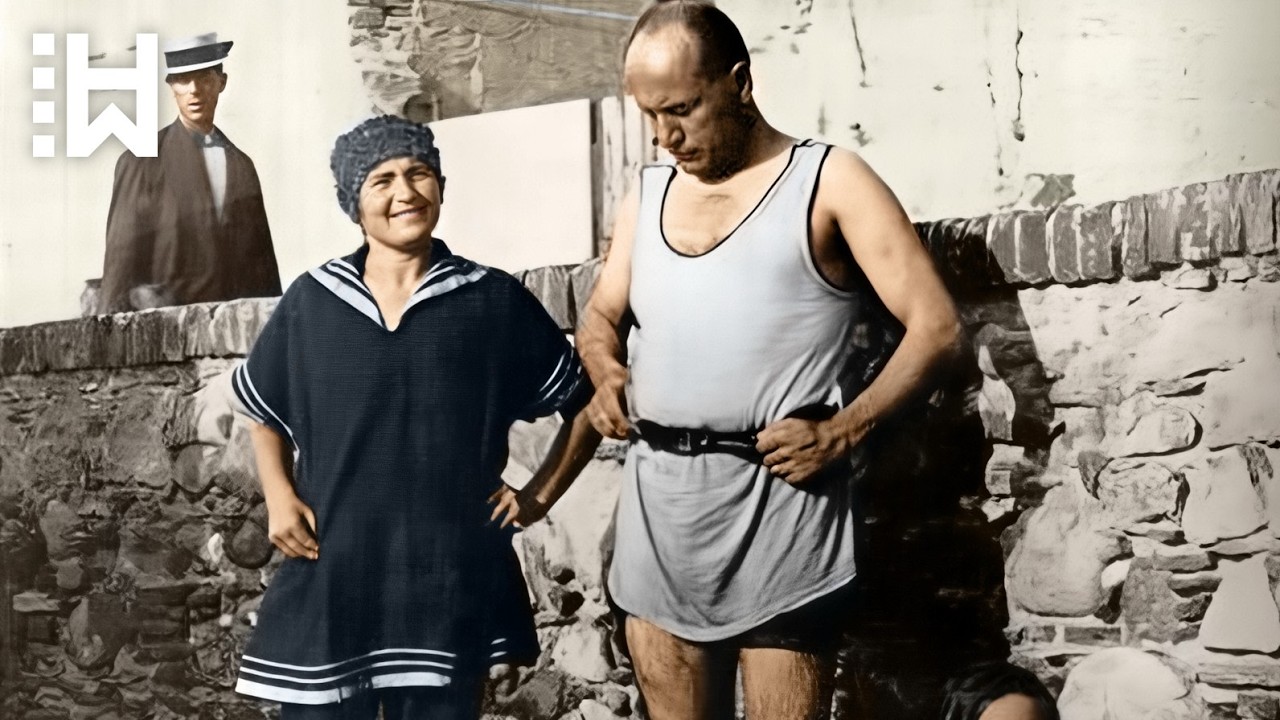
She did not share his imprisonment, his humiliation, or his fall from grace. Yet her story was bound up with his. For three decades she had stood at his side through his rise, his countless affairs, and his collapse. Behind the scenes, those who knew the household called her the real dictator in Il Duce’s house.
Her name was Rachele Mussolini. Rachele Guidi was born on 11 April 1890 in Predappio, then part of the Kingdom of Italy. She was the youngest of seven children in a modest peasant family. She started working as soon as she could walk, feeding the animals and cleaning the small stone hut where she lived with her parents and siblings.
At the age of five, she carried water from the fountain balanced on her head. Neighbors remembered her as a hardworking, likable, wholesome girl, one whose early life gave no hint of the future that lay ahead of her. In 1902, her father Agostino died, plunging the family into extreme poverty. Rachele and her mother Anna moved to Forlì, where Rachele went to work as a maid for several wealthy families.
Three years later, after the death of Benito Mussolini’s mother, his father Alessandro began a relationship with Anna. Some believed Anna had been Alessandro’s mistress even before her husband died, which led some to suspect that Rachele may have been Mussolini’s half sister. By this time, Benito Mussolini had returned from Switzerland and moved to Forlì to live with his father. There he met Rachele and began a relationship with her, but their parents disapproved.
In 1909, Mussolini confronted his father and Rachele’s mother brandishing a revolver. He declared that if they did not consent to the marriage, he would kill Rachele and then himself. In 1910, Rachele moved in with Benito Mussolini and gave birth to their first child, a daughter named Edda, in September of that year. Because they had not yet married, the child was considered illegitimate.
Before Mussolini came to power, the couple had two more children together, Vittorio and Bruno. Mussolini finally married Rachele in December 1915, though as it later turned out, he had already been married to another woman, Ida Dalser, with whom he had a son. The records of that earlier marriage were later destroyed by Mussolini’s own government. On 30 October 1922, Benito Mussolini came to power in Italy after the March on Rome, when fascist supporters forced the government to hand him authority.
He soon established a dictatorship, suppressing political opposition, controlling the press, and promoting aggressive nationalism. His regime emphasized loyalty to the state, the militarization of society, and expansionist ambitions aimed at restoring Italy’s power and influence across Europe and beyond. Mussolini settled in Rome, but Rachele remained in Milan with their children. The new dictator lived first in two modest rooms in the Palazzo Tittoni, while Rachele stayed behind, wanting to keep the children’s lives stable and having no desire to be thrust into the political circles of the capital.
In Milan, she raised Edda, Vittorio, Bruno, and the younger children Romano and Anna Maria, managing the household with just one servant. She walked them to and from school every day and handled all the usual domestic chores herself. Rachele did not join Mussolini in Rome until 1929, when the family moved into the grand Villa Torlonia. Even then, she refused to live in the grand mansion and settled instead in the modest entrance lodge at the villa’s gates.
People called her Donna Rachele Mussolini, a title of honor, but she remained a simple woman at heart. Her daily life in Rome was remarkably ordinary. She fed the chickens in the early morning, slipped a basket over her arm, and walked through the back streets to the markets, where stall holders knew her as an experienced bargainer. She never attended the official banquets held in hotels or restaurants.
She spoke no foreign language and still addressed her husband in the thick rural dialect of their youth. She believed a woman’s place was by the fireside and in the kitchen, and her joys were simple, centering on her husband and family. Her husband lived by very different rules. Benito Mussolini had a well-documented weakness for women.
A notorious womanizer, he regularly abandoned his marital bed and pursued countless affairs, including one period in which he claimed to have had fourteen lovers at once, taking three or four women every evening. His long-time driver, Ercole Boratto, kept a diary that revealed the dictator’s relentless womanizing in vivid detail. Mussolini would often order Boratto to stop the car in the middle of a drive simply to chase after a beautiful woman he had spotted. He would regularly retreat to his beach resort, Castel Porziano, in order to concentrate properly on his extramarital affairs.
Rachele seemed to deal with her husband’s nature as best she could. Once she said, “My husband had a fascination for women. They all wanted him. Sometimes he showed me their letters, from women who wanted to sleep with him or have a baby with him.
It always made me laugh. “
But Boratto’s diary suggests a different reality. One night, Mussolini came home to find Rachele waiting for him. She made a jealous scene, hysterically shouting at him about his cheating and his many mistresses.
His most famous mistress was Clara Petacci, a young woman half his age who remained devoted to him until the very end. Yet Mussolini was not the only one who was unfaithful. In 1923, while he was in Rome building his dictatorship, Rachele took a lover of her own. The man was the cousin of a station master near Forlì, where the family had a country home.
Their affair lasted for several years. In 1995, shortly before her death, their daughter Edda revealed the secret in a recorded interview. Edda said that by the age of fifteen, she already knew about her father’s countless affairs, but discovering her mother’s infidelity made her furious. In her mind, her father could do whatever he wanted, but her mother had no such permission.
Edda eventually confronted her mother, who admitted to the affair. Rachele then told Benito Mussolini about her lover, reportedly saying that she had found someone who truly cared for her. Mussolini was said to be astonished but did not forbid the relationship. Edda could not bear the situation and threatened to ask to be sent to boarding school.
Only then did Rachele end the affair. Inside their home, Rachele had a terrible temper, and Mussolini always indulged his wife as if he feared her. He lost his temper with her only once. On one occasion, Rachele gathered together all the recognition trinkets her husband had received over the years: plaques, cups, medals, gold and silver objects.
With the down-to-earth outlook of a peasant woman, she regarded them as nothing but pointless ornaments cluttering the place. So she had them melted down to raise money for something she judged much more practical, a cheap stove. When Mussolini learned of it, he erupted and bellowed at her, “You have stolen from the state. That gold and silver were not given to me.
They were given to the head of government.”
Thanks to her temperament, Edda described her mother as the true dictator of the household. One reason for that label was her merciless position during the Verona trial. In 1943, Edda’s husband, Galeazzo Ciano, had been serving as Mussolini’s foreign minister.
But when the fascist Grand Council voted to remove Mussolini from power, Ciano cast his ballot against his father-in-law. After the Germans freed Mussolini, Adolf Hitler insisted on revenge. Ciano was taken into custody, tried for treason in the northern Italian city of Verona, and condemned to death. Rachele displayed no pity and fought any gesture of clemency for her son-in-law, even while her daughter Edda pleaded for his life.
She was not in the least cowed by the situation. Through the final months of 1943, she went each evening to two-hour meetings with Guido Buffarini-Guidi, interior minister of the German-backed puppet state in northern Italy known as the Italian Social Republic. She pressed him for harsher measures to restore internal order. Her son-in-law was shot by firing squad on 11 January 1944.
After that, Edda never spoke to her father again. On 28 April 1945, Italian partisans seized and executed Benito Mussolini and his mistress, Clara Petacci. Barely more than a week later, on 8 May 1945, the Second World War in Europe came to an end. After the war, Rachele was exiled to the small island of Ischia off the coast of Naples, where she stayed until 1958.
She then came back and lived out her remaining years in her hometown of Predappio, in the district where she and Mussolini were born and where they first met. There she kept a small farm and also opened a restaurant that grew popular with tourists, curiosity seekers, and neo-fascists. Despite the wreckage wrought by Mussolini’s public career and the infidelities that scarred his private life, Rachele kept his memory alive until the end of her days. She demanded that the Italian government return his body to her, and in the end it did.
She saw to it that he received a Christian burial in the cemetery at Predappio. She demanded the return of the portion of his brain that had been taken to the United States, and it was returned. She campaigned for the return of his personal possessions, all of which had been seized after the war, and many were handed back. It is said that the one item of her husband’s belongings she would not accept was a large walnut bed.
When the government offered it to her along with other furniture, she refused it and reportedly remarked, “Clara Petacci used it.”
Rachele Mussolini was eighty-nine years old when she died on 30 October 1979 in Forlì, Italy. In the end, the old rumors about her origins were never confirmed. There is no conclusive proof that she was her husband’s half sister, only suspicion arising from circumstance.
What is certain is her character, hardened and practical. She tolerated her husband’s endless infidelities, yet could display fierce jealousy and resentment, especially toward Clara Petacci, the woman who was with Mussolini in his final moments. After the war, a reporter asked Rachele about Petacci. Her eyes flashed and she answered, “They did well to shoot her.
“
