On May 4, 1945, American troops entering Berchtesgaden pushed into the garage complex near the Berghof, Hitler’s mountain residence, and found what every Allied soldier in Germany had dreamed of uncovering. Inside the concrete shelter sat several of Adolf Hitler’s personal Mercedes-Benz automobiles, including at least two of the massive 770K Grosser models, the parade limousines that had been photographed thousands of times in newsreels and propaganda films. For the men who found them, the cars were more than machines; they were the physical residue of a regime that had terrorized the world, now abandoned and waiting in the Bavarian Alps. The discovery set off an immediate scramble.
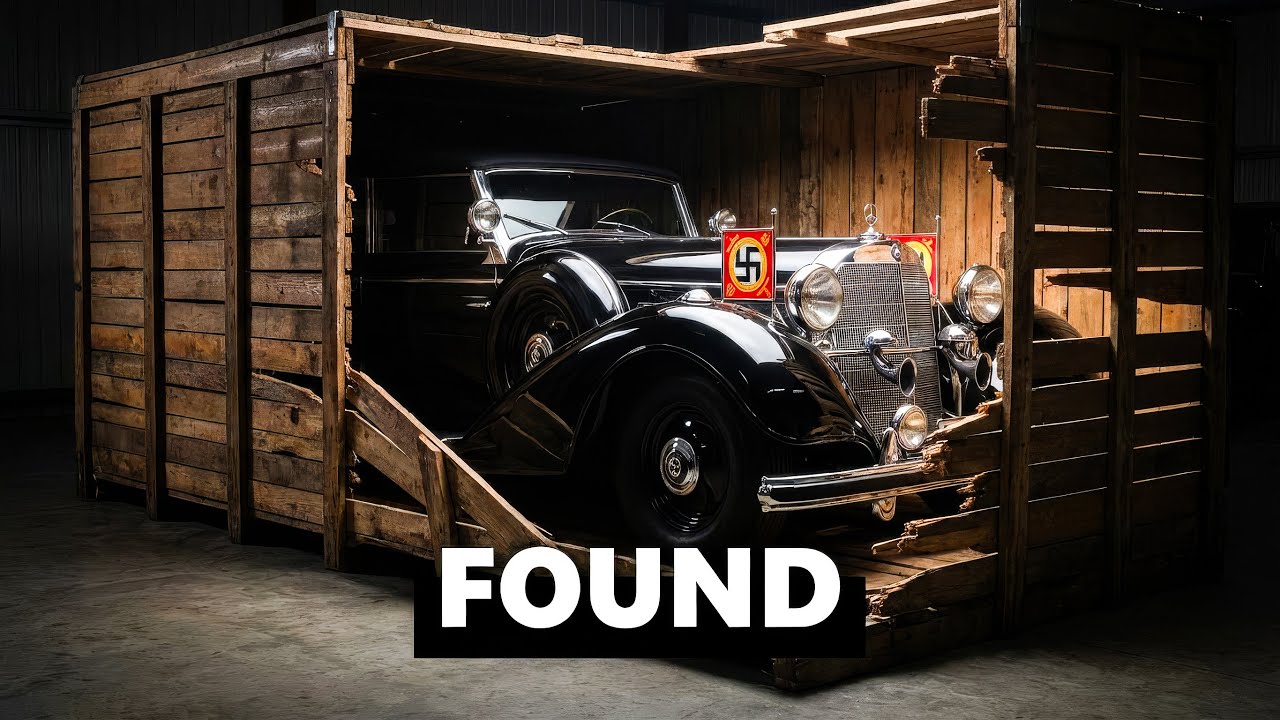
Soldiers posed for photographs beside the vehicles, some trying to climb into the dictator’s seat or crank the engines. Officers quickly roped off the area, recognizing both the historical weight and the potential value of what stood before them. Within days, intelligence officers arrived to document every angle of the cars, compiling detailed reports on their specifications and condition. But the very question of what to do with these machines proved far more complicated than anyone had anticipated.
Were they spoils of war, historical artifacts, or evidence for war crimes tribunals? The legal framework governing captured enemy property was clear enough for military equipment, but it said almost nothing about the personal effects of a deceased leader. The story of these vehicles began long before the Americans arrived. In the final days of April 1945, as Soviet forces closed in on Berlin, Hitler’s motorpool had been deliberately dispersed for safekeeping.
Some cars remained hidden in the underground garages beneath the Reich Chancellery. Others had been sent to Berchtesgaden, to secure locations in Austria, and to Czechoslovakia. They were not ordinary automobiles. The Mercedes-Benz 770K, known as the Grosser Mercedes, was the pinnacle of German automotive engineering of the 1930s and early 1940s.
Weighing over three tons, armored with plating up to 18 millimeters thick, and powered by a massive 7. 7-liter supercharged inline-eight engine producing 230 horsepower, these limousines were built to carry heads of state in both comfort and security. Hitler’s personal vehicles carried additional modifications: bulletproof glass, reinforced chassis components, and special seating arrangements that elevated him above his passengers during parades. The most famous of them was a 1939 Mercedes-Benz 770K open-top touring car, used extensively for public appearances and military parades.
Its distinctive features included a raised rear seat platform, external grab handles for accompanying security personnel, and the ability to accommodate Hitler’s preferred standing position as the car rolled slowly through adoring crowds. That particular vehicle had become one of the most recognizable images of the Third Reich, distributed across newspapers and propaganda films worldwide. The United States Army made the first decisive move. Several of Hitler’s Mercedes-Benz vehicles were loaded onto transport ships and sent to the United States for public display and fundraising.
The War Department calculated that these automobiles could generate significant public interest and support war bond drives and veterans’ charities. By late 1945, at least three of Hitler’s personal vehicles had reached American soil. One of the most documented, a 1939 770K, was displayed at the Canadian National Exhibition in Toronto in September 1945, drawing enormous crowds. The car then toured American cities, appearing at state fairs, military bases, and civic events.
Admission fees and associated fundraising generated substantial sums for veterans’ organizations. For many Americans, seeing Hitler’s car represented a tangible connection to victory, a physical trophy that symbolized the defeat of evil. The tour continued through 1946 and 1947, visiting dozens of cities. Promotional materials leaned heavily on the vehicle’s connection to Hitler, often exaggerating its role in specific historical events.
Newspapers reported that this was the car Hitler rode in during the occupation of Paris, or the vehicle used during the annexation of Austria, though documentation for such specific claims was often lacking or uncertain. Meanwhile, other vehicles from Hitler’s fleet followed different paths. The Soviet Union claimed several cars found in eastern Germany and Berlin. At least one 770K was shipped to Moscow, where it remained in storage for decades before eventually appearing in Russian military museums.
Soviet authorities were less interested in public display than in studying the vehicle’s armoring techniques and mechanical features. The French also acquired at least one of Hitler’s Mercedes-Benz vehicles, discovered in southwestern Germany by French occupation forces. This car was displayed briefly in Paris before disappearing into private ownership. Its whereabouts were uncertain for many years.
By 1948, the American-held vehicles had largely completed their public tour circuit. The question then became what to do with them permanently. The US Army initially considered several options, including permanent display at West Point, donation to the Smithsonian Institution, or sale to defray storage costs. What actually happened was more complicated and less official.
Several of Hitler’s vehicles entered private hands through unclear channels. American officers who had been involved in their seizure or transportation made arrangements to purchase or acquire the vehicles, sometimes through legitimate army surplus sales, sometimes through murkier processes. Documentation from this period is incomplete, but it appears that at least three different 770K models ended up in private American collections by the early 1950s. One vehicle was acquired by a businessman from Aberdeen, Maryland, who displayed it at his restaurant as a tourist attraction.
Another reportedly belonged to a scrap dealer who recognized its value beyond the metal content. A third surfaced in Nevada, owned by a casino operator who featured it as a curiosity to draw visitors. The authenticity of Hitler’s vehicles soon became a significant issue. As genuine cars from his fleet entered private ownership, numerous forgeries and misattributed vehicles appeared.
Any large black Mercedes-Benz from the 1930s or 1940s could be marketed as Hitler’s car with minimal evidence. The proliferation of claimed Hitler vehicles quickly exceeded the actual number that had ever existed. Historians and automotive experts began attempting to establish provenance for claimed Hitler vehicles, and the task proved challenging. Manufacturing records from Mercedes-Benz had been partially destroyed during the war.
The company’s archives in Stuttgart contained some documentation of special orders for government vehicles, but specific chassis numbers and delivery records were incomplete. Additionally, the Nazi government had maintained poor records of the Führer’s personal property, deliberately obscuring connections between state resources and personal use. Genuine Hitler vehicles did possess certain identifying features. The 770K models built for Hitler typically had chassis numbers in specific ranges, between 189,000 and 190,000 for the W150 series produced from 1938 to 1943.
They featured specific upholstery patterns, particular dashboard configurations, and unique armor plating arrangements. However, several vehicles were built to identical specifications, making definitive attribution difficult without comprehensive documentation. Through the 1950s and 1960s, Hitler’s authenticated vehicles gradually became valuable collector’s items. The initial post-war revulsion toward Nazi symbols began to give way to historical interest.
Museums sought these vehicles as artifacts documenting the Third Reich. Private collectors, particularly those interested in automotive history or World War II memorabilia, competed for ownership. One of the most famous Hitler vehicles now resides at the Canadian War Museum in Ottawa, with a well-documented history. American forces captured it at Berchtesgaden, shipped it to North America for war bond tours, and eventually sold it through army surplus channels.
It passed through several owners before the Canadian War Museum acquired it in 1970. This particular vehicle, a 1940 Mercedes-Benz 770K with armor plating and bulletproof glass, remains one of the few with uncontested provenance. Another authenticated vehicle ended up in France, purchased by a private collector in the 1950s. This car, a 1938 model, was eventually acquired by a French museum dedicated to World War II history.
It had been found in southwestern Germany, requisitioned by French occupation forces, and sold at auction in 1956. The vehicle that perhaps saw the most extensive use, the 1939 touring car used for countless parades and public appearances, remained in American private ownership for decades. It changed hands several times, each sale accompanied by authentication debates and provenance investigations. In the 1970s, this vehicle was purchased by a collector who maintained it in running condition, occasionally displaying it at automotive events and museums.
Several vehicles that may have been Hitler’s remain in dispute. A 770K displayed at a museum in Russia bears characteristics consistent with Hitler’s fleet, but lacks definitive documentation. Another vehicle held by a private European collector has chassis numbers that place it in the correct production range, but its specific wartime use cannot be confirmed. The question of displaying Hitler’s vehicles has generated ethical debates that continue to this day.
Some argue that these automobiles are important historical artifacts that help document the Nazi regime and educate future generations about totalitarianism. Others contend that displaying them glorifies Hitler or provides platforms for neo-Nazi sympathizers. Museums that own authenticated Hitler vehicles typically contextualize them with extensive educational materials, explaining their historical significance and the horrors of the Nazi regime. The Canadian War Museum’s approach is instructive.
Its Hitler Mercedes is displayed with detailed explanatory text discussing not just the vehicle itself, but its role in Nazi propaganda, the personality cult surrounding Hitler, and the ways physical objects were used to project power. Visitors see the car not as a mere automotive curiosity, but as a tool of dictatorship. Commercial exploitation of Hitler’s vehicles has also raised serious concerns. When these automobiles appear at auction, they can command extraordinary prices.
In 1973, one of Hitler’s staff cars sold for $153,000, a record for any automobile at the time. More recently, vehicles with authenticated Hitler connections have sold for several million dollars. Critics argue that such sales trivialize history and create financial incentives for fraud. The authentication industry around Hitler vehicles has grown considerably.
Experts examine chassis numbers, compare photographs, analyze paint samples, and review historical documents to determine whether specific vehicles genuinely belong to Hitler’s fleet. The process is complicated by the fact that Mercedes-Benz produced multiple 770K models with similar specifications for various Nazi officials, making it easy to mistake a vehicle that belonged to Hermann Göring, Heinrich Himmler, or another high-ranking Nazi for one that belonged to Hitler himself. Modern forensic techniques have aided these efforts. Paint analysis can determine whether a vehicle’s finish is original or has been altered.
Metallurgical testing can confirm armor plating specifications. Upholstery examination can identify original materials versus replacements. However, after seventy-five years of ownership changes, restorations, and modifications, determining absolute authenticity remains challenging. The fate of Hitler’s remaining vehicles varies.
At least six Mercedes-Benz 770K models with strong claims to Hitler ownership can be accounted for today. Two are in museums, one in Canada and one in Russia. Three are held by private collectors, two in the United States and one in Europe. At least one vehicle’s location remains unknown, last documented in France in the 1960s.
Several others may exist, but lack sufficient authentication to confirm their connection to Hitler. Mercedes-Benz, the manufacturer, has maintained a complex relationship with these vehicles. The company acknowledges the historical reality of producing automobiles for the Nazi leadership while emphasizing that this occurred under a dictatorship. Mercedes-Benz archives have cooperated with researchers and museums seeking to authenticate Hitler vehicles, providing what documentation survives from the wartime period.
The preservation challenges facing Hitler’s vehicles have proven substantial. Unlike aircraft or military equipment designed for durability under harsh conditions, these luxury automobiles require constant maintenance to remain functional. The 770K models, with their complex supercharged engines, leather interiors, and specialized armor plating, demand expertise that became increasingly rare as decades passed. Rubber seals deteriorate, wiring harnesses decay, and mechanical components wear out.
Museums and collectors face difficult decisions about restoration versus preservation, weighing the desire to maintain original components against the practical need to prevent total degradation. Some owners have chosen full restoration, replacing worn parts with period-correct reproductions and returning vehicles to operational condition. This approach allows the cars to be demonstrated at events, providing dynamic displays that static exhibitions cannot match. However, each replacement part reduces authenticity, transforming a historical artifact into something closer to a replica.
Other custodians have opted for conservation, stabilizing existing components without replacement, accepting that the vehicles will gradually deteriorate while preserving maximum historical integrity. The legal questions surrounding Hitler’s vehicles have never been fully resolved. Germany has no claim to vehicles seized as spoils of war, and Hitler’s heirs, if any could be identified, would have no legal standing to claim property of a deceased dictator whose regime was dismantled. Yet the moral dimension persists: should objects so intimately connected to genocide and war crimes be bought and sold like ordinary collectibles?
Some jurisdictions have considered legislation restricting trade in Nazi artifacts, though enforcement remains inconsistent. Security and insurance present additional complications for institutions and collectors who possess Hitler’s vehicles. These automobiles are theft targets, not just for their monetary value, but for their symbolic power. Neo-Nazi groups have expressed interest in obtaining such artifacts, while others might seek to destroy them as symbols of evil.
Museums housing authenticated Hitler vehicles employ sophisticated security systems, and private collectors rarely publicize their ownership. These vehicles have also played unexpected roles in Holocaust education. Several museums display Hitler’s cars alongside exhibitions documenting Nazi atrocities, using the limousines as entry points for discussions about power, propaganda, and the banality of evil. Young visitors who might struggle to engage with abstract historical concepts often respond to the physical presence of an object Hitler touched and used.
Educators report that seeing Hitler’s car makes the historical figure real in ways that photographs cannot, facilitating deeper conversations about how ordinary people enabled extraordinary evil. Controversies have erupted when Hitler’s vehicles appeared in inappropriate contexts. In 1981, a 770K claimed to be Hitler’s was displayed at a county fair in Pennsylvania alongside carnival rides and livestock exhibitions, drawing protests from Jewish groups and veterans’ organizations who argued the setting trivialized the Holocaust. Similar objections arose when a purported Hitler vehicle was featured in a Las Vegas casino in the 1990s.
These incidents sparked debates about appropriate venues for displaying Nazi artifacts and whether commercial entertainment contexts dishonor victims of the Third Reich. The question of what will happen to Hitler’s vehicles in the future remains open. Museums that own them face ongoing costs for preservation and security. Private collectors eventually age and must decide whether to pass vehicles to heirs, donate them to institutions, or sell them at auction.
Each transition creates opportunities for vehicles to be lost, damaged, or fall into hands that might misuse them. Some scholars argue that Hitler’s vehicles should eventually be destroyed, asserting that no amount of historical value justifies preserving objects that might inspire fascist sympathizers. Others maintain that destroying historical evidence, however uncomfortable, represents a dangerous precedent that impoverishes our understanding of the past. The debate reflects broader tensions about how societies should remember traumatic history and what physical remnants of evil regimes should be preserved.
As the last survivors of World War II pass away, Hitler’s vehicles acquire new significance as tangible links to a fading living memory. They become increasingly important educational tools, precisely because direct testimony grows scarcer. Future generations will learn about Hitler primarily through artifacts, documents, and recordings. In that context, his personal vehicles offer unique insights into how dictators constructed images of power and how propaganda operated through spectacle and symbol.
The automobiles also serve as reminders that evil often presents itself through ordinary means. Hitler’s Mercedes-Benz vehicles were not weapons of war, but tools of political theater, used to create impressions of strength, legitimacy, and permanence. They demonstrate how aesthetics, engineering, and design can be weaponized in service of ideology, and how the trappings of state power can mask criminal purpose. These lessons remain relevant in any era when authoritarian leaders deploy spectacle to manufacture consent.
What survives today of Hitler’s personal fleet is a fraction of what once existed. Scattered across continents in museums and private collections, authenticated to varying degrees and preserved with different philosophies, they remain controversial, valuable, and historically significant objects that force uncomfortable conversations and challenge simple narratives. The post-war journey of Hitler’s Mercedes-Benz vehicles illustrates how even the most infamous artifacts can serve educational purposes, provided they are contextualized thoughtfully and displayed with proper regard for the suffering they symbolize.