The corridor of the Shelborne Hotel was dim, the kind of modest light that softened edges and blurred faces. On that June night in 1952, a woman lay dying there, struck down not by an army, not by the Gestapo she had so often outwitted, but by the hand of a single man. She was Christine Granville, though once she had been Christina Scarbeck, daughter of Poland, trusted by Churchill’s war office, and one of the most daring figures of the secret war. The hand that felled her belonged to a ship steward she had spurned, a man whose jealousy had curdled into desperation.
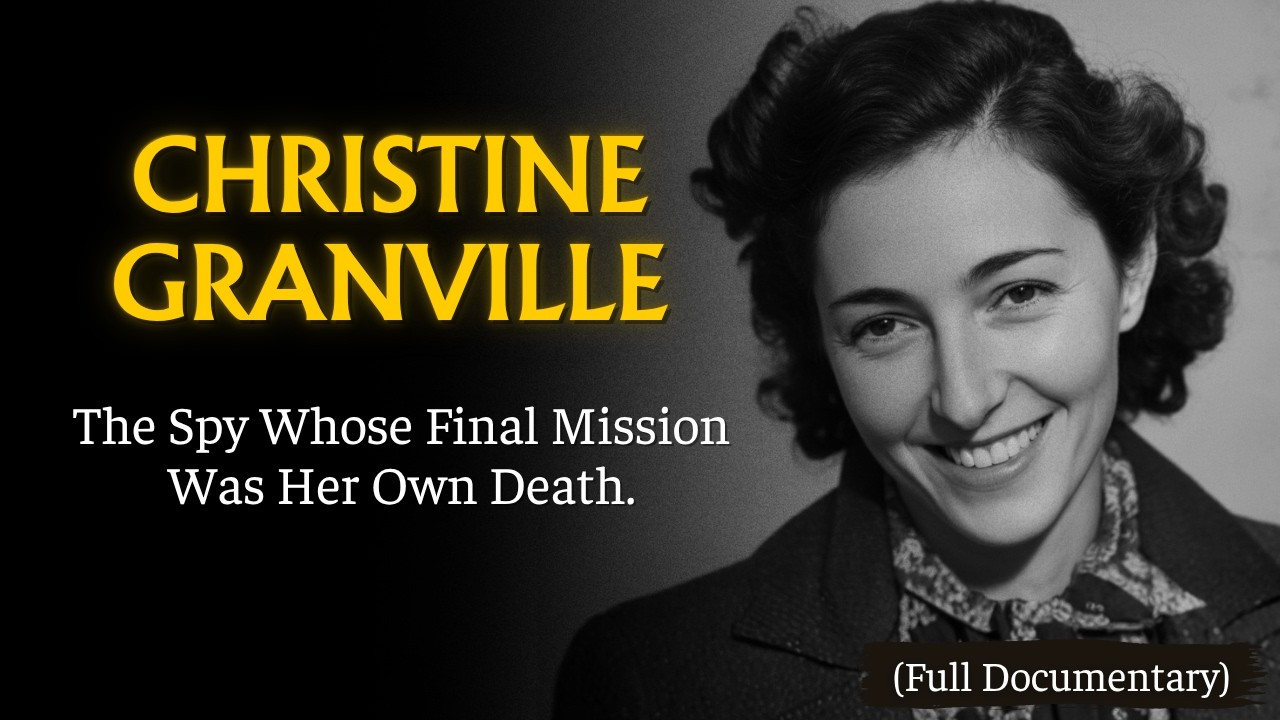
As the lamps flickered in that narrow hallway, her long journey was stilled by a knife’s sudden intrusion. Witnesses would speak of her beauty, faded but still evident, of her proud bearing, of the strength that clung to her even in death. The newspapers gave her passing small space, a column here, a few words there. The world had little room for a woman whose heroism did not fit the patterns of tidy victory.
How had she come to this? To understand, one must look back to the beginning, to a childhood in a land that had known division and sorrow for generations. She was born Christina Scarbeck in 1908 in Poland, a nation whose soil had been carved apart by more powerful neighbors. Her father, Count Jerzy Scarbeck, belonged to the old nobility, though his fortune was fading like a candle too long burned.
He was tall, handsome, a man who lived as if money were endless even as debts pressed closer. Christina adored him, saw in him the romantic figure of tales, though others judged him careless and wasteful. Her mother, Stefania, was of Jewish heritage, a woman of refinement and quiet strength who knew the precarious place her lineage occupied in a country where prejudice smoldered beneath the surface. Between the extravagant father and the vigilant mother, the child grew with both recklessness and caution entwined within her.
The great house where they lived had cracks in its walls and drafts that chilled the halls, but to a child it was still a manor, a place of horses in the stables, of orchards in blossom. Christina learned to ride almost as soon as she could walk, her small hands clutching the reins, her laughter scattering through the fields. That early mastery of risk, of balancing at speed, of trusting instinct rather than hesitation, was a lesson no finishing school could offer. She was not a quiet child.
Stories tell of how she once placed her bare leg upon a burning stove after her father had mocked her courage, holding it there until the flesh blistered, proof that she would never be cowed. The tale may have grown in the telling, but even if only half true, it reveals the defiance already burning in her. Pain did not frighten her. Shame did not bind her.
School did not contain her restlessness. She preferred the company of grooms, of hunters, of the wide fields rather than the narrow lessons of etiquette. The Great War came and with it hunger and disruption. Armies tramped across the land, borders moved again.
When Poland rose from partitions to stand once more as an independent state in 1918, the nation celebrated, but her family found themselves less certain of their place. Wealth had dwindled, debts pressed in. Christina learned early that appearances were masks, that beneath noble titles and polished manners lay fragility. Perhaps this lesson made her later so adept at wearing masks herself.
As she grew into a young woman, her beauty sharpened. Suitors came, drawn by the name of Scarbeck and by her fiery charm. Yet in her heart she remained restless. Marriage came early to a businessman of some means, steady and respectable.
He offered her security, and for a time she seemed content. Yet within months, the old restlessness stirred. She found the life of a merchant’s wife stifling, and the marriage ended swiftly. Divorce was still whispered of in society, but Christina did not mind whispers.
She trained as a journalist, involved herself with circles where politics and adventure mingled, traveled, observed, sharpened her wits. She seemed always to be leaning forward, searching for the next threshold to cross. The Europe she lived in was uneasy. Germany grew loud and menacing, Italy strutted in militaristic display, the Soviet Union loomed with its own hunger.
Poland, newly reborn, trembled between them like a candle in a draft. Christina married again, this time to Jerzy Giżycki, a diplomat and explorer whose postings promised travel and wider horizons. With him she traveled to Ethiopia, where the highlands baked in the sun and the mountains lifted in dry majesty. Yet the rhythm of diplomatic society did not satisfy her.
The marriage gave her the name by which she would later be remembered in Britain, Granville, the anglicized version that accompanied her into legend. But the bond itself loosened. In September of 1939, the storm broke at last. German armies crossed Poland’s borders, and the land of her childhood was torn apart in fire and steel.
From the east, Stalin’s armies marched, claiming their half of the prize agreed upon in a secret pact. For Poland, there was no chance. Its armies were brave but outmatched. Christine, instead of fleeing into despair, found in the destruction the very stage she had awaited all her life.
She left Poland as armies closed in, traveling southward through Hungary, seeking the chance not merely to survive but to resist. In Budapest, she began to reveal the qualities that would soon make her invaluable to the secret war. Her charm opened doors, her wit disarmed questions. She had the gift of listening, of drawing out confidences, of appearing both harmless and fascinating at once.
She conceived of a bold step, to reach Britain and offer herself directly to those who sought to fight Germany with all means, even those of shadow and secrecy. The journey westward was not easy. Borders were closing, papers were questioned, trains were crowded with desperate passengers. Yet she passed again and again, slipping through checkpoints with the confidence of one who refuses to imagine failure.
It was winter when she arrived in London, a city dimmed by blackout curtains, its streets patrolled, its air thick with anticipation of the bombs that had not yet begun to fall. Here she presented herself not as a refugee seeking shelter, but as a fighter demanding to serve. Britain was wary of strangers, suspicious of spies. Yet the British were gathering such souls into a new force, one that would later be called the Special Operations Executive.
Churchill himself urged it on, declaring that Europe must be set ablaze. In Christina, they found not only willingness but eagerness. She was among the very first women recruited into this clandestine service. Her new identity was fashioned.
Christine Granville, a name that carried both familiarity and concealment. She trained in the arts of espionage, learned codes, invisible inks, the handling of weapons. Yet what made her most effective could not be taught. Her quickness of wit, her fearless improvisation, her ability to charm or deceive in an instant.
Sent back to Hungary with secret instructions, she slipped through borders under false papers, carrying messages, carrying hope. Her first great test came in missions that carried her back across the mountains into Hungary, back toward the soil she had crossed as an exile. The cold bit at her face, the paths were narrow, the patrols alert. Yet she passed, sometimes smiling, sometimes feigning indifference, sometimes relying on sheer boldness.
Her companions marveled. She seemed to know with unshakable clarity that fear betrayed more than false papers ever could. She made herself calm, even playful when questioned. There was a story told of one crossing when a guard, suspicious of her accent, questioned her harshly.
Christine leaned forward, her dark eyes meeting his with sudden intimacy, and said softly that if he wished she could tell him more, but only when they were alone. The man, flustered, let her pass. Back in London, reports of her success reached her superiors. Churchill himself, when her name was mentioned, is said to have smiled, remarking that she was precisely the sort of spirit the war required.
The months passed and Britain endured. The bombs began to fall, the sirens wailed in the night. Yet amid the destruction, the quiet war of shadows continued, and Christine was at its center. She slipped again into Europe, again into danger, bringing out messages, bringing back hope.
She carried messages of immense danger, names of officers, plans of movements, warnings of betrayal. Sometimes they were sewn into the lining of her coat, sometimes hidden in the hollow of a heel, sometimes committed to memory so nothing written could betray her. Her mind became a living archive. There is a story of how she brought out the news of German intentions on the Eastern front, a message warning of Hitler’s plan to turn against his temporary ally, the Soviet Union.
Whether she was the sole bearer or one among many, her role was crucial. Without her, knowledge might have come too late. In Budapest, where agents and exiles mingled in a haze of smoke and whispered alliances, she became a figure both admired and envied. Her name appeared on lists, her face was described in whispers among those who hunted spies.
Yet each time she slipped past barriers with an elegance that seemed to defy probability. It was not luck. It was the blend of nerve and instinct. Among her daring deeds were the rescues of Polish officers captured and imprisoned.
To free them required forged documents, careful persuasion, and above all the ability to make others believe what was not true. The story is told of how she secured the release of fellow agents by convincing the authorities that they were of vital importance, not as prisoners, but as potential collaborators. She wove her tale with such conviction that suspicion melted away. The men walked free, bewildered at their sudden release, while their captors remained certain they had acted wisely.
Her arrival in occupied France came by parachute, the roar of the aircraft fading into the blackness as she floated downward. She joined the underground networks, those fragile webs of farmers, railwaymen, students, priests, and shopkeepers who risked everything to resist. Her tasks were many. To carry messages, to coordinate drops of weapons, to train others in the arts of sabotage, to maintain the lifeline between the field and London.
The crackle of radio became her companion. In barns and cellars, operators tapped out coded signals, their ears straining for the faint reply across the ether. German direction finders swept the countryside, hunting the faint signals. Radios were moved, dismantled, hidden, then set up again miles away.
Christine carried arms and explosives to partisans hidden in forests, disguised as a local woman traveling with groceries. She rode bicycles down narrow lanes, messages sewn into her clothing, smiling at soldiers she passed. On one occasion, stopped by a German patrol, she produced false papers with such calm that the officer, convinced of her authority, saluted and let her pass. On another, when danger pressed close, she swallowed a capsule of cyanide only to spit it out later, her teeth stained with its bitterness.
There was one night when the crackle of the radio was suddenly interrupted by a knock at the door. Silence fell. Christine moved quickly, gathering papers, scattering them into the fire. With a gesture, she indicated a back way, a narrow stair, a hidden exit.
Within moments they were gone, slipping into the night as the door was forced open behind them. Among her companions there were whispers of her affairs, of brief entanglements kindled in the heat of peril. One name often spoken in connection with hers was Andrzej Kowerski, a fellow Pole, an agent like herself who shared not only her homeland but her daring. He had lost a leg in an accident before the war, yet continued to serve with unflinching bravery.
Together they undertook missions, crossing borders, deceiving guards, carrying secrets. Some said they were lovers, others that their bond was deeper than romance, a companionship forged in fire. Christine herself left no clarity. Her deeds reached the highest circles.
She was spoken of not as Christina Scarbeck, the restless Polish aristocrat, but as Christine Granville, Churchill’s favorite spy. Her medals, when finally bestowed, were among the highest a woman of her time could receive. The George Medal, the Order of the British Empire, the Croix de Guerre from France. Winston Churchill himself, when told of her exploits, is said to have remarked that she was his favorite spy.
Whether the phrase was uttered often or only once, it clung to her name thereafter. The Gestapo carried her description, her name appeared on lists. Each mission grew more dangerous, for anonymity was no longer her shield. London rejoiced in 1945.
The war was over, the long darkness lifted. Yet for Christine, standing amid the celebrations, the joy was edged with silence. Where others saw peace, she felt only emptiness. The Special Operations Executive, the shadow army that had embraced her, was dissolved.
Files were closed, agents released, their extraordinary deeds folded into silence. Christine was left adrift. She worked as a stewardess on ocean liners, her beauty and charm serving now as ornaments rather than weapons. She moved from job to job, from place to place, never settling, always seeking something that peace could not offer.
Poland, her homeland, was lost to her, consumed by Soviet control. She belonged nowhere. Her allegiance spent, her courage unrewarded. She took positions abroad, sought adventure in distant lands, returned again to London, departed once more.
Each journey promised meaning, yet each ended in the same restlessness. Her lovers faded. Some returned to their families, others could not endure her refusal to settle. Andrzej Kowerski remained close, his loyalty unwavering, but even he could not fill the void.
She had given her life to the cause of liberty, and in return she had been left to fend for herself in a world that preferred to celebrate others. She was stateless in spirit, belonging to no land, no cause, no home. The silence of absent names pressed closer with each year. Comrades she had admired, others she had loved, still others she had saved only to lose later, were gone.
Executed in prison yards, shot in forests, tortured into silence, or vanished altogether. She carried their memory within her, though she never spoke of it openly. There is a story told of her visiting the grave of a comrade, standing silently as the wind stirred the grass. She placed a flower there, her hand lingering on the stone, then turned away without a word.
She did not weep, but the sorrow was evident in the stillness of her posture. She traveled widely in those post-war years, sailing through the Mediterranean, across the Atlantic, drifting through Cairo, through Nairobi. Yet beneath the surface the old disquiet stirred. Her suitcase closed again and again as she left behind the ships, the sea, the endless horizon.
She took other work. Hotel clerk, saleswoman, companion to wealthier friends. Always moving, always searching, never satisfied. Her romances followed the same pattern, intense, fleeting, unfinished.
She would give herself for a time, but never wholly. And when the relationship pressed toward permanence, she withdrew. Men still noticed her, drawn to her presence, her elegance, the aura of mystery that clung to her. Yet the glances no longer lingered as they once had.
The mirror reflected back a weary face, lined not only by time but by a life lived always at the edge of danger and disquiet. Beauty had been her ally once, as much a weapon as charm and courage, and though it had not yet abandoned her, she could see it fading. She lived instead in fragments. An evening here, a conversation there, a fleeting romance, a restless journey.
Her medals lay in a drawer unseen. Her comrades were gone or far away. The world had forgotten her, and she, though unwilling to admit it, felt the sting of that forgetting. For all her independence, all her pride, Christine had longed in her heart for recognition.
Not for vanity’s sake, but as proof that her sacrifices, her courage, her very life had meant something. His name was George Muldowney. An Irishman, a ship steward, a man who had crossed her path during her post-war years at sea. To him, Christine was not merely another woman.
She was an obsession. Her laughter, her poise, her restless energy became to him a source of both fascination and torment. His adoration was not gentle. It was possessive, insistent, consuming.
Where others accepted her elusiveness, George could not. He wanted to hold her, to keep her, to bind her spirit. But Christine could never be bound. At first she tolerated him, perhaps even pitied him.
He was attentive, eager to please, quick to follow her wherever she went. But she soon sensed the darkness in his devotion, the instability in his gaze. He hovered near her in bars, in hotels, in streets where she wished to walk alone. His devotion was suffocating.
Friends noticed his presence and warned her. Christine, with her usual defiance, dismissed him lightly, confident she could handle him as she had handled so many others. Yet perhaps she underestimated the depth of his obsession. The more she distanced herself, the tighter he clung.
The more she laughed at his devotion, the deeper his desperation grew. What began as courtship became pursuit. What began as affection became threat. She had faced the greatest dangers of the war, had survived where so many had fallen.
Yet here, in the peace she had never embraced, danger came not from armies but from a single man whose heart had turned into a weapon. She returned to her room at the Shelborne Hotel on that June night, her day behind her, her spirit perhaps weary but still unbroken. The locked door closed behind her, sealing her in, sealing him out, or so she might have believed. But George Muldowney waited.
His jealousy, his anger, his desperation pressed against his thoughts. He could not accept her rejection. He could not endure her freedom. In the corridor of the hotel, he confronted her.
What words were spoken that night, we cannot know. Perhaps she laughed at him as she had so often laughed at danger. Perhaps she dismissed him sharply. But George, unstable, consumed by obsession, could not hear reason.
His devotion had become a knife in his hand. The attack was sudden, brutal. Christine, who had faced Gestapo officers with fearless eyes, met her end in the narrow corridor of a London hotel, felled by the hand of a jealous lover. She died quickly, her body collapsing in silence.
There is a cruel irony in it. The woman who had escaped every trap, who had survived every mission, was undone not by empires or armies but by the frailty of one man’s heart. The murderer was found swiftly. George Muldowney, still trembling with the frenzy of his act, did not flee far.
He confessed. The newspapers reported the story briefly, their tone factual, their words restrained. Her service was acknowledged with a few lines, her medals mentioned, but the space allotted was small. The world moved on, as it always does.
Her service was small. A few friends, some comrades who remembered her from the war, stood in silence as the coffin was lowered. There were no bands, no flags, no speeches from officials. The government she had served so fiercely was absent.
Her grave, beneath the London rain, held her body, but her story could not be confined. In the years that followed, it became a place of quiet pilgrimage for the few who still remembered. Veterans, Poles in exile, friends who had survived came to stand before the stone, to leave flowers, to whisper her name. What remains of her?
A grave in London where rain falls on cold stone, a few lines in newspapers, a scattering of files in archives, medals in drawers, their meaning dimmed, memories carried by those who once knew her, now themselves long gone. She lived fully, fiercely, without compromise. The candle burns no more, but its smoke drifts upward, carrying with it the memory of her name, lingering in the silence.
