In the summer of 1851, a carpenter worked eighty feet above the floor of the Genesee River gorge in western New York, driving a wooden peg with a mallet and listening to the sound it made. The peg was a treenail, a cylindrical dowel, usually six inches long, driven through a hole bored in two joined timbers to lock them together. The sound it made when it seated properly differed from the sound it made when the angle of the hole was slightly off, when the peg grated against green wood that had not yet dried to the size the hole was meant for. He had been repeating the motion since before the sun rose over the eastern rim of the gorge.
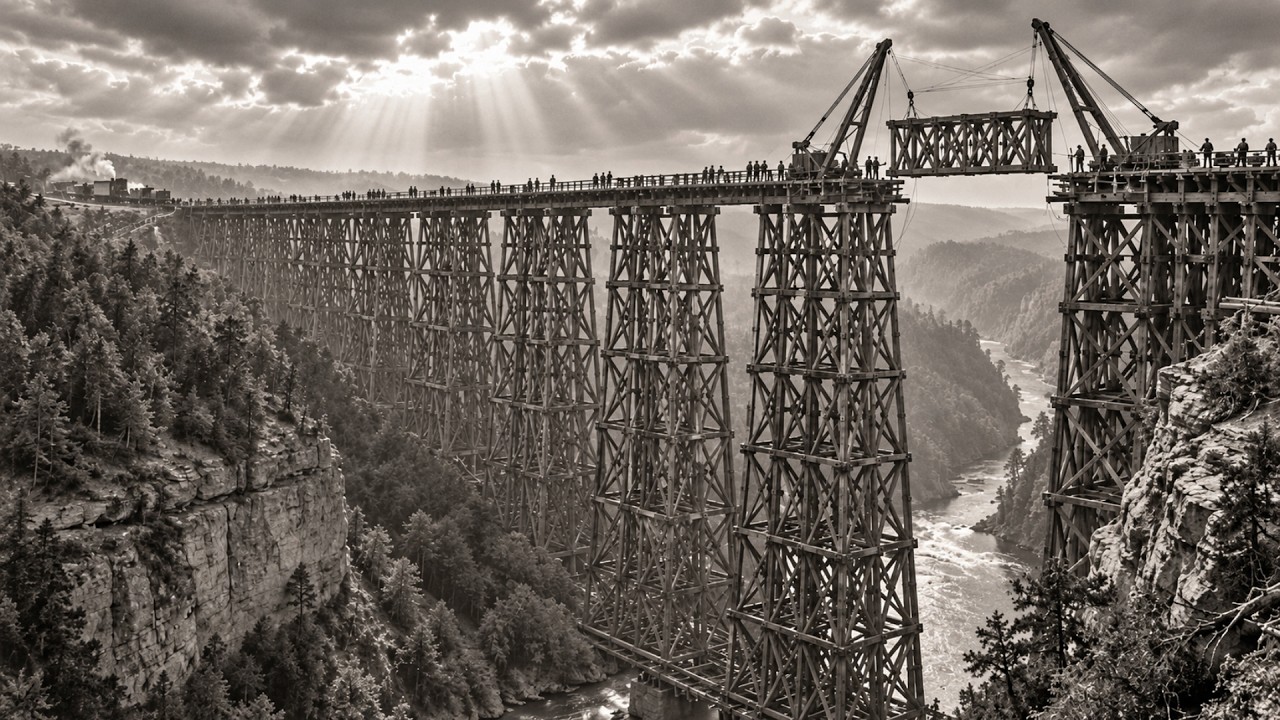
He would keep repeating it until the light down in the valley turned from gold to gray. The gorge dropped a hundred and fifty feet below the planks of the scaffolding he stood on down to the Genesee River. Above him, the timber bents he was working on rose another eighty feet to the level where the rails would be laid. The structure taking shape around him was not yet finished.
When it was, it would be the tallest railroad bridge in the world. The original Portage Bridge, a wooden trestle crossing the Genesee River gorge at Portage, New York, from 1852 until the morning of May 6, 1875, was eight hundred feet long and two hundred and thirty-four feet high at its highest point above the river. The Buffalo and New York City Railroad built it in less than a year, with a workforce of carpenters and Irish immigrant laborers who had come to western New York from the canal and railroad projects that had employed them across the northeastern states over the previous decades. When it opened to rail traffic in the spring of 1852, it was the highest railroad structure in the world.
It carried trains over the Genesee River gorge for twenty-three years. On the morning of May 6, 1875, sparks from a locomotive set fire to the timber deck. The flames consumed the whole structure in under two hours. The bridge fell in sections into the gorge below, from a height of two hundred and thirty-four feet, and burned on the rocky floor of the valley.
The men who built it have no names on any memorial plaque at the site. To understand why the Buffalo and New York City Railroad needed to cross the Genesee River gorge at Portage in 1851, you have to understand what the railroad was trying to build, and why the gorge stood in its way. The Buffalo and New York City Railroad Company was chartered by the state of New York in 1843 to build a direct rail line connecting Buffalo, on the eastern shore of Lake Erie, south and east across the Allegheny Plateau to the railroad network of the Hudson River valley and New York City. By the early 1840s, the commercial importance of a continuous rail link between the Great Lakes and the Atlantic coast had been demonstrated by the partial beginnings of several competing routes across New York and Pennsylvania.
None of them yet provided the connection that the commerce of the interior Great Lakes region required. Buffalo was the point where the Erie Canal ended at Lake Erie, where commercial produce coming in from the western interior was transferred to the canal system to head east toward Albany and the Hudson River. A rail line from Buffalo to the southeast toward New York would provide a faster, year-round alternative to the canal route, positioning the railroad and the city it served to absorb the traffic the canal could not handle at the height of its commercial pressure. The route the railroad surveyors chose ran south from Buffalo across the Allegheny Plateau in western New York before turning east through the Southern Tier counties toward the Hudson River valley.
The Allegheny Plateau is an ancient upland, in essence a dissected plateau cut through by river valleys carved by post-glacial drainage, creating exploitable terrain at plateau level with sharp, sudden slopes wherever a river had cut its way across the surface. Any railroad crossing this terrain had to overcome the challenge of crossing the valleys. The Genesee River gorge was the most prominent lateral obstacle on the route the surveyors chose. The Genesee River drains a large portion of the Allegheny Plateau in western New York, flowing north through Rochester to Lake Ontario.
In the part of its upper course the railroad had to cross, the Genesee had cut gorges through the plateau to depths that raised the gorge walls more than two hundred feet above the river to the surrounding terrain. The Upper Genesee Falls, three separate cascades of the river over ledges of shale and limestone, marked the places where the river had found harder rock beneath its bed and its downward erosion had temporarily halted. This gorge was the product of ten thousand years of continuous carving. The shale of the gorge walls was the rock layer the river had not yet reached.
The railroad engineers chose the crossing point at Portage, above the Upper Falls, where the geometry of the gorge offered the best possible combination of width, height, and stable wall conditions for the foundation work the crossing required. At Portage, the gorge was about eight hundred feet wide at the level of the surrounding plateau. The distance from the plateau surface down to the river was two hundred and thirty-four feet. These two numbers defined the nature of the crossing required.
There was no other number. The geology of the Genesee gorge at that site was the specification, and the engineers’ task was to design a structure that met it. The man the Buffalo and New York City Railroad put in charge of designing and supervising the construction of the Portage crossing was Silas Seymour. Born in Connecticut in 1817, Seymour trained as a civil engineer in a period when American railroad construction was creating the first generation of engineers who built something larger than a canal lock or a highway survey.
By 1851 he had accumulated enough experience to be placed in charge of the most difficult problem in one of the most ambitious railroad projects in New York State. He was in his early thirties. He had never built anything this large, and no one else in the United States had either. A wooden bridge two hundred and thirty-four feet high spanning a gorge eight hundred feet wide was not a structure that existed in the American engineering record in 1851.
It was a structure that had to exist by 1852, when the railroad expected to open its line across the southern tier of New York. The design Seymour produced was for a timber bridge supported on bents. The choice of wood over stone masonry was not difficult once the financial constraints of the Buffalo and New York City Railroad were fully considered. A stone arch bridge crossing the Genesee gorge at two hundred and thirty-four feet high would have been more durable, less fire-prone, and would require less continuous maintenance against rot and weather degradation.
The problem was not the structural logic of masonry. The problem was cost. The company had been in intermittent financial difficulty since its founding. Building a railroad across the Allegheny highlands of western New York required the capital the company had raised through stock subscriptions and bond sales, and that capital had to be spread across the entire line.
A masonry construction at Portage, at the scale the gorge required, would have consumed capital the company needed elsewhere on the route. The cost of the timber bridge was a fraction of what masonry would have cost. It could be built in months instead of years. It would require maintenance and eventual replacement, but those were future expenses.
The company’s officers were managing the present. The financial officers of the Buffalo and New York City Railroad did not have to account for the difference between building a structure once and building it twice. They only had to account for what they could afford to build now. Seymour designed the timber structure the railroad needed to cross the gorge by the date the railroad needed to cross it.
The railroad approved the plans. Work began. The timber for the Portage Bridge came from the forests of the Allegheny highlands surrounding the gorge. White pine and hemlock grew in woods within hauling range of the construction site.
Portable sawmills set up near the gorge rim handled the first stage of conversion from logs to roughly sawn lumber. A framing yard on the rim was where the raw lumber became elements with the precise dimensions specified in Seymour’s drawings: the sill timbers that carried the base of each bent, the upright timber posts rising from the sills to the cap beams, the cap beams that transferred the load of the deck down to the posts below, the cross braces and diagonal bracing that kept the bents from swaying sideways under wind forces and the movement of trains, the deck beams running the length of the bridge between bents, and the transoms that held the rail spikes. The bent was the basic structural unit of a high timber bridge. Each bent was a transverse frame oriented perpendicular to the direction of travel, transferring the vertical load of the deck and rails above down to the ground below.
A line of bents spaced along the direction of travel, connected by longitudinal beams of the deck system, formed the structural skeleton of the bridge. At Portage, where the gorge floor lay two hundred and thirty-four feet below the deck at its deepest point, the bents could not be single-stage frames rising from the gorge floor to deck level. Building a timber structure two hundred and thirty-four feet tall as one unsupported frame was not possible by any engineering standard available in 1851. What Seymour designed was a staged structure that used the gorge walls and natural rock formations within the gorge as intermediate foundation points, stepping the structure up from the ground in sections rather than one continuous rise.
The approach sections of the bridge, where the gorge walls were at their lowest, carried bents of modest height. As the structure extended over the gorge, the bents grew taller as the gorge floor dropped beneath them. The tallest interior bents, positioned over the deepest part of the gorge directly above the river, were the last sections completed and the most technically demanding. Every joint in the structure, connecting timber to timber, was made with a mortise-and-tenon joint secured by a treenail.
The mortise was a rectangular cavity cut into the face of a timber to a specified depth and dimension. The tenon was a matching projection cut into the end of the connecting timber. When the tenon entered the mortise, the two pieces became mechanically interlocked. The treenail, driven through a bored hole, locked the tenon inside the mortise and prevented the joint from opening under load.
In the framing yard on the gorge rim, this bench work was done on solid ground. At the construction site, the same work was done on scaffolding one hundred, one hundred and fifty, and two hundred feet above the river, by the same men with the same hammers, with a treenail needing to be driven correctly in every joint. With the gorge below their feet, a consequence that did not exist in the framing yard. Construction proceeded from the gorge walls inward.
The sections of the approach spans, where the height above ground was manageable, were assembled and raised using gin poles and a block-and-tackle system. A gin pole was a wooden mast set vertically and guyed to keep it upright, fitted at its head with a pulley through which the lifting rope passed down to the load and up to the hoisting wheel at the base, which in 1851 was a horse engine, a horizontal winch turned by horses walking in a circle, the motion carried through ropes to the lifting system above. The horse engine was the standard type at construction sites during the 1850s, capable of lifting roughly fifteen hundred to two thousand pounds to working height. A major section of the structure, consisting of a bent and its attached framing, weighed several hundred pounds.
The hoist at the gorge rim could lift it to the scaffolding below. As construction moved toward the center of the gorge and the structures grew taller, the construction difficulties grew with them. Moving a heavy timber from the framing yard on the gorge rim to its assembly position one hundred and fifty or one hundred and eighty feet above the gorge floor required guiding the lifted load across the increasing distance between the hoist on the rim and the scaffolding on the tall structure below, and steadying it for connection at the height where the construction crews waited. A forty-foot white pine timber, weighing several hundred pounds, swinging on a hemp rope above a construction crew positioned one hundred and fifty feet above rocks and river, was not a stable load.
The men on the scaffolding who received those loads and guided them into place did so as part of their daily work routine through the summer and fall of 1851. The records do not tell us how many of them knew what could happen when a load did not reach its intended destination. Any man who lost his balance on that scaffolding fell to the gorge floor or into the river. The shale rocks at the bottom of the Genesee gorge need no explanation.
The river flowing two hundred feet below was not substantially different. The casualty records of the Buffalo and New York City Railroad construction during the period of the Portage Bridge build are not comprehensive in any publicly available form. The labor law requirements governing the documentation of construction fatalities in New York in 1851 were not those of a later era. What the records show is that the work was completed to specification.
What the records do not show, in most cases, is the price paid in the lives of the men who did it. The workforce that built the Portage Bridge came from the pool of Irish immigrant laborers who had been following the construction economy of the northeastern United States since the 1820s. Irish men had been arriving at Atlantic ports in increasing numbers throughout the thirty years before the summer of 1851. The famine years from 1845 to 1852, when potato crop failure caused death and emigration on a scale that halved the population of some Irish counties, accelerated a migration already growing since the agricultural disruptions of the Napoleonic era.
The men who arrived in New York and Boston in the late 1840s and early 1850s entered a labor market that was actively absorbing Irish workers for the construction projects generated by the railroad expansion of the period. The men who had built the Erie Canal, completed in 1825, dispersed on the canal’s completion to the next project and the one after that, carrying heavy construction skills and knowledge of where work was starting. Canal building and early railroad building across the mid-Atlantic states in the 1830s and 1840s had created a mobile construction workforce that knew how to use a pick in rock, how to move heavy materials across difficult terrain, and how to live in a construction camp near the work and leave when the work moved. The famine migration added men who arrived with less prior industrial experience but with a willingness to accept whatever the labor market offered.
At Portage in the summer of 1851, work was available, the Irish labor pool was close by, and the wage for heavy construction labor in western New York was the prevailing rate. The prevailing rate was set by the number of men who wanted work and the number of jobs open. The construction camp on the gorge rim housed the men who could not travel daily from the nearest towns. The nearest town of any size required travel by road standards that made daily commuting impractical for men who needed to start before sunrise.
The camp was as construction camps of the period were, temporary structures adequate to keep men on site and ready for work. They were not designed to accommodate the conditions of a western New York summer or a western New York winter beyond the minimum the men needed to get up and work the next morning. The western New York summer at the gorge rim focused the season’s heat on exposed rock and timber surfaces. Men worked on the outer turns in the summer of 1851 under direct sun, on timbers that absorbed heat and re-radiated it from their surfaces.
The men on the inner turns worked on the tall sections above the deepest part of the gorge, at a height averaging above the river and gorge floor below the rim, swinging between the shade of the gorge walls and the direct sun of the plateau highlands, depending on the time of day and the position of their work platforms on the rising bents. The western New York winter came early and lasted long. October brought snow to the highlands. The Genesee River at Portage did not freeze over completely in most winters, but flowed dark and fast between ice shelves at the gorge walls through January and February.
Working timber framing below freezing was possible. It was not comfortable. Treenail holes froze before the pegs were driven into them. Mortise surfaces were wood hardened by the cold.
The men on work platforms above the gorge in November winds were fully exposed to the highlands plateau, with nothing between them and the temperatures that season produced. The construction schedule gave the workers no option of waiting for spring. The original Portage Bridge opened to rail traffic in the spring of 1852, when the rails were completed across the deck and the first locomotive crossed the Genesee River gorge two hundred and thirty-four feet above the river, on structures of white pine and hemlock assembled by men who had spent the previous summer and fall driving treenails. The bridge held.
The deck did not deflect more than the structure was designed to bear under live loads. The bents did not rack. The joints did not open. The crossing was open.
The men who built it did not stay at Portage. The construction workforce of the 1850s moved with the work. When the contract in the gorge was complete, the timber framers and laborers and foremen moved on to the next section of work on the rail line or to other projects in western New York and Pennsylvania where the construction economy offered employment. The railroad needed its crossing.
The crossing was ready. The men were no longer needed at the crossing. The Portage Bridge, at the moment of its completion, was the tallest railroad structure in the world. This was not a record Seymour had set out to design.
It was a record the Genesee gorge imposed on the design by virtue of its depth. But it was a fact. The tallest railroad bridge in the world was a timber structure carrying trains across a gorge in western New York State. Travelers on the line wrote about the crossing as mid-nineteenth-century travelers wrote about high railroad crossings, describing it as an experience that gave those who dared to look down a sensation of suspension over a void that wagon roads had never provided them.
At twenty-five miles per hour, crossing the eight-hundred-foot bridge took about twenty seconds. During those twenty seconds, a passenger looking from the window of a wooden 1850s railcar saw the gorge walls receding on either side. If he looked straight down, he saw the Genesee River two hundred and thirty-four feet below passing as a blurred streak produced by height and speed through the windows of the moving train. The locomotive engineers who crossed the bridge lived those twenty seconds as part of their professional duties.
The sound of the wheels changed from the familiar sound on solid embankments to a different sound over timber planks. The throttle setting required for the crossing was not the same as for open track. The operating rules for the crossing specified precisely what the structure could safely carry in terms of speed. The engineers adhered to that speed.
They crossed it hundreds of times. They kept crossing it until May 6, 1875. The Buffalo and New York City Railroad had been absorbed into the Erie Railroad system by the early 1860s. The Erie was one of the major railroads of the northeastern United States, running from Jersey City across New York State to Buffalo and Lake Erie, with the Southern Tier line through Portage one of its most important subsidiary routes.
The Civil War began in April 1861. The Erie carried the military and commercial traffic of the Union war effort across the Southern Tier and over the Portage Bridge throughout the war years. Confederate cavalry operations that disrupted the Baltimore and Ohio Railroad along its route in Maryland had no comparable effect in western New York. Union military trains crossed the Portage Bridge without needing a military garrison.
The war ended, and the bridge remained. The locomotives of 1862 were heavier than the locomotives of 1852. The locomotives of 1872 were heavier than those of 1862. The standard American freight locomotive of the early 1870s weighed between twenty-five and thirty tons, compared with fifteen to twenty tons for the machines that first crossed the Portage Bridge in 1852.
Train lengths had increased. So had the freight load in every car. The structure was carrying in 1875 weights that Seymour’s 1851 design had not anticipated, on timber that had weathered and undergone twenty-three years of stress cycles. The maintenance system managed the gap between the original design and the operating reality by replacing damaged components on inspection cycles.
But the gap did not close. It widened. Maintaining a timber bridge carrying steam locomotives was a continuous process, with a trajectory not fully determined by the initial construction. Every timber in the structure was subject to the forces affecting all weather-exposed wood: moisture absorption and drying, the freeze-thaw cycle of the western New York climate, and the biological activity of fungi and insects that consumed damp wood wherever they gained a foothold.
A timber bent sound in 1852 was not guaranteed to remain sound in 1862, and certainly not guaranteed in 1872. Maintenance crews inspected the bridge deck and access points in the structure on a schedule set by the railroad’s maintenance supervisor. Elements found to have deteriorated beyond the remaining structural section, a limit set by engineering judgment rather than written standards, since no written standards for such matters existed in American practice at the time, were placed on the replacement schedule. Replacing a major timber element in a structure two hundred and thirty-four feet above a river gorge was a major operation in itself, requiring the lifting and access equipment that the original construction had required, but this time to remove the damaged element and install the new one without disrupting traffic on the deck above.
Fire watch was the other continuous operation. Every train crossing the bridge was a potential fire event. The wood-burning locomotives of the early period expelled burning material from their stacks in quantities proportional to the intensity of the fire under the boiler. Crossing the Portage Bridge, which required maintaining sufficient speed to cross safely, was a combustible event every time a train used it.
The coal-burning locomotives that began replacing wood-burners on American railroads during the 1860s and 1870s produced a different kind of spark: smaller, more numerous, harder to see against the sky before they fell. Fire watch for a coal-burning locomotive crossing a timber bridge was a different operational problem from fire watch for a wood-burner, and the development of the locomotive fleet on the Erie line had not been matched by a corresponding development in the fire watch protocols at Portage. The fire watch depended on men. Men stationed to watch the bridge deck after each train crossing and extinguish any fire before it reached the structural timber beneath the deck.
It worked perfectly right up until the moment it stopped working. The morning of May 6, 1875, was an early-May Thursday in western New York. The Genesee River was flowing at its spring level, higher and faster than its late-summer low, fed by snowmelt from the highlands upriver. The bridge deck timbers, exposed to the previous winter’s weather, had dried during the warmer weeks of late April and early May.
By the morning of May 6, the bridge deck wood was not as saturated with moisture as it would have been in April. A train crossed the bridge from west to east in the early morning hours. The locomotive was coal-burning. Sparks from the stack settled on the deck in the wake of the train’s passage.
The fire watch crew was at its post. The watchmen saw what the sparks had done and responded. They reached some of the fires. They could not reach everything the sparks had ignited before the fire spread.
The fire they could not extinguish reached the structural timbers of the supporting frames beneath the bridge deck. The burning of structural timber inside the body of a massive structure does not show its effect on the exterior surface until the remaining part of a beam is too small to carry the weight above it. A post burning from within, consuming its cross-section from the inside out while its exterior surface retains the traces of twenty-three years of weather and maintenance paint, is a post that collapses suddenly. The collapse of a post brings down the frame that supports it.
The collapse of the frame brings down the section of the bridge above it. The bridge sections fell. A section of the Portage Bridge deck carrying rails and ties fell from one hundred and fifty or two hundred and thirty-four feet to the shale floor of the Genesee gorge, reaching the rock at a speed set by the physics of falling, without regard to anyone’s wishes. The shale at the bottom of the gorge at Portage was not soft.
The sections fell and burned where they settled. The fire spread along the full length of the bridge from the ignition point outward, the structural collapses in each supporting section carrying the burning deck into adjacent sections on both sides. Witnesses on the gorge rim recorded the collapse happening in stages, the structure falling inward toward the gorge and burning on the gorge floor below the part still standing. The entire sequence from the first structural collapse to the loss of the whole deck took less than two hours.
By the time the fire had consumed everything it could reach, the original Portage Bridge, the tallest railroad bridge in the world in its early years, eight hundred feet of pine and hemlock built by men whose names are not recorded at the site, was scattered wreckage at the bottom of the Genesee River gorge. Two hours of fire ended twenty-three years of crossing. The Erie Railroad’s response was immediate, because the cost of closing a major route accumulated with every hour the crossing stayed out of service. Passengers and freight were diverted around the gap at Portage via wagon road and alternate routes that railroad officials managed to organize in short order.
Every hour of diversion was a cost the railroad paid for a bridge that no longer existed. The decision to replace the timber structure with an iron one was made within days. Iron railroad bridge construction technology in the United States had matured by the late 1850s and 1860s to a point that allowed the design, fabrication, and construction of an iron replacement for the Portage crossing on a schedule set by the railroad’s operating conditions. The design included iron posts and truss structures resting on the same foundation work in the gorge walls that the fire had not destroyed.
The iron posts would not burn. The fire hazard that had consumed the original structure would not apply to the replacement. The men who built the iron replacement in the summer of 1875 were not the men who built the original timber structure in the summer of 1851. Twenty-three years had passed.
The workforce of 1875 in western New York was different. The construction methods were different. The materials were different. What remained constant was the gorge and the river at its bottom, the eight-hundred-foot width and the two-hundred-and-thirty-four-foot height that the crossing imposed on any structure spanning it.
The iron Portage Bridge was completed in about ninety days from the morning of May 6, 1875. It opened to rail traffic in August 1875. The iron structure rises from the same crossing alignment, reaches nearly the same height above the Genesee River, and has carried the same rail traffic the timber structure carried, but now on a frame that will not burn. The iron structure has been in continuous service since August 1875.
It stands in what is now Letchworth State Park. Trains still cross it. The structure built in ninety days to replace what burned in less than two hours has remained in service for nearly a hundred and fifty years. If you drive south from Rochester to Letchworth State Park and find the overlooks above the Genesee River gorge, you can see the iron bridge crossing above you.
The gorge walls rise from the river to the plateau on both sides. The river below flows past the shale ledges that the Genesee has been carving for ten thousand years. The iron structure crosses the gorge on the same alignment used since 1852. You can hear the train before you see it.
The sound builds from the south, deepening as it approaches the gorge, crossing the structure in the twenty seconds it takes to cover eight hundred feet at operating speed, then fading toward the north. There is nothing on the gorge floor to tell you that a timber structure once stood there. The river has removed the debris. The shale retains no trace of what fell on it in the hours after May 6, 1875.
The gorge remains as it was before the railroad came to Portage, and as it would be if the trains stopped crossing tomorrow. The original timber structure no longer exists in the gorge except in the historical record. The accounts of the Buffalo and New York City Railroad’s construction for the period of the bridge’s building contain the project’s labor costs aggregated by period and type of work. The Irish laborers who drove the treenails in the mortise-and-tenon joints of the tallest railroad bridge in the world appear in those accounts as daily and weekly wages aggregated into a single total.
Where individual names appear in the engineering correspondence and contractor records of the project, they are the names of the supervisors and construction contractors who had a formal contractual relationship with the railroad. The men who worked on the scaffolding one hundred and fifty feet above the gorge floor appear as a labor cost per period. They do not appear as people. This is not an exception in the Portage records.
It is the structure of the historical record of construction labor in mid-nineteenth-century America, applied uniformly across the construction economies of the period. The accounting conventions recorded the cost of labor. They did not record who provided it below the level at which the construction economy required a name attached to a contract. Silas Seymour’s name is in the engineering literature as the designer of the original structure.
His name is attached to the record of the tallest railroad bridge in the world that the Portage Bridge held during its early years. His name appears in the history of American railroad engineering in the way engineers’ names appear as authors of the design that produced the structure. The man who was driving treenails eighty feet above the gorge floor in the summer of 1851, and at one hundred and fifty feet as the bents rose, and at two hundred feet at the top of the highest part of the tallest railroad bridge in the world, his name is not on any monument or designation associated with the Genesee gorge crossing that is accessible to the public. He exists in the accounting records as part of a labor cost in a construction work period.
He exists in the historical record as an absence of a name in a place where a name belongs. The treenails he drove held for twenty-three years. They held through every crossing from 1852 to May 6, 1875. They held through the Civil War years when Erie trains carried Union military traffic across the gorge.
They held through the winters when ice crusted the edges of the Genesee and the gorge was frosted below the bridge. They held until fire reached the timbers they bound together. At that point, whether the treenails held was no longer a question of any importance. The plaque at Letchworth State Park records the name of the bridge and its dates.
It does not record the names of the workers. The iron structure that replaced the timber one crosses the Genesee gorge on the same alignment the workers established. The gorge is below, just as it was beneath the workers’ feet in the summer of 1851. The river runs over the same shale it ran over when the carpenter above was striking his mallet on a treenail and listening to the sound it made.
That sound was the right sound. The joint held. Then he moved on to the next one.






