In June 2021, Sheriff Jesse Slaughter stood before cameras in Great Falls, Montana, and announced that a case which had haunted the city for sixty-five years was finally closed. It was, he said, the best conclusion possible in a case of its kind. There would be no trial, no sentence, because the man identified as the killer had been dead since 2007. Three generations of investigators had worked the case, and they had finally put a name to it: Kenneth Gould.
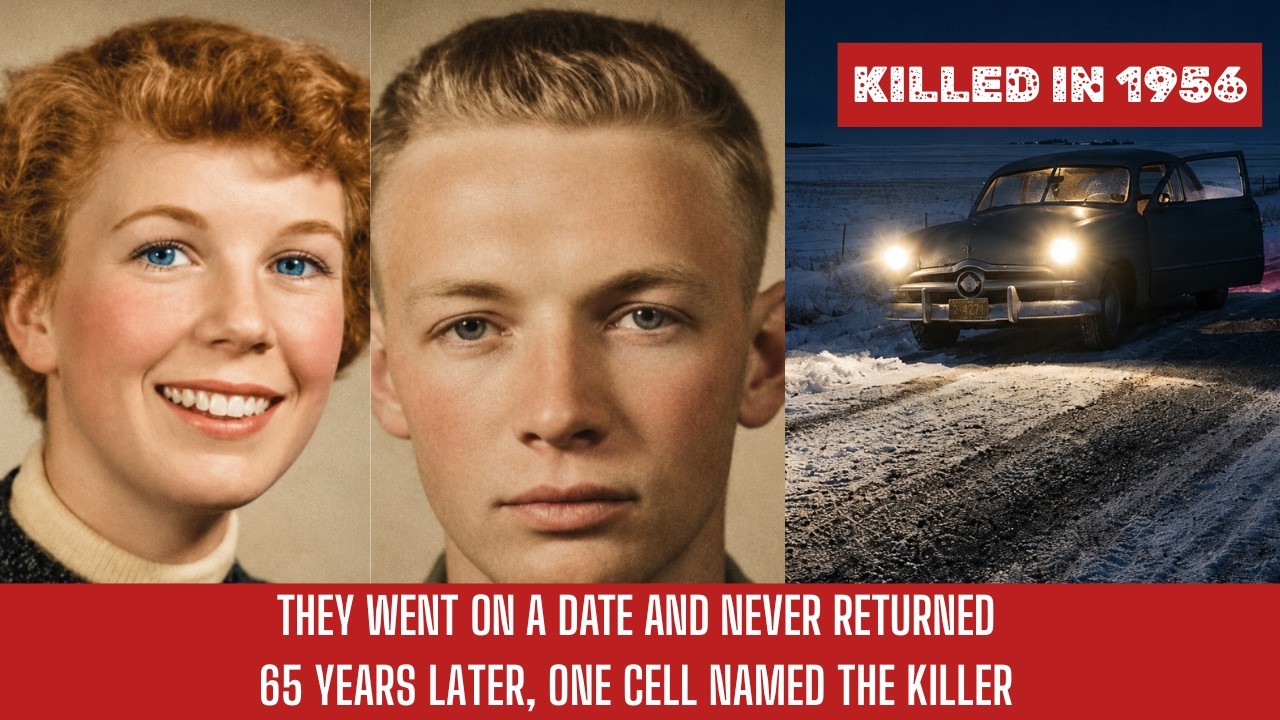
The story began on the night of January 2, 1956. Patricia Kalitzke, a sixteen-year-old junior at Great Falls High School, went on a date with Lloyd Duane Bogle, an eighteen-year-old airman from Waco, Texas, stationed at Malmstrom Air Force Base. They stopped at Bates Drive-In, a popular teenage spot, before driving west to a secluded area near Wadsworth Park along the Sun River. Neither returned home that night.
Their families noticed the empty houses the next morning, but in 1956 Great Falls, the first assumption was romance, not tragedy. A young couple in a serious relationship, mature enough to make a reckless decision, had perhaps simply run off together. That explanation collapsed on the morning of January 3, when three teenage boys hiking along the Sun River found Bogle’s car parked alone on a frozen side road with the engine still running and headlights on. Bogle lay nearby on the frozen ground, his hands bound behind his back, shot dead.
Patricia was still missing. For a full day, investigators had only half the truth. Then, on January 4, a county road worker driving along Vineyard Road, several miles north of where Bogle was found, spotted something at the bottom of a steep embankment. It was Patricia.
She too had been shot. The official account released to the public described her as fully clothed with no sign of resistance, and that narrative went unquestioned for sixty-five years. What was immediately clear was that robbery had not been the motive. Nothing of value had been taken from either scene.
There was no weapon, no witnesses, no obvious motive. The double murder of two well-known teenagers plunged Great Falls into a crisis investigators had never handled before, and the response was to cast the widest possible net. Over the following years, the list of potential suspects expanded to thirty-five names. Two stood out enough to make headlines decades later.
The first was James Bulger, known to most as Whitey, who would become one of the most infamous organized crime figures in American history, linked to Boston for the rest of the twentieth century. In 1956, he was simply a man in Montana with a documented arrest record from 1951 for a serious offense. He matched the profile investigators were developing and remained on the suspect list for years. The second was Edward Wayne Edwards, a man with a prior criminal record who had served time in Montana State Prison for burglary, placing him in the state at the time of the murders.
Years later, a retired investigator became so convinced of Edwards’s involvement that he wrote an entire book identifying him as the killer, linking him to a series of similar unsolved cases in Ohio and Wisconsin. Both men underwent extensive investigation and were ultimately cleared. Every name on that list of thirty-five was eventually exonerated. The geographic proximity, the criminal records, the timing, all led to dead ends.
The person responsible did not look like a suspect. He had no criminal record, no documented arrests, no reputation for violence. He was completely outside the list investigators had built. By the late 1980s, Captain Keith Wolverton took over the case.
Near where Bogle’s car had been found stood a lone cottonwood tree, and Wolverton believed it held a secret no one had thought to look for: bullets fired more than three decades earlier, buried deep within its trunk. In 1989, using imaging technology, his team located and extracted several of them. The evidence was sent to the FBI for testing, hoping to finally find the weapon. No match was found.
Another door closed, but Wolverton refused to leave the file untouched, and his work became the foundation for the investigator who would follow. Detective Phil Madison inherited the case in 1988 and worked on it for over a decade alongside every new case that came his way. In 2001, he made a decision whose impact would last long after his police career ended. During Patricia’s original autopsy in 1956, a swab had been collected and preserved on a microscope slide, a routine procedure.
At the time, no one had the means to use it. Madison sent that slide to the Montana State Crime Lab, hoping to compare biological evidence directly with a suspect, something impossible in 1956. What the lab found changed the course of the case entirely. The cell extracted from that slide did not belong to Duane Bogle.
It belonged to someone else. A DNA profile was built from that cell and entered into CODIS, the FBI’s national criminal database. The system works in only one direction: it can show a match only if the person responsible had DNA already on file, usually from a previous arrest. No match appeared.
The person who left that cell had never been arrested for anything serious enough to enter the system. Madison continued searching for years without success. When he finally retired, he stated publicly that many investigators had worked the case without reaching a conclusion. The DNA evidence had existed since 2001, stored in a national database for nearly two decades without matching anyone, not because it was flawed, but because the person responsible had never given the system a reason to know his name.
By the early 2000s, investigators had a genetic profile with no criminal match, two main suspects already cleared, and a suspect list of thirty-five names that had led nowhere. The missing piece was not more evidence. It was a completely different way to search for a name. That breakthrough came from the other side of the country, in a case with nothing to do with Montana.
In 2018, California authorities identified the man responsible for a decades-long series of murders and assaults known as the Golden State Killer, using a method never before applied to a criminal case of that scale. Instead of searching criminal databases, investigators used public genealogy websites, the same ones ordinary people use to trace their family histories, starting with distant relatives and narrowing down to a single name. In 2012, Sergeant Jon Kadner had been assigned the case. It was older than his parents.
He began not by chasing new suspects but with a scanner, spending months digitizing decades of handwritten notes and brittle newspaper clippings that had sat untouched since before he was born. He consulted a local history book titled We Called Them to compile a list of every man who had lived near the crime scene in 1956. It was slow, painstaking work with no guarantee of results. Kadner later said his first impression was that the only way to solve the case was through DNA.
By 2019, the old evidence reached Bode Technology, a forensic lab in Virginia, using the same genealogy method that had exposed the Golden State Killer. The lab created an entirely new profile from evidence untouched for more than sixty years. That profile was uploaded to public genealogy databases, not to find the suspect directly, but to find his relatives. Three genetic matches appeared, none of them the responsible man.
All were distant family connections. Investigators contacted each one, tracing family trees across generations. Two of those lineages led nowhere near Montana. The third narrowed generation by generation, branch by branch, until it stopped at a single name.
A name that had never appeared in any file of the case over sixty-five years. A name no investigator from three generations had ever written down. Kenneth Gould. A man who had spent sixty-five years absent from his own case file, hiding not in the shadows but in plain sight, less than a mile from the girl he was accused of killing.
In January 1956, Gould was twenty-nine years old, a husband and father, a lifelong resident of Great Falls with no criminal record of any kind. He worked with horses just a few buildings away from Patricia’s home. He regularly rode his horse in the same area where her body was later found. He was never questioned.
Six weeks after the murders, Gould sold his property and left the area permanently. He moved first to a neighboring town, then another, before leaving Montana for good in 1967. He settled in Missouri and never returned, even to visit family. Gould died in 2007 and was cremated.
No direct sample of him remained for testing. The only way forward was his sons. Kadner traveled to Missouri and told them that their late father was the prime suspect in a sixty-five-year-old double murder. He later admitted he was not sure how they would react, but three of Gould’s sons agreed to provide DNA samples.
The comparison confirmed the match. A DNA match with the sons of a deceased man is not a confession, but it is the strongest proof modern forensic science can offer, a level of certainty that allowed investigators to consider the case solved, even though the only person who could have confirmed it definitively had been gone for over a decade. On June 8, 2021, Sheriff Slaughter announced that Kenneth Gould had been identified as the person most likely responsible for the deaths of Patricia Kalitzke and Lloyd Duane Bogle. Within days, the case made national headlines, covered across the country as one of the oldest murder cases in American history solved through this method.
Most members of both families had already died by the time of the announcement. The surviving relatives described it as a mix of joy and grief, an answer at last, but one that reopened a wound that had never fully healed. The Cascade County Sheriff’s Office later stated that the outcome prompted the department to consider forming a cold case unit, hoping to achieve the same result for more families. The full results of that original examination were not revealed until after the case was closed.
The thirty-five names led nowhere because the investigation, like any investigation, followed the men who seemed capable of such an act. Gould did not. He was never questioned because for sixty-three years, there was no method that would have led investigators to his door. That method had to be invented first on the other side of the country before it could reach Montana.
This was not a case abandoned to neglect. It was a case that exhausted every means available to solve it, until finally, one by one, those means ran out.
