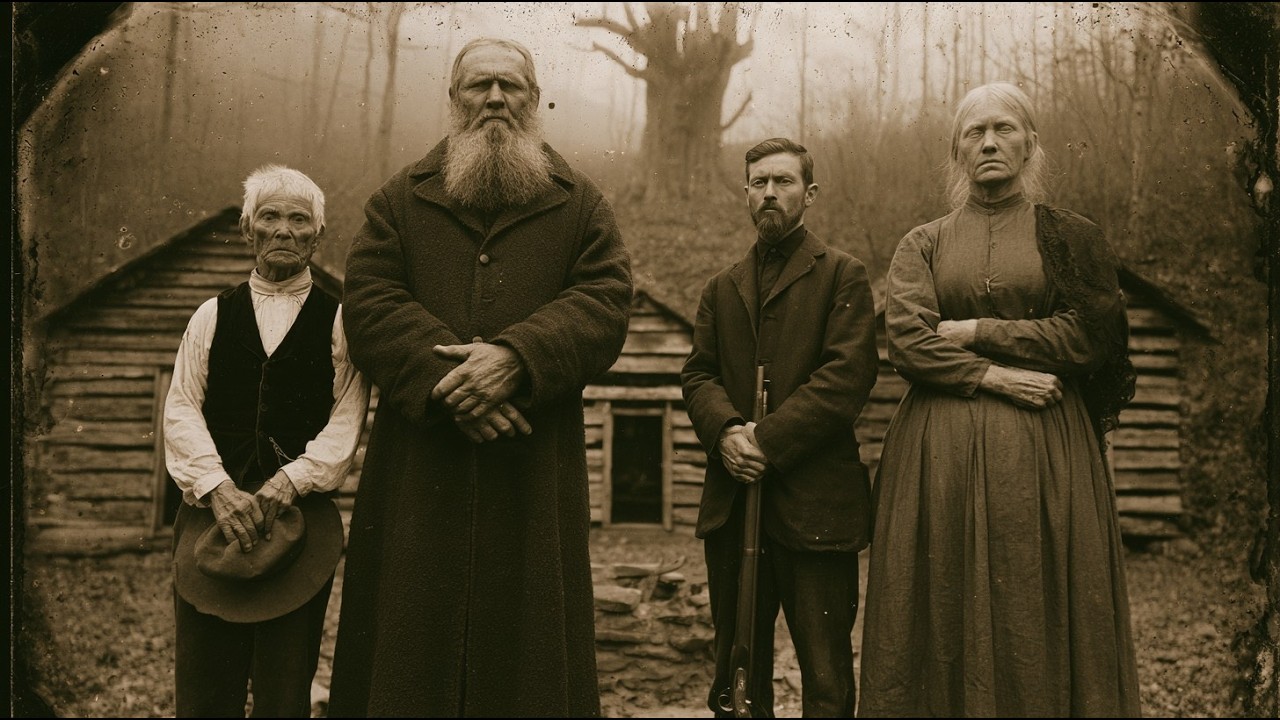
The old man, Isham Marrowbone, waited on the porch of the largest house with his hat on his knee and his hands folded over it. He had been sitting there in the grey light before dawn, watching the door of the west house where the surveyor from Louisville slept. When the door opened and Absalom Vail stepped out with his gear, Isham spoke in his thin, courteous voice: “Good morning, Mr. Vail.
You are up very early. ” Vail said he had received word that he was needed in Louisville and intended to leave that morning. The old man noted that he had seen no messenger. Vail said the messenger had come late the night before, that he had met him at the edge of the clearing so as not to disturb the household.
Old Isham smiled his neat, polite smile and asked Vail to sit down. Vail did not sit. Isham repeated the request, more quietly, and gestured to the second rocking chair on the porch. Vail sat because he did not know what else to do.
“Mr. Vail,” said Old Isham, “my family has kept this hollow for four generations. My great-grandfather set the first mark. My grandfather set the tree.
My father set the marks you have been passing. I keep them now. There is a duty in this hollow, sir, that goes back to 1794, and it is not lifted because a company in Louisville decided to survey the land. ” Vail answered that his survey was separate from the family’s duty.
“No, sir, it is not,” said Old Isham. “And I believe you know that. And I believe, from the way you sat at my table last night, and the way you carried your equipment this morning, that you have understood some of what you walked through. ” Vail said nothing.
Old Isham told him that his father used to say the men who came up into the hollow to work its land did so from one of two impressions: either they believed there was no hollow worth mentioning, and came out of ignorance, or they believed the hollow was something to be tamed, and came out of pride. The ignorant ones were easier, the old man’s father had said. The proud ones were harder to break. “Which are you, Mr.
Vail? ” Vail said he was a surveyor who had come to work. Old Isham nodded and said he would tell him what he had told every surveyor, every timber man, and every well-meaning preacher who had walked that trail in his lifetime. “The hollow does not release what it swallows.
That is the duty my family holds. It was not a duty we chose. It was laid on us in 1794, when the men of this county hanged eleven innocent people from the tree at the head of this hollow. And when what lived in the ground under that tree acquired an appetite from that hanging, my family has fed that appetite for four generations.
Not our kin. That would violate the old understandings about what the hollow brings us. And the hollow brings us those who come to it. It is very patient.
It is very slow. But it brings them. ” Vail said, “And you feed it. ” Old Isham said, “We keep it.
” Vail said, “With the men in the hollow. ” Old Isham fell silent for a long moment. Then he said, “Ah. So you went into that hollow.
” He looked across the common ground of the clearing at the sky turning pink above the trees. “A pity, Mr. Vail. A pity.
For if you had not gone into that hollow, I would have let you finish your survey and leave. I would have followed you to the mouth of the trail and watched you go, and the hollow would have taken from the next who came, and the balance would have held. But now it will not. The hollow saw you see.
And the hollow does not release what is seen. ” Vail said he would not stay here. Old Isham replied, “No, sir, I do not expect you to stay. That is not how it works.
The hollow does not require you to remain here. All it requires is that you do not leave with what you have seen. ” He rose from the rocking chair, put on his hat, and said, “Fardaman will come in a moment. I ask you to go with him quietly.
It will be easier for you. ”
Absalom Vail, sitting on that porch in the dawn, understood in a moment of complete clarity that the polite old man before him was not making a request. He ran. He did not stop to argue.
He did not draw his pistol. He did not shout. He rose from the rocking chair and ran off the porch, across the common ground, past the little shed where the mare was tied, and into the trees on the western edge of the clearing. He did not go for the mare.
The mare was a trap. He understood that even as he ran. He ran into the trees. Behind him he heard Old Isham Marrowbone speak a single clear word in a voice that was not loud but was perfectly audible.
He heard the word: “Fardaman. ” Then he heard, or felt, the heavy start of the pursuit. Fardaman Marrowbone, the huge silent man, moved through the woods of Hangman’s Hollow at a speed a man of his size should not have possessed. Vail heard him coming from behind and did not turn, because turning cost three steps, and three steps were more than he could spare.
He ran. The hollow rose before him. The trail that had descended into the hollow on his first day, descending further than the land behind it should have allowed, now rose and climbed at a steeper grade than it had ever descended. He ran and climbed, and the brown light of the hollow, for the first time in four days, began to thin ahead of him.
He was climbing toward the ordinary yellow of an autumn morning. He was climbing out. Behind him, Fardaman Marrowbone was gaining. Around him, in the woods on both sides of the trail, he heard other footfalls.
Twigs, he told himself. Brush. And once or twice he heard the low humming he had heard on the first night in the west house, which he had persuaded himself was the sound of the wind. He heard voices too.
Voices that did not speak any language he understood. They were the voices from midnight, and this time they were not distant. They were in the trees on either side of him, keeping pace with his steps. He ran.
His lungs began to burn. The crooked little finger on his right hand throbbed as it did in cold weather. He ran, and somewhere during the climb he lost his hat. Somewhere higher, the toe of his boot tore on a root.
Somewhere higher still, his field notebook came loose from the inner pocket of his coat and fell into the leaves. He stopped to pick it up. He stopped because he understood, even with the crashing behind him and the voices on both sides, that the notebook was the only thing in the hollow that bore witness to everything he had seen. If he came out of the hollow without it, he came out empty-handed.
He knelt in the leaves. He put his hands into them. He found the notebook. He pushed it inside his shirt against his skin where it could not be lost.
Then he stood. And in the moment he stood, he heard Fardaman Marrowbone’s breath behind him, so close that Vail felt the heat of it on the back of his neck. He did not look back. He ran.
By every law of sense, Absalom Vail should not have survived Hangman’s Hollow. Fardaman Marrowbone was faster. The Marrowbones knew the country. Whatever ran in the woods at his flanks was not bound by the same limits that bound him.
Yet he survived. He would say later, when he could speak of it at all, that at some point on the climb, a point he could not identify, the sound of Fardaman Marrowbone’s pursuit simply stopped. Not slowed. Stopped.
And the sound of whatever had been pacing him from both sides faded like a wind falling. He ran the last quarter mile up out of Hangman’s Hollow in absolute silence, so that the sound of his own steps on the trail seemed indecent to him. He reached the top of the last ridge. He fell to his knees in the fallen leaves.
He looked down into the hollow. What he wrote in the back of his field notebook about this was this: “I looked down into the hollow and saw the four of them, Old Isham and Fardaman and Thurl and Merritt, standing in the common ground at the center of the clearing. They were not looking at me. They were not looking at each other.
They stood in a small tight circle, their faces turned inward, their heads bowed. And in the center of them, between them, the ground was moving. Not the ground beneath them. The ground between them, as though something under the earth was rising toward the surface and being pressed back down.
I did not stay to watch any more of it,” he wrote. “I got up and ran, and I do not remember the rest of that day. I do not think I want to remember it either. ”
He came back to Red Fern Crossing that evening at dusk on foot, without his gear, without his horse, without his hat, his boot torn open at the toe.
Barnabas Combs was standing in the door of his store as if he had been waiting there. He said nothing to Absalom Vail. He came out into the road. He took Vail by the elbow and walked him to Rua Colburn’s house, and Rua fed him a plate of something he did not remember afterward, then put him to bed in the smallest of the three rooms above the kitchen and sat on a chair outside the door of that room all night.
He left Red Fern Crossing the next morning on a borrowed horse and rode to Louisville without stopping more than the horse required. He walked into Witson’s office three days later, put the field notebook on the desk, and said: “Sir, that hollow is not to be surveyed. Not by me, not by any man your company sends. If you send another man up that trail, you will not see him again, and his blood will be on your hands, and on mine too, for telling you this now.
And you will remember that I told you. ” Then he said: “Sir. Burn this notebook. ” Witson did not burn it.
He kept it. And so, decades later, a private account of that survey came to rest in a company records box in Louisville, and that is how the story eventually reached me. Absalom Vail left the land company within a year. He returned to his people in a small town in the northern part of the state, took up a trade that did not require him to walk in the woods, and lived quietly for the rest of his life.
He never went east to Frankfort again. He never spoke of Hangman’s Hollow. In the nights when the wind came in from the north and the leaves began to move in the yard, his housekeeper remembered, Absalom Vail would rise from his bed, go down to the sitting room, sit in a chair by the window, and watch the yard, and he would not return to bed until the wind died. She said he was not afraid.
She said he was, she thought, listening. She said that once, in the last year of his life, she came down to the sitting room at three in the morning and found him at the window, and asked him what he was listening to. He answered without turning: “They are not close tonight, Mrs. Reid.
Go back to bed. ” She asked who they were. He did not answer. She went back to bed.
Absalom Vail died in the autumn of 1889, peacefully, in his bed, of causes his doctor considered entirely ordinary. He was buried in the cemetery of the small town where he had settled, and his headstone is still there, bearing only his name and his age. The Marrowbones remained in Hangman’s Hollow after his death. There is a record in the Louisville archives themselves of a second survey attempt in 1867, after the war, by a Union man from Ohio who was ignorant of the local history.
That man was never heard from again. Nor was his horse. Old Isham Marrowbone died, or is said to have died, in 1879. Fardaman is said to have died the following winter.
Merritt and Thurl kept the hollow between them for years after that. Whether it still exists in any form, I do not know, and I will not pretend to know. The county records for that part of the Cumberland Mountains are, and I say this with full force, incomplete. One detail stays with me, and I will leave it with you.
On the last page of Absalom Vail’s field notebook, in the same steady hand he used for his survey notes, he wrote a single line. It was not dated. There is no way to know when he wrote it. Perhaps it was in the week he returned to Louisville.
Perhaps it was forty years later. The line reads: “The hollow has not forgotten me either. ”
