On a damp March morning in 1945, the guards came for the women. Five hundred and twenty Jewish girls, aged between fifteen and twenty-five, had been marched out of Hitler’s war machine and put to work in a place called rolling mill two, a heavy steel plant owned by the Krupp family in Essen. They had survived on one meal of soup and bread a day, slept on straw over a damp cellar floor, and been driven barefoot through the streets in wooden clogs, wrapped in torn blankets against the German cold. Now the Allied armies were approaching, and Krupp’s managers were shipping them east to the Buchenwald concentration camp.
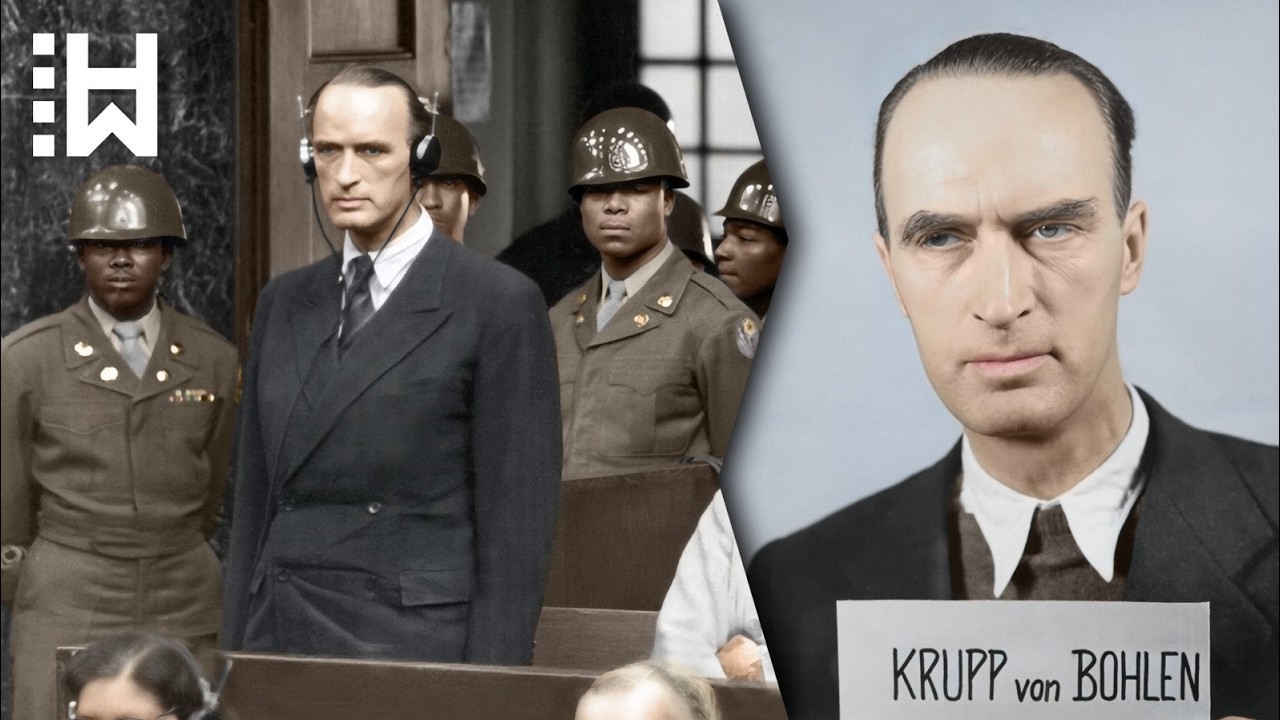
Their fate after that, no one recorded. What is known is that a man named Alfried Krupp, heir to one of Germany’s greatest industrial empires, had personally traveled to Auschwitz to select these women and bring them to his factories. He was the man who had made rolling mill two possible. And in less than a month, American troops would arrest him.
Alfried Felix Alvin Krupp von Bohlen und Halbach was born on the 13th of August, 1907, in the city of Essen, then part of the German Empire. He came into the world as the heir to a dynasty that had built the cannons, battleships, and steel that powered Germany’s rise. The family name was so closely tied to the Imperial Court that Kaiser Wilhelm II himself agreed to become the boy’s godfather. When the First World War ended in German defeat in 1918, Alfried was eleven years old, and he watched the Kaiser abdicate and the empire fall.
Economic crisis and political instability followed, and by the early 1930s the country was in turmoil. On the 30th of January, 1933, President Paul von Hindenburg appointed Adolf Hitler Chancellor of Germany. Democracy came to an end, and the Third Reich was built on racist and authoritarian ideas, the abolition of basic freedoms, and the demand for absolute loyalty to a single Führer. The Nazis quickly turned Germany into a repressive police state, where individuals were subjected to arbitrary arrest and imprisonment, and where propaganda won over millions.
But ideology alone did not build tanks or fire artillery. The Nazi war machine depended on steel, coal, and capital, and on the industrialists who supplied weapons, financed expansion, and profited from human suffering. By the time Hitler took power, Alfried Krupp was already a committed supporter. For two years he had been a supporting member of the SS, the Nazi paramilitary organization, and he had also joined the National Socialist Flyers Corps, a paramilitary aviation organization of the Nazi Party, in which he would ultimately reach the rank of Standartenführer, the equivalent of a colonel in the American army.
He studied engineering, and in 1935 he joined the family business, Fried. Krupp AG, beginning at the company’s headquarters in Essen. In 1937 he married Anneliese Lampert, and they had one son, Arndt, but the marriage ended in divorce four years later. In December 1938, at the personal request of Adolf Hitler, Krupp became a member of the Nazi Party.
The Second World War began on the 1st of September 1939, when Nazi Germany invaded Poland. During the war, Krupp maintained close contacts with Armaments Minister Albert Speer and other high-ranking members of the Nazi regime, and he expected economic advantages from his support. He was part of a business elite willing to exploit German war successes and occupation rule for their own benefit. On the 16th of May 1940, just six days after the German invasion of France and the Low Countries had begun, Krupp met with industrialists from the Ruhr region in the city of Düsseldorf to discuss the future of confiscated factories in the occupied territories.
Alfried Krupp was put in charge of dismantling factories in the territories occupied by the Wehrmacht and rebuilding them in Germany, and he was awarded the War Merit Cross, first and second class. Krupp was indispensable to Hitler’s war machine. The company produced the essential tools of modern warfare: armor plate for tanks and warships, artillery guns, tank hulls and turrets, shells, and parts for fortifications. Its main plant in Essen, the Gusstahlfabrik, was not a single factory but a massive complex of nearly one hundred facilities dedicated to armaments.
Krupp also built submarines at its shipyard in the Baltic port of Kiel, and manufactured finished guns and tanks at another plant in Magdeburg. Without Krupp’s steel and engineering, the German military could not have sustained its rapid invasions or equipped its divisions. And the company did not simply follow orders. It designed, developed, and mass-produced the weapons that made Hitler’s aggressive warfare possible.
On the 22nd of June, 1941, Nazi Germany launched Operation Barbarossa, the massive invasion of the Soviet Union. The war on the Eastern Front demanded even greater quantities of weapons, tanks, and artillery, and Krupp’s factories worked around the clock to meet the need. But as German losses mounted and the labor pool at home shrank, the company turned increasingly to a new source of workers: prisoners of war, deported civilians, and concentration camp inmates. According to evidence presented at the Nuremberg trials, the entire Krupp enterprise consisted of about eighty separate plants within greater Germany.
Between 1940 and 1945, the company employed nearly seventy thousand foreign civilian workers, almost five thousand concentration camp inmates, and more than twenty-three thousand prisoners of war. The vast majority were forcibly brought to Germany and detained under compulsion throughout their service. And these figures do not include the thousands who died or were worked to death before ever being counted. The conditions at Krupp’s factories violated nearly every provision of the Geneva Conventions.
Prisoners of war were forced to manufacture weapons and ammunition, which was strictly prohibited. They were assigned to heavy labor for which they were physically unfit, and they were denied proper food, rest, and medical care. Russian prisoners of war, in particular, were treated with deliberate cruelty. Their daily ration consisted of watery soup with cabbage leaves and a few pieces of turnip, with nothing else to sustain them.
One Krupp manager reported that the prisoners returning from work made a completely worn out and limp impression, and that some prisoners simply tottered back into camp. Another wrote that people who live on this diet always break down after a short time and sometimes die. At one camp, conditions were so desperate that inmates ate mice to survive. At the Dürrfeld Schuler penal camp, a facility run directly by the Krupp company, guards woke inmates at half past four in the morning by shouting, “Get up!
” and striking anyone who was not fast enough with rubber hoses. The prisoners were counted not as human beings, but as pieces of human material, and they were beaten with leather truncheons three-quarters of an inch thick. A Catholic priest who survived the camp later testified that beatings were part of life inside Krupp’s facilities. In one workshop, a Russian prisoner was beaten to death, and no action was ever taken against the culprit.
Even the most vulnerable were not spared. At Camp Werder, about thirty kilometers from Essen, the Krupp company housed the infants of Eastern workers who had been forced into its factories. Of the 132 babies received at the camp, 98 died of malnutrition. Older children, some as young as six years old, were put to work alongside adults in the Krupp plants.
Then there were the five hundred and twenty young Jewish women, deported from Hungary, Czechoslovakia, and Romania to Auschwitz. Krupp officials traveled to the camp, personally selected the women, and brought them to Essen, where they were forced to work in the heavy steel mill known as rolling mill two. When the Allied armies approached in March 1945, Krupp shipped them to Buchenwald. Their fate after that is unknown.
A Krupp guard named Ernst Wertz was later convicted for his brutality. The evidence against him included beating Eastern workers, both male and female, with a wooden board and rubber hose, waking them up with a water hose, throwing a French civilian down a stairway, and ruthlessly beating a Russian prisoner of war with a four-edged piece of wood, which resulted in death from head injuries. Wertz testified that he was asked by the plant management to beat people, and that it was general knowledge in the plant that the management tried to maintain work discipline through physical mistreatment. On the 11th of April 1945, less than one month before the end of the Second World War in Europe, American troops arrested Alfried Krupp.
The Allies had originally intended to put Krupp’s father, Gustav, on trial at Nuremberg, but doctors declared the elderly man too ill and weak to stand trial. Instead, the Americans charged Alfried Krupp and eleven senior employees of the company in a separate case known as the Krupp trial. In 1948, the court found Krupp guilty of using slave labor and plundering economic assets in occupied countries. He was sentenced to twelve years in prison and the confiscation of all his property.
The judges also accused him of planning a war of aggression, but they acquitted him on that charge, ruling that his father had still been in charge of the company before the war. Krupp served only a fraction of his sentence. In January 1951, the US High Commissioner for Germany reconsidered the case and decided that it was unfair for Krupp to be the only war criminal to have his property confiscated. The order was revoked.
His sentence was reduced to six years, and he was awarded thirty million pounds in compensation, the equivalent of one and a half billion United States dollars today. Krupp walked out of prison a free man. Years later, in an interview with the British newspaper Daily Mail, a reporter asked Krupp if he felt any sense of guilt. He replied, “What guilt?
For what happened under Hitler? No. But it is regrettable that the German people themselves allowed themselves to be so deceived by Hitler. ”
Following his release from prison, Krupp remarried in 1952.
His new wife, Vera, received a spectacular gift from the family fortune, a 33-carat diamond ring, a jewel purchased with money built on slave labor. Vera later divorced Krupp, kept the ring, and eventually put it up for auction. In 1968, at an auction in New York, the actor Richard Burton, then Elizabeth Taylor’s husband, bought the diamond for $307,000 and gave it to his wife. Taylor, who was Jewish, later explained why she cherished it.
She stated, “This remarkable stone is called the Krupp diamond because it had been owned by Vera Krupp of the famous munitions family which helped knock off millions of Jews. When it came up for auction in the late 1960s, I thought how perfect it would be if a nice Jewish girl like me were to own it. ” In the hands of Elizabeth Taylor, a symbol of Nazi cruelty became a trophy of survival. After Taylor’s death, the stone formerly known as the Krupp diamond was renamed the Elizabeth Taylor diamond.
Alfried Krupp was fifty-nine years old when he died on the 30th of July, 1967, in Essen, West Germany. The official cause was heart failure resulting from lung cancer. His funeral was attended by top German politicians, including then Federal President Heinrich Lübke, who apparently saw no contradiction in honoring a convicted Nazi war criminal.
