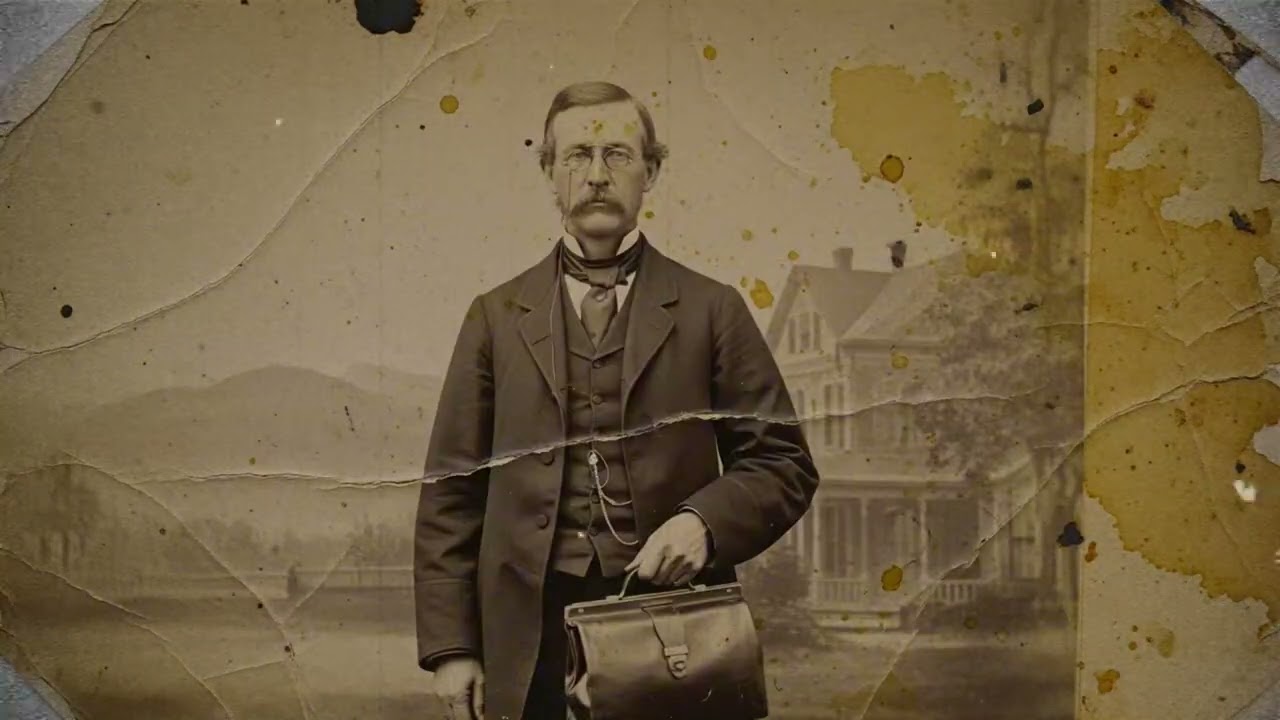
During the winter of 1933, the coal mining community of Lynch, Kentucky, found itself at the heart of an affair that area newspapers would eventually dub the Hollow Incident. On the morning of January 23rd, Dr. William Thornton—the town’s only doctor for more than fifteen years—did not show up at his clinic. Three miners had been hurt in a cave-in the night before, and the doctor was supposed to look in on them.
Sheriff James Mallister launched an inquiry, yet what unsettled him was not the vanishing itself—it was the quiet that hung around it. Not one resident appeared to be worried. Mrs. Thornton, the doctor’s wife, seemed relieved rather than anxious.
Lynch was a community constructed entirely around the mine, founded in 1917 by U. S. Coal and Coke, a subsidiary of U. S.
Steel. At its height, close to 10,000 people occupied rows of identical company houses, every one of them within walking distance of the mine entrance. The company governed every facet of life, from the church to the company store where miners were required to shop. By the early 1930s, the Great Depression had strengthened the company’s hold, and safety measures were being scaled back to save money.
Dr. Thornton resided with his wife, Eleanor, and their housekeeper, Martha Sullivan, in a sizable two-story Victorian home at 17 Looney Ridge Road, cut off from the main town by thick forest and a small creek known as Whisper Stream. Official records claimed that Thornton was researching respiratory ailments common among coal miners. But passages in Eleanor Thornton’s diary, discovered years afterward during a renovation, suggested something else entirely.
She noted that her husband seldom came to bed anymore, that noises drifted up from the basement throughout the night. She mentioned the arrival of a metal container bearing government markings and recalled overhearing him on the telephone say, “The reaction is more pronounced than we anticipated. We may need to adjust the dosage. “
Martha Sullivan remembered coming across a letter from the mining company’s head office in Pittsburgh that referenced “continuing financial support for your valuable work” and “maintaining absolute discretion about the experimental procedures.
” When the doctor discovered her holding the paper, he sent her away for a week without pay. Sullivan also recounted shifts in the doctor over the years. He grew distant, his eyes would fix on something that wasn’t there, and at times she would catch him muttering to himself in a voice that seemed deeper, with a strange cadence to it. In the week before he disappeared, five large wooden crates arrived from Johns Hopkins University, addressed to the doctor.
The station master observed that Thornton insisted on moving them himself. One crate had been damaged along the way, and the station master said he could make out glass containers holding a black liquid that appeared to shift on its own. Mrs. Thornton bought an unusual quantity of lye, formaldehyde, and salt—sufficient to preserve several large specimens.
The shopkeeper’s granddaughter remembered that Mrs. Thornton was trembling that day and whispered, “He’s changing them, and I think he’s changing, too. “
The town’s telephone operator reported that the doctor took calls from the same Pittsburgh number at exactly 9:15 every evening for three days before he vanished. She later admitted she had overheard him discussing “successful integration at the cellular level” and “unexpected cognitive side effects.
” When the person on the other end asked whether he could control these effects, the doctor laughed in a manner that chilled her to the bone. On January 20th, a night watchman reported that the lights at the doctor’s house burned all night, and shrill, high-pitched noises issued from the basement until daybreak. As he drew near the house, he caught sight of a silhouette in the window that he said was taller than any man ought to be, with a head that seemed the wrong shape. Sheriff Mallister’s investigation was perfunctory.
His three-page report determined that Thornton had probably left town of his own accord, perhaps because of money problems or private matters. No search parties were formed, and the case was essentially shut within 48 hours. Then, in March, a party of hunters discovered a doctor’s bag ripped apart and stained black near Whisper Stream. Inside were glass vials holding unidentified powders, a water-damaged notebook, and a pocket watch engraved with the initials W.
T. The sheriff seized the items, and no reference to them ever surfaced in an official report. One of the hunters later asserted that the notebook held formulas and diagrams of human organs with bizarre alterations, and that the vials contained tissue samples suspended in dark liquid—one resembled a piece of lung, but it was too dark and had odd fibers running through it that looked nearly metallic. Eleanor Thornton stayed in the house for six months after her husband vanished, keeping the curtains drawn.
A local delivery person who had regular contact with her observed that her hands were always bandaged and that he could hear scratching noises from within. When he asked whether she had a cat, she answered, “What’s in this house isn’t anything you’d recognize as an animal. ” The Reverend Thomas Walker, who paid her visits, reported scratch marks on the walls from floor to ceiling, as though made by something with claws, and a substance on the floor that resembled coal dust yet shifted slightly even with no draft. In August 1933, Eleanor sold the house to the mining company for a fraction of what it was worth and left.
No trace of her was ever discovered after she departed Lynch. The company gave the house to a new physician, Dr. Alan Richards, who arrived in September 1934. Richards and his wife began experiencing disturbing events almost at once.
Doors that had been locked were discovered open in the morning, and there were noises from the basement—scratching, tapping, whispered conversations—even after repeated confirmations that the space was empty. Richards’s wife described waking one night to see a figure at the foot of the bed, shaped like a man but somehow wrong in its proportions, wearing a doctor’s coat with no face. By November she had gone back to Philadelphia, citing health concerns. Richards resigned in December, writing to the company that “no salary is worth what awaits in that house after dark.
” The company tore out the basement, filling it with concrete. Construction workers found odd metal sheeting lining the walls, drains that led nowhere, and a large stone table with straps attached to it, like something you might use to restrain a person. Strikingly, in the months after Thornton’s disappearance, coal output at mine number 31 rose by nearly 30 percent despite employing fewer miners. Internal company memos recorded that workers were going as long as 36 hours without coming out of the mine and sometimes had to be ordered back to the surface.
Miners seldom spoke during shifts, moved with unusual synchronicity, and had no memory of the episodes. A visiting physician from the Kentucky Department of Health wrote that the pulmonary function of Lynch miners “defies medical explanation. ” Men who had worked in coal dust for decades showed lungs clear of the expected accumulation. Yet he also noted elevated body temperatures, unusual pupillary response to light, and a faint rhythmic tremor in the hands.
In a private letter, he voiced his unease about working with their blood samples, which were dark and thick and held particles that looked almost crystalline beneath the microscope. The whole affair might have stayed hidden were it not for what turned up in 1952. While renovating to add a new wing to Lynch Hospital, crews digging below the original foundation came upon a sealed room fifteen feet down, its walls lined with copper and its interior holding a desk, a filing cabinet, and medical apparatus. Inside the desk, locked away, lay a leather-bound journal filled with entries in Thornton’s own hand.
A clerk who read parts of it before it was taken into custody described what the doctor termed the “breathable solution”—a formula he was working on so miners could endure longer shifts in dusty conditions without harm to their lungs. He had been trying early versions on patients without telling them and intended to put the compound into the town’s water supply. The last entries grew increasingly erratic. Thornton wrote that the compound was producing a sort of shared consciousness among those he tested.
In the closing entry, dated January 22nd, 1933, the day before he vanished, he wrote, “It is no longer accurate to say that I am administering the compound to the subjects. Something has reversed the relationship. It is communicating through them, and now it is beginning to communicate through me as well. “
The room was sealed with concrete, and the journal was supposedly sent to state archives, yet researchers who have gone looking for it have been informed that no such item exists.
The only firsthand account of what may have befallen Thornton surfaced in 1960, when a retired miner named Samuel Carter, lying on his deathbed, gave a recorded statement. Carter claimed that a handful of miners had learned Thornton was using them as unknowing test subjects. They showed up at his house on the night of January 22nd to demand answers. Thornton admitted he had found something in the mountain—something in a deep seam that altered when exposed to air—and had been refining it and dosing them with it through their water.
The confrontation grew heated, a struggle broke out, and the doctor fell and struck his head. He was still breathing when the miners left. When they came back the following day, the doctor was gone, and so were all his papers and equipment. Mrs.
Thornton was seated in the kitchen, staring at the wall, and told them, “They came for him in the night. They’ll come for all of us eventually. ” Carter described the same troubling changes: shared dreams, the ability to communicate without speaking, and a growing sense that the mountain itself had become aware of them. A 1975 Freedom of Information Act request turned up a heavily redacted Department of Energy file confirming that Thornton had been part of a classified research project involving mining efficiency and worker performance.
A memo from a federal mining inspector in 1934 observed, “The situation in Lynch has been contained for now, but continued monitoring is essential. Whatever Dr. Thornton introduced into the ecosystem appears to be self-perpetuating and adaptive. “
The Lynch mine kept running until 1971, when U.
S. Steel shut it down because profits were falling. The town’s water supply was entirely rebuilt in 1980, and a contractor who worked on the job reported that federal specialists in modified hazmat suits treated portions of the old pipes with chemicals they refused to name, telling him only, “Containment, not detection. “
Today, Lynch has fewer than 600 residents.
The Thornton house is gone, replaced by an empty lot choked with brambles. Among the older residents, there is still a reluctance to talk about certain matters. The last person with a direct tie to the case, the daughter of the Thornton housekeeper, remembered that her mother once said the doctor had found something he called “mountain breath,” something that lived deep in the earth and changed when it met air. She said he became part of his own experiment in the end, that the mountain took him back.
What is certain is that something strange happened in Lynch in the early 1930s. A doctor disappeared. A community was altered. Men who should have been damaged by decades of breathing coal dust somehow were not.
And through it all, a wall of silence has hidden whatever truth might exist. Now and then, hikers near Looney Ridge report hearing sounds that shouldn’t be there—whispered conversations with no one in sight, the rhythmic tapping of metal on stone coming from solid rock, and sometimes a lone figure in early twentieth-century clothing carrying a doctor’s bag, walking with purpose toward the sealed entrances of mine number 31. By the time they reach the spot where the figure was seen, there is never anyone there.
