On a spring morning in 1986, twelve-year-old Michella Welch rode her bike home from Puget Park in Tacoma, Washington, to make sandwiches for her two younger sisters. It was the start of spring break, and as the oldest sibling, she was in charge for the day. When she returned to the picnic table and chained up her bike, her sisters had wandered off to a nearby business to use the restroom. They returned minutes later to find the sandwiches waiting, but Michella was gone.
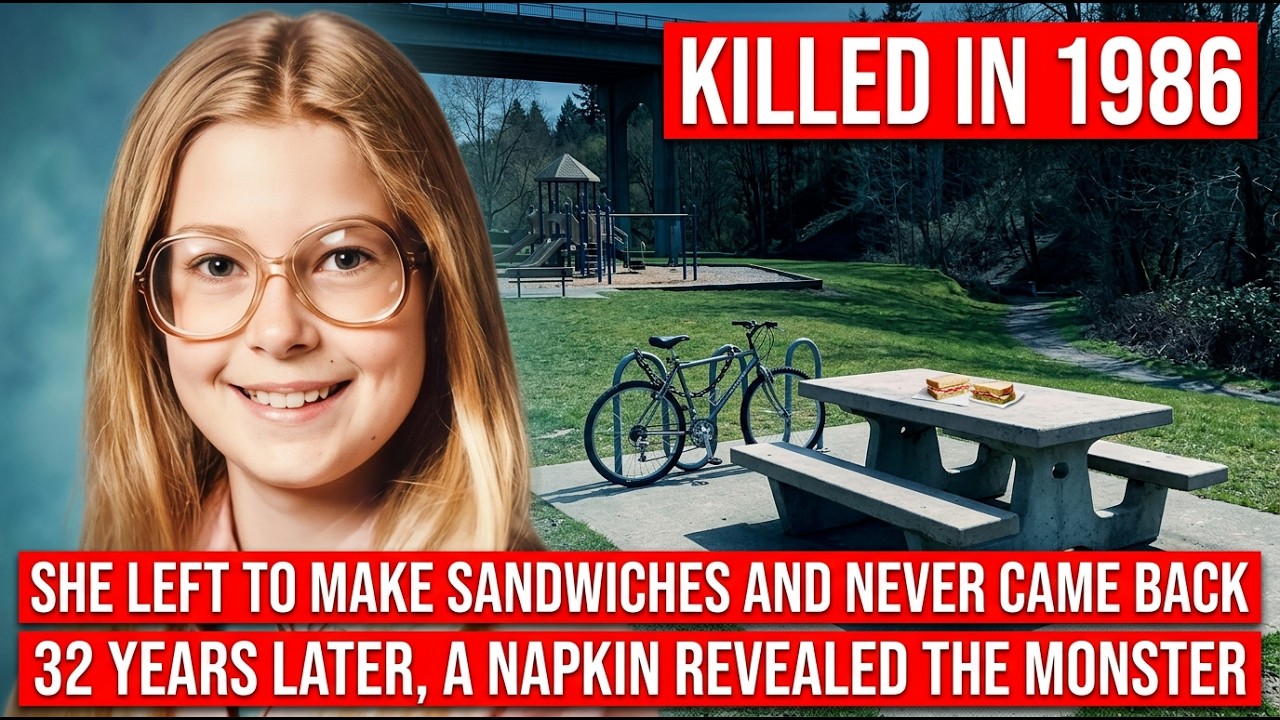
Her sisters searched the way children do, calling out with a special “yoo-hoo” they used to find each other. The park answered only with silence. When the alarm was raised, police officers flooded the area, and community members joined the search as daylight faded. It was not until around 11:00 that night that a search dog led its handler into a deep wooded ravine known as the gulch, a quarter mile from where Michella was last seen.
Near a makeshift fire pit, they found her body. The autopsy confirmed she had died from blunt force trauma to the head and a severe cut across her neck. She had also been sexually assaulted. An entire city was shaken.
Puget Park, a place of childhood laughter, became the scene of an unspeakable crime committed in broad daylight. Detectives swarmed the park and interviewed witnesses. One classmate reported seeing Michella talking to a man under the Proctor Street Bridge, who pointed down a trail into the ravine. But a description was not a name, and the lead went nowhere.
The killer remained a phantom. Five months later, Tacoma was struck again. Thirteen-year-old Jennifer Bastian disappeared while riding her bike in Point Defiance Park, just miles from where Michella had been killed. Her body was found weeks later.
The similarities were chilling: two young blonde girls on bikes, abducted from public parks, murdered. Law enforcement linked the cases and operated for years under the assumption that one man was responsible for both crimes. But the investigation grew cold. For Michella’s family, the silence was a unique form of torture.
Her mother, Barbara, and her two younger sisters were left in a state of suspended grief, unable to mourn without knowing who was responsible. The file on Michella Welch became one of Washington’s most notorious cold cases. Science, however, was quietly advancing. In 2006, twenty years after the murder, technicians developed a full male DNA profile from evidence collected at the crime scene.
Investigators ran it through CODIS, the national felon DNA database, hoping for a match. There was none. The killer had never been arrested for another serious crime. He was, in effect, invisible.
In 2013, more advanced DNA testing brought another shock. The DNA from Michella’s case did not match the DNA from Jennifer Bastian’s case. There had not been one monster stalking the parks of Tacoma in 1986. There had been two.
This fractured the long-held theory but allowed detectives to focus on each killer individually. Still, the DNA profiles yielded no hits. The trail went cold again. By 2018, the murder of Michella Welch was thirty-two years old.
Detective Lindsey Wade of the Tacoma Police Department treated it as an active puzzle waiting for the right key. That key was forensic genetic genealogy. The department partnered with Parabon NanoLabs with a new strategy. Instead of looking for an exact match in a criminal database, genealogists uploaded the unknown killer’s DNA to public genealogy websites like GEDmatch, where everyday people submit their own DNA to find relatives.
The goal was not to find the killer but to find a distant cousin who had submitted their DNA. It worked. The crime scene DNA returned a partial match. From there, genealogists built a family tree, working backward through generations and then forward through marriages and births.
Their research pointed toward a single family, and specifically to two brothers living in Tacoma’s North End in 1986. One of them was named Gary Charles Hartman. After thirty-two years of searching for a phantom, investigators had a name. When they pulled his file, they found something deeply unsettling.
Gary Hartman had no criminal record. By all appearances, he was a model citizen: sixty-six years old, married, a father, a collector of vintage cars. Most disturbingly, he was a registered nurse who worked at Western State Hospital, an inpatient psychiatric facility. A man whose entire career was built on trust and care.
His mother-in-law described him as a gentle giant. Neighbors called him sweet. The genealogy pointed to Hartman, but it was not proof. They needed his DNA for a direct comparison.
In early June of 2018, Tacoma police began a secret surveillance operation. The break came on June 5th. Detectives tailed Hartman as he left work and went to a restaurant with a coworker. A detective sat ten feet away, watching Hartman eat, talk, and occasionally wipe his mouth with a crumpled paper napkin.
When Hartman finished, he bundled the used napkin into a bag and left it on the table. After he left, the detective approached the employee cleaning the table and asked for the bag of trash. The lab rushed the test. The results came back.
The DNA on the napkin was a perfect match to the DNA recovered from Michella Welch’s body in 1986. Gary Hartman was the killer. Shortly before his arrest, he confided in a coworker that thirty years ago he had done something terrible and thought he had been discovered. On June 21st, 2018, police pulled over his vehicle and arrested him for the first-degree murder and first-degree rape of Michella Welch.
The news sent a shockwave through the community. For those who remembered the terror of 1986, it was disbelief and relief. For those who knew Gary Hartman, it was incomprehensible. A neighbor said they had invited him into their home for a beer.
He seemed like a normal, cool guy. He had hidden his secret for over three decades, masquerading as a healer while the family of the little girl he murdered waited for justice. The man who stood before Pierce County Superior Court was not the predator who had lurked in Puget Park. He was seventy years old, frail, and using a walker.
He initially pleaded not guilty, but the DNA evidence was irrefutable. Facing the scientific proof, Hartman waived his right to a jury trial. The trial took place on March 22nd, 2022, and lasted less than two hours. The prosecution and defense agreed to the facts: the crime and the DNA that proved Hartman’s guilt.
In exchange, prosecutors dropped the rape charge, knowing a murder conviction would mean he would almost certainly die in prison. Judge Stanley Rumbaugh reviewed the facts and delivered the verdict swiftly. Gary Hartman was guilty of the first-degree murder of Michella Welch. The facade crumbled.
He broke down sobbing. Turning to Michella’s family, he repeated the same words: “I’m so sorry. God knows I’m so sorry. That doesn’t help.
I’m just sorry. ”
His apology offered no comfort. Michella’s sister, just nine years old at the time of the murder, spoke of the lifelong burden she carried. Michella’s mother, Barbara Leonard, finally faced her daughter’s killer.
“For over 35 years, I have wept in lonely silence,” she told the court. “I say lock him up and throw away the key. ”
Judge Rumbaugh agreed. He looked directly at the weeping old man and delivered a scathing assessment.
“There are no excusing conditions for your behavior,” he stated. “You are guilty of one of the most malignant and depraved crimes it’s ever been this court’s obligation to address. ” He handed down the maximum sentence: twenty-six and a half years in prison. Justice, after thirty-six long years, had finally been served.
The conviction closed one of the most painful chapters in Tacoma’s history. Prosecutor Mark Lindquist issued a stark warning to other criminals hiding from their past: “If you’re a criminal who left DNA at a crime scene, you might as well turn yourself in now. We will eventually catch you. ”
The case became a landmark.
A Washington state bill to help fund cold case investigations was named in Michella’s honor. The story leaves unsettling questions. How does a person commit such an evil act and simply walk away, folding it into a normal life? Hartman went on to get sober, become a nurse, and dedicate his career to helping people while harboring this unspeakable knowledge.
His defense attorney claimed a childhood of abuse and addiction had led him to a point where he convinced himself he did not do it. In the end, the story is not about the monster. It is about the light he tried and failed to extinguish. It is about Michella Welch, a twelve-year-old girl who loved her sisters enough to ride her bike home to make them sandwiches.
It is about her family, who endured an unimaginable loss and waited a lifetime for answers. And it is about the truth, which no matter how long it is buried, always finds its way back to the light.
