The ground lies to you. That is the first thing you must understand about places like Coron Valley. It sits low and easy between the hills, green enough in the spring, and asks nothing of a man who wants to cross it. No cliff to climb, no river to ford—just a valley floor, a long gray wall at the far end, and a little cluster of buildings under that wall with a bell that still keeps time.
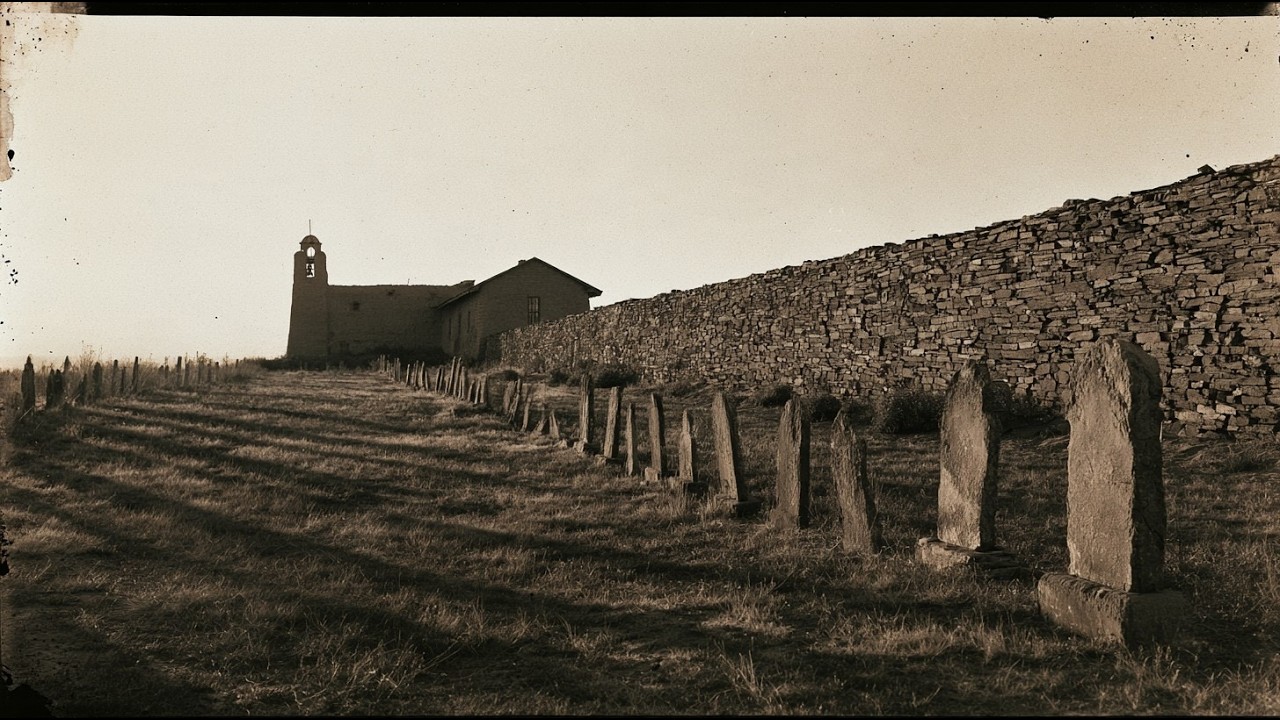
You would look at a place like that and think that whatever else is wrong in the world, nothing much can be wrong here. And you would be nearly right, for a very long while. That is the trick of it. The ground that takes the fewest people is the ground that never once looks like it would.
The bad places announce themselves—the cliff edge, the black water, the mineshaft with the rotten ladder. Those places kill a few careless souls, and everyone learns to respect them. But the ground that looks safe, the ground that looks like rest at the end of a long day, that ground can go on taking people quietly for a hundred years because no one ever thinks to be afraid of it. And the ones it takes, it takes so gently that the law can always find a tidy word for where they went.
In Coron Valley, the sisters buried their dead facing the wall. Not facing east the way the old churches taught, so that the dead would rise looking into the morning. They laid their dead facing the wall, foreheads turned to the stone, to the west, as if every one of them had been laid down mid-prayer and told to keep watching something. For thirty years they did it that way.
And when a bishop’s man finally wrote out to ask why, the answer he wrote in his report was one careful, tidy word that did not come close to the truth. That is usually how these end. Somebody with clean boots signs off with the wrong word, and the valley keeps what it keeps, and the file goes into a drawer, and the drawer goes into a room, and the room is forgotten. And the wall stays exactly where it was, patient as ever, waiting for the next one to come down the easy green slope and think, well, now nothing much can be wrong here.
The place had a name, though you will not find it on any map printed after the turn of the century. Coron Valley, in what was then New Mexico territory, in the year 1889. Coron is an old word for a song sung over the dead—a lament, the wailing kind that old countries used to make when they lowered someone into the ground. You do not call a place a funeral song by accident.
Somebody stood on that easy green slope and looked down at that low, restful, welcoming ground, and the word that came to them was the word for grief sung out loud. The convent there was called Our Lady of the Vigil, which is a strange name for a house of women in the middle of nowhere—until you understand what they were keeping vigil over. A vigil is a watch kept through the night, beside something that must not be left alone, beside the sick, beside the dying, beside the dead. And the sisters of Coron kept theirs not beside a bed, but beside a wall, and they kept it in shifts, and they kept it for thirty years.
There were nine sisters living there that spring. There had been more once. There were graves for the rest, out along the western edge of the churchyard, right up against the old wall, every single marker with its back to the sunrise. Our man was named Ambrose Teller.
He was forty-four years old, a monument mason by trade—he cut stone for the dead. Headstones, grave markers, the low curbs that ring a family plot, the lettering that tells whoever comes after you who lies here and how long they had. He was a tall man gone a little stooped, the way tall men do who spend their lives bent over a working stone, and lean in the way of somebody who forgets to eat when the work is going well. His hands were the map of his whole life: every knuckle thickened, fingertips split and healed and split again, a white scar across the left palm where a chisel had jumped years back and opened him to the bone.
His eyes were a gray so pale they looked nearly colorless in strong light, and people who met him tended to remember that first—the eyes—before the height or the hands, because there was a stillness in them that most living faces do not have. He was a quiet man, and he had made his peace with quiet because he had had to. He had been a widower for six years. His wife had been called Marion, and she had gone in a fever winter along with half the town they lived in then, one of those winters that comes through a small place and empties it.
And he had cut her stone himself, which is a thing not to be wished on any man: to letter the name of the person you loved into rock with your own two hands, to measure out the space for the dates, and know one of them, and have to wait to learn the other. He chose the stone, smoothed the face of it, cut her name and the two years—the one she came into the world and the one she left it—and set it over her. And then he could not stay in that town another season. Everywhere he looked in it, there was a thing she had touched.
After that, he took whatever work carried him furthest from where he had been—the far jobs other masons did not want, the strange ones, the ones out past the edge of the settled country. That is how he came to answer a letter from a diocese office asking whether a mason would ride out to a territory convent and set proper markers in a yard that had gone too long without them. The letter did not mention the direction of the graves. Letters like that never mention the thing that matters.
They mention the money and the distance and the number of markers, and they leave out the one detail that would have made a wiser man turn right back and say, no, thank you. He came in on the mail road with his tools and a canvas roll and his good coat folded over the saddle, and he saw the valley—low and green and easy—and he felt the way any tired man feels coming down into shelter at the end of a long ride. Glad. Nothing in him warned him.
Why would it? The evening was coming on soft and gold, and there was wood smoke on the air, and the sound of a bell ringing the hour as he came down the last slope. The sound carried strange across the flat, arriving a half-beat late, as if the air out there was thicker than air ought to be, as if the sound had to push through something to reach him. He noticed that and set it aside.
A man notices a hundred small wrong things in a day and sets ninety-nine of them aside. And that is a mercy most of the time, because a man who stopped to worry over every small wrong thing would never get anything done and would go mad besides. But once in a great while, one of those ninety-nine set-aside things is the reason he does not walk out of a place while he still can. The sister who met him at the gate gave her name as Sister Concordia.
She kept the convent’s records and its small infirmary, and she was somewhere past fifty, square and steady, built low to the ground like something that would not blow over in a wind, with ink stains worked so far into her fingers that no washing would ever take them out. She thanked him for coming so far. She had a way of looking at a person full in the face that most people out there had lost, as if she had decided long ago there was no more time to waste on looking away. She showed him where he would sleep—a clean cell in the guest range with a cot and a table and a window that looked out, as it happened, straight at the western wall.
And she told him, in the plain way you tell a man the house rules, the way you would tell him where the well was and when the meals came, that there were two things he was to mind while he stayed with them. He was not to work in the churchyard after the evening bell. And whatever he heard in the night, from whatever direction, he was not to answer it, and he was not to go out to the wall. Ambrose was a polite man and a tired one, so he said, yes, ma’am.
And he did not laugh, though a part of him wanted to—the tired traveling part of him that had heard a hundred strange local customs in a hundred strange local places and had learned to nod at all of them. He asked only because a mason likes to know his site, only because a man who is going to be digging and setting stone in a piece of ground likes to know what he is dealing with. What was wrong with the wall? Sister Concordia looked at it through his little window for a moment, the way you might look at a person you have known your whole life and never once trusted.
A long, level, weary look. She said that nothing was wrong with the wall. The wall, she said, was the only thing out here that had never once changed. It was everything on this side of it that a person had to watch.
Then she wished him good night and left, and he heard her draw the outer bolt on the guest range door. A heavy iron sound. Final. And it stopped him where he stood.
Because you bolt a door from the outside for one of two reasons: to keep something out, or to keep something in. He lay a while on the cot trying to decide which it was, and could not, and fell asleep before he settled it, which is its own kind of mercy. The churchyard was not large. Coron’s convent had never been a big house, never more than a dozen women even at its fullest.
But the yard was old for that country, older than it had any right to be, and the graves went back further than the buildings, which is its own small mystery—that the dead should predate the living quarters. You build the house first and the graveyard fills up after. That is the natural order. Here it was backward.
Here the graves were waiting when the sisters came. Some of the oldest ones, the ones whose markers had gone to blank weathered stubs, and the house had been raised among them like a thing that had come to keep them company. There were eleven marked graves he could read, and a handful more that had lost their markers to weather. And Ambrose could tell at a glance the thing the diocese letter had not told him.
Every grave faced the wrong way—west, into the wall, when a Christian grave by every custom he had ever cut for should face east, into the coming light, so that on the last morning the sleeper sits up looking into the sunrise. He had lettered stones for forty years. He had worked in Catholic yards and Protestant yards and one Chinese cemetery on a rail line where he learned to hold his opinions and his compass to himself and take the pay. He had never once in all those years seen a whole burial ground laid backward on purpose.
And it was on purpose. You could see the care in it. These were not graves dug by frightened people in a hurry, hacked into the ground any old way in the dark. Somebody had measured.
Somebody had squared each one to the wall with a care that bordered on love, and had wanted every sleeper in that ground to lie with her face to the stone, watching it through the dirt forever. He did what a craftsman does with a thing he does not understand. He measured it, and he wrote it down, and he kept his mouth shut and worked. The sisters had given him the names for the markers, copied out in Sister Concordia’s stained hand on good paper, and he began the slow business of laying out the yard, deciding the spacing, choosing which of the fieldstones the convent had quarried would take a face and which would not, sorting the good stone from the stone with a hidden flaw that would split wrong under the chisel.
It was good stone, better than he expected. A hard, pale limestone that rang under the mallet like it was glad to be worked, like it had been waiting. He fell into the rhythm of it, chisel and mallet, and the small talk of the stone—the little conversation between a mason’s hand and the rock that no one else can hear. And for a day and a half, he almost forgot the direction the graves were laid.
The way you can almost forget a stone in your boot if the walking is good enough and the road is pretty. He met the other sisters over those first days, the way you meet the people of a small closed place, a few at a time at the edges of the work. There was Sister Finella, the youngest of them, who kept the garden and the few goats, and had a laugh that seemed too big for the quiet place—a laugh she would catch herself in the middle of and swallow, as if laughing out loud was a thing you learned not to do here. There was Sister Roseanne, tall and silent, who did the heavy work, the hauling and the mending of the roof, and who Ambrose never once heard speak, though Sister Concordia told him she could, and simply chose not to, and had chosen not to a long time ago, and no one asked her why anymore.
And there was the one they called only the Fortress, the doorkeeper, an old sister whose whole task now was to sit near the gate through the daylight hours and watch the road. Ambrose thought at first she was watching for travelers, for news, for the mail. It was some days before he understood she was not watching the road at all. She was watching the wall.
The first night that something happened, it was nothing he could have taken to a sheriff. He woke a little before three in the morning—he knew the hour because the convent bell told it, the same half-beat late toll—and he lay in the dark counting the strokes out of the habit of a man who has spent his life keeping time with tools, with the fall of a mallet, with the steady work of hands. And under the last stroke of the bell, or just after it, in the space where the sound of the bell was still fading out of the room, he heard his name. Not shouted, not even really spoken.
More the shape of his name laid gently into the quiet, the way you would say it if you were sitting on the edge of a sleeping man’s bed and did not quite want to wake him yet. The way you might say the name of someone you loved who was very tired and had earned the sleep. Ambrose. It came from the west.
It came from the wall. Now here is the part that is the whole of the thing, the key to the whole valley. He was not frightened. That is what the valley does, and it is why the valley is so patient and so successful and so old.
The voice was kind. The voice was familiar in a way he could not place and did not question, the way you do not question a smell that takes you back to a childhood kitchen, the way a certain slant of light can undo you before you have even worked out why. He lay there and it said his name again, softer, and something in his chest leaned toward it the way a plant leans at a window. The whole body turning without permission toward the thing it wants.
He had his feet halfway to the cold floor before he remembered what the square, steady sister had told him at the gate. Do not answer it. Do not go out to the wall. He stopped with his bare feet on the boards and his heart going quiet and slow—too slow, slower than a heart should go when a man is sitting up in the dark.
And he made himself lie back down, and he pulled the blanket to his chin like a man half his age. And he did not answer. And after a while, the voice stopped, and the cold in the room lifted all at once, the way it does when a door you did not know was open finally closes. In the morning he told himself it was a dream, and did not believe it.
And both of those things can be true at the same time. And a man can live in the gap between them for a surprisingly long while. We are built to live in that gap. It is where we keep the things we cannot afford to look at directly.
He went to Sister Concordia after breakfast, and he tried to ask without asking. He said he had slept poorly. He said the wind out here carried sound in odd ways, that the country was strange to him, that a man takes a while to settle in a new place. She was writing in a ledger, and she did not look up, and she said, the wind had nothing to do with it, flatly, the way you correct a child who is telling you a story you both know is not true.
And she said that he had done well, and that was all she would say. Which is a strange thing to tell a man about a night he only lay in bed and listened. But it told him one thing he had not been sure of. It told him she knew exactly what he had heard, down to the shape of it.
And it told him more than that, because for her to know what he had heard, she had to have heard it herself. And it does not call every soul with the same voice. It reaches into you and finds the voice you would least like to refuse. The one voice in all the world you have been aching to hear again.
And it uses that. That was the other thing he came to understand about the house. Every woman in it was carrying a voice she refused every night, and not one of them ever said whose voice it was, because to say the name out loud, even in daylight, was to give the thing a little more of a foothold. They kept their dead private.
It was the only protection they had. He investigated in the small ways a stranger can. He was in the convent’s papers anyway, taking down the names and dates for the markers, and a man cannot copy thirty years of a place’s dead without starting to see the shape of it, without the numbers starting to talk to him. He found the founding date.
The house had been raised in 1859 by a small order out of the east. Seven women and one wagon and a letter of permission, on a spot chosen, the record said, for its good water and its natural shelter. He read that line twice. The natural shelter.
There was no natural shelter in Coron Valley except the wall. The valley was open on every side—a broad, shallow bowl, no cliff, no cave, no windbreak. The shelter was the wall. And someone in that first party had looked at that long gray wall standing there in the middle of the open ground, standing there already, older than anything, and had decided to build in its lee, and had written down that it was shelter.
And they built their house against it. And then they spent the next thirty years learning what it really was. In the earliest of the record books, in a hand different from all the others—older, browner, pressed so hard into the page that Ambrose could read it with his fingertips in the dark, like a blind man reading a raised letter—he found the first prioress. She had signed herself Mother Amalthea.
And it was Mother Amalthea who had written the rule that governed the whole strange yard. Ambrose copied it out because it chilled him, and because he did not yet understand it, and because a mason copies things. It is what his hands do. Let them be laid facing the wall, she had written, that they may keep the watch we could not keep forever.
And let no living soul answer what calls in the night, for it wears the ones we loved, and it is patient, and it does not tire, and we do. He read that last part over and over. It is patient, and it does not tire, and we do. She had put her finger on the exact nature of the trap.
It was not that the thing was strong. It was that it was tireless, and they were not. It could call every night for a hundred years and lose nothing by the waiting. They had to refuse it every night for the length of a human life, and one single night of weakness in all those thousands of nights was all it needed.
You have to ask what happened to her. To make a woman write a rule like that in that hand, pressing hard enough to scar the paper, digging the words into the page as if she wanted them to survive the fire, the flood, the long forgetting—as if she knew someone would come along in thirty years and need to read them with his fingertips in the dark. Ambrose asked it, and the answer was in the record, too, if you read the deaths in order and did the arithmetic, which a man who cuts dates for a living does without meaning to, the way a baker counts loaves. In the first two years of the house, the order lost four of its eight women.
Half the house gone in two years, not to fever, not to the winter, not to any of the ordinary killers of the frontier that fill up ordinary graveyards with ordinary sorrow. The record simply gave a date and a single word beside each name. Departed. Not died.
Departed. And beside the fourth, in Mother Amalthea’s scarred hand, a few more words: Departed in the night toward the wall, and was not recovered. As if they had gone looking for her. As if there had been out there in the dark something to recover, and they had not found it.
After that fourth one, the rule appears. After the rule, the departures stop, or very nearly. There are one or two more across the thirty years—one about ten years in, one about twenty, a sister who woke on a bad night and answered before anyone could reach her. And each one is marked the same way.
Departed toward the wall. Not recovered. And each one is followed by a tightening of the rule. A new line added: Always keep two awake.
Never let the newest sister sleep alone in her first year. And after those, the record settles back into the slow, ordinary grief of a house where old women die of being old. Died. Taken to God.
Fell asleep in the Lord. Whatever Mother Amalthea had learned in those first two years, she had learned it at a cost of four, and she had bought the rest of them thirty years of relative peace with a compass direction and a warning and a watch kept in shifts. Face the wall. Do not answer.
Keep two awake. That was the whole of her hard-won wisdom, paid for in the only currency the valley took. And it had held. For thirty years it had held.
The week wore on, and the valley worked on him the way it worked on everyone, patiently, without hurry, because it had nothing but time. He slept worse. The voice came most nights now—not every night, which was almost worse, because he found himself lying awake on the quiet nights, waiting for it, listening into the dark for it, half disappointed when it did not come. And that frightened him more than the voice ever had.
That a part of him had started to want it. He began to understand that this was the real danger, and that Mother Amalthea had understood it, too. It was not a night when the thing shouted and clawed and came at the window like a storm. A man can brace against a storm.
A man can be brave for one terrible night. It was the hundred quiet nights. Each one asking so gently. Each one a fraction easier to answer than the last.
Each one wearing a groove a little deeper. Wearing a man down the way water wears down the very stone he cut—not by force, but by never once stopping. Stone always loses to water in the end, if the water is patient enough. And there has never been anything as patient as whatever waited behind that wall.
He started to hear it in the day, too, or thought he did, which is its own kind of unraveling. A word in the wind. His name in the creak of the well rope as he drew water. His name in the scrape of his own chisel, so that he would stop, mallet raised, and listen, and hear only the goats and the wind and Sister Finella singing something low in the garden.
And once, working close to the wall in the last good light, before the evening bell, closer to the stone than he usually let himself get, he heard it use Marion’s voice. He had not heard her voice in six years. That is the thing people who have not lost someone do not know: you lose the voice first, before anything else, before even the face. You keep the face a long time.
You have the photographs. The face stays. But the voice goes early. No matter how you try to hold it, no matter how many nights you lie there trying to play it back in your head, until you cannot summon the sound anymore—only the fact of it, only the knowledge that she had a voice and that you loved it.
And the wall gave it back to him. Whole, perfect, warm, every particular of it: the exact pitch, the exact way she leaned on the middle of a word, and the small, ordinary name she had for him that no one else had ever used. A soft, private name from the early days of a marriage, a name he had never told a living person out in the world, a name that existed nowhere anymore except inside his own skull. And it came from between the stones, low down near the ground, from the west.
And every part of him that had spent six years starving for that exact sound stood up at once and started walking him toward the wall before his mind had any say in the matter at all. His legs simply went. That is the horror of it. Not that he chose to go, but that his body went without asking him, toward the voice, the way it would have gone toward her across a room in the years when she was alive to cross a room to.
The evening bell saved him. It rang that half-beat late, right into the middle of it, right into the pull of the voice, and the ordinary iron sound of it—the dumb, mechanical, daily sound of a bell marking an hour—broke the spell enough that he came back to himself three steps from the stone, with his hand already out, reaching, fingers already spread to touch the wall, and his mouth already open to answer, to say her name back to her, to say I am here, I am coming, I have missed you past all bearing. To give the thing on the other side the one and only thing it had been fishing thirty years of nights to get: a living voice that answered back. A door opened from the inside.
He shut his mouth so hard he bit his tongue and tasted blood. He walked backward. He would not turn his back on it, not for one instant. Backward all the way across the yard to the churchyard gate, stumbling on the graves he himself had been squaring, shaking so that his teeth knocked together.
And Sister Concordia was standing there in the dusk, as if she had known to come, as if the bell had been rung for exactly this. And she did not scold him, and she did not look surprised. She only looked at him with a terrible gentleness and said, So it found your voice, then. And he understood that she was not asking a question.
She was welcoming him, into the company of people who had heard the one voice in all the world they could not bear to refuse, and had refused it, and would have to go on refusing it every night for the rest of their lives, and would never once be free of it, and had decided to stay anyway, and to keep the watch, and to hold each other’s hands in the dark. That night he did not sleep at all. Near three, the voice came again, with Marion in it, closer now, bolder, and he lay with his hands pressed hard over his ears like a boy in a thunderstorm, though pressing your ears did nothing because the voice was not really coming through the air. It was coming up from underneath the sound of the world.
And he prayed, though he had not truly prayed since the fever winter, since he had knelt by a bed and prayed and been answered with silence and a cooling hand. And he did not answer the wall. And in the morning his hair had more gray in it than it had the day before. Or so he swore for the rest of his life to anyone who would listen—which was almost no one, because a man does not tell this story often, and does not tell it to just anyone, and mostly does not tell it at all.
He should have left then. He knew it. Any sane man knows the moment he should leave a place, feels it in the gut, and Ambrose felt it that morning with his changed hair and his bitten tongue. But there was the yard and the markers half cut, a job started and not finished, and some stubborn craftsman’s part of him could not walk away from a job undone, could not leave those women without the stones they had asked for.
And whether it was the work that held him—the honest, decent pride of a man who finishes what he starts—or whether the valley had already got its hook far enough into him that leaving had quietly stopped being a thing he could choose, and only felt like a thing he was choosing, he did not know. The two feel exactly the same from the inside. He went to Mother Ranghild at last, because Sister Concordia would only tell him so much, and he needed more. He needed to understand the shape of the thing he was refusing every night.
And there was one person left in that house who had refused it longer than any of them. She was the superior of the house, very old, near ninety, mostly blind, kept to her cell and to a chair by a window that faced, of course, the wall. They set her there on purpose. Even blind, especially blind, they set her facing it.
The sisters brought her out into the sun some afternoons, and she would sit with her ruined, milky eyes pointed west and her old hands still in her lap. Ambrose asked Sister Concordia if he might speak with her, expecting to be refused. And to his surprise, he was allowed. And he understood the allowing was itself a kind of answer—that they had decided he was one of them now, that he had earned the right to the truth by nearly walking into the wall and turning back.
He sat with the old woman in the slow gold light of a territory afternoon, the light going long and amber across the yard and the stones and the wall. And he asked her the only question that mattered, the one he had carried since the gate. What was on the other side of the wall? And Mother Ranghild, who had come to the valley as a young woman more than sixty years before, who had heard the voice in more shapes and more names than she could count and refused it every single time for the better part of a lifetime, turned her blind face toward him, following his voice.
She said she did not know what was on the other side, and that this was the plain truth, and that everyone who ever claimed to know was either lying or was already lost—already halfway through the wall in their own mind, and would go the rest of the way soon enough. She said the wall was older than the order, older than the church that sent the order, older than the tribes who had been in that country long before the church, and who had their own word for the valley. A word she had heard once from an old man who would not come down off the ridge and would not repeat it. A word that meant roughly the mouth that is always a little bit open.
And she said the wall had not been built to hold a field or a flock or a boundary. It went nowhere and enclosed nothing. It just stood. And that it had been built by someone a long time gone, some people whose name was lost, who had understood the same thing Mother Amalthea came to understand at the cost of four sisters: that the valley wanted answering, that it collected the ones who answered, and that a wall—a plain wall of stacked stone—was the only thing anybody had ever found in all those centuries that slowed the thing down at all.
Not stopped. Slowed. The dead face it, she said, so that even in death they keep the watch. So that even asleep in the ground, they are turned the right way, ready, because the dead can be called too.
That is the thing you were never told, Mason, and it is the true heart of why we lay them the way we do. It is not only the living it wants. A grave that faces east—a soul laid down looking away from the wall, out toward the sunrise and the world—is a soul with its back turned to the thing in the dark. And the valley has all the patience in the world.
And the dead sleep so lightly here, so very lightly, that a back turned is an invitation. And a face turned toward the wall is a guard that never has to be relieved. Then she said the thing that Ambrose carried to his own grave. She said, We do not bury them facing the wall to protect the living from what is out there.
That is what everyone assumes, and it is wrong, and it is a small enough wrong that we let it stand. We bury them facing the wall so that what is out there cannot gather up an army of the ones we loved and send them back to us across the yard wearing the faces we would open any door to, using the voices we would crawl over broken glass to hear one more time. Every marker in that yard is a sentry standing his post. And you, she said, and here she reached out with one old hand and found his forearm and gripped it with a strength that shocked him—you are here to give my sentries their proper stones.
Good stones. Square stones. So that they stand up straight in the ground, and do not slump, and do not forget which way they are meant to look. That is your work.
That is the whole of your work. Do it well. Do it facing the wall. He asked her, because he had to, because he was in it now up to his neck.
What happened to the ones who answered? The four in the first years, and the other few across the decades. And the one he had found the barest mention of in a margin—a man, not a sister at all, a surveyor named Willem Pell, who had come to map the valley for the territory in 1871, who had boarded three nights at the convent because there was nowhere else to board, whose name appeared exactly once in the record and then never again. Not a death notice, not a departure.
Just a name and three nights and then nothing. A man simply subtracted from the world between one page and the next. What became of them? Where do they go?
And the old blind woman was quiet for a long moment, so long he thought she had drifted off the way the very old do. And then she said the kindest and the most terrible thing anyone said to him in the whole of that place. She said, They went home. That is the only way I can put it and have it be true.
They heard the voice of the person they had lost the most in all their lives, the one whose loss had never once stopped aching, and they could not bear it. They simply could not bear not to answer one more time. And they got up in the dark, and they went out to the wall to be with them. And the wall took them in, and closed over them, quiet as water.
And here is the mercy of it, Mason, if there is a mercy in it. And I have decided in my old age that there is. I have kept this watch for sixty years. And I have never once, not on the worst night, heard any of them scream.
Not the four. Not any of them. Whatever is out there does not hurt them. It does not want to hurt them.
It only wants to keep them. It wants the one thing we all want, Mason, in the end. It wants the ones who left it to come back. And it will wear any face and use any voice and wait any number of years—ten, fifty, a hundred.
It does not feel the years to get them. Now understand where Ambrose was by this point, because it matters, because it is why he nearly went. He had a voice calling him every single night in the one sound on this earth he could not resist. He had spent six years grieving.
And he had a wise old woman, a holy woman, the one soul in that house he had come to trust completely, telling him gently, almost tenderly, that answering it would not hurt him, that it would feel like going home, that it would feel like Marion, that the thing out there was not a monster in the way he had first feared, but was only lonely—only endlessly and patiently lonely—and that the ones who went to it did not suffer, did not scream, were only kept. Do you see how the trap is built? It is not built out of fear. Fear you can run from.
Fear puts strength in your legs and sends you the other way. This is built out of love, and out of grief, and out of the bone-deep tiredness of a person who has carried a loss for years and is so weary of carrying it. And there is no running from those, because you carry them in your own chest through every single door you will ever walk through, out of the valley and clear to the other end of your life. The last night was the worst, and it was also the quietest, and those two things together are how you know a thing has decided to end.
It was late in his second week. He had finished all but the last two markers, and he had done everything as he was told—cut the stones plain and square, and set them to face the wall—and something about the work coming to its end, the yard nearly whole, the sentries nearly all in place, seemed to bring the whole valley to a fine point. The way the air goes very still and very heavy right before the weather turns. The way birds stop singing before a storm.
He woke near three. There was no bell that night. Either it did not ring or he did not hear it, and he never knew which was worse—a bell that stayed silent, or a man too far gone to hear it. The room was cold in the particular way he had learned meant the thing was close, but colder than it had ever been.
A cold that was almost a pressure, almost a hand. And when the voice said his name, it did not come from the wall. It came from inside the room, from the foot of his cot. Marion’s voice, right there in the dark with him, close enough to touch, saying the small name, saying she was so cold, saying she had been waiting for him so long and was so tired, so tired of waiting all alone out there in the dark.
And would he not just come out and walk with her a little, the way they used to on summer evenings? Only to the wall and no further. Only far enough to be together for one moment, and then he could come back. Of course he could come back.
She would never ask him to stay, she promised. He could always come back. They can always come back. That is what the valley tells you, in the voice you love best.
No one ever has. He got up. He told me himself, sitting in that boarding house chair with his ruined hands folded, that he got up. Because you should know how close it runs, even for a careful man, even for a warned man, even for a man who had turned back once already.
He got up in the cold and the dark, and he crossed the little room, and he put his hand on the door bolt—the outer bolt, the one that would let him out into the yard and the night and the short walk to the wall. And the voice was so happy, so relieved, so full of a joy that broke his heart. And it was her. It was every atom of her.
There was not one false note in it. And he stood there with the bolt half-drawn back under his fingers, and the whole night waiting on the other side of the door, and the wall waiting, patient past the night. And what stopped him was not courage. And it was not faith.
And it was not the rule. And it was not the memory of the sisters or the old woman’s warning. It was his hands. He looked down in the dark and he saw his own two hands on the iron bolt.
And even in that dark he knew them. The split knuckles. The white scar across the left palm. Forty years of stone worked into them.
Forty years of the dead worked into them. And he thought, with the last clear working corner of his mind, the corner the voice had not yet flooded, These are the hands that cut Marion’s stone. These very hands. I lettered her name into the rock myself.
I chose the stone, and I smoothed its face, and I cut the two years, and I set it over her in the ground with my own two hands. And I know better than any man living, better than anyone in this world or out of it, exactly how dead she is. Because I measured it. I measured the letters of her name into her marker.
And the dead do not get cold. And the dead do not stand at the foot of your bed. And the dead do not say they are tired of waiting, because the dead are not waiting. The dead are at rest.
I put her at rest myself. He knew, precisely and beyond any argument, what he had put into the ground, and how deep, and under what stone. And the thing at the foot of his cot did not know that. It had reached down into him and pulled up her voice, every perfect particular of it.
But it did not know that he was the one who had carved her, that he alone held the one fact it could not fake—the truth that lived in the calluses of his own two hands. It could counterfeit her voice. It could not counterfeit the grave he had dug and filled and lettered himself. He took his hand off the bolt.
He stepped back from the door. And he said, out loud, into the freezing dark of that little room, to the thing wearing the voice he had loved most in all the world and would love most until he died, You are not her. Because I buried her. And I would know.
And the room went silent the way a held breath goes silent. An enormous silence, a silence with a shape to it. And the cold did not lift slowly and gently the way it had on all the other nights, easing out of the room like a tide going out. It left all at once.
It left the way a great weight leaves a rope when the rope is cut, so that the whole room seemed to lurch. And he had the clear and certain sense of something vast—something that had been leaning very close over his cot—turning away all at once, disappointed, unhurried even in its disappointment, and going back, back across the dark yard, back over the graves and the sentries, back to the patient stone, to wait. Because it could always wait for someone with less certain hands. For someone who had never dug a grave himself.
For someone who did not know, for a fact, in the bone, exactly how far away their dead really are. In the morning he packed his tools into the canvas roll. He did not say much to anyone about the night. There was not much to say that they did not already know, that they had not each lived through in their own turn.
But he did one thing before he left, and it tells you everything about the kind of man he was, and maybe about why he was the one who turned back when so many had not. He set the last two markers. He would not leave the job undone, not even then, not even after everything. He squared them to the wall and lettered the two names the sisters had given him, and set them straight and true in the ground.
And he found that his hands, working, knew now exactly why they were being set that way. Knew it the way you know a thing you have paid full price to learn. Sister Concordia walked him to the gate in the early light. She thanked him plainly, the way she did everything.
She said the sentries would stand straight now, thanks to him, that the yard was whole again for the first time in years, and that the house would remember him in its prayers for as long as there was a house—which, from a woman like that, a woman who did not spend her words, was no small coin. Was very nearly everything she had to give. He asked her at the gate the question that is maybe the only real question the whole account leaves us with. How she stood it.
How any of them stood it. A whole lifetime of nights, every night, refusing the one voice you would give anything—anything at all—to answer just once more. How does a person do that year after year and not break, not go out to the wall in the end, not simply give up and go home? And she stood a moment in the cold light and looked at him with those direct, tired eyes, and she said, You do not do it alone.
That is the whole of it, Mason. That is the only answer there is. Alone out here, everyone answers. In the end, everyone.
There is no one strong enough to refuse that voice every night for a lifetime by themselves. And we have never once asked anyone to try. That is why the rule says keep two awake. That is why there must always be more than one of us with our eyes open in this house through the dark hours.
So that when the voice comes for one of us—and it always comes—another one is close by to hear her not answer, to sit with her, to hold her hand and say her own name back to her, and remind her which side of the wall she is on, until the cold lifts and the morning comes. We are not brave, Mason. Do not go away thinking we are brave. We are only together.
And we take turns being the one who remembers, and being the one who is reminded. Then she drew the bolt and led him out through the gate. And he walked up out of that easy green valley the way he had come down into it, leading his horse. And behind him the bell rang the hour, that same half-beat late.
And he did not look back at the wall, not once. Because you do not turn your face to it. Not even to say goodbye. Especially not to say goodbye, because goodbye is a word spoken to someone, and the last thing you ever want to do at that wall is speak to what is listening.
Ambrose Teller lived another thirty-one years after he rode out of Coron Valley. He never cut stone in a territory again. Never took another far job. Never went back out past the edge of the settled country.
He worked cities after that, the rest of his life—big, crowded, loud, dirty cities full of noise and streetcars and strangers. And he told me near the end that he had chosen the crowds on purpose, because the thing in the valley was patient, and it had learned his voice now, and he did not ever again want to be somewhere quiet enough at three in the morning for a voice to come up from underneath the world. He heard it a few more times over the long years, he said, not often. In a bad fever once, when he was low and his guard was down.
In the last soft moment before sleep on certain still nights, when the city outside had gone quieter than he liked. Always Marion. Always the small name. Always asking gently, patiently, if he would not just come and walk with her a little way.
And every single time, he said, he opened his eyes in the dark and he looked at his own old, ruined hands—the split knuckles, the white scar—and he made himself remember what those hands had done, what they knew, the stone they had cut. And he did not answer. And he was grateful past all telling, grateful in a way he could never quite explain to anyone who had not lived it, that he had cut her stone himself. That terrible mercy.
That awful gift. That he alone in all the world held the one proof the valley could never argue away. I do not know what is behind the wall in Coron Valley. I want to be honest with you about that, because I have spent a long time with this account, and I would tell you if I knew.
Neither did the oldest, blindest woman who spent sixty years of her one life guarding it. And if she did not know, I am not going to pretend to. The convent is gone now. The order withered as those small far orders did.
The house stood empty, and then it fell. Someone hauled off the good timber and the cut stone for a barn somewhere. The desert took the rest. It is wiped clean off the maps printed after the turn of the century.
The diocese report—the one written by the man with the clean boots, who wrote out at the very end to ask why the graves faced the wrong way—closed the whole matter with one clean, careful, tidy word that will not be repeated here, not because it has been forgotten, but because it insults the dead. It is a small, dry, official word for a thing that word was never big enough to hold. But the wall is still there. I have made my peace with the fact that the wall is still there.
Walls like that do not fall. The house fell, and the order died, and the maps forgot, and the wall did not so much as lean. And I think about the sisters lying out there, facing it still in the ground, in the dark, keeping the watch, standing their sentry posts long after there is anyone left to relieve them. And I wonder how long a promise cut in stone and set in the earth can go on keeping itself.
And I wonder, on my worst nights, what happens on the night—however far off—when the last marker finally weathers down to a blank nub and slumps and falls, and the last sleeper in that yard is left at long last with her back turned to the wall. Whatever calls you tonight, in whatever voice, however well you know it, do not answer it. Do not go out to the wall.
