At the beginning of the twentieth century, the French had a phrase for extraordinary wealth. If someone possessed a fortune beyond imagination, they would say he was “rich as an Argentine. ” Not rich as an American. Not rich as a Briton.
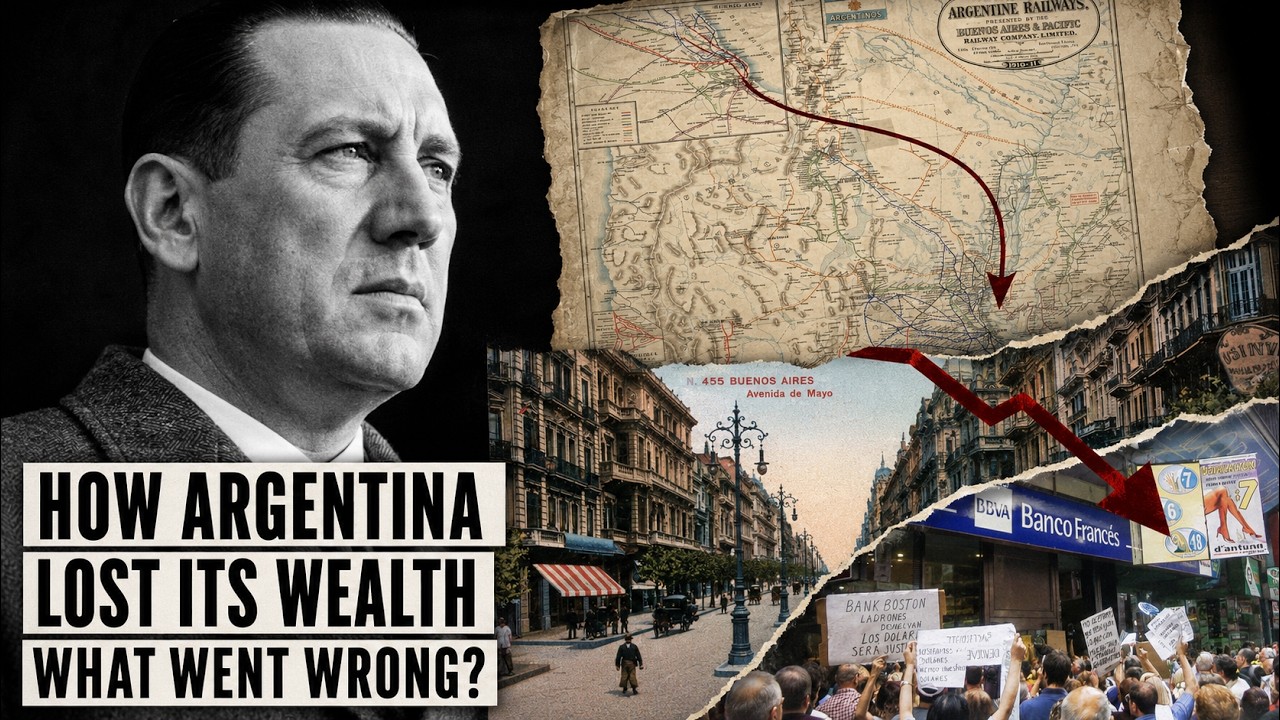
Rich as an Argentine. It was not merely a metaphor. At the dawn of the 1900s, Argentina’s per capita income exceeded that of France and Germany, was nearly double that of Japan, and clearly surpassed Italy and Spain. By 1895, Argentina had the highest per capita gross domestic product on earth.
It remained among the ten richest nations until roughly 1920. Its economy was larger than the rest of Latin America combined and approached that of all Western Europe. Migrants poured into Buenos Aires the way they poured into New York. The country overflowed with natural resources, from some of the most fertile farmland on the planet to vast oil and gas reserves and endless fresh water.
Argentina seemed destined to become a permanent world power. Over the following century, however, that same nation defaulted on its debt nine times. Inflation once exploded beyond five thousand percent. The currency was devalued so often that new notes had to be printed again and again.
The country endured repeated political crises, military coups, social upheaval, and economic collapse after economic collapse. By the early 2000s, economists had a name for it: the Argentine paradox. How could a country with so much potential fall so far? To understand, one must trace the rise and ruin step by step.
Argentina declared independence from Spain in 1816, but for decades afterward the country was torn by internal conflict, civil wars between Buenos Aires and the interior provinces, and constant struggles over control of the government. The situation was chaotic and economically stagnant. In the late 1870s and 1880s, a new generation of leaders, inspired by European liberal economic thought, opened the country to the world. They adopted free trade, welcomed foreign investment, and built the legal foundations for one of the most extraordinary booms in modern history.
The years from 1880 to 1914 are often called Argentina’s golden age, and with good reason. The world was experiencing an unprecedented era of globalization. Free trade flourished, international capital moved freely across borders, and European nations, especially Britain, were hungry for raw materials and agricultural products. Argentina, sitting on the vast fertile plains known as the Pampa, was perfectly positioned to meet that demand.
The economy rested on exporting beef and wheat, primarily to Britain. The country transformed itself into the breadbasket of the world, and the profits were staggering. Two forces supercharged the rise: foreign investment and mass immigration. British investors poured enormous sums into Argentina, with most of the money building railroads.
Between 1856 and 1914, Argentina’s rail network grew into the largest in Latin America, stretching more than thirty-five thousand kilometers across the country. The railroads connected remote agricultural lands to coastal ports, especially Buenos Aires, allowing meat and grain to reach ships bound for Europe quickly and cheaply. British investment jumped from about five million pounds in 1865 to 365 million pounds by 1913. Between 1870 and 1920, more than seventy percent of all foreign investment flowing into Latin America went to Argentina.
Then came a technological breakthrough that changed everything: refrigerated shipping. Before refrigeration, exporting fresh meat across the Atlantic was impossible. Argentina could only ship hides, salted meat, and live cattle. When refrigerated ships became commercially viable in the late 1870s and 1880s, everything changed overnight.
Argentine beef could now be shipped fresh to dinner tables in London and Paris. Demand was insatiable. Between 1864 and 1888, the number of cattle in Argentina more than doubled, from ten million to nearly twenty-three million head. Britain became the main market for Argentine meat, and the two economies became deeply intertwined.
Immigration transformed the country just as profoundly. The government actively recruited settlers, offering subsidized tickets and promising land and opportunity. Millions of Italians, Spaniards, Germans, and Eastern Europeans poured into Buenos Aires and the surrounding provinces. By 1914, fifty-eight percent of Argentina’s population was foreign-born.
These newcomers brought skills, ambition, and labor that fueled the growing agricultural and industrial economy. Buenos Aires was completely transformed, with grand boulevards modeled on Paris, opera houses and theaters rivaling those in London, and a port among the busiest in the Western Hemisphere. People called it the Paris of South America, and it was no exaggeration. By the early twentieth century, Argentina was at the height of its glory, ahead of comparable emerging economies like Canada and Australia in population, total income, and per capita income.
Yet beneath the brilliance lay a fatal weakness. Argentina’s wealth was built almost entirely on exporting agricultural commodities. By 1914, industry represented only about sixteen percent of the country’s economic output. The nation had not diversified, and it had not industrialized.
Its wealth depended completely on the steady flow of global trade, the constant demand of European buyers, and the unbroken stream of foreign capital. As long as the world wanted Argentine beef and wheat, the machine kept running. But what happened when the music stopped? The first cracks appeared during World War One.
The war disrupted trade routes, imposed blockades, and redirected European demand toward military needs. Argentine export revenues plummeted, foreign investment dried up, and the economy stumbled. The war exposed a deeper structural problem. While the United States, Germany, and even Japan were industrializing rapidly, Argentina remained essentially an agricultural exporter.
The riches accumulated in the golden age enriched a powerful landowning oligarchy that controlled vast stretches of the Pampa, but that wealth did not flow into broad economic development. Then came the Great Depression of 1929. Global markets collapsed, commodity prices plummeted, and international trade shrank dramatically. Demand for Argentine exports fell sharply, foreign capital fled, and the entire economic model that had made Argentina one of the richest nations on earth proved catastrophically fragile.
The 1930s marked the beginning of what economists call Argentina’s long decline. It began with a military coup. In 1930, General José Félix Uriburu overthrew the democratically elected president Hipólito Yrigoyen. The coup established a terrible precedent: from that moment on, the Argentine military repeatedly intervened in politics, toppling elected governments whenever it saw fit.
The new government and its successors turned away from the liberal economic policies of the golden age, imposing tariffs, restricting imports, and attempting to develop local industry through import substitution. In practice, the new approach was poorly implemented, created a closed and uncompetitive economy, and suffered for decades. Then came the most influential figure in Argentina’s economic history: Juan Domingo Perón. He first came to power in 1946, and his presidency radically reshaped the relationship between the state, the economy, and the people.
By the mid-1940s, Argentina was deeply divided. The old landowning elite still controlled enormous wealth, but a growing urban working class, fed by decades of immigration, demanded a larger share. Trade unions were gaining strength, and social tensions were rising. Perón stepped into this vacuum as a charismatic military officer with a talent for populist rhetoric.
His wife, Eva Perón, known as Evita, became an iconic figure beloved by workers and hated by the elite. Together they built a political movement that blended worker advocacy, nationalism, and personality worship. Peronism promised dignity, better wages, social protection, and a greater voice for workers. In the short term, Perón delivered.
He raised wages, expanded welfare programs, nationalized major industries including the British-owned railroads, created new state-owned companies, and poured money into public works. For the working class, Perón was a hero. But there was a devastating economic cost. Perón closed the economy to foreign competition, imposed heavy tariffs, and used the central bank as a personal piggy bank, expanding the money supply to fund spending without regard for inflation.
Between 1946 and 1955, government spending exceeded revenue every year by an average of fourteen percent, reaching forty-five percent of GDP by 1949. The agricultural sector, the backbone of the economy, was deliberately squeezed. Perón imposed controls on agricultural export prices and used the proceeds to fund industrial and social programs, effectively punishing the very sector that generated the country’s wealth. Inflation spiraled from about nineteen percent in 1946 to over fifty percent by 1951.
By the end of his first term, per capita economic output was only about six percent higher than when he began. Perón was overthrown in a military coup in 1955, but his legacy was permanent. The Peronist movement survived his exile and became a defining force in Argentine politics. Subsequent governments, civilian and military alike, found it nearly impossible to reverse his structural changes.
The oversized public sector, protectionist trade policies, entrenched state intervention, and powerful unions that could paralyze the economy with strikes all continued. Between 1955 and 1976, the country alternated between weak civilian governments and military juntas, none of which could stabilize the economy. In 1976, a military junta seized power with a brutality that exceeded all that came before. Under the pretext of fighting leftist insurgents, the regime waged a systematic campaign of state terror.
Estimates suggest that between ten thousand and thirty thousand people were killed or simply disappeared. Security forces kidnapped them, held them in secret detention centers, tortured them, and murdered them. Many were thrown alive from aircraft into the sea. Children born in captivity were stolen and given to military families.
The junta’s economic record was equally catastrophic. Inflation had already exceeded three hundred percent annually in 1976. The military’s solution was to borrow heavily from international banks and implement badly designed neoliberal reforms. The foreign debt exploded from about eight billion dollars when the junta took power to forty-five billion dollars by the time it left in 1983.
In 1982, in a desperate gamble to cling to power, the junta invaded the Falkland Islands, a British-controlled territory in the South Atlantic that Argentina had long claimed. Britain sent a massive naval force and defeated the Argentine military in just over two months. The Falklands disaster sealed the junta’s fate. Argentina returned to democracy in 1983 under President Raúl Alfonsín, but the economic chaos he inherited was almost beyond imagination.
Inflation was out of control, the foreign debt was crushing, the economy was stagnant, and the political landscape was fractured. Multiple stabilization plans failed. Then in 1989, the crisis reached its peak. Inflation exceeded forty-nine hundred percent that year.
Prices changed from hour to hour. Workers rushed to spend their wages immediately because the money would be worth far less by the next morning. Supermarkets stopped putting price tags on products because they could not keep up. Savings evaporated overnight.
Hyperinflation forced Alfonsín to resign early, handing power to Carlos Menem. Menem, despite being a Peronist, made a sharp turn toward the free market. He privatized state-owned companies, liberalized industries, and most importantly implemented the Convertibility Plan in 1991. The plan, the brainchild of his economy minister Domingo Cavallo, pegged the Argentine peso to the US dollar at a rate of one to one, backed by law.
In the short term, it worked like magic. Inflation collapsed from thousands of percent to near zero. Foreign investment flowed back. The economy grew rapidly.
Argentines could suddenly travel abroad, buy imported goods, and feel wealthy again. Buenos Aires boomed. It seemed the golden age had returned. But the Convertibility Plan was a time bomb.
Pegging the peso to the dollar meant Argentina could not adjust its exchange rate in response to economic shocks. It could not devalue to make exports cheaper, and it could not print money to stimulate the economy during recessions. As long as times were good, the peg held. But when conditions changed, the rigidity became a death sentence.
In the late 1990s, Argentina suffered a series of external shocks: the Asian financial crisis in 1997, Russia’s default in 1998, and Brazil’s devaluation in 1999. Argentine exports became increasingly uncompetitive because the dollar-linked peso was massively overvalued. Meanwhile, the government kept borrowing heavily. By 2000, Argentina was in full recession.
Unemployment rose, tax revenues fell, and the government was trapped. It could not devalue, could not spend, and could not borrow. In December 2001, the entire system collapsed. Cavallo imposed the “corralito,” a freeze on bank deposits that prevented Argentines from withdrawing their money.
The move sparked an explosion of popular rage. Hundreds of thousands poured into the streets. Riots broke out across Buenos Aires and other cities. Shops were looted, cars burned, and police responded with force, killing dozens.
President Fernando de la Rúa resigned and fled the presidential palace by helicopter while protesters stormed the gates. Within two weeks, Argentina had five different presidents. The interim president declared the largest sovereign debt default in history at that point, nearly one hundred billion dollars. The peso was unpegged and immediately lost about seventy percent of its value.
Savings were destroyed, poverty reached fifty-seven percent, and unemployment hit twenty-two and a half percent. It was a total and complete economic collapse. Argentina eventually stabilized and partially recovered. Under Presidents Néstor Kirchner and then his wife Cristina Fernández de Kirchner, the country defaulted on much of its debt and renegotiated, convincing most bondholders to accept about thirty cents on the dollar.
A global commodity boom raised prices for Argentine exports like soybeans, and the economy grew strongly for several years. But the structural problems were never truly addressed. Government spending remained high, inflation crept back up, the central bank was again used to finance deficits, and currency controls were reimposed. The vicious cycle persisted.
In 2014, Argentina defaulted again, this time over a legal dispute with bondholders who had rejected the 2001 restructuring terms. It was the country’s second default in thirteen years. Inflation figures were routinely understated under the Kirchners. The government changed the methodology for calculating inflation statistics, and independent economists who published higher numbers faced fines.
The official rate hovered around ten percent, but the real rate was estimated at more than double that. By 2018, under President Mauricio Macri, matters deteriorated again. The peso lost half its value in a single year. Inflation rose above fifty percent.
Argentina was forced to accept a record fifty-seven billion dollar bailout from the International Monetary Fund, the largest in the Fund’s history. The austerity measures attached to the bailout triggered widespread protests. Macri lost the next election, and the Peronists returned to power with Alberto Fernández as president and Cristina Kirchner as vice president. The cycle continued without pause.
By 2023, Argentina was on the edge once more. Annual inflation exceeded two hundred percent, among the highest in the world. The peso was in freefall, poverty was rising, and the public was furious. Into this void stepped an unexpected figure: Javier Milei.
A libertarian economist with wild hair and a theatrical persona, he carried a chainsaw at political rallies as a symbol of the cuts he planned. He called himself an anarcho-capitalist, attacked the political class, and promised to abolish the central bank, dollarize the economy, and slash government spending to zero. Critics dismissed him as a marginal candidate, a madman, or a clown. But the Argentine people, desperate for change after decades of failure, elected him president in December 2023.
Then Milei did something almost no one expected: he actually implemented his promises. In his first months in office, he applied what economists call shock therapy. He cut government spending by about a third, halved the number of government ministries, eliminated more than forty thousand civil service jobs, reduced subsidies for electricity, gas, and public transport, and devalued the peso by more than fifty percent in one stroke. The immediate pain was enormous.
Monthly inflation jumped to 25. 5 percent in December 2023. Poverty rose to fifty-three percent in the first half of 2024. Prices for food, healthcare, housing, and transport soared.
People suffered terribly. But Milei held his course, and gradually the numbers began to improve. By 2024, Argentina recorded its first budget surplus in more than fourteen years. Inflation, while still high in absolute terms, began to decline dramatically, from a record annual rate of nearly 290 percent in April 2024 to about 36 or 37 percent by mid-2025.
Real wages began to recover, and poverty fell from its peak of fifty-three percent to about thirty-two percent by mid-2025. Whether Milei’s experiment will succeed in the long term remains an open question. The social costs of his austerity measures have been staggering. There are legitimate concerns about the sustainability of cuts to education, healthcare, and scientific research.
But what cannot be denied is that Argentina, for the first time in a generation, has a leader attempting to break the vicious cycle that has plagued the country for nearly a century: the cycle of populism, deficit spending, money printing, inflation, crisis, and collapse. What exactly went wrong with Argentina? Looking back over more than a century of economic history, clear patterns emerge. The first and most fundamental problem was that Argentina never diversified its economy during its golden age.
It was rich because of commodities, beef and wheat, not because of industry, innovation, or a diverse economic base. When the global conditions supporting those commodities changed, Argentina had nothing to fall back on. The second problem was institutional collapse. Democratic institutions were weak and repeatedly undermined by military coups, authoritarian leaders, and populist movements that prioritized short-term political gains over long-term economic stability.
The rule of law eroded, property rights were not respected, the central bank was politicized, and corruption became pervasive. The third problem was the legacy of Peronism. Whatever the original intentions, the economic model Perón created, based on heavy state intervention, protectionism, deficit spending, and patronage, became a permanent feature of Argentine political life. Every subsequent government, left or right, civilian or military, operated within the Peronist framework.
Breaking free proved nearly impossible. Finally, there was the issue of external dependency. Argentina repeatedly borrowed heavily from international creditors, the IMF, foreign banks, and bond markets to finance spending. Each time, the debt became unsustainable, leading to default, devaluation, and crisis.
Argentina’s tragedy is that none of this was inevitable. The country still possesses every natural advantage a nation could wish for: vast fertile land, abundant resources, an educated population, and strategic geography. Even today, Argentina holds one of the largest shale oil reserves in the world, quadrupling production in just the past five years. The potential remains.
It has always remained. But potential without stable institutions, sound economic management, and the political will to make hard decisions remains only potential. The story of Argentina is a warning: wealth is not permanent, a nation can go from being the richest in the world to one of the most troubled in a few generations, and repeated wrong policy choices can compound into national catastrophe. Whether Argentina is finally breaking its century-long curse or simply entering the latest chapter of the same old story is something only time will tell.
But one thing is certain: the world is watching.
