In September 1857, workers clearing debris from the Cole plantation made a discovery that would never be fully explained. The main house lay damaged from the hurricane that had struck Galveston Island, and as they worked through the wreckage, they found human remains on the property. The Galveston Daily News reported the find on October 5th, noting only that authorities were investigating. There were no follow-up stories.
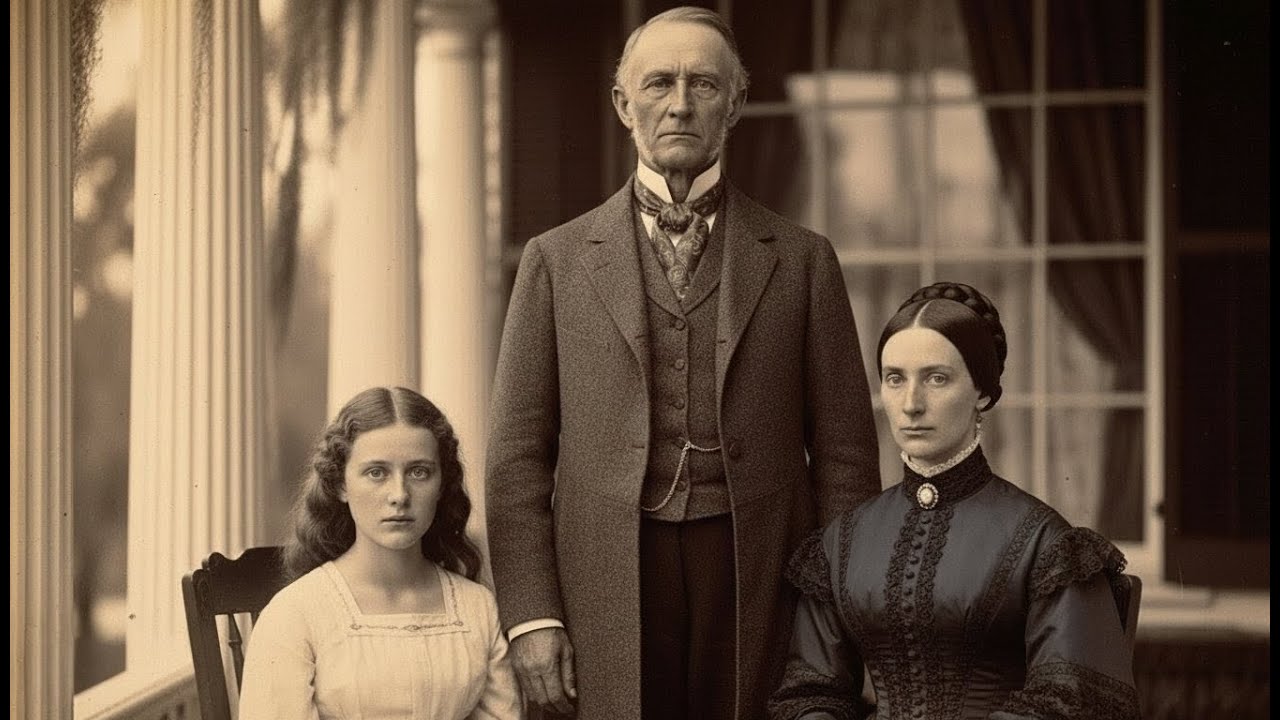
Sheriff James Williams conducted an inquiry but filed no charges. His official report stated that the remains appeared to date from the previous year, and that due to hurricane damage and decomposition, determination of identity and cause was not possible. The matter was officially closed on October 20th, 1857. Exactly one year earlier, in September 1856, the final entry had been written in a leather-bound journal belonging to Elizabeth Cole, the 18-year-old daughter of Nathan and Rosalie Cole, owners of one of the wealthiest plantations in Galveston County.
That journal contained a record of six months that contradicted everything Galveston society believed about the respected Cole family. But by the time the remains were found, Elizabeth had already vanished, and the journal itself had been destroyed in a fire that authorities deemed accidental. The Cole Plantation stood three miles east of the bustling port of Galveston, its white columns visible from the harbor against the flat coastal landscape. Texas had been part of the Union for eleven years, and the plantation was a testament to the economic boom that followed.
Nathan Cole had established himself as one of the wealthiest landowners in the county, known for his profitable cotton fields and his stern but fair business dealings. His wife, Rosalie Duval, was known for her French ancestry and the quiet dignity with which she managed the household. But beneath this prosperous surface, a darker reality was taking shape. The summer of 1856 was unusually hot and dry.
The cotton fields suffered, and tension hung in the air like the relentless humidity. Elizabeth’s journal begins in April with observations about changes in her father’s behavior. Nathan Cole had always been stern but fair, but something shifted that spring. He began spending long hours in his study, refusing meals, and speaking in hushed tones with Rosalie behind closed doors.
Elizabeth wrote on April 12th: “Father paces the floorboards above my room until dawn. When I inquired about his troubles at breakfast, mother silenced me with a glance. There is a heaviness in this house that seems to be crushing us all. ”
The first indication that something was truly amiss came in early May.
Elizabeth documented a strange encounter with Sarah, a house servant who had been employed in the Cole household for over a decade, serving primarily as Rosalie’s personal attendant. Elizabeth found Sarah trembling in the kitchen pantry one morning, clutching a small cloth bundle to her chest. “I asked what troubled her, but she would not speak,” Elizabeth recorded. “When I reached for her hand, she pulled away as if burned.
‘Miss Elizabeth,’ she finally whispered, ‘some things are better left unseen. ‘” Before Elizabeth could question her further, Rosalie appeared in the doorway. Sarah straightened immediately, her face emptying of all emotion. The bundle had vanished into the folds of her dress.
Two days later, Sarah was gone. Rosalie explained that she had been transferred to work in the fields. This struck Elizabeth as odd, given Sarah’s position and years of service. When Elizabeth attempted to locate Sarah among the field workers, she was told that no one by that name worked on the plantation.
Sarah had simply disappeared. She wasn’t the last to vanish that summer. According to customs records from the Port of Galveston, the Cole Plantation reported 43 enslaved individuals in January of 1856. By December of that same year, that number had mysteriously dropped to 29.
Fourteen people vanished from official documentation. No deaths reported, no sales recorded, simply gone. The county archives contained no explanation for this discrepancy. Church records from St.
Mary’s Cathedral in Galveston show that Rosalie Cole increased her attendance dramatically between May and September of 1856. The parish priest, Father Thomas Moore, noted in his personal diary that Mrs. Cole seemed troubled by matters of the soul and requested private confession weekly. What was discussed in those confessions remains between Rosalie and her priest, but Father Moore’s writings suggest a growing concern.
“Mrs. Cole speaks of salvation and sacrifice in concerning terms,” he wrote in late June. “When pressed, she refers only to a necessary cleansing. I fear her understanding of doctrine has become dangerously distorted.
”
Elizabeth’s journal entries from this period describe changes in the household routine. Meals became silent affairs with Nathan often absent. Rosalie developed new rules. No one was permitted to enter the east wing of the house where Nathan’s study was located.
The household staff was reduced with familiar faces disappearing without explanation. Most concerning to Elizabeth was her mother’s new habit of locking all interior doors at sunset. “I was awakened last night by voices in the courtyard,” reads an entry from June 30th. “When I tried to investigate, I found my bedroom door locked from the outside.
The voices continued until dawn, low murmurs punctuated by what sounded like weeping. When morning came, I confronted mother about being confined to my room. She claimed it was for my protection, though from what danger she would not say. ”
By July, Elizabeth began documenting strange sounds coming from beneath the house at night.
The Cole Mansion, like many substantial homes in Galveston, was built elevated on pillars to protect against flooding. The space beneath was typically used for storage and remained cool even in summer heat. Elizabeth described rhythmic scraping and the sound of metal on stone emanating from below her bedroom floor. “I cannot sleep,” she wrote on July 15th.
“The sounds continue for hours and with them comes a smell that seeps through the floorboards, earthy and metallic. This morning, I noticed soil in the hallway outside father’s study. When I mentioned it to mother, she claimed it must have been tracked in by the gardener, though I have not seen Mr. Winters on the property for nearly a month.
”
Elizabeth attempted to investigate the space beneath the house on at least two occasions. The first time, she found the access points sealed with new padlocks. The second attempt, in early August, proved more fruitful and more disturbing. “I finally managed to pry loose the boards beneath the kitchen pantry,” she recorded.
“The space below was too dark to see clearly, but I lowered a lantern on a string. What it illuminated makes no sense. The earth has been disturbed with neat rectangular depressions arranged in rows. They resemble nothing so much as open graves, though smaller than would accommodate a full-grown person.
” Before she could investigate further, she heard her mother’s footsteps. She barely had time to pull up the lantern and replace the boards. The next day, the kitchen pantry floor had been nailed shut and a heavy cabinet moved to cover the area. Port records show that in August of 1856, Nathan Cole made an unusual purchase: 20 barrels of quicklime, typically used in construction or agricultural applications.
Elizabeth’s journal mentions the delivery, noting that the barrels were taken directly to the space beneath the house. “Father supervised the placement himself,” she wrote. “When I asked about the purpose of the lime, he looked through me as if I were not there. Mother later explained it was for treating the soil in preparation for a garden renovation, but we have never maintained gardens on the north side of the property.
”
By September, Elizabeth’s entries became increasingly desperate. She documented attempts to communicate with plantation workers, only to find herself more isolated. Her parents restricted her movement, claiming concerns for her health. A physician, Dr.
William Harris, was summoned to examine Elizabeth on September 10th. His medical notes, preserved in the county records, indicate that he found the young woman agitated but physically sound, and prescribed rest and limited excitement. “Dr. Harris is complicit,” Elizabeth wrote afterward.
“He spoke with father privately before examining me, and his questions seemed designed to establish a pattern of nervous excitement. He suggested I might be suffering from feminine hysteria, and recommended I be kept indoors. They are conspiring to silence me. ”
The most disturbing entry comes from September 20th.
Elizabeth described waking in the night to find her mother standing at the foot of her bed, watching her sleep. “She was perfectly still, her white nightdress glowing in the moonlight. When she realized I was awake, she did not start or apologize for the intrusion. Instead, she sat beside me and stroked my hair with cold fingers.
‘You have always been such a curious child,’ she whispered. ‘But there are matters in this world that require discretion and sacrifice. Your father and I have taken on a great burden to secure our position. Soon, it will be your turn to contribute to the family legacy.
‘ She kissed my forehead and left, locking the door behind her. ”
Four days later, on September 25th, Elizabeth made a discovery that would form the most horrifying entry of all, though it would not be found for over a century. She followed her parents from the house one night to the cotton storage barn. Inside, she witnessed something “so contrary to nature and humanity” that her hand trembled as she recorded it.
Her father had converted the back room of the barn into a processing area, with tables of surgical implements, draining troughs, and containers of chemicals. Her mother moved about the space with practiced efficiency, arranging tools while Nathan consulted a ledger. They spoke of inventory reduction and necessary sacrifices to maintain appearances. Nathan mentioned that the banks were threatening to call in their loans, that their apparent prosperity was a facade covering mounting debts.
Elizabeth watched in horror as they brought in Thomas, who had worked their fields for over 15 years. He was unconscious, likely drugged. What happened next, she could not fully describe. She could only record that it involved the systematic dismantling of a human being.
Her mother collected certain parts in jars of solution, consulting a document with Chinese characters. Her father processed the remainder with quicklime in a pit beneath the floorboards. They spoke throughout the procedure with the detached interest of butchers discussing a particularly challenging cut of meat. Rosalie mentioned contacts in New Orleans willing to pay handsomely for specific materials, especially those from young, healthy subjects, and referred to some arrangement with a physician who conducts unorthodox research.
The excavations beneath the house, Elizabeth now understood, were for temporary storage before final disposal. The missing workers had not been sold or transferred. They had been harvested piece by piece, their remains dissolved with chemicals to leave no trace. Most horrifying was her mother’s casual mention of Elizabeth’s coming involvement.
“Elizabeth has steady hands,” she told Nathan. “Once she understands the financial necessity, she will make a valuable assistant. ” They planned to introduce her to their enterprise after her 19th birthday next month. “I must escape before then,” Elizabeth wrote.
“I have written to Father Thomas at St. Mary’s begging for sanctuary without revealing the full horror of what I’ve witnessed. ”
The final dated entry in Elizabeth’s journal is from October 3rd, 1856. It contains just three lines: “They are planning something for the new moon.
I have found a loose board in the window frame. If I do not have another opportunity to write, know that what happens beneath this house is not the will of God, regardless of what mother believes. ”
There are no further entries. According to Galveston society records, Elizabeth Cole was sent to stay with relatives in New Orleans in mid-October, supposedly to complete her education at a prestigious finishing school.
Correspondence between Rosalie and her sister-in-law in New Orleans, however, contains no mention of such arrangements. What happened to Elizabeth Cole remains unknown. No records of her arrival in New Orleans exist. No marriage certificate, death certificate, or further documentation of her life can be found in any archive.
Like the 14 people missing from the plantation records, she simply vanished. A patient register from the Louisiana State Insane Asylum for 1857 lists a Miss E. C. , aged 19, committed by family for dangerous delusions.
The entry notes that the patient claimed her parents murdered and processed multiple individuals on their property, and expressed fear that she would be next. The register indicates that this patient died of brain fever after six months in the institution. Whether this was Elizabeth Cole cannot be confirmed, but the coincidence of timing and circumstances is difficult to ignore. The winter of 1856 brought change to the Cole plantation.
According to business records, Nathan Cole sold a significant portion of his landholdings in December, despite falling cotton prices. Neighbors reported that the Coles became increasingly reclusive. The number of social engagements they hosted or attended dropped to almost none. Rosalie’s church attendance became sporadic before stopping altogether by February 1857.
A letter from Mrs. Margaret Thornton to her daughter in Virginia, dated January 1857, provides a rare glimpse into public perception of the Coles during this period. “The Christmas gala at the Hopkins estate was well attended, though noticeably absent were the Coles. Nathan’s absence might be explained by business matters, but Rosalie has withdrawn from society entirely.
When encountered at the market last week, she appeared gaunt and distracted. Her once immaculate appearance has given way to something approaching neglect. There are whispers among the servants about strange occurrences at the Cole plantation, workers refusing assignments there, and items being delivered at unusual hours. ”
The most concrete evidence of deteriorating conditions came from a complaint filed with the county sheriff in March 1857.
A merchant named Thomas Wilson reported that Nathan Cole had threatened him with a firearm during a dispute over an unpaid debt. The sheriff’s notes indicate that when he visited the Cole plantation to investigate, he found the main house in a state of disrepair, with broken windows boarded over, and the once manicured grounds overgrown. Nathan was described as unkempt and agitated, insisting that his business affairs were private matters. No charges were filed.
Rosalie Cole’s mental decline is documented in a series of letters between her sister, Catherine Duval, and their family physician in New Orleans. Catherine visited the plantation in April 1857, and was apparently so disturbed by what she found that she consulted the doctor immediately upon her return. “My sister is not herself,” she wrote. “She speaks in riddles about purification and necessary sacrifices.
The house, once a showpiece of Galveston society, has fallen into shameful condition. Most concerning are the inexplicable scratches on the interior walls, as if someone had been trying to claw their way out. When I inquired about Elizabeth, Rosalie became hysterical, claiming that her daughter was closer than I knew. Nathan appears to have surrendered all authority in the household to my sister’s increasingly bizarre dictates.
There were rooms I was forbidden to enter, and subjects I was not permitted to mention. I fear for both their sanity. ”
After the hurricane of September 1857 forced the Coles to relocate to their property in Houston, they never returned to Galveston. They lived in relative obscurity until Nathan’s death from liver failure in 1862.
Rosalie survived him by only three months, reportedly taking her own life in January 1863. The Houston Telegraph’s brief obituary mentioned only that she was preceded in death by her husband and daughter, the sole public acknowledgement that Elizabeth Cole had not simply gone away to school. The Cole plantation in Galveston changed hands multiple times over the following decades. Each owner reported difficulties with the property: structural problems, soil that would not sustain crops, and an inability to retain workers.
By the turn of the century, the land had been divided and sold for development. The main house, or what remained of it, was demolished in 1922. The story might have ended there, forgotten like so many dark chapters of history, if not for the renovation work in 1964 that uncovered Elizabeth’s journal. Construction workers discovered a sealed compartment beneath the dining room floor.
Inside was a tin box containing a leather-bound journal, its pages yellowed but still legible. The handwriting belonged to Elizabeth Cole. The journal was briefly examined by local authorities before being transferred to the University of Texas archives for preservation. Three weeks later, a fire in the storage facility destroyed several historical documents.
According to the report filed, Elizabeth Cole’s journal was among the items lost. However, before its destruction, portions were transcribed by Dr. James Hargrove, whose personal notes would later surface in an estate sale in 1968. In 1968, during the sorting of Dr.
Hargrove’s effects, a sealed envelope was discovered addressed to future historians of Galveston. Inside was a single page of notes that never made it into his academic paper. The page contained what appeared to be a direct transcription from Elizabeth Cole’s journal dated September 25th, 1856, the account of what she witnessed in the cotton storage barn. This page, unlike Hargrove’s other notes, was never donated to any institution.
Its current whereabouts are unknown, and its authenticity cannot be verified. Hargrove himself published a brief paper in the Journal of Texas History in 1969, suggesting that the evidence pointed to systematic elimination of individuals from the plantation and a subsequent cover-up. The paper received little attention outside academic circles and was largely forgotten after Hargrove’s death in a car accident the following year. Historical records confirm that Nathan Cole was indeed facing financial difficulties in 1856.
The banking panic of 1855 had created a credit shortage that particularly affected landowners who had expanded aggressively in previous years. Cole had purchased additional acreage in 1854, financing the acquisition through loans that became increasingly burdensome as agricultural prices fell. A tantalizing clue appears in the correspondence of Dr. Antoine Laurent, a New Orleans physician known for his controversial research into human anatomy.
In a letter to a colleague dated November 1856, Laurent mentions receiving specialized preparations from a Gulf Coast supplier preserved with remarkable skill for a non-medical practitioner. The letter goes on to describe these preparations as particularly valuable due to their freshness and the precision of their extraction. Laurent’s research papers were largely destroyed during the Civil War, but fragments survive in the archives of Tulane University. They suggest he was investigating differences in tissue composition between races, a pseudo-scientific pursuit common in that era.
The possible connection between the Coles and Laurent is further suggested by financial records showing that Rosalie made several trips to New Orleans between June and November 1856. Each time, she returned with substantial sums in gold coin, unusual for a woman in that period to transport alone. A former groundskeeper for the property where the Cole Plantation once stood shared an account with local historian Thomas Wright in 1997 that adds another layer to the mystery. The man, then in his 80s, recalled that while digging irrigation trenches in the 1950s, he and his crew discovered what appeared to be a hidden cellar not documented in any building plans.
It was walled with brick and had a heavy iron door, rusted shut. “When we broke it open, we found an empty room about 12 feet square. The floor was concrete, but had these channels cut into it, all leading to a central drain. The walls had iron rings mounted at intervals about the height a person’s wrists would be if they were standing.
The whole place had a strange smell even after all those years, like chemicals and something underneath that I can’t describe. We reported it to the property manager, but he told us to brick it up and never mention it again. Said it would decrease the property value. So, that’s what we did.
” No official record of this discovery exists. In 1968, a geological survey was conducted in the area where the Cole plantation once stood, preparatory to the construction of an office complex. Ground-penetrating radar revealed regular disturbances in the subsoil layer, approximately six to eight feet below current grade, extending in a grid pattern over roughly half an acre. The report recommended archaeological assessment before construction proceeded.
That assessment never took place. The construction company changed its plans, citing engineering challenges, and built on a different section of the property. The area in question was paved over for a parking facility that stands to this day. In 2005, during excavation for utility lines near the former Cole property, workers uncovered a collection of glass containers buried approximately four feet below the surface.
The containers, estimated to date from the mid-19th century, held preserved organic material in a solution later identified as a mixture of alcohol and arsenic compounds, a preservation technique used by anatomists of the period. The contents were too degraded for definitive identification, but preliminary analysis by the medical examiner’s office indicated they were of human origin. After a brief investigation, the containers and their contents were classified as historical medical specimens of unknown provenance, and eventually transferred to a university collection for further study. No connection to the Cole family was officially established.
In 1974, anthropologist Dr. Margaret Sinclair conducted interviews with elderly descendants of enslaved people who had worked on Galveston plantations. One interviewee, whose great-grandmother had been enslaved on a property neighboring the Cole Plantation, recounted a story passed down through generations. “Great-grandma Harriet told her daughter, who told my mother, who told me that the Cole place was a place of disappearances.
People would be working there one day, gone the next. The masters would say they’d been sold off, but no one ever heard from them again. Harriet said that the enslaved people knew better than to ask questions, but they had their ways of warning each other. They had a saying, ‘When the missus takes to praying and the master takes to drinking, keep your head down and your feet ready.
‘ Meant that trouble was brewing and you might need to run. They said that Mrs. Cole had eyes that saw right through you, like she was measuring your worth by the pound. ”
In 1992, a descendant of Dr.
William Harris discovered a hidden compartment in an antique medical bag inherited from his ancestor. Inside was a folded letter dated October 5th, 1856, addressed to the Galveston sheriff, but apparently never delivered. In the letter, Dr. Harris expressed grave concerns about the Cole family.
“Having given the matter considerable thought since my examination of Miss Elizabeth Cole, I feel compelled by professional ethics to share certain observations. The young lady, while exhibiting some agitation, struck me as entirely sound of mind. Her concerns regarding activities on the plantation deserve serious investigation. During my visit, I observed unusual security measures throughout the residence, including multiple locked doors and barred windows.
Mr. Cole’s explanation that these were necessitated by fear of slave uprising seems excessive given the relative calm in the region. More concerning was my glimpse of what appeared to be surgical implements in Mr. Cole’s study.
Tools that would have no place in a plantation home. When I inquired about these items, Mrs. Cole interposed herself between myself and her husband explaining that he had developed an interest in amateur dissection of small animals for scientific inquiry. The explanation was delivered with practiced ease, yet her eyes betrayed apprehension.
Most disturbing was what I observed as I departed the property. Near the cotton barn, I witnessed two workers carrying what appeared to be a human body wrapped in canvas. When they saw my carriage, they quickly retreated into the structure. Mr.
Cole, who had accompanied me to my conveyance, explained that it was merely a deer carcass from a recent hunt. ” Why this letter was never delivered remains unknown. Dr. Harris continued to practice in Galveston until 1860 when he relocated to Houston.
His medical notes make no further mention of the Cole family. In 2015, when the parking facility was scheduled for resurfacing, a ground composition study revealed unusually high concentrations of calcium compounds in the soil beneath the asphalt, consistent with the presence of quicklime. The environmental assessment noted this as a minor anomaly. During the resurfacing, completed in January 2016, workers uncovered what appeared to be a small leather-bound book approximately two feet below the original surface.
According to the construction foreman’s report, the item was severely deteriorated and fell apart when touched. The fragments were disposed of as construction debris. Today, the site where the Cole plantation once stood is occupied by commercial developments and residential neighborhoods. Nothing remains of the main house or the outbuildings.
The only physical reminder is a small historical marker on Broadway Avenue that makes no mention of Nathan, Rosalie, or Elizabeth Cole, only noting that the area was home to several productive plantations in the mid-19th century before becoming part of Galveston’s urban expansion. The true nature of what happened at the Cole plantation in 1856 may never be known with certainty. The evidence that might have provided answers has been lost, destroyed, or deliberately suppressed. What remains are fragments: a journal briefly glimpsed before disappearing, discrepancies in official records, a physician’s undelivered letter, a buried cellar bricked up on a property manager’s orders, and the memory, passed down through generations, of a place where people disappeared and the missus had eyes that measured your worth by the pound.
The 14 missing people are nameless entries in a ledger, their fates unrecorded and unmourned. Elizabeth’s final witness to whatever horror transpired on that plantation has been silenced. What we are left with is the outline of a darkness, human in origin, terrible in implication.
