On the morning of September 1, 1939, German armed columns crossed the Polish frontier from the north, the west, and the south all at once. In London and Paris, the governments that had pledged to protect Polish sovereignty drew up ultimatums that would turn into declarations of war within two days. In Warsaw, civilians packed the streets, gazing up at the sky. Throughout the country, men headed to mobilization points, and women started gathering whatever they could carry.
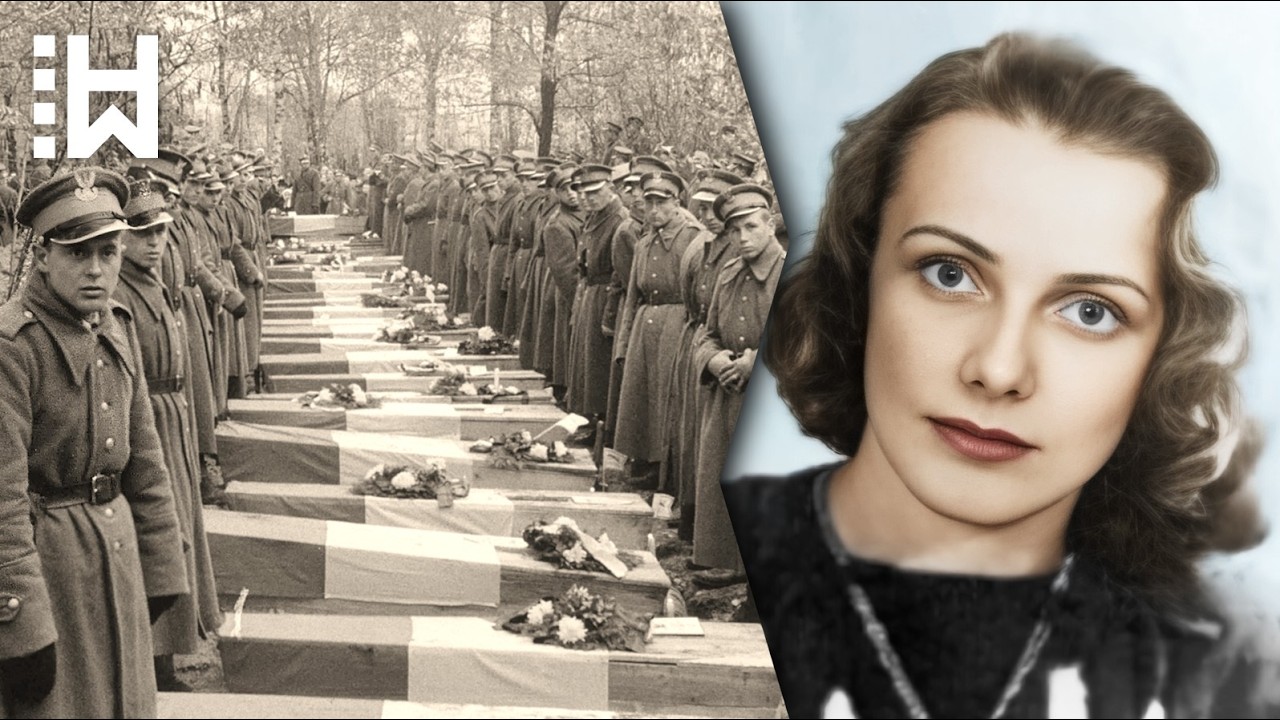
In the town of Siedlce, east of Warsaw, a sixteen-year-old girl learned the news together with the rest of her compatriots. She was the daughter of a military judge. Within two years she would enlist in the Polish resistance, and General Stefan Rowecki, commander of the Home Army—the largest underground organization in occupied Poland—would award her a decoration for bravery. Within three years, she would hand him over to the Nazi secret police, the Gestapo.
Her name was Blanka Kaczorowska. Blanka Kaczorowska was born on October 13, 1922, in Brześć Litewski, known today as Brest in Belarus, then a part of the Polish Republic. Her father, Jan Kaczorowski, hailed from a noble family in the settlement of Husiatyn in Podolia Province. He had studied at St.
Petersburg Technical University, volunteered for the Russian army during World War I, and after the war joined the newly independent Polish state, rising through the military legal system until he qualified in 1931 as an investigating judge. From 1934 to 1938 he presided over the local military court in Siedlce. The family was respected, patriotic, and well connected within Poland’s prewar state institutions. Blanka grew up in this environment.
She attended the school of the Military Family Association in Warsaw, then Queen Jadwiga Secondary School of Natural Sciences in Siedlce. She belonged to the Polish Scouting Association, which instilled in her early values of patriotism and organizational discipline. When World War II broke out in September 1939, she had not yet finished her final school examinations. The German occupation of Poland, which followed the invasion within weeks, split the country into different administrative zones.
Siedlce fell within the General Government, the German colonial administration set up over central and southern occupied Poland. Under the occupation, secret resistance organizations formed quickly, drawing on prewar civil society and army structures. By early 1940, Kaczorowska was in contact with the underground and had joined the structures of the Union of Armed Struggle, the predecessor organization of the Home Army. She worked in the kitchen of a German airfield, then as a cleaning woman in a German military hospital—positions that gave her access to information of intelligence value.
During this period, she drew the attention of a German Luftwaffe officer named Johannes Barand, and her resistance superiors encouraged her to exploit this contact as a source of information. In November 1941, the Gestapo arrested her in Siedlce. They confiscated incriminating material, including private letters from Barand. She was released after a few days, explaining to the resistance that she had convinced the Germans the material had been found by accident while cleaning.
The underground accepted this explanation, and she was awarded the Cross of Valour—ironically, on the orders of General Rowecki, the man she would later betray and deliver to the Gestapo. At the ceremony for the award, she met for the first time Ludwik Kalkstein, the man who would destroy her. Kalkstein was an intelligence officer in the Home Army, leading a group called Group H, a network operating under the Home Army’s command. He received his own medal at the same ceremony.
In early 1941 and 1942, she joined his group. Ludwik Kalkstein became her superior in the underground, and their relationship quickly grew close. In late March or early April 1942, the Gestapo arrested him and held him at its headquarters on Szucha Avenue in Warsaw. He broke under interrogation and agreed to cooperate.
After his release in August 1942, he changed his appearance and sought out Kaczorowska, finding her a month later. He told her plainly that he had been released in exchange for agreeing to work for the Germans, and she raised no objection. On November 14, 1942, they were married in a church in Radość, a suburb east of Warsaw. The marriage was kept secret from the resistance.
Kaczorowska continued to work in the underground organizations under her maiden name and kept a separate address from her husband so that their connection would not be discovered. In secret meetings with Kalkstein, she told him everything: the names of the people she worked with, the tasks she had been assigned, the identities of her organizational contacts. This information passed through Kalkstein to the Gestapo, where it was recorded under the agent number V-98. Kalkstein himself held the number V-97.
The third member of that network, Kalkstein’s brother-in-law Eugeniusz Świerczewski, worked under the number V-100. The consequences for the Polish resistance were severe. Kaczorowska later admitted in her postwar testimony that she knew the information she passed to her husband reached the Gestapo. In the summer of 1943, her capacity for damage grew when she was assigned to the main headquarters of the Home Army.
She exploited this position to obtain information for the Gestapo, and in December 1943, the information she provided directly led to the arrest of at least fourteen resistance members, five of whom were later executed. Among the dead was Jadwiga Karaśewska, head of the propaganda and morale section in the Studies Bureau and Kaczorowska’s direct superior. But the most serious act of treason had occurred months earlier. On June 30, 1943, General Stefan Rowecki, commander of the Home Army, was arrested in his safe house in Warsaw and later executed.
After an investigation lasting several months, the Home Army’s counterintelligence concluded that three agents—Kalkstein, Kaczorowska, and Świerczewski—bore collective responsibility, and according to some sources, the secret military court sentenced all three to death in absentia. The sentence was carried out on Świerczewski, who was identified as the man who had spotted Rowecki on the street and informed the Germans, in June 1944. An assassination squad went looking for Kalkstein and Kaczorowska at their apartment on Śniadeckich Street in Warsaw, but failed. Kaczorowska, pregnant at the time, had taken refuge in a hospital under German protection.
She gave birth to a son, and in April 1944, Kalkstein moved her to the town of Piastów outside Warsaw. The marriage did not last, and the couple separated shortly after the birth of their son. The sentence was never carried out, and Kaczorowska survived the following months under German protection. In January 1945, with Soviet forces approaching and the structures of German occupation collapsing, Kaczorowska and Kalkstein headed for the newly liberated city of Łódź.
Probably in February 1945, Kaczorowska left Łódź for her last prewar place of residence, Siedlce, to obtain official documents. At the local municipal office, she obtained the necessary document under her maiden name. At the same time, she did not hide the fact of her marriage. Her father, Jan Kaczorowski, the prewar military judge, had by then been recruited by the new communist authorities and appointed a judge on the Supreme Military Court in Lublin.
That post, occupied by one of the most senior judicial figures in the new state machinery, gave Blanka a degree of cover that she used to the maximum during Poland’s unsettled first postwar years. She put down roots in Łódź and in July 1945 secured her high school completion certificate, having finished her interrupted education through an intensive course. On October 31, 1945, she matriculated in the art history department at the University of Łódź. In her application she declared that she was married, yet omitted her husband’s surname.
At the university she was no standout student, gave no cause for complaint, and graduated with an unblemished rating for good conduct. She also became involved with Roman Vogel, also known as Roman Rawicz, a military judge serving in the same section of the Supreme Military Court as her father, with whom she later co-authored a commentary on the military criminal code. She moved in with him and introduced him as her husband, though the two were never formally married. Through the late 1940s, Kaczorowska led a quiet existence in Łódź and afterward in Warsaw, where she finished her university studies, and in 1949 she found employment at the State Institute for the Study of Folk Art in Warsaw.
On the face of it, she had completely remade herself. It was not to endure, however. Poland’s political weather was shifting. The Stalinist tightening of communist control in the early 1950s brought intensive scrutiny of wartime records and fresh attention to former Gestapo collaborators.
The protective network around Kaczorowska started to crumble. Her father was discharged from military service in April 1948, and her partner Vogel came under mounting political pressure. In late December 1952, she was arrested. Her apartment was searched, and a formal investigation was opened against her.
She gave lengthy testimony laying out her wartime activities in detail, trying to play down her personal responsibility, asserting that she had trusted Kalkstein, denying any direct cooperation with the Gestapo, and maintaining that she had discussed her work only with her husband. On June 12, 1953, she stood trial before the Warsaw Provincial Court. The charge was collaboration with the Nazi occupation under the decree of August 31, 1944, on the punishment of Hitlerite fascist criminals. The court found her guilty and sentenced her to life imprisonment with permanent deprivation of civil rights.
On appeal, the Supreme Court cut the sentence to fifteen years with deprivation of civil rights for ten years. A judicial amnesty then reduced this to twelve years. She served her term in the women’s prison in Fordon, near Bydgoszcz in northern Poland, and was paroled in July 1958, after five and a half years behind bars. While in prison, she became an informer for the communist security service, reporting on her fellow inmates.
After her release she carried on in this role, operating as a secret agent under the code name Katarzyna. In 1968, she left Poland legally for Paris, where she first took on small projects in art history, then worked as a caregiver and hotel receptionist. Her former husband, Ludwik Kalkstein, had been arrested after the war and sentenced to prison for his collaboration with the Germans during the war. Once released, he left Poland and in time settled in France, where their son was living.
Using a false identity, he spent the remainder of his life in Western Europe and died in 1994. In 1983, Kaczorowska was admitted to a Polish charitable nursing home in La Haye-en-Val, in the Loire Valley, which since 1957 had cared for veterans of the Polish Armed Forces in the West and political refugees. There she was recognized by chance when a Polish woman employed in the administration came across her French residence card, which described her as a victim of a political trial in communist Poland. Her wartime past quickly surfaced.
She lost her job, and after reaching retirement age, Kaczorowska was moved to a French nursing home in Bougency, north-central France, where she stayed for the rest of her life. Blanka Kaczorowska died on August 25, 2002, at the age of seventy-nine, in a hospital run by the Camillian fathers in Bry-sur-Marne, a suburb east of Paris. She was laid to rest in the local municipal cemetery.
