She sat up in bed with her back against the headboard and said two names out loud, over and over, from 1:45 in the morning until it got light. There were eight inches of snow on the ground outside her house in Kingsport, Tennessee, and at some point in the dark someone had stood in her yard and whistled through his teeth, the way her brother Denny had done his whole life, and then had walked barefoot up to her porch steps and gone back to the road in a stride that measured about forty inches at a walk. She is Karen Wadell, 54 years old, a medical records clerk who has lived within nine miles of the house she was born in her entire life. And the reason she spent that February night saying two names instead of three is a matter of what happened to her on a mountain called Bitterbald, on the North Carolina and Tennessee line, in a county most people have never had a reason to drive through.
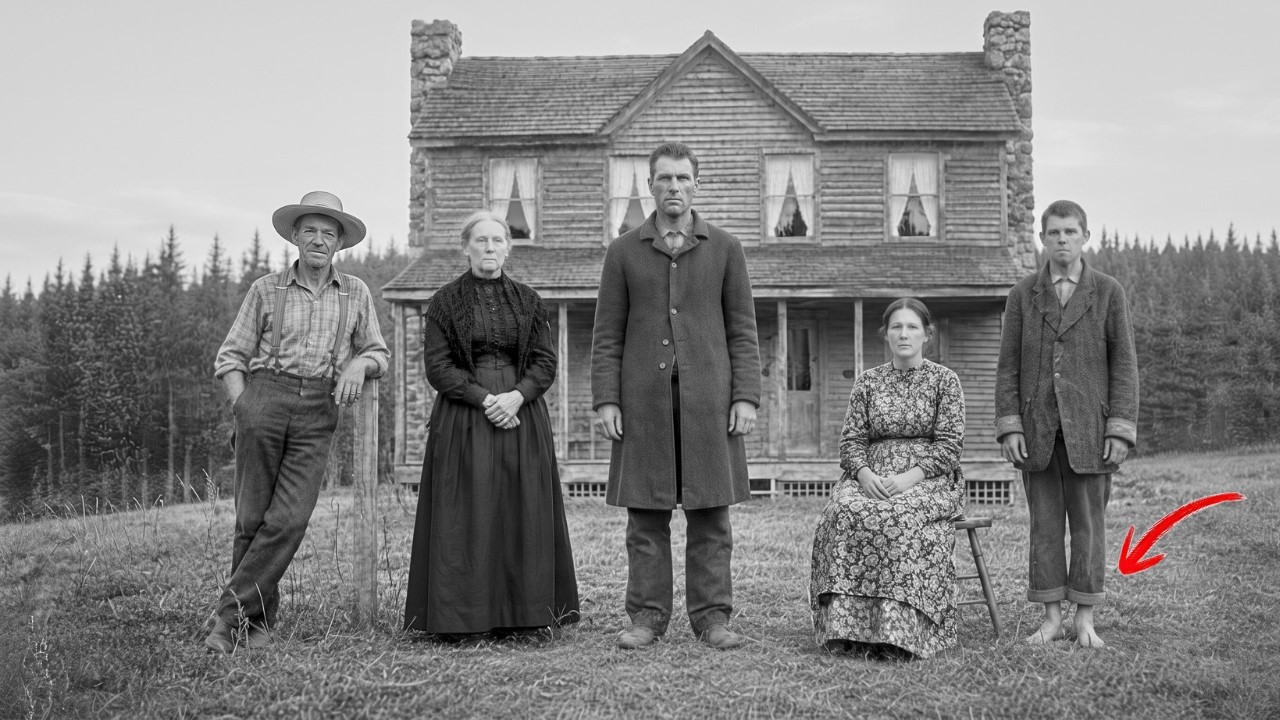
The story of how she came to be sitting in that bed, and how the grass that grew against her door in the snow came to be in a Ziploc bag in her freezer, begins more than two hundred years earlier, with a man who appears in the historical record out of nowhere and never receives an explanation for it. The first document that mentions the name at all is a land grant. Deed book 4, page 212, recorded on the 11th of March, 1798, in Halloway County, North Carolina, conveys 640 acres on the waters of Salat Creek, including the high open ground locally called Bitterbald, to a man written down as Abselum Kennard. That is the first time the name appears in any document anywhere in the world.
There is no earlier record of him: no census listing, no tax roll, no ship manifest, no marriage, no christening, no militia muster. He is not a man who moved to Halloway County. He begins there. The clerk who recorded the grant was a man named Josiah Meer, who kept a personal daybook alongside the official records.
His entry for that day notes that Abselum Kennard paid in coin, all silver and old, that he would not sit but stood the whole while by the door, a tall man, dark, well-made, of perhaps thirty years, with a way of looking at a person that put him in mind of a man reading a page. Kennard asked twice whether the grant carried the open ground on top or only the timber below it, and when Meer said it carried all of it, he seemed easier. He said his wife was waiting in the road. Two lines down, in different ink, Meer added that he went out afterward to be civil to the wife, and there was no one in the road.
The horses were there and the wagon was there, and no one was in it or near it. There was a wife, though. In the federal census of 1800, the Absalom Kennard household in Halloway County contains 11 free white persons. In 1810 it contains 11.
In 1820 it contains 11. In 1830 it contains 11. That is not strange on its own; large households were normal in the mountain counties. What is strange is what the tally marks do across the four decades.
The same age brackets are full. The same brackets are empty. Two males under 10 in every census. One female of 45 and upward in every one.
Children who are under 10 in 1800 should be under 20 in 1810. A household that never adds and never loses and never ages is not a household. It is a photograph that somebody keeps taking. There are dull explanations.
Enumerator laziness was real, and copying an old book instead of climbing a mountain happened more than you would think. Except that the 1830 enumerator, a man named Ambrose Dill, did climb, and he complained about it in writing in a letter requesting additional compensation, and he named the Kennard household on his list with a note beside it. He wrote that he went up to the Kennard place on the fourth day of August, counted 11 as before, was given dinner, and was well used. Then he added: I have set down what they told me but I did not see 11 people on that mountain and I would not swear to 11 in a court.
The bald itself is as strange as the family. It is 61 acres of grass on the top of a ridge called Salot Mountain, surrounded by a wall of red spruce and Fraser fir, and the grass is not native pasture. In 1974, a graduate student from the University of Tennessee named Paul Ostrander took core samples and pollen counts from the soil. On eight of the nine balds he studied, the pollen tells the usual story: trees, then fire or grazing, then grass, then trees creeping back in.
On Bitterbald, the record goes down eleven feet and does not change. Grass all the way down. No fire layer, no stump horizon, no charcoal. Ostrander dated the deepest sample he could get a reliable number out of to somewhere between 4,300 and 4,900 years before present.
It was grass then. It was grass in 1798. It is grass now. In the whole of that time, not one tree has stood up on it.
He wrote in the driest possible language that the site appears to resist succession by a mechanism not identified in this study, which is a botanist’s way of saying he had no idea. And in his acknowledgements, he wrote one sentence that has no business in a botany paper: the author declines to return to site 9. Site 9 was Bitterbald. He never published again.
The first outsider to marry into the family that can be named was a girl called Nancy Odell, 17 years old, from a family down on Salat Creek. She married Elias Kennard on the 22nd of October, 1841. She went up the mountain and wrote letters home, about one a year for 41 years, always near the turn of the year, always short. The first four are what you would expect from a homesick teenager.
The fifth letter, December of 1845, turns. She writes that she is well, that the winter is mild, that they have put up 40 gallons of kraut and the orchard bore heavy. Then she writes that her younger brother Pettit came up in September and stayed one night, and she has thought on it since. He is a good boy, but he was not easy, and I was not easy for him being here.
It is better if I come down, which I will do when I am able. There is nothing wrong. Only it is better. She never came down.
Not once in 41 years. Her mother died in 1859 and she did not come to the burial. Her father died in 1866. She did not come.
But the letters kept arriving, one a year, always near the turn of the year, always well. And the handwriting gets better. Not steadier, not more mature: better. The letters from the 1840s are a country girl’s hand, cramped, uneven, words crossed out.
By the 1850s the crossing out has stopped. By the 1860s the letters are even, the spacing regular, the margins straight without a ruled line. By the 1870s the hand is beautiful, and by 1880 it is so regular that if you lay two letters written three years apart on top of one another and hold them up to the light, the ascenders line up. People’s handwriting does not do that.
It degrades. And in every one of the 41 letters, Nancy Odell Kennard asks after the dog Pettit: tell me is Pettit well. In the letter of 1842, right and proper. In the letter of 1879, 38 years after she went up the mountain, a dog that would have been dead for thirty years.
Not as a joke, not as a running gag: it sits there in the middle of the letter between the weather and the kraut, in a beautiful even hand, year after year. The last letter is dated the 2nd of January, 1883, and it is the same as all the others. Then nothing. No letter in 1884.
No death notice, no probate, no grave that anybody has ever found. In the fall of 1863, the war came up Salat Creek. A home guard detachment out of Halloway County went up the mountain looking for four deserters supposed to be hiding on the bald. There were 11 men in the detachment, under a lieutenant named Cordell Seep, 36 years old, with a limp from a mule kick and a wife named Melinda and five children.
They went up on the 12th of October. They came down on the 14th. Nine of them came down, and every single one of the nine gave a statement in the weeks and months after. Those nine accounts agree about almost everything.
They agree the detachment reached the bald about 4:00 in the afternoon. They agree there was no sign of the deserters. They agree the Kennards came out of the house, the women first, which every one of them thought strange, and were as hospitable as any people I ever met, and I did not like a minute of it. They agree they were fed cornbread, dried beans, apple butter, buttermilk.
They agree the Kennards would not eat with them, but stood around the walls of the room and watched them eat, smiling, friendly. They agree that when the lieutenant asked how many people lived there, a Kennard man said 11. They agree they camped on the grass that night about 200 yards from the house, and it was a clear cold night and there was frost. And they agree that at some point in the small hours, every man in that camp woke up at the same time, not to a noise.
Sergeant Doss Wills said it in a deposition taken in 1868: I have woke up to noise all my life and this was not that. I wake up the way you wake up when somebody has come in the room and is standing there. Then the accounts disagree, and it is a very specific disagreement. Four of the nine say they lay there and went back to sleep and nothing else happened.
Five of the nine say a man walked through the camp from the direction of the house toward the tree line, unhurried, not looking at anybody, and not one of the men lying awake on the ground said a word or moved. Two of those five, men who lived four counties apart after the war and never spoke to one another again, said the same additional thing: they knew the man. Doss Wills said it was his brother Isham Wills, who had died at Sharpsburg 13 months earlier and was buried in Maryland. A private named Looney Trantham said it was his father, who had drowned in 1851.
Neither of them ever said the other had said it. The two men who did not come down were Lieutenant Seep and a private named Jasper Bohannan, 19 years old. In the morning they were gone from the camp, and their blankets and weapons and boots were still there. The nine searched the bald all day, and the Kennards helped them, the whole family out in the grass in a line, walking slowly, calling the two names correctly.
On the afternoon of the 13th, one of the men found boot prints: two sets leaving the camp going north across the grass toward the tree line, barefoot, in the frost. They followed them 140 yards, and the prints stopped at the edge of the spruce, and there was no disturbance in the brush, no broken branch, no bent rhododendron. And coming back the other way, from the tree line toward the camp, there were two more sets of prints in the same frost, the same feet. Same feet going out.
Same feet coming back. But the stride was longer coming back. Considerably longer. Doss Wills paced it out and put it in his deposition five years later: going out about a 26-inch stride, which is a man walking.
Coming back about a 40-inch stride, which is a man running, except that the prints were flat-footed and evenly weighted, and a running man does not print like that. Something walked back at 40 inches a step. The nine left the bald on the morning of the 14th. They did not tell the Kennards they were going.
As they came down through the gap, they could hear, for about the first quarter mile, somebody up on the grass behind them still calling the two names. In March of 1901, a country doctor named Hollis Truit was fetched at night to Bitterbald to attend a sick child. Truit had his medical degree from Jefferson Medical College in Philadelphia and had practiced in and around Fathergill since 1889. He was a compulsive note-taker, and his case books survive, 11 black ledgers covering 35 years.
The child was a girl he was told was seven years old, named Sarilda. She had a high fever, a cough, and the beginnings of a rash on the chest and neck. Truit diagnosed measles with a probable pneumonia coming on and told the family so. He writes that he explained the danger to the mother, called Ardith, and she listened with attention and thanked him.
She did not seem afraid. She listened the way you listen to a man explaining a machine you do not own. While he was there, with time on his hands and a physician’s curiosity and a growing unease he did not name, he examined the rest of the family. They were entirely willing and stood in a line to do it, and he did not ask them to stand in a line.
He examined nine people over those two days. Excluding the sick child, whose fever ran to 104, the other eight read between 94. 2 and 94. 9 degrees Fahrenheit, morning and evening.
At 94 degrees, a person is confused, shivering violently, headed for cardiac arrhythmia. Truit knew that; he had pulled men out of creeks. He writes: they are not cold to the touch in the manner of a chilled man. They are cool as a cellar wall is cool.
There is no shivering. There is no confusion. Their pulses ran between 42 and 46 beats a minute at midday, and between 88 and 94 at dusk. And on the second evening he had three of them sit in a row and counted all three at once with his watch on his knee.
He wrote: they are together. I do not mean they are near to one another in rate. I mean that I counted three wrists, and they are beating together, and I could not make it come out otherwise, and I did it four times. Every one of the nine had a second row of small teeth seated flat in the gum.
The four children had an additional suture in the skull, a seam running across the top of the head where the human skull does not have one. He drew it in the margin of the case book: a top-down view of a child’s skull with the ordinary sutures marked and a fifth line laid across them, and beside it, in his hand: not a fracture. It is a joint. It is meant to be there.
And then the scars. He wrote at the top of the last page that he had examined nine persons of this family, farming people who live by axe and hoe and fire on a mountain, and there is not one mark on one of them. No scar, no vaccination, no burn from a stove, no cut from a knife, no callous at the hand. They are working hands and they are smooth.
Not one white line anywhere on nine bodies. I have never in my life examined a farmer’s hand that had nothing to say. The child Sarilda died on the morning of the 6th of March, 1901, at about 4:00, with Truit in the room. The mother said, All right, and got up and put wood on the fire.
When Truit asked where they would bury her, the man he had spoken to at his door in Fathergill, whom he now names as Silas, took a moment to answer and then said, Out on the grass. And when Truit came out of that house at daybreak with his bag, there were 11 people standing in the yard. He had examined nine. There had been nine, plus the dead child, which is 10.
He counted 11 standing in the yard in the gray light, and he did not recognize one of them, a man of about 30, who was standing at the back, and who nodded to him. Truit rode down, and he wrote one more line for that day: I am glad to be off that hill. Seven months later, on the 2nd of November, 1901, Truit was in the Fathergill store buying nails, and a woman he recognized as Ardith Kennard came in, and with her was a girl of about seven, whom she introduced without any hesitation whatsoever as Sarilda. Truit wrote: I attended that child for two days and nights with my face a foot from hers.
The same eyes and the same mole below the ear on the left side and the same manner of holding her mouth. On the sixth day of March I laid a mustard plaster on that child’s chest and raised a blister the size of a half dollar and it broke and I dressed it. That was eight months ago, and no blister of that size heals in a child without a mark. There is no mark.
The mother said there was not another daughter of the same name. She said it kindly. Then she said, You come again if you like. You are welcome up there.
You are the only one that ever come when we asked. Truit wrote: I do not intend to go up there again. I believe that family is not made the way we are made and I believe it has been on that mountain a long time and I believe it has been very careful all this while to be polite. In 1918, with the influenza epidemic at its height, North Carolina required every county to keep a running census of households in quarantine.
The job in Halloway County fell to a public health nurse named Iona Brashier, 29 years old, who did the work on a horse. She went up Salot Mountain three times. On the 7th of November, 1918, the Kennard household had 14 persons in residence, none sick, none dead. On the 19th of December, 17 persons, none sick, none dead.
On the 4th of February, 1919, 22 persons, none sick, none dead. Fourteen, seventeen, twenty-two in 89 days, in the deadliest winter that county ever had, in a household nine and a half miles up an unmaintained road. In the margin beside that last entry, Iona Brashier wrote four words, and then she scratched them out so hard that the pencil went through the paper. Under a raking light they can be read.
They say, Where are they from? She resigned her post on the 11th of March, 1919, and never worked in medicine again. In 1911, the 640-acre Salat Creek tract was deeded from the heirs of a Kennard to a man named Silas, who had married a Kennard woman in 1909 and taken her name. He had been born Silas Doggett in Carter County, Tennessee, in 1884, the fourth of seven children of a family that made barrels.
His wife was Ardith, the same woman who had listened to Dr. Truit tell her her daughter would probably die. Silas kept a farm ledger from 1911 until 1934, 188 pages of a standard agricultural account book. For the first four years it is farming, plainly farming: bushels, weights, weather, sorghum.
The first odd entry is the 22nd of June, 1915, four words long: 11 at supper. Nine slept. It recurs. 11 at supper, nine slept.
Then a line: Ardith says I miscount. He is counting the household at the table and counting the household in the beds and getting two different numbers. 1916 has nine such entries. 1917 has 14, and by the middle of 1917 he has started keeping the count in the margin of every page, and the two numbers are never the same, and neither of them is ever 11 twice in a row.
On the 3rd of April, 1918, in the middle of a page about lambing, he wrote: I have been here eight years and six months. In that time not one has took sick and not one has died and not one child has been born in this house that I have note of. But there is more of them than there was. I cannot make it come out.
Ardith is 45 years old this month and looks the same as the day I come up here and I am the one that is going gray. From the summer of 1918 forward, he kept a list in the back of the ledger, and he redid it about twice a year for 16 years, writing out every person under that roof by name, with a check if he had seen them that day and a dash if he had not but was told they were about. The first list, dated the 11th of July, 1918, has 14 names: Ardith, Elias, Serilda, Ron, Cassander, Verlin, Mahala, Isham, Dell, Feba, Tolbert, Atwe, Junia, Cordell. Four of those names would have been impossible to anyone who knew the records.
Serilda is the name of the seven-year-old girl who died of measles and pneumonia in front of Dr. Truit in 1901, and who stood in a store in Fathergill eight months later without a mark on her chest. Beside her name on the 1918 list, Silas has written her age as about seven. Isham is the name of the brother that Doss Wills said he saw walk through his camp in 1863, a man dead in Maryland for 13 months.
Cordell is the name of the home guard lieutenant who did not come down off Bitterbald in October of 1863. And Atwe was Silas’s own brother, two years older, a barrel maker in Carter County, Tennessee, who died of a burst appendix in 1906, three years before Silas ever laid eyes on Ardith Kennard. On the list of the 11th of July, 1918, beside the name Atwe, Silas put a check mark, which in his own system means I saw him that day. The ledger shows the slow process of a practical man assembling a conclusion he did not want.
On the 12th of September, 1919: Atwe sat with me at the woodpile an hour. He is my brother and I know him and he knowed me. He told me about the dog we had that got in the lime. Nobody living knows about that dog but me.
On the 3rd of March, 1920: Atwe does not eat. He sets at the table and he takes up the fork and he don’t eat. Nor does Serilda, nor Isham, nor the one they call Cordell. There is nine at that table that eats, and the rest of them keeps us company.
On the 19th of June, 1921, he asked Ardith outright: Ardith, who are these people? And she was not angry nor put out. She sat down on the meal barrel and she said, They are ours. I said, They are dead people.
And she said, They was somebody’s dead people. Now they are ours. And then the 30th of June, 1921, the longest single entry in the book: I have got it out of her at last. She says the grass on this bald don’t grow trees because it is already growing something.
She says it has been there a long while longer than her people and that her people did not start it and cannot stop it and only tend it the way you would tend a thing you found on your land that was bigger than you. She says it does not take the dead. It cannot go and get Atwe out of the ground in Carter County and it don’t want to. She says it takes the missing of him.
She says when a body grieves hard enough and long enough, that grieving is a shape, and the shape is as real as a plow or a wall, and most places have got no use for it and it wears off a person in a few years like weather. But this ground has got a use for it. If you carry a grief onto this bald, the ground will read it the way you would read a pattern for a dress, and then it will make the thing you are missing out of what it has got, which is dirt and grass and time. I said, That is not a person then.
And she said, It is now. I said, How many? And she said, As many as has been grieved for up here. That is why it wants a new one married in every so often.
Her people are all made up here now and they have got no fresh grief in them. A house of made people goes thin after a while. She says I was brought up here because I come to a burying at Doggett’s Chapel in 1909 with my brother 11 weeks in the ground and my mother 16 months and she seen me across that graveyard and she says I was lit up like a lamp. After that conversation, Silas did something nobody in that family had done in 123 years: he went down and asked somebody in the valley for help.
Her name was Perie Scholes, 52 years old, a midwife who had caught something over 400 babies and laid out the dead, and who did the other part of that job, the part that nobody named out loud: when a house had something in it that would not leave, you went and got Perie Scholes. She told Silas, in his own account of the visit, that some ground grows trees and that ground grows people because trees would not stay. She told him the mistake everybody makes is thinking of it as a haunt. A haunt is a leftover.
This is not a leftover. This is a crop, and a crop has got a season and a yield and a want. She gave him the ritual. When it comes at you, and it will come at you wearing something you loved, you do not argue with it, and you do not run from it while it is talking.
You say your own name out loud. Then you say your mother’s name, then you say her mother’s name, out loud so you can hear it in the air. That thing works by knowing you. It comes up through what you have lost.
So you tell it out loud where you come from, and every name you say is a fence post, and three posts is a fence. Three. And then you stop and you start over at your own name again. Do not go past three.
Three is a fence and four is a gate. I asked her why. She said because you don’t know who you are opening it to. And then she told him the most important sentence anybody has ever said about Bitterbald: it only holds if them names is yours.
When Silas asked what she meant, she said, Hun, some people gets up that hill and finds out they was already in the crop and did not know it. If you say a name and something answers to it, you shut your mouth and you go down that mountain. I mean that night. Silas stayed 13 more years.
He began ending each day with three tally marks and the letter N: names three. Done. He barred the door of the room he slept in alone. He failed once, in 1928, when it came to his door as his dead mother, who had been in the ground since 1908.
He wrote the account the next day: it was her voice. She called me Sile, which is what she called me, and no other soul ever has. It stood at that door and it cried and it said let me come in out of the cold. What saved me is it got one thing wrong.
It said, Sile, honey, it is cold out here. My mother never in her life said honey to a soul. She would have said boy. So I said Emiline Doggett.
And I said Vashy Combs, which was her mother. And I said all three of them over and over until it was light and my throat had give out and there was nothing at that door. But there was three feet of new grass growed up against the sill in the night and I had to cut it out with a knife to get the door open. He wrote a final page in November of 1934, in the middle of an entry about killing a hog: If you have got this book, listen at me.
Do not go up on Bitterbald. But if you have gone, here is the whole of what I know after 25 years. One, it cannot take you. It has got no hands.
It can only be let in, and it is let in by a person answering it. Two, it will come at you as whoever you have wanted the hardest and the longest, and it will be perfect except for one small thing, and the small thing is always a reason, never a fact. It will know what she said. It will not know why she said it.
Three, say your three names out loud and do not never say a fourth. And that is where the page ends, and the remaining leaves have been cut out with a knife close to the gutter. Silas did not leave. He is on the 1940 census on Salot Mountain.
He is on the 1950 census. His sister in Carter County received a letter from him at the turn of every year from 1935 until 1961, one a year, always short, always well. The handwriting in the letters from 1936 and 1958, laid on top of one another, lines up. In 1936, a WPA field worker named Vera Osgood spent 11 months in Halloway County collecting folk material.
She filled six notebooks. Five went to Raleigh and are ordinary and rather good. The sixth was never submitted. It stayed in a trunk until after her death, and when it was cataloged, the last 11 pages had been torn out.
In it, among ordinary collecting, are nine items relating to Bitterbald. There is a children’s counting rhyme she collected from three separate groups of children in the Fathergill schoolyard, which she noted as universal here: One for the going and two for the come. Three for the fence and four for the door. Count them on the grass till your mouth goes numb and never tell them what your granny’s name was for.
There is a piece of practical advice from a woman she calls only Mrs. B, of Wolf Fork: if you must go on the bald, go in the morning and be off it before the dew, not before dark, before the dew. Because up there the dew does not come down out of the air. It comes up out of the ground, and whatever comes up with it is not water.
There is a fragment of a song, four lines, sung to her by an old man who would not give it entire: Oh, the Kennards, they are 11, and 11 they will stay, for what goes up on Bitterbald don’t ever come away. And there is the interview. On the 19th of September, 1936, Vera Osgood walked out to Wolf Fork and spoke with Perie Scholes, then 67. The transcript runs nine pages, and then the notebook ends, and the torn edges are old and even, cut with the same kind of blade as the missing final leaves of Silas Kennard’s ledger.
In the surviving pages, Vera Osgood asked whether the family had ever been bothered by anybody. Perie Scholes said, Because they pay their tax and they don’t sell liquor and they don’t come to town but twice a year and they are the politest people in this county. Ain’t nobody got a reason. Mrs.
S said the thing on the bald is not a family. A family is a thing you are born into, and this is a thing you get planted in. She said, you have seen a hornet’s nest. It is not 100 hornets living in a nest.
It is one thing, and the hornets is how it gets around. That ground is the nest. She said the grass grows nine inches in a week in a drought year. She said they burnt it in 1894, half the county went up with kerosene and rags, and burnt 61 acres black in one afternoon, and it come back green in 11 days, and two women that helped burn it lost a child apiece that fall, and both of them children was seen on that bald inside the year.
And at the end of the last surviving page, Vera Osgood asked Perie Scholes whether she herself had ever been up on Bitterbald. And Perie said: I have been up there the one time in 1891, and I was 22 years old, and I went up with a purpose because I had lost my first baby in the March. I stood out on that grass at 10:00 in the morning in the sun with a whole valley of people at the bottom of the hill and I heard my baby crying under my feet. I did not hear a sound.
There was not any sound, but I heard it. I turned around and I walked down and I have not been back and I never will. Vera Osgood left Halloway County three months early, without collecting her final payment. Her niece told an archivist in 1991 that Aunt Vera, every night of her life, in the bathroom with the water running, said three women’s names out loud into the mirror.
In 1954, a truant officer named Ray Dester drove up the mountain because the county superintendent, a man named Frell Jud, had discovered that the household on Salot Mountain had never in the entire history of the county school system enrolled a single child. Dester went up and came back down the same afternoon. He reported that he had been received courteously, had counted between 15 and 20 persons, had been told the children were taught at home, and had seen no evidence of neglect. Then he asked not to be sent back up there, and not to have anyone else sent either.
When pressed, he said: Mr. Jud, they knew my boy’s name. I never said it. There was a woman up there asked me was Wendell doing any better with his reading.
Wendell has been dead nine years and he never went to school in this county nor any other. Do not send anybody up there. Wendell Dester died in 1945 at the age of six of acute nephritis. He was taught at home in bed by his mother out of a McGuffey’s reader.
There was no document anywhere connecting Wendell Dester to a school. The file was closed. In 1971, a deputy named Bud Fentress drove up the Dover Gap Road in response to a report of a fire on the bald. He carried a portable cassette recorder he had bought himself at a drugstore.
The tape from that call is 31 minutes long. The first 19 minutes are a man driving up a bad road narrating what he sees. At minute 14 he notes he can smell it, and the description is the first strange thing on the tape: it does not smell like wood smoke. It smells like a hay field, real strong, like cut hay in a barn.
At minute 19 he reaches the bald, and there is no fire. At minute 26 he says, There’s somebody out here. At minute 27 a woman’s voice comes onto the tape, conversational, friendly, ordinary, and that is what makes it hard to sit through. She says good evening.
She asks if he is looking for the fire. She says there is not any fire. She says there gets to be a light up here sometimes in a dry summer and it worries people down below, and she is sorry for it. Then a pause of about four seconds, and she says his name.
She says, You’re Adah’s boy. Bud Fentress does not say anything for 11 seconds. Then, in a voice that has changed completely, he says, Yes, ma’am. And she says, She sings good.
Present tense. Adah Fentress died in 1963. She sang alto in the choir at a church in Fathergill for 26 years. The last four minutes of the tape are him walking back to the car.
Then he starts talking to the recorder in a rush, giving the time and place and no fire, no evidence of a fire. Then quieter: Bud Fentress. Adah Ruth Seismore Fentress. Nola Jean Seismore.
Three names. He says them once, and then he says them again, and then he says them again, and the tape runs out with him still saying them. Bud Fentress never filed a report on that call. In 1978, a physical anthropologist named Francis Oaks spent two summers in Halloway County studying six extended families, the Kennards being one entry on a list of six, expected to be the easiest because they were the most isolated.
She got up to the bald four times. They were, as everyone always says, extremely polite. Her dissertation, submitted in 1980, is 411 pages long and has been restricted since 1981 on human subjects grounds. In it she writes that she was unable to construct a pedigree for the Kennards, not that she constructed a poor one, unable.
Their answers do not describe a pedigree and do not appear to be evasive. They appear to describe a different structure for which my instrument has no field. When she asked one woman who her mother was, the woman named another woman in the household. When she asked that second woman how many children she had, she named four people, and the first woman was not among them.
Neither of them thought there was any contradiction. Finally the first woman explained it to her in a tone of great patience as to a slow child: She’s my mother now. The serum protein work is where it comes apart. She ran electrophoresis on 11 serum proteins, 22 individuals, and every single sample was identical.
She assumed lab error and went back and redrew all 22 personally, split the samples, and sent them to two independent laboratories without telling either about the other. Both returned identical results. Both labs added unsolicited notes to the reports. The Chapel Hill note said the samples had an unusually low proportion of nucleated cells.
The Atlanta lab’s returned report included a handwritten annotation from the technician: What is this? These are not from 22 people. These are not from 22 anything. The physical samples were destroyed in 1983.
Francis Oaks left academia and became a hospital administrator in Delaware. And Paul Ostrander, the botanist who declined to return to site 9, was interviewed in 2009, at age 78, for an oral history project. When asked about that acknowledgement, he said it was spite. His adviser wanted him to go back and take a fourth core, and he put that sentence in so it would be in print forever.
Then he told the interviewer what had actually happened up there. He ate his lunch sitting on the grass. His wife had put a note in his lunch bag, which she did sometimes, and he read it and put it back, and a woman came out of that house and walked out to him and was perfectly nice and said, Mr. Ostrander, tell Ruth we said thank you.
He had not told anybody his name. There was not a soul in the world who knew he was on that mountain that day except his adviser, and nobody knew what was in that bag. The interviewer asked what was in the note. Ostrander said, My wife died in 1972, two years before.
It was an old note. I kept it in the lunch bag. I’d been carrying the same note around in that bag for two years, and I read it every day at lunch like a fool. There was nobody in this world I had told about that.
Karen Wadell came into this story through DNA. In April of 2019, she mailed off a saliva kit, mostly to find out whether the family story about a Cherokee great-grandmother was true. It was not. But her match list contained a cluster of 19 matches, all substantial, all sharing between 51 and 182 centimorgans with her, all matching each other heavily, and none of them intersecting a single one of her four grandparent lines.
It was hanging off her chromosomes like a fifth branch on a four-branch tree. One of the matches, a woman in Ohio, wrote back: My grandmother was a Kennard from North Carolina and that whole side is a brick wall. Nobody will talk about it. All 19 were Kennards, all descending on paper from four different Kennard men who left Halloway County between 1890 and 1924 and scattered to Ohio, Indiana, Michigan, one to Oregon.
And Karen Wadell had not a single Kennard in her own tree. Her people were Wadells and Prathers and Seismores and Kellums out of Sullivan and Hawkins counties in Tennessee, 60 miles from Halloway County over two ridges and a state line. She spent 20 months researching. She found the 41 letters.
She found the deed book and the daybook. She found Dr. Truit’s case books and drove three hours to read them in a university library. She found Silas’s ledger, bought at auction for $240, and the 1936 notebook, and the Fentress tape, and the restricted dissertation.
She went up to the gate on the Dover Gap Road in October of 2020 and did not go past it. She had been warned by a woman in the register of deeds office, Dovy Prine, who gave her three rules and then would not talk about it again. Do not say one of their first names out loud past the third switchback. Whatever you carry up, you carry back down, all of it, and if your hat blows off you go get your hat.
And if somebody up there says something to you about your own family that you never told a living soul, you stop talking and you start walking, and you do not stop until you are at your car. In June of 2022, she went up. She walked the five and three-tenths miles from the gate. The road above the gate was in better condition than the road below it.
The birds stop at the 15th switchback. The grass is nine to eleven inches tall across the entire 61 acres, and it is that height everywhere. There is no transition zone between forest and grass: the spruce stops and the grass starts in a line sharp enough to look like a photographic error. The house is a two-story frame house with a porch, in perfect repair, with curtains in the windows, and nobody has lived in it since 1989, when the county stopped receiving tax payment on the tract for the first time since 1798.
She probed 104 points with a steel rod and did not find one hard spot and did not find one rock. She found the ring by drone: a discoloration in the grass, about 90 feet across, and 11 river stones set flush with the ground in a ring, and there is no river within 2,000 feet of elevation of that spot. She found seven of them. At 3:20 in the afternoon on the 11th of June, on a clear day at 71 degrees, the dew came up.
She walked off the bald and did not look back. And that night, going through her photographs, she found that in 43 of them, all taken from the east side between about 11 and 1:00, the house has 23 windows instead of 22. The extra one is on the second floor at the north end, and it has a curtain in it. She went to see an old woman in a nursing home in Erwin, Tennessee.
Audie Scholes Rand, 91 years old, granddaughter of Perie Scholes, the last living link in a chain of oral transmission going back to 1891. Audie had never wanted the job. She got it because she was 14 years old and in the room when her grandmother was dying, and her grandmother looked at the three of them and picked the one that was looking back. She told Karen the same rules, with additions.
Whatever comes to you up there is going to be perfect, and it is going to get one thing wrong, and the thing it gets wrong is never a fact. Ask it why. It will know every fact there is. What it does not know is why anybody ever did anything.
A reason stays inside. That is the only door it cannot get through. Be off that grass before the dew. And the fourth rule, which her grandmother did not have: do not go back up to prove something.
Everybody it has ever got, it got on the second trip, not the first. Nobody is fool enough on the first trip. It got them on the second, when they had a plan and a recorder and a rule written down on a card and they was not scared anymore. Audie told her she had been up there once herself, in 1959, 11 steps out onto the grass, and heard her four-month-dead son fussing.
And she said: There has not been one single day since the 11th of April 1959 that I have not thought about going back. When you feel that pull, you say to yourself, that is not mine. That is his. He put that there.
Karen had been saying three names out loud every night for a year and a half: Karen Fay Wadell. Janice Seismore Wadell. Ada Ruth Seismore. Two death certificates exist for Ada Ruth Seismore.
One, from 1963, in Fathergill, North Carolina, says she died of complications of pneumonia, aged 52, born the 2nd of July 1911 in Hawkins County, Tennessee, daughter of Otis Seismore and Nola Jean Combs Seismore. The informant is her son, Ellis Boyd Fentress Jr. , aged 25, who went by Bud. The other, from 1971, in Kingsport, Tennessee, says she died of a cerebral hemorrhage, aged 60, born the 2nd of July 1911 in Hawkins County, Tennessee, daughter of Otis Seismore and Nola Jean Combs Seismore.
The informant is her daughter, Janice, aged 23. For 25 years there were two of her, 61 road miles apart, both raising a child, both known to their neighbors, both getting older. Bud Fentress and Janice Wadell were half siblings and neither ever knew. There is no record of any Ada Ruth Seismore before 1930, when a 19-year-old of that name appears in the household of Otis and Nola Jean Seismore in Hawkins County.
There is, however, a record of an Ada Ruth Seismore born the 2nd of July 1911 who died the 19th of January 1913, aged 18 months, of what a family Bible calls the summer complaint, buried in a churchyard in Hawkins County under a small stone that is still standing. Nola Jean Combs Seismore was born on Wolf Fork in Halloway County, North Carolina, eleven miles from the foot of the Dover Gap Road, and she was a first cousin of a midwife named Perie Anne Scholes. She knew exactly what was up there. In 1929 or 1930, she went up on Bitterbald with four dead children in her, and she came down with a 19-year-old daughter, and she took her home and she never said one word about it to anybody for the rest of her life.
The third name that Karen Wadell had been saying out loud in the dark for 611 nights was not her grandmother. It was a thing made on a mountain out of a dead child’s name and a brokenhearted woman. She had built two posts and a gate. She went back up on the 21st of March, 2023, to finish surveying the ring.
She found the other four stones. The house had 23 windows from every angle. At 10:54 in the morning, she stopped walking because somebody was whistling. Denny Wadell whistled through his teeth, a thin, breathy, tuneless sound, up and down at random, the sound of a man who is not thinking about anything.
You cannot fake that. It has no content. It is a texture. The only people who would recognize it are the four or five people who lived with him.
It was coming from behind her and to the left, out toward the western tree line, maybe 80 yards off, and it was moving. On the tape she says one word: no. Then she says two names. She stops.
Two posts. And out on the grass, a man’s voice, ordinary volume, slightly amused, says, You’re missing one, Korn. Denny Wadell called his sister Korn from the time he was six years old until the day he died. Nobody else ever did.
She did not answer. He talked. He did not come closer. He talked about the shop where he worked, about a job in Bristol where the roof fan came off in his hands, about her hip, which had been bothering her, which she had told nobody but her doctor.
Then he said, Ain’t you going to ask me anything? And Karen Wadell did the one thing she had been told to do. She asked him why. Why did you always get up before the end of a movie?
And he said easily, with his exact rhythm: Cuz I already knew how it went. That is what he always said. It is the correct answer. It is not the reason.
The reason was that their father had died at the end of a movie, in 1994, and Denny was the one who found him on the kitchen floor, and after that he could not sit through the end of a film, and he never once said that was why, and it had never been anywhere but inside her. She said on that grass, out loud: That’s not why. And the thing in the grass said nothing at all for 11 seconds. And then it said, in a completely pleasant voice: Say your third name, Korn.
She did not build the third post. She did the other thing. She named the gate. She said: Ada Ruth Seismore was made on this hill in 1929.
She was not my grandmother. She was not anybody’s grandmother. There is no third name. My brother is Denny Ray Wadell and he died on the 14th of March 2017 in the parking lot of Bell Chapel in Blountville, Tennessee, and I found him at 20 minutes to 7, and he is dead, and I am not going to be talked out of it by a hill.
And at 11:03 in the morning, 41 degrees, clear sky, sun well up, every blade of grass on 61 acres went wet at once. She walked off the grass at a good clip, saying two names over and over. She did not run. At the tree line she turned around and looked back.
There was nobody out on the grass. But there was a line of flattened wet grass from the middle of the ring to the edge of the trees, her track, going one direction, and beside it a second line of flattened grass coming from the tree line back out toward the ring, made by something that had walked out of the woods behind her while she was walking toward them. On the second track, the flattened patches were farther apart. Considerably.
She measured the photograph later: 39 to 41 inches. Doss Wills wrote down 40 inches in the frost in October of 1863. The walk down took four hours and forty minutes. A mile and a quarter of road, between the 11th and 15th switchbacks, was soaked through as if somebody had run water down it for a day, in the exact section where the woods are too clean and the birds are not, in a county that had seen no rain for nine days.
And at about 2:30 in the afternoon, walking downhill in dry gravel with birds audible all around her, Karen Wadell stopped saying her two names, and a woman’s voice from up the hill behind her at some distance said, Karen. And Karen said on the tape immediately, in a voice like a door slamming: You are not my mother. And the voice said: I know, hun. I know.
Come here a minute. She got to the car. She checked herself over, because of Dovy Prine’s second rule. Whatever you carry up, you carry back down.
The folded piece of paper was not in her jacket pocket. Four sentences in her own handwriting: I have two posts, not three. Ask why, not what. The wanting to stay is not mine.
Denny is dead. He died on the 14th of March, 2017 in the Bell Chapel lot in Blountville. I found him at 6:40. Her handwriting, his name, the date, the place, the time she found him.
It was not in her pocket and it was not in the pack and it was not in the car. She sat at the gate for 31 minutes with the engine running, deciding whether she was going to walk five and three-tenths miles back up that mountain in the last two hours of daylight to pick up a piece of paper. And she said out loud, alone in a car: That’s not mine either. And she drove down.
She did not go home. She drove 110 miles the wrong way to Erwin, Tennessee, and she slept in the parking lot of the nursing home, and in the morning she went in and saw Audie Scholes Rand. Audie looked at her and said, You went back. Karen said, Yes.
Audie said, Did you say the third one? Karen said, No. And Audie Scholes Rand, 92 years old, 64 years past the 11 steps she took onto that grass in 1959, put down her pen and put her hand over her eyes and cried for about a minute and a half, and then wiped her face and said: Well, then you are the first one I ever heard of that got asked and said no. Granny never was.
I never was. They just leave, hun. They leave before it asks. You stood there and you got asked and you said no.
They talked for five hours. Karen told her about the paper. Audie said it did not need the paper. It had all that off of her the minute she set foot up there.
The paper was a thing she left on purpose without meaning to, and that was different. You know what a man does when he wants a bird to keep coming back to the yard? He don’t chase it. He puts out one handful of feed and then he goes in the house and shuts the door and he waits.
That paper is not the feed. You are the bird. That paper is the door being open. And when Karen asked what the thing actually is, Audie said: I don’t know.
Granny didn’t know. Here is the closest I ever got. You take a low place in a field and the water goes there. It don’t go there because the low place wants it.
It goes there because it is low. After a hundred years there is a pond. After 200 years there is things living in the pond that would not be anywhere else. That hill is a low place in something.
I do not know in what. Sorrow. Maybe if sorrow is a thing the world has got a surface to, and everything runs downhill into it, and it has been filling up since before there was anybody here to notice, and what is living in it now is not the hill. That is all I have got.
And if somebody tells you they have got more than that, they are selling something. There is one more thing, and it is the thing Karen Wadell asked permission to have told. When she was on that grass and the thing said, Say your third name, Korn, she had already opened her mouth. She was going to say it.
There was not any thinking about it. She had the breath in her and her mouth was open. And the only reason it did not come out is that she could not remember it. 611 nights she had said that name out loud before bed, and she stood on that hill and it was gone out of her head like it had been lifted out with a spoon, and she stood there with her mouth open for about two seconds trying to find it, and in those two seconds she got hold of herself.
She has wondered every day since whether she forgot it, or whether somebody who has been dead 60 years, who was never anybody’s grandmother, who used to sing alto in a church in Fathergill, North Carolina, took it out of her mouth on purpose. Audie Scholes Rand died on the 9th of March, 2024, of pneumonia, in that same room, at 93. Among her effects, her granddaughter found a spiral notebook with about 40 pages of names in it, written in Audie’s hand over many years. Sets of three, over and over, hundreds of them: somebody’s name, their mother’s name, their mother’s mother’s name.
Karen Wadell asked for it and has it. Karen’s own three names are on page 31 in Audie’s handwriting, from June of 2022. And beside the third one, Ada Ruth Seismore, in the same ink, in a 91-year-old woman’s careful hand, there is a small circle with a line drawn through it. The same mark that 11 people made in front of a notary in 1911.
Audie knew. She knew in June of 2022, sitting in that chair by the window, when Karen said her three names out loud in that room. She knew what the third one was, and she did not say so. Karen has an answer for why: because if she’d told me, I’d have gone up there that week, and she knew that.
She wanted me to have another year first. Karen Wadell has not been up on Bitterbald since the 21st of March, 2023. She says two names out loud every night before she sleeps. Not three.
Two, and then a pause where the third one is not, and then she starts over, until she has done it enough. She will not answer a door unless she heard a car. She goes in and out of a building by the same door. She talks about her brother in the past tense on purpose, out loud, deliberately, and she corrects other people who do not.
She told a woman who had spent her whole life in that territory, over the telephone: that’s the only thing I’ve got that it can’t use. Every single time I say he’s dead out loud, that’s one less place for it to get a foot in. It works on what you won’t say. In the fall of 2024, a 68-year-old retired postal worker from Ohio, whose grandmother was a Kennard from Halloway County and who had lost his wife in the spring, drove down and told his daughter he was going to see about family history.
His car was found at the gate on the 11th of October, locked, with his wallet in the console and $11 in it. Halloway County searched that mountain for four days with dogs and a state helicopter and 80 volunteers. The dogs would not go out onto the grass. That is in the incident report in one line, phrased: K9 units non-productive at the open field.
They found nothing. The case is open. His daughter asked that his name not be used, and it was not. On the night of the 11th of February of this year, Karen Wadell woke up in her house in Kingsport, Tennessee, because somebody was whistling in her yard.
There were eight inches of snow on the ground. She did not go to the window. She sat up in bed and said two names out loud from 1:45 in the morning until 6:45, five and a half hours, her voice going out about halfway through. The whistling stopped at some point she cannot place.
In the morning there were tracks in the snow, bare feet, coming in from the road to the bottom step of her porch, and then turning and going back out. The two lines were about four feet apart, one going and one coming. The ones coming in were an ordinary man’s stride. The ones going out were about 40 inches apart, flat, evenly weighted.
She photographed them, and then she went and got a broom and swept every track out of the yard, for an hour and a half, in the snow, in her nightgown and her coat and her boots, because she did not want to look at them, and she did not want anybody else to see them, and she did not want them there when the sun got on them. And against the bottom of her front door, growing up out of the crack between the concrete step and the threshold in eight inches of snow, there was a tuft of green grass about nine inches tall. She cut it out with a kitchen knife. She put it in a Ziploc bag, and she has it in her freezer.
That is the file. That is all of it. There are the rules, as Karen asked that they be given: do not go up on Bitterbald. If you go anyway, go in the morning, be off that grass before the dew.
Do not say one of their first names out loud above the third switchback. Whatever you carry up, carry back down; a thing you leave up there on purpose without meaning to is a door left open. If it comes, ask it why, not what. Say your names out loud, three and then stop, because three is a fence and four is a gate, and you do not know who you are opening it to.
And know your names before you need them, all the way down, because there are people walking around this country tonight who have been saying three names into the dark for years, and one of those three was made out of somebody’s grief on 61 acres of grass, and they do not know it, and they have been knocking on a door every night before bed and calling it a prayer. And the last one, which Audie Scholes Rand paid 64 years for: when you feel that pull, you say to yourself, out loud if you have to, that is not mine. He put that there.
