The salesman walked into the office of New York Police Commissioner Theodore Roosevelt and produced a fully loaded six-round 12-gauge shotgun from beneath his coat. He snapped it open from its folded position with a single flick of his wrist and pointed it at the future president before Roosevelt had time to react. Roosevelt did not hesitate. He immediately ordered 100 of these guns for the New York State Penal System.
The year was 1895, and the weapon that had just been demonstrated in the commissioner’s office was the Burgess Folding Shotgun, patented two years earlier. Its hinge sat behind the chamber, allowing the barrel and magazine assembly to fold back against the stock. Compressed, a six-round repeating 12-gauge fit under a duster coat. The salesman, a man named Charlie Damon, had made his point convincingly.
But the story of how the shotgun won the American West did not begin or end with that office demonstration. It began much earlier, with the guns men could actually afford, and it ended with a weapon so effective that a nation at war formally protested its existence. Before any of that, before the Burgess, before the models that would define the era, there were the guns that most men on the frontier could actually buy. The cheapest of them all was the Belgian Meteor 10 gauge, a firearm nobody respected and almost nobody survived.
The Meteor flooded the American market as one of thousands of inexpensive European imports. Critics called them crude. Gunsmiths looked down on their Damascus steel barrels, strips of iron and steel wire twisted and welded together. The barrels were genuinely beautiful and genuinely soft.
Most men who owned one eventually took a saw to it, cutting the barrel down to 18 or 20 inches and turning it into what the era called a coach gun. A sawn-off Meteor 10 gauge loaded with buckshot was not a precision instrument. It was a statement. At seven yards, the average distance of an urban gunfight, the pattern spread covered enough area that careful aim was almost beside the point.
The gun cost under $15. The result it produced was identical to what a $45 Colt would have produced. The Meteor likely appeared at the most scrutinized gunfight in American history. At least one account places a 10-gauge Belgian shotgun in Doc Holliday’s hands on October 26, 1881.
Tom McLaury was struck under the right armpit by a 12-pellet blast and died within minutes. To understand what that meant, consider what the men who carried these weapons were actually paying. In 1891, the average American laborer earned approximately $1. 10 for an eight-hour workday.
The cheapest functional shotgun in the Sears catalog that year cost $5. 90, a little over 43 hours of wages. A premium L. C.
Smith grade 5 double with high engraving cost $200, more than eight months of full-time work for a single firearm. The men who chose cheap guns were not choosing poorly. They were choosing the only option that existed. And the cheap guns worked.
The frontier did not reward elegance. It rewarded function. The La Fever Arms Sidelock was built for the man who had the money to demand more. La Fever Arms was the first American manufacturer to use Whitworth fluid press steel for their barrels, beginning in 1887.
Their shotguns were proof tested for the newer smokeless powder shells, which the company stamped as nitro status at a time when most American competitors were still building for black powder and hoping for the best. What made La Fever unusual was that their guns never stopped changing. The company constantly updated its patents, adding a two-hook cocking mechanism, a center pivot top lever, and refinements that kept the action tight long after hard use would have loosened a cheaper gun. For the man on the frontier who needed to know his gun would fire when the moment came, the La Fever’s obsessive mechanical evolution was the closest thing to a guarantee the era could offer.
The Baker three-barreled drilling took a different approach. Fewer than 1,200 of these were ever made. If you found one on the frontier, you knew you were dealing with someone serious. Built by L.
C. Smith under the Baker name, it offered two side-by-side shotgun barrels, usually 10 or 12 gauge, mounted over a single rifled barrel chambered in . 44-40 or . 45-70.
The front trigger fired the shotgun barrels. The rear trigger accessed the rifle. One weapon, three shots. Every threat covered.
A rider moving alone through dangerous country had a single answer for targets at distance and anything that got close. Homesteaders, solitary frontiersmen, and the rare well-funded lawman who could find one considered the Baker the ultimate tool for a landscape that offered no second chances. The Springfield Trapdoor Forager Model 1881 existed because soldiers were hungry. The United States Army produced the weapon when Springfield Armory married a 20-gauge smoothbore barrel to the standard Trapdoor rifle action in 1881 and issued it to troops with instructions to hunt game and supplement their rations.
Men who were issued a weapon to find food discovered quickly that it also worked on people. When those weapons cycled out of military service, thousands were sold as surplus for approximately $12 each. That price made the Forager the most affordable deadly shotgun on the frontier. Homesteaders bought them by the crate, and because they were built on the standard military action, any army armorer could fix one using parts already on the shelf.
The Forager was never glamorous, never fast, but it was indestructible and within reach of every family trying to hold on to whatever piece of the West they had managed to claim. The Roper Revolving Shotgun was the future arriving 15 years too early. Patented in 1867, it used a four-shot revolving housing with a bolt that pulled each cartridge directly into the barrel before firing, eliminating the gap between cylinder and barrel that made other revolving designs dangerous. On paper, it was elegant.
In the field, black powder fouling turned its intricate bolt mechanism into a gummed-up liability within a single firefight. For a narrow window in the late 1860s, the Roper offered a higher volume of fire from a shoulder arm than anything else a man could buy. The outlaw or lawman who kept his Roper meticulously clean held a genuine tactical advantage over every other man in the territory. Its failure was a lesson the firearms industry absorbed completely, and every repeating shotgun that came after it owed its existence to understanding exactly where the Roper went wrong.
Parker Brothers built their shotguns by hand at a time when most firearms were moving toward industrial production. They called it the Old Reliable for a reason that had nothing to do with marketing. The Trojan and VH grades retailed for between $25. 50 and more, serious money for a working man.
What that money bought was a mechanism that locked like a bank vault. The wood-to-metal fit on a Parker was so precise that the alkaline dust of the high plains simply could not penetrate it the way it worked into cheaper guns and turned their actions into grinding paste. A wealthy rancher or gentleman gunfighter chose the Parker because he knew with certainty what the gun would do after years of hard use. There was no wondering, no testing the action before a fight.
In an era when mechanical failure was a death sentence, that consistency was worth every cent. In 1886, L. C. Smith introduced a hammerless shotgun, and every lawman in the Southwest immediately understood why it mattered.
External hammers, the rabbit ears on older designs, were notorious for snagging on clothing and gear during a rapid draw. The L. C. Smith Hammerless eliminated that problem entirely.
Its double cross bolted action could handle heavy charges of buckshot without the receiver loosening over time, a failure point so common in cheaper Belgian imports that experienced men always checked the lockup before trusting their life to one. L. C. Smith guns stayed tight through hundreds of firings, through prolonged use in the dusty alkaline environments of the Southwest where other guns quietly failed.
For lawmen who might fire their weapon dozens of times in a month, the 1886 L. C. Smith was the answer. Jean Alexandre LeMat of New Orleans invented a pistol with a secret.
The LeMat’s nine-shot revolver cylinder rotated around a central large-bore smoothbore barrel, approximately 18 to 20 gauge. A simple flip of a lever on the hammer redirected the firing pin from the revolver cartridges to the shotgun barrel beneath, giving a shooter nine rounds of pistol fire followed, if necessary, by a single devastating blast of buckshot, all from one sidearm without reloading. Confederate officers carried LeMats through the Civil War, and when those men moved west, the guns moved with them. A rare carbine version featured a 20-inch barrel and detachable shoulder stock, essentially a 10-shot repeating shotgun.
In mining camps where irregular ammunition made resupply unreliable, the LeMat’s psychological impact was as significant as its ballistic one. Men who had never seen anything like it did not want to find out what it did. No firearm on this list reached more hands, ended more lives, or shaped more of American history than a cheap single-barrel smoothbore that most historians barely mention. The Northwest trade gun, also called the Hudson’s Bay fuke or the Mackinac gun, was manufactured specifically for trade with Native American tribes.
Lightweight, . 62 caliber, flintlock and later percussion, it could fire a single lead ball for buffalo hunting or a charge of swan shot for waterfowl. For the Cree and Blackfeet warriors who adopted it, a technique called the thump load—pouring powder, dropping a ball, and thumping the butt on the ground to seat the projectile—made it rival the bow in speed. The Northwest trade gun was not a primitive weapon reluctantly accepted in lieu of something better.
It was a tool of survival and resistance that kept indigenous nations armed and autonomous long after they were expected to have been disarmed and defeated. The Burgess Folding Shotgun, demonstrated in Roosevelt’s office in 1895, became one of the era’s defining weapons. Winchester bought the Burgess company in 1899 and shut it down to protect the market share of their competing Model 1897. The greatest concealable combat shotgun of the 19th century was discontinued four years after Roosevelt’s office demonstration.
William Wellington Greener solved a problem everyone else had simply accepted. At ranges beyond 40 yards, a cylinder bore scattered its pattern too widely to reliably put enough pellets on a target. His answer was the choke bore, a slight constriction at the muzzle that controlled shot spread and extended effective lethal range to distances that left conventional designs unable to compete. The Greener was built in Birmingham, England and was expensive, commanding several times the price of a standard American double.
Wells Fargo equipped their best guards with Greeners, precisely because bandits who stayed just outside the range of an American cylinder bore were still inside the Greeners. Owning one on the frontier was a signal that you were either wealthy or employed by someone who considered your survival a serious investment. Remington produced approximately 135,000 Model 1889s between its introduction and 1908, and in the history of the American West, that number means something specific. This gun was everywhere.
Offered in seven distinct grades and available in 10, 12, or 16 gauge, it could be configured for the stagecoach messenger who needed maximum payload, the lawman working in town, or the homesteader who also needed to feed his family. Prison guards, bank messengers, stagecoach companies, and ordinary families all carried the 1889. Surviving examples used by professional guards frequently show evidence of weapons that were hit, beaten, dropped, recovered, and put back into service because the job wasn’t done. The Model 1889 was not the finest shotgun available.
It was the one that worked without complaint and appeared in the hands of more working men across more of the West than any other double barrel made. Colt entered the premium shotgun market in the 1870s with a specific intention to beat the Europeans at their own game. The Model 1878 was the result, an exposed hammer side-by-side built to a standard of precision that cheaper imports could not approach. Custom orders for coach gun lengths gave express agents and lawmen a weapon deployable in close quarters, and the double crossbolt lockup kept the action tight through thousands of high-pressure discharges where lesser guns would have loosened into dangerous unreliability.
It was the specific choice, according to the most credible historical accounts, of Doc Holliday, contradicting nearly a century of cinematic portrayal. The man who walked down Fremont Street on October 26, 1881 carried one of the finest American-made shotguns ever produced. History recorded what it did. The Colt 1878 ensured it only had to do it once.
John Moses Browning designed a pump action shotgun, and Winchester’s management said no. Their identity was built on lever action rifles, and they told Browning to make the lever work. He did. The Model 1887 became the first truly successful repeating shotgun in American history.
A five-round tubular magazine, rolling block lever action, offered in 10 and 12 gauge, it was adopted immediately by law enforcement and stagecoach companies. Then smokeless powder arrived, and the 1887 action couldn’t handle the increased pressures. Winchester redesigned it as the Model 1901, offered exclusively in 10 gauge to avoid competing with the 12-gauge pump they were simultaneously developing. Browning had known from the beginning that the pump was the future and had told them so.
By the early 20th century, he had been proven exactly right, and the 1887 and 1901 faded into relative obscurity. Magnificent weapons made obsolete by the man who invented them. The Winchester Model 1897 was designed the way John Moses Browning wanted from the start, and nothing on the American frontier has ever been deadlier. It evolved from the earlier Model 1893, with Browning thickening the receiver and redesigning the ejection port to handle smokeless powder without flinching.
Take-down models added in 1898 broke apart for easy cleaning and could be packed into a saddlebag. Its true claim to lethality was a mechanical decision that seems almost accidental. It was built without a trigger disconnector. Holding the trigger back while cycling the pump fired the gun the instant the action closed.
A technique called slam firing allowed a shooter to empty all five rounds in under two seconds. No other shoulder arm available to a lawman, outlaw, or soldier could match that rate of fire from a weapon that fit under a coat. The United States military adopted it in 1900 for service in the Philippines. And during the First World War, the German government formally protested its use in combat, claiming the shotgun was too cruel for warfare.
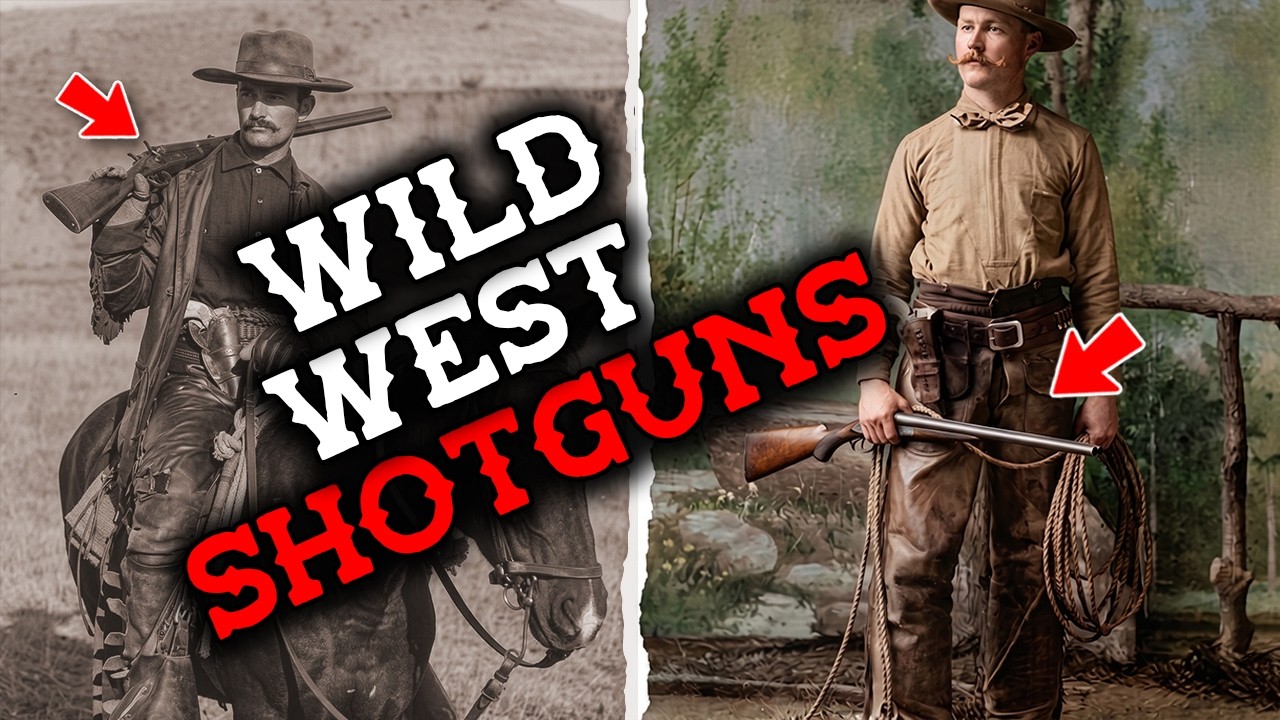
They filed this protest while actively using mustard gas. The shotgun won the American West, not the revolver, not the rifle. The weapon that could miss and still kill, be cut down, folded up, hidden under a coat, and fired faster than a man could think was what actually settled the frontier’s disputes. The men who carried these guns made their choices based on what they could afford, what they could get, and what they needed it to do.
From the $15 Belgian Meteor in Doc Holliday’s hands to the Model 1897 that terrified an empire, each one was a tool built for survival in a landscape that offered no second chances.
