In 1842, a woman died in her upstairs bedroom in a small Pennsylvania farmhouse. There were no sirens, no phone calls, no strangers arriving to take her body away. Her daughters climbed the narrow wooden staircase with a basin of warm water, homemade soap, and a clean linen sheet. They closed the door and washed their mother’s body with their own hands.
They combed her hair and dressed her in her finest Sunday clothes. They bound her jaw shut with a strip of cloth and placed pennies on her eyelids. Then they carried her downstairs and laid her out in the front parlor on a plank balanced between two chairs, where she remained for three days while neighbors came to pray and pay their respects. This was not unusual.
For roughly two and a half centuries, this was simply what Americans did with their dead. And then, within about fifty years, almost all of it vanished, replaced by a sterile, professionalized industry that today most Americans never think about until it becomes unavoidable. Death in colonial America was a constant companion. Infant mortality was catastrophic, with death rates for children under five reaching fifty percent in some communities during cholera outbreaks.
Women died in childbirth with grim regularity. Men died from infected cuts, pneumonia, and accidents. Entire families could be wiped out by yellow fever or typhus. Because death was so common, communities developed intricate rituals to handle it.
These rituals were not professional or commercial. They were communal. When someone died, word traveled through the neighborhood within hours. Specific groups of women, sometimes informally called the layers out of the dead, would appear at the family’s door almost immediately.
Unpaid and untrained in any formal sense, they came with cloths, basins, and whatever herbs or oils were traditional in that region. The body was undressed and washed thoroughly, often on the kitchen table. The eyes were closed, sometimes held shut with coins. The jaw was tied in place with a strip of fabric.
Limbs were straightened before rigor mortis set in. Hair was brushed and arranged. In some traditions with roots in Scottish and Irish Catholicism, a small plate holding salt and soil was placed on the chest. While the women prepared the body, the men had their own roles.
Someone was dispatched to find the local cabinet maker, who was almost always the same man who built the coffins. There was no such thing as a dedicated coffin manufacturer. The cabinet maker would measure the body and build a simple six-sided wooden coffin within a matter of hours. A famous surviving shop sign from colonial Williamsburg depicts a cradle, a clothes chest, and a coffin together.
Life and death came from the same hands and the same wood. The home itself was transformed. Mirrors were covered with black cloth, drawn from a mix of superstition and tradition so the soul would not become trapped in reflective glass. Clocks were stopped at the exact moment of death.
Window shades were drawn. A length of black crepe was tied to the front door knocker. If the deceased was a child, white ribbon was often used instead. The body was then laid out in the front parlor, the formal room of the house reserved for weddings and christenings.
During a death, it was given the nickname the death room. The viewing, often called the wake, lasted from one to three days. There was a deeply practical reason for this. Without embalming or refrigeration, bodies decomposed quickly, so the wake could not stretch indefinitely.
But families also genuinely feared burying someone who was not actually dead. The fear of being buried alive was one of the most pervasive anxieties of the eighteenth and nineteenth centuries. Even George Washington, on his deathbed in 1799, asked that his body not be placed in the vault for at least three days after his death. This was not vanity.
This was terror. That same fear spawned an entire cottage industry of safety coffins equipped with bells, breathing tubes, and spring-loaded lids. During the wake, someone was always awake in the room. Family members and neighbors took shifts sitting beside the open coffin through the night, reading from the Bible and telling stories about the deceased.
Food was central. Neighbors arrived with bread, pies, and roasted meats. The grieving family was not expected to cook. After the service, held in the home or church, the coffin was closed by the men of the community.
The procession to the graveyard was solemn, with the coffin carried on foot or placed on a cart drawn by black horses. At the gravesite, prayers were said, the coffin was lowered into the ground, and mourners took handfuls of dirt to scatter onto it. There was no funeral director in a dark suit. There was just the family, the neighbors, the preacher, and the hole in the ground.
For enslaved African Americans in the antebellum South, death care took a profoundly different form. Enslaved people were often denied even basic rituals of mourning, their dead buried hastily in unmarked plots. Yet within those brutal constraints, enslaved communities built spiritually rich death traditions drawn from Yoruba, Kongo, and other West African beliefs. Night burials were lit by torches, accompanied by singing and drumming.
Grave goods such as broken plates and personal items were placed on burial sites. These traditions would eventually give rise to the black funeral tradition, which in turn created one of the most important business sectors in black American history. And then, in April 1861, the first shots were fired at Fort Sumter, and everything began to change. The American Civil War was the single most transformative event in the entire history of American death care.
For four years, young men died hundreds of miles from the parlors where their bodies were supposed to be laid out, from the mothers who were supposed to wash them. The traditional American way of death simply could not function at that distance and at that volume. By the end of the war, an estimated 620,000 soldiers were dead. Families desperately wanted their sons returned, but by the time a body could be shipped from a Virginia battlefield to a farm in Vermont, it would have decomposed beyond recognition.
Into this crisis stepped a man named Thomas Holmes. Born around 1817 in Brooklyn, Holmes had trained as a coroner’s physician and become obsessed with preserving bodies. He developed a method of arterial embalming, draining blood and replacing it with a chemical preservation fluid. His fluid was a toxic cocktail of arsenic, zinc chloride, creosote, and turpentine.
It was deadly to the embalmer but extraordinarily effective at preserving bodies for weeks or months. In May 1861, Colonel Elmer Ellsworth, a close friend of President Abraham Lincoln, became one of the first prominent Union officers killed. Holmes offered to embalm his body at no cost. When Mrs.
Lincoln viewed the preserved body, she reportedly remarked that he looked natural, as though he were only sleeping. The body was displayed in the East Room of the White House, and the newspapers published her reaction. A new industry was born. Holmes sent trained embalming surgeons onto the battlefields, charging fifty dollars for an officer and twenty-five for an enlisted man.
As demand soared, he charged up to one hundred dollars per body. Across the entire war, roughly forty thousand soldiers were embalmed. It was still a small fraction, but it was enough to transform the industry forever. The final, decisive moment came on April 15, 1865.
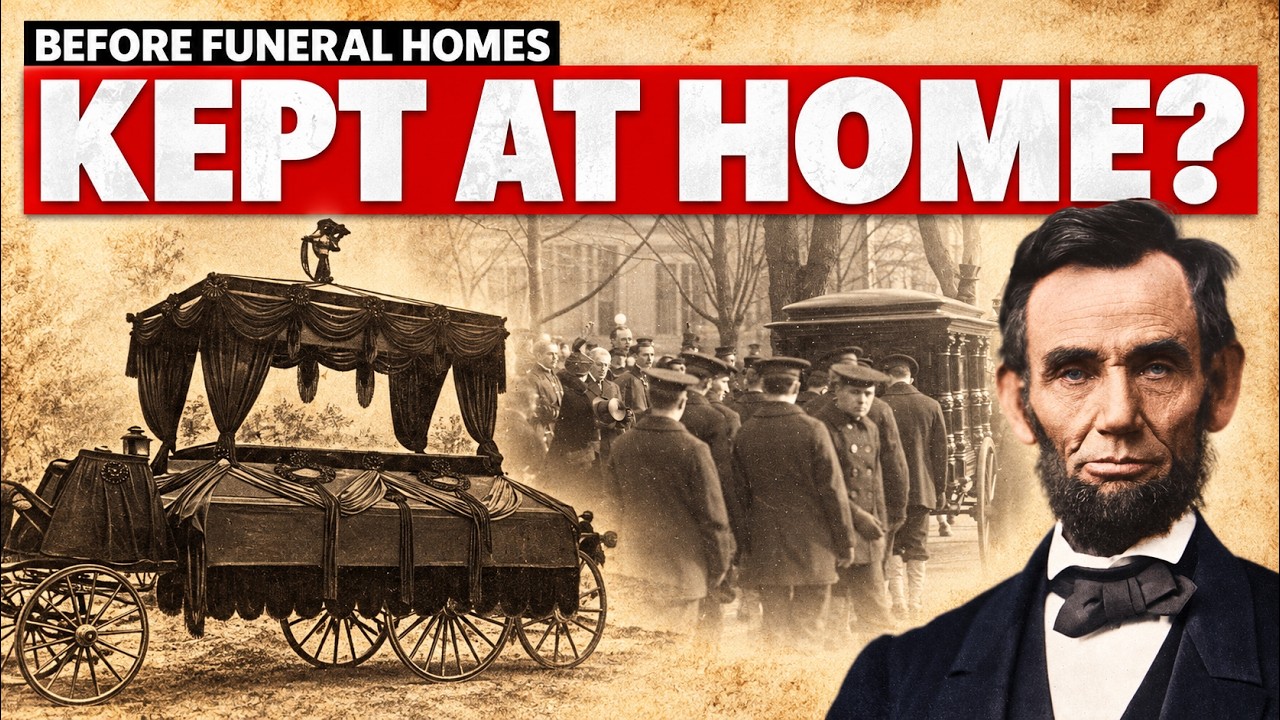
Abraham Lincoln was assassinated at Ford’s Theatre. Mary Todd Lincoln requested that her husband be embalmed. Lincoln’s body was placed on a funeral train that traveled roughly sixteen hundred miles over two weeks, stopping in major cities so mourners could view the body. In each city, the body was re-embalmed to maintain its lifelike appearance.
By the time Lincoln reached Springfield, Illinois for burial, millions of Americans had seen a preserved corpse in person for the first time in their lives. If the president of the United States could be preserved and displayed for a national tour of mourning, then embalming was no longer strange. It was dignified. It was presidential.
And soon enough, it was for sale on every Main Street in America. The embalming surgeons who had learned their trade on the battlefield went home and set up shop. Many combined their new skills with their existing businesses as cabinet makers, livery stable owners, or furniture dealers. Over the following decades, they gradually consolidated the entire process of death care into one professional service run out of their own homes, which came to be called funeral homes.
By 1920, there were approximately twenty-four thousand funeral homes operating across the United States. The old network of neighborhood women was quietly displaced. The handmade pine coffin was replaced by a factory-made casket shipped by rail. Even the architecture of American houses began to change.
In 1910, the Ladies’ Home Journal suggested that the parlor no longer be called the death room and instead be renamed the living room. In 1963, journalist Jessica Mitford published The American Way of Death, a scathing exposé of the funeral industry that documented how undertakers had transformed death from a sacred ritual into a commercial transaction. The book led to federal regulations, including the Federal Trade Commission’s Funeral Rule, which required funeral homes to provide itemized price lists. But the fundamental transformation remained.
Today, the American funeral and cemetery business generates an estimated twenty to twenty-five billion dollars annually. The average cost of a traditional funeral is around eight to ten thousand dollars. Embalming, which is medically unnecessary in the vast majority of cases and not legally required by any state except in specific circumstances, is still routinely performed and billed. Modern grief researchers argue that the industrialization of death has deprived Americans of important psychological tools for processing loss.
The hands-on care of a loved one’s body served as grief work, the physical processing of loss that helps the mind accept what has happened. There is a quiet countermovement underway. Every American state allows home funerals, requiring in most cases only a death certificate. A small but growing number of families have been reclaiming the practice, washing and laying out their own dead exactly as their great-great-grandparents did.
Green burial, which rejects embalming in favor of natural decomposition, has become one of the fastest-growing segments of the industry. The modern funeral home, which feels timeless and inevitable, is in fact a relatively new invention, built on the foundations of a battlefield innovation, popularized by the assassination of a president, and sustained ever since by an industry most of us never think about until we have no choice. The parlor became the living room. The daughter became the funeral director.
The three-day wake became the one-hour visitation. For most of American history, the silence of the deathbed was filled by the voices of family and neighbors. For the last hundred and sixty years, it has been filled by the sound of a telephone call to a professional.
