The rain in Harlem fell like an interrogation, a cold, relentless November downpour that washed the cheap perfume off the street walkers and drove the corner boys into the smoky sanctuaries of basement speakeasies. It was a Tuesday night in 1966, a night meant for drawing heavy velvet curtains, pouring a glass of neat bourbon, and listening to the mournful wail of a John Coltrane record spinning on the hi-fi inside the third-floor apartment of the Lenox Terrace. The world outside was nothing more than a rumor. The air smelled of expensive cigars, floor wax, and the subtle floral notes of Mamie Johnson’s French perfume.
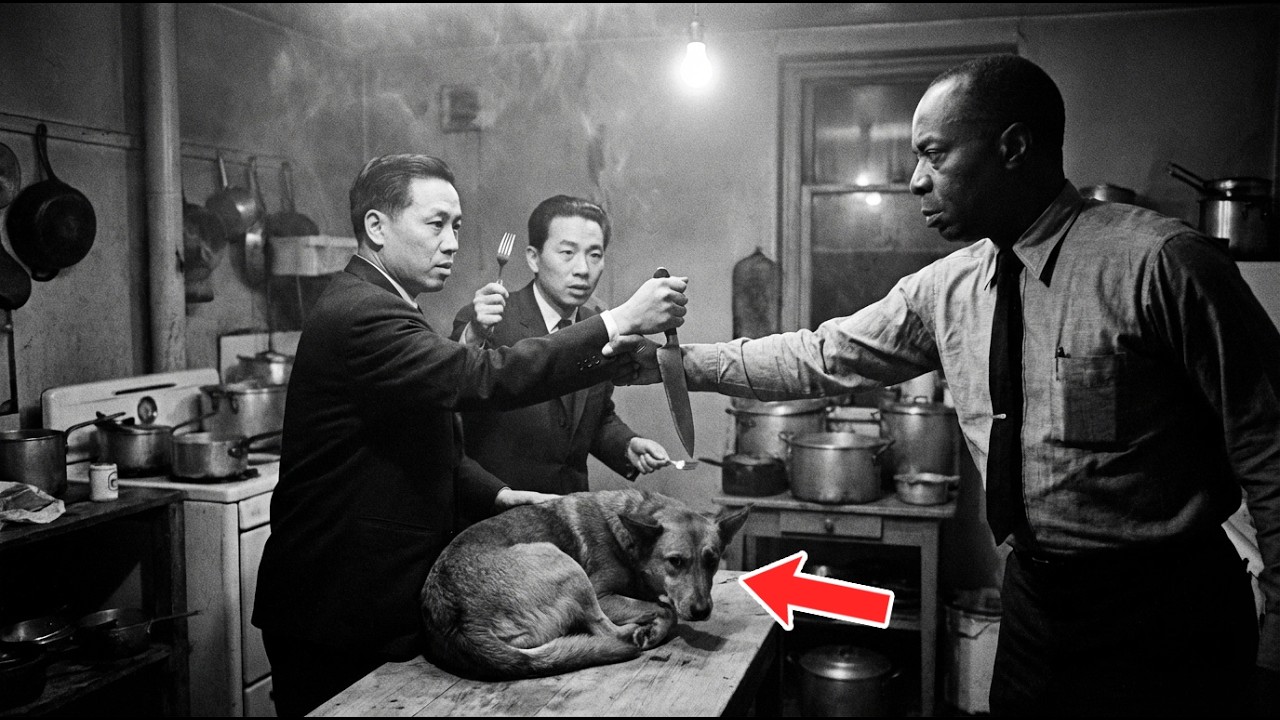
Ellsworth “Bumpy” Johnson sat in his custom-upholstered leather armchair, a newspaper resting on his lap. He was a man who carried the weight of an entire underworld on his shoulders, a man who had stared down Italian capos, crooked police commissioners, and the ghosts of Alcatraz. But in this room, in the quiet hours past midnight, the king of Harlem was at peace. And resting heavily across his polished Italian leather shoes was Duke.
Duke was not a purebred show dog. He was a massive 70-pound brindle boxer mix with a chest like a whiskey barrel and a face scarred from a rough youth on the streets before Bumpy had taken him in. To the neighborhood, Duke was a terrifying shadow, a muscle-bound gargoyle that walked silently at the Godfather’s side. But to Bumpy, Duke was something entirely different.
He was the one living creature in New York City that didn’t want money, didn’t ask for favors, and didn’t care about the numbers racket. Duke just wanted the quiet warmth of his master’s presence. Mamie walked into the living room tying the belt of her silk robe. She looked at the two of them, the most dangerous man in America and his fearsome hound, and a soft, affectionate smile touched her lips.
“He’s snoring again, Ellsworth,” Mamie said, her voice a smooth melody in the quiet room. Bumpy didn’t look up from the sports page. He just reached down with a hand that had broken jaws and stroked the dog’s broad head. “He’s earned it, Mamie.
A cat works hard keeping the ghosts out of this apartment. He’s allowed to make a little noise. ”
Duke let out a long, rumbling sigh, leaning harder into Bumpy’s leg. “Take him down to the courtyard before he decides to claim my Persian rug,” Mamie said, turning toward the kitchen to put the kettle on.
“And wear your heavy coat. The wind is coming right off the Hudson. ”
Bumpy folded his newspaper with deliberate precision. He set it on the side table, adjusting it so the edges aligned perfectly with the wood grain.
He was a man of absolute order. He stood up, and Duke was instantly on his feet, his clipped ears perked, his stubby tail vibrating with quiet excitement. Bumpy slipped into his heavy wool overcoat and grabbed the thick leather leash from the hook by the door. He didn’t carry a gun.
He was just taking his dog to the private, high-walled courtyard at the back of the building. It was a secure area locked behind heavy wrought-iron gates. It was his sanctuary. The elevator ride was silent.
When Bumpy pushed open the heavy lobby doors and stepped out into the biting wind, the cold slapped him across the face. The courtyard was bathed in the dim yellow glow of a single sodium streetlamp from the alleyway. The shadows were deep and long. Bumpy unclipped the leash, letting Duke wander toward his usual patch of grass near the brick wall.
Bumpy stood under the awning, lighting a cigarette, watching the smoke swirl and vanish into the rain. For three minutes, the night was perfectly still. Then the rhythm of the city shifted. It wasn’t a loud noise.
It was the subtle metallic scrape of a crowbar against iron. Bumpy’s eyes narrowed. He turned his head slowly toward the back gate of the courtyard, the one that led into the blind alley. “Duke.
” Bumpy called out, his voice low, steady, commanding. The dog didn’t return. Instead, a low, vicious growl rumbled from the shadows near the gate, followed instantly by the muffled sound of a heavy struggle. There was no barking.
Duke was a fighter. He didn’t waste breath on noise. Bumpy dropped his cigarette. He didn’t run.
Kings do not run. But his stride ate up the distance across the wet courtyard in seconds. He moved with a terrifying fluid speed, the instincts of a man who had survived a hundred ambushes taking over. As he reached the edge of the shadows, the heavy iron gate swung open with a violent screech.
Bumpy saw the silhouette of a long jade green Lincoln Continental idling in the alley, its headlights cut. Four men were wrestling a thrashing, furious Duke toward the open trunk. These weren’t street-corner hustlers. They were moving with coordinated, desperate energy.
One of them had a heavy canvas sack pulled over the dog’s head, while another had a thick catch pole looped around Duke’s neck, twisting it tight to choke off the dog’s air. “Hey,” Bumpy said. It was a single syllable spoken at conversational volume, but it cut through the sound of the rain and the struggle like a straight razor. The men froze.
One of them, a young man wearing a flashy, cheap silk bomber jacket with an embroidered dragon on the back, turned around. His face was slick with rain and adrenaline. He looked at Bumpy standing alone in the courtyard wearing an expensive coat, no weapon drawn. The young man didn’t see the Godfather of Harlem.
He just saw an old man in his way. “Mind your own business, old man,” the punk spat, his accent thick, marking him as part of the new Triad syndicate that had been aggressively pushing into the borderlands of Harlem. “The boss likes the dog. It’s his now.
”
Before Bumpy could take another step, the man with the catch pole gave a vicious, brutal yank. Duke let out a choked, sickening yelp and went limp, his air supply completely severed. They shoved the unconscious animal into the trunk and slammed it shut. The young punk sneered, flashing a mouthful of gold caps.
He reached into his jacket, pulling out a snub-nosed revolver, and pointed it at Bumpy’s chest. “Walk away, granddad, before I leave you in the mud. ”
Bumpy Johnson did not raise his hands. He did not flinch.
He stood perfectly still in the freezing rain, his eyes locking onto the young man’s face. Bumpy’s gaze was not angry. It was something far worse. It was a cold, calculating autopsy.
He was memorizing the shape of the boy’s jaw, the distance between his eyes, the cheap embroidery on his jacket. He was looking at a ghost. “You have no idea what you just did,” Bumpy whispered, the words barely carrying over the idling engine. The punk laughed, a nervous, jagged sound, then jumped into the passenger seat.
The Lincoln Continental’s tires squealed against the wet asphalt, leaving a cloud of blue exhaust as it tore down the alley and vanished into the New York night. Bumpy stood alone in the rain for a long time. He looked at the scuff marks on the concrete. He saw a small drop of blood where the catch pole had bitten into his dog’s neck.
He didn’t scream. He didn’t curse. The anger that blossomed inside Ellsworth Johnson was not a chaotic, fiery explosion. It was liquid nitrogen.
It froze his veins, slowed his heart, and sharpened his mind to a razor’s edge. When he walked back into the third-floor apartment, Mamie was in the kitchen, pouring hot water into a porcelain teacup. She heard the heavy rhythmic thud of his shoes and turned around. The smile died on her face the second she saw him.
He was soaked, but that wasn’t what frightened her. It was the absolute terrifying blankness in his eyes. It was the look he had when he came back from Alcatraz. It was the look of a man who had just closed the door on his humanity.
“Ellsworth? ” Mamie whispered, setting the kettle down slowly. “Where is Duke? ”
Bumpy walked over to the heavy oak cabinet in the corner of the living room.
He opened the bottom drawer, reaching past the stacks of ledgers and the velvet pouches of jewelry. He pulled out a heavy oiled cloth bundle. “Some foolish boys took him, Mamie,” Bumpy said, his voice flat, devoid of any inflection. He unwrapped the cloth, revealing a beautifully maintained snub-nosed .
38 Special. Mamie felt a chill run down her spine that had nothing to do with the drafty window. “Who? ”
“I don’t know their names yet,” Bumpy said, checking the cylinder of the revolver with a series of sharp mechanical clicks.
“But they are wearing silk dragons and they are driving a jade green Lincoln. ”
“Ellsworth, please,” Mamie said, taking a step toward him. “It’s a dog. Don’t start a war over a dog.
Send Junie to talk to their elders. Negotiate. ”
Bumpy stopped. He looked at his wife, the only person in the world he truly loved.
His face softened just for a fraction of a second, but the coldness remained in his eyes. “It’s not about the dog, Queen,” Bumpy said softly. “It’s about the lock on the gate. It’s about the territory.
They came to my home. They put a gun to my chest in my own courtyard. If I let them take the dog tonight, they will come for the numbers tomorrow. And the day after that, they will come for us.
”
He slipped the revolver into his heavy overcoat pocket. “They didn’t just steal a dog, Mamie. They insulted the crown. And in this jungle, you don’t negotiate with a mosquito.
You crush it. ”
Bumpy walked to the rotary phone on the side table. He dialed a number he knew by heart. It rang only twice.
“Yeah. ” A deep, gravelly voice answered. “Junie,” Bumpy said. “Get your coat.
Meet me downstairs in five minutes. Bring the heavy tools. We have an extermination job. ”
There was no hesitation on the other end of the line.
No questions asked. Junie Byrd was a man of the old code. “Solid. ”
“Five minutes.
”
When Bumpy walked out of the Lenox Terrace and into the driving rain, a black Cadillac Fleetwood was already idling at the curb. Junie Byrd was behind the wheel. Junie was a mountain of a man, wide-shouldered and silent, wearing a dark trench coat and a fedora pulled low over his eyes. He didn’t speak as Bumpy slid into the passenger seat.
He didn’t need to. The grim set of Bumpy’s jaw told him everything he needed to know. The peace was over. “Drive east, Junie,” Bumpy said, staring out the rain-streaked windshield toward the border.
The border was the invisible line that separated Harlem from the territories controlled by the new aggressive factions bleeding over from downtown. The Italians knew better than to cross it without permission. The Irish respected the boundaries. But the new Triad Syndicate, flush with heroin money and arrogant youth, had been testing the fences for months.
Bumpy had been patient. He had watched them open illegal gambling parlors just on the edge of his territory. He had let them play their little games. Patience, he realized now, had been interpreted as weakness.
The Cadillac prowled through the neon-lit streets like a predatory shark. The tires hissed on the wet pavement. “We are looking for a jade green Lincoln Continental,” Bumpy said, his voice a low hum against the sound of the engine. “And we are looking for boys wearing silk bomber jackets with dragons on the back.
”
Junie didn’t nod. He just turned the steering wheel, his massive hands gripping the leather tight enough to leave indentations. Their first stop was a dingy basement-level pool hall on 116th Street, a place where information flowed as freely as the cheap bootleg gin. Bumpy didn’t walk in through the front door.
He walked through the alley, kicking open the rusted metal fire door with a crash that silenced the entire room. The crack of billiard balls stopped. The jukebox, playing a mournful blues track, seemed to lower its volume. Twenty heads turned, eyes widening in sheer panic as Bumpy Johnson stepped out of the shadows flanked by the looming mass of Junie Byrd.
Bumpy didn’t draw a weapon. He didn’t shout. He simply walked to the nearest pool table, picked up the chalk, and slowly, deliberately chalked the end of a cue stick lying there. “A jade green Lincoln,” Bumpy said to the room, his voice calm and conversational.
“It was in my neighborhood ten minutes ago. Who knows the car? ”
Silence. The men in the room looked at the floor, looked at their shoes, looked anywhere but at the ice-cold eyes of the Godfather.
Bumpy sighed. It was a disappointed, weary sound. He nodded to Junie. Junie stepped forward.
He reached out with terrifying speed, grabbing a small, wiry hustler by the lapels of his suit. With one effortless motion, Junie lifted the man off his feet and slammed him down onto the green felt of the pool table, scattering the balls with a loud clatter. Junie placed one massive hand around the man’s throat, not squeezing, just resting the weight there, a promise of broken cartilage. “Cat,” Junie rumbled, his voice like grinding stones.
“Okay. Okay, man, be cool,” the hustler choked out, his eyes bulging. “The Lincoln? It belongs to Johnny Low’s crew.
They run the new pai gow parlor over on the edge of the district. That flashy kid, Jimmy the Blade Chen, he drives it. ”
Bumpy set the chalk down. “Johnny Low,” he murmured, tasting the arrogance in the name.
Low was a new upstart, a lieutenant in the syndicate who had been making noise about expanding into Harlem’s numbers racket. “Where is this parlor? ”
“An abandoned laundry front,” the hustler wheezed, “two streets over. Just past the border.
But Bumpy, man, they got guys in there. Heavy guys. You can’t just walk in. ”
Bumpy looked down at the terrified man on the felt.
He reached out and straightened the man’s crooked tie. “I can walk anywhere in this city I please,” Bumpy said softly. “Let him up, Junie. ”
They left the pool hall in silence.
The Cadillac crept two streets over, parking in the shadows across from a dilapidated storefront. The sign above the door read Golden Star Cleaners, but the windows were blacked out, and a pair of tough-looking young men in cheap suits stood near the alleyway smoking cigarettes and watching the street. “We doing this loud, Bumpy? ” Junie asked, his hand resting on the heavy crowbar sitting on the seat next to him.
“No,” Bumpy said, smoothing the lapels of his coat. “Loud is for fools who want to show off. We are going to have a polite conversation about respect. ”
Bumpy stepped out of the car and walked straight across the street, ignoring the rain.
He walked with absolute authority, the kind of presence that bends reality around it. The two guards in front of the laundry saw him coming. They dropped their cigarettes, reaching under their jackets. Before their fingers could even touch the grips of their guns, Junie Byrd was there.
He moved like a ghost despite his size. Junie grabbed the first guard by the back of the neck and drove his face into the brick wall with a sickening crunch. The man slumped instantly to the wet pavement. The second guard opened his mouth to shout, but Junie’s fist caught him flush in the solar plexus.
The air rushed out of the boy’s lungs in a violent hiss as he doubled over. Junie brought a knee up, shattering the boy’s nose, and let him drop into a heap. The entire exchange took less than four seconds. No guns drawn, no noise louder than the rain.
Bumpy hadn’t even broken his stride. He stepped over the unconscious bodies, reached out, and opened the heavy steel door of the laundry. The inside was a wall of thick, sweet-smelling cigarette smoke, the clatter of mahjong tiles, and the low murmur of men gambling away money they didn’t have. It was a large back room, dimly lit by hanging pendant lamps.
About thirty men were crowded around tables. At the far end of the room, sitting on a raised dais behind a desk covered in cash, was a man in his late thirties with slicked-back hair and a custom-tailored silk suit. The manager. When the heavy steel door clanged shut behind Bumpy and Junie, the room fell dead silent.
The clatter of the tiles stopped. The manager looked up, a scowl forming on his face. He didn’t recognize Bumpy Johnson. He was new to the city, insulated by his syndicate’s recent success, drunk on the illusion of his own power.
“We are closed for private business,” the manager barked in broken English, gesturing for his security. Four large men at the corners of the room stood up, pushing their jackets back to reveal shoulder holsters. Bumpy walked slowly down the center aisle between the gambling tables. He ignored the guards.
He ignored the gamblers who were shrinking back into the shadows. He walked straight to the manager’s desk, pulled out a chair, and sat down. He crossed his legs, brushing a speck of dust off his perfectly creased trousers. “I am private business,” Bumpy said, his voice smooth and cold.
The manager sneered, leaning forward, resting his hands on the stacks of cash. “You got a lot of nerve walking in here, old man. You know whose territory this is? ”
“It’s God’s territory,” Bumpy replied, unblinking.
“But I collect the rent. And tonight, your boys came to my house and stole something that belongs to me. ”
“A dog? ” The manager paused.
For a second, a flicker of recognition passed behind his eyes. He realized he wasn’t talking to a random street thug. He looked at the impeccably tailored suit, the absolute absence of fear, the mountain of a man standing silently behind the chair. “I don’t know nothing about a dog,” the manager lied, his voice losing a fraction of its arrogance.
“And I don’t know who you think you are, but you need to leave before I have my men carry you out in pieces. ”
Bumpy sighed. It was the same weary sound he had made in the pool hall. It was the sound of a teacher disappointed by a slow student.
“Junie,” Bumpy said softly. Junie didn’t draw a gun. He walked over to the nearest guard, a burly man reaching for his holster. Junie simply grabbed the man’s wrist with one hand and his elbow with the other.
He applied pressure. There was a loud, sharp pop, followed by a scream of absolute agony as the guard’s arm snapped backward at an unnatural angle. Junie dropped the screaming man to the floor and looked at the other three guards. They froze.
Their hands hovered over their weapons, terrified by the silent, brutal efficiency they had just witnessed. Bumpy didn’t even look at the screaming man on the floor. He kept his eyes locked on the manager. “Let me explain the mathematics of this situation to you, son,” Bumpy said, leaning forward slightly, resting his elbows on the desk right next to the stacks of cash.
“You have three men left standing. They are scared. They are slow. The man behind me is not scared and he is not slow.
If you don’t tell me where my dog is and where Johnny Low is, Junie is going to break every finger on your hands. Then he is going to break your jaw. And then I am going to take all this cash, set it on fire, and watch you try to put it out with your broken hands. ”
The manager swallowed hard.
Sweat was beading on his forehead, catching the dim light of the pendant lamps. He looked at the cash. He looked at the screaming guard. He looked into Bumpy’s eyes and saw a bottomless, terrifying void.
“Jimmy the Blade,” the manager stammered, the arrogance entirely evaporated. “He brought a dog here an hour ago. Big dog, brindle. Said it was a trophy.
Said he took it from some old head in Harlem to prove a point. ”
“Where is Jimmy now? ” Bumpy asked, his voice a whisper that commanded the entire room. “He left.
He took the dog to the boss, to Johnny Low. ”
“And where is Johnny Low? ” Bumpy’s voice was getting softer, which meant the danger was increasing. “The Golden Dragon,” the manager whispered, his hands trembling on the desk.
“It’s a dim sum house down in Chinatown. Mott Street. Johnny uses the back office for operations. They got a whole crew down there, man.
You go down there, you ain’t coming back. ”
Bumpy stood up slowly. He adjusted his coat, buttoning it against the chill he knew he would face outside. “Thank you for your hospitality,” Bumpy said.
He looked down at the stacks of cash on the desk. He didn’t take a single bill. He wasn’t a thief. He was a king collecting a debt of honor.
He turned and walked toward the exit, his footsteps echoing in the silent room. Junie followed, a silent shadow of impending violence. When they stepped back out into the freezing rain, the night felt different. The tension hadn’t broken.
It had coiled tighter. The Cadillac was waiting, a dark chariot in the downpour. “Mott Street,” Bumpy said as he got into the passenger seat. Junie put the car in drive.
“They’re going to be fortified, Bumpy. The Golden Dragon is a fortress. They got lookouts on the roof, heavy doors, and a kitchen full of butchers with cleavers. ”
Bumpy stared straight ahead, watching the rhythmic sweep of the windshield wipers pushing the heavy rain away.
He pictured Duke chained in a dark room, confused and waiting for his master. He pictured the arrogant smirk of the young punk in the courtyard. “They think they stole a dog, Junie,” Bumpy said, his voice dropping an octave, carrying the promise of absolute devastation. “They think they made a point.
Tonight, we are going to teach them the difference between an animal and a monster. We are going to walk into their fortress, and we are going to tear it down to the foundation. ”
The Cadillac turned south, leaving the borders of Harlem behind, plunging into the neon-drenched, rain-slicked labyrinth of downtown. The engine hummed a dark, steady rhythm, carrying the king of Harlem toward a reckoning that the underworld would whisper about for decades.
The neon lights of Chinatown began to bleed through the rain, glowing red and gold against the black pavement like blood spilled on wet coal. Bumpy reached into his coat pocket. He felt the cold steel of the . 38 Special.
He didn’t check the cylinder this time. He just rested his hand against it, feeling the weight of the coming storm. “Step on it, Junie,” Bumpy whispered into the darkness. “The dragon is waiting.
”
The tires of the Cadillac hissed against the slick, uneven pavement of Mott Street, slowing to a predatory crawl as the narrow canyons of Chinatown swallowed them whole. The rain had intensified, washing the neon glow of the street signs into a watercolor blur of crimson and gold. To a square, the neighborhood looked asleep, shuttered tight against the November storm. But Bumpy Johnson did not see the world like a square.
He saw the subtle flutter of a curtain in a third-story window. He noticed the lack of stray cats near the overflowing trash cans. He felt the heavy, unnatural silence that meant the street was being watched. “Pull into that loading zone past the herbalist shop,” Bumpy murmured, his eyes scanning the architecture of the block.
“Keep the engine running, but kill the headlights. We don’t want to announce the collection agency before we knock on the door. ”
Junie maneuvered the heavy Fleetwood into the shadows between a delivery truck and a brick wall with the silent precision of a phantom. The engine idled with a low, rhythmic purr that you could feel more than hear.
Bumpy reached into his coat and withdrew the . 38 Special. He didn’t check the cylinder. A professional knows his tools.
He simply held the cold steel in his lap, letting his body adjust to the weight, letting the chill of the metal center his mind. “The Golden Dragon,” Junie rumbled, staring through the rain-streaked windshield at the three-story building down the block. It was an imposing structure dressed in faux pagoda roofing, its front doors chained shut from the inside. “They got iron bars on the ground-floor windows.
A single point of entry through the back alley. And I see a shadow moving on the fire escape. Roof lookout. ”
“A fortress built by boys who have never seen a real war,” Bumpy said softly, slipping the revolver into his right overcoat pocket.
He kept his hand wrapped around the grip. “A lookout on the fire escape is only good if he’s looking at the street. He’s cold, he’s wet, and he thinks he’s untouchable. That makes him blind.
”
Bumpy opened his door. The freezing rain immediately began to soak the shoulders of his tailored coat, but he did not shiver. “You take the alley, Junie. Clear the back door.
But do it quiet. I want to walk into their living room before they even know the lock is broken. I will handle the bird on the wire. ”
“Solid,” Junie said, stepping out into the deluge.
The giant man melted into the darkness of the street instantly, a shadow detaching itself from the night. Bumpy did not cross the street directly. He moved with a terrifying fluid grace, sticking to the deep shadows cast by the awnings of the shuttered storefronts. He crossed at the corner, letting a passing delivery truck mask his movement until he was standing directly beneath the rusted iron lattice of the Golden Dragon’s fire escape.
He looked up through the freezing rain. Three stories up, a faint orange glow pulsed rhythmically: the cherry of a cigarette. The lookout was tucked under the overhang of the roof, trying to stay dry, looking down at Mott Street with bored, arrogant eyes. Bumpy did not climb the fire escape.
The iron would groan, and the vibrations would travel upward. Instead, he stepped into the narrow, pitch-black crevice between the restaurant and the neighboring tenement building. The gap was barely two feet wide, filled with the stench of stagnant water and rotting vegetables. Bumpy pressed his back against the wet brick of the tenement and braced his expensive Italian leather shoes against the brick of the restaurant.
Using absolute controlled tension, he began to scale the alley wall. It was a technique he had perfected decades ago, long before the tailored suits and the penthouses, back when survival meant moving through the city like a ghost. His muscles burned, but his breathing remained slow and measured. He ascended ten feet, twenty feet, bypassing the first and second floor windows.
When he reached the level of the third-floor fire escape landing, he stopped. He was suspended in the darkness, perfectly parallel to the metal grating. He could hear the lookout humming a discordant tune, the scrape of a match being struck. Bumpy reached out with his left hand and gripped the rusted iron rail of the fire escape.
He didn’t pull himself over abruptly. He flowed over the railing like water cresting a dam, his feet landing on the metal grating without a single metallic clatter. He rose to his full height behind the lookout. The boy was young, wearing a thick wool pea coat, leaning against the brick wall with a rifle resting casually over his shoulder.
He exhaled a long cloud of smoke into the rain. Bumpy didn’t draw his gun. He simply raised his left hand and tapped the boy gently on the shoulder. The lookout spun around, his eyes wide, his mouth opening to shout a warning.
He never drew a breath. Bumpy’s right hand shot forward, his thumb and forefinger clamping around the boy’s throat with the force of a steel vise, crushing the vocal cords instantly. The shout died as a sickening wet rasp. With his left hand, Bumpy snatched the heavy rifle from the boy’s grasp before it could clatter to the metal floor.
He pulled the terrified, choking boy close, bringing their faces inches apart. The boy’s eyes were rolling in absolute panic, staring into the emotionless, obsidian depths of the Godfather’s gaze. “You should have stayed out of the rain, son,” Bumpy whispered. He pivoted flawlessly, using the boy’s own momentum to drive his head into the solid brick wall.
The impact was a dull, heavy thud. The boy went completely limp, his eyes rolling back in his head. Bumpy caught him before he hit the grating, lowering him silently to the cold iron floor. He took the boy’s cigarette, which had fallen to the grate, crushed it beneath his heel, and dropped the rifle into the darkness of the alley below.
Bumpy walked to the third-floor fire door. It was heavy steel, but Bumpy knew the arrogance of new money. They locked the front to keep the cops out, but they left the back open for their own convenience. He turned the brass handle.
It clicked softly. He was inside. The third floor was a storage area. Heavy sacks of rice, crates of porcelain teacups, and towers of folded linen napkins lined the dimly lit corridor.
The air was thick with the scent of dried ginger and dust. Bumpy moved silently down the hallway, descending the narrow, carpeted stairs to the second floor. The second floor was the administrative level. He passed closed wooden doors, hearing the faint hum of a radio from one, the clacking of an abacus from another.
The syndicate’s bookkeepers were working late. Bumpy ignored them. He wasn’t there for the money. He was there for the soul of the organization.
He reached the top of the grand staircase that led down to the main dining room on the ground floor. Here, the atmosphere changed entirely. The smell of stale tobacco, spilled beer, and cheap cologne drifted up the carpeted steps. He heard the raucous laughter of a dozen men, the clinking of glasses, the bravado of a gang celebrating a victory they had not earned.
Bumpy stood in the shadows at the top of the stairs, looking down at the reflection in a large gilded mirror positioned on the landing. The main dining room was a cavernous space decorated with opulent red velvet curtains and heavy mahogany tables. In the center of the room, twenty men were gathered around two tables pushed together. They were drinking imported whiskey, smoking cigars, and laughing loudly.
Sitting at the head of the table, wearing the same flashy silk bomber jacket with the embroidered dragon, was Jimmy the Blade Chen. He was holding court, regaling the table with a highly exaggerated story, using his hands to mimic a struggle. “…and the old man just stood there, froze like a statue. ” Jimmy laughed, taking a deep drag of his cigar.
“Thought he was a statue. I took his mutt right out from under his nose. He didn’t do a thing. Just watched me drive away.
This is the big bad Godfather of Harlem. Man is a fossil. ”
The table erupted in sycophantic laughter. Bumpy did not react.
He felt the cold steel of the . 38 in his pocket. He took one step down the grand staircase. At that exact moment, the heavy steel door at the back of the dining room, the door leading to the alleyway, exploded inward with the force of a derailed freight train.
The steel frame ripped free from the brick, screeching like a tortured animal, and crashed onto the polished wooden floor. The laughter at the table died instantly. Twenty heads snapped toward the back of the room. The cigar fell from Jimmy Chen’s mouth, burning a hole in his silk trousers.
Standing in the ruined doorway, silhouetted by the yellow light of the alleyway, was Junie Byrd. He was soaked with rain, his trench coat plastered to his massive frame. He didn’t have a gun in his hands. He was holding a three-foot length of solid iron plumbing pipe, the metal slick with rain and something darker.
“Evening, cats,” Junie rumbled, his voice echoing through the stunned silence of the dining room. For two entire seconds, the room was paralyzed. The Triad soldiers couldn’t comprehend how a man that size had bypassed their reinforced door, let alone the three armed guards stationed in the alley. Then, the panic broke.
“Kill him! ” Jimmy Chen screamed, scrambling backward over his chair, clawing at his shoulder holster. Half a dozen men leaped up, their hands diving for their weapons. From the shadows at the top of the grand staircase, Bumpy Johnson spoke.
He didn’t shout. He projected his voice, smooth and resonant, cutting through the chaos like a silver blade. “Nobody moves. ”
The men froze, their hands hovering over their guns, their eyes darting frantically up to the landing.
Bumpy walked slowly down the remaining stairs, stepping into the dim light of the dining room chandeliers. He moved with the casual elegance of a man strolling through a park on a Sunday afternoon. He didn’t draw his weapon. He kept his hands in his coat pockets.
He walked directly toward the long table, the sea of terrified thugs parting before him. They looked at the tailored suit, the unblinking eyes, the absolute absence of fear. They looked at the mountain of a man guarding the back door. They realized, with a sudden suffocating horror, that they were entirely trapped.
Bumpy stopped at the head of the table, looking down at Jimmy Chen, who was currently tangled in his fallen chair, staring up with wide, trembling eyes. “You have a very loud voice for a boy who steals dogs in the dark,” Bumpy said softly. Jimmy swallowed hard, his bravado entirely vanished. “You… you’re crazy, old man.
You walked into a graveyard. There’s twenty of us. ”
“There are twenty bodies,” Bumpy corrected him, his tone academic. “But there are no men in this room.
”
One of the thugs to Bumpy’s left, a heavily scarred enforcer with a shaved head, decided to test the mathematics. He let out a primal yell and lunged at Bumpy, pulling a heavy combat knife from his belt. Bumpy didn’t even look at him. The crack of the .
38 Special was deafening in the enclosed space. Bumpy fired from inside his overcoat pocket. The heavy bullet tore through the expensive wool and struck the charging enforcer squarely in the right kneecap. The man’s leg shattered instantly.
He didn’t just fall. His momentum carried him forward as his leg collapsed beneath him, sending him crashing face-first into the mahogany table, sending glasses and whiskey bottles shattering across the floor. He rolled onto the ground, screaming in absolute, unadulterated agony, clutching the ruined stump of his knee. The room recoiled in terror.
The smell of burnt wool and cordite mixed with the spilled whiskey. Bumpy slowly pulled his hand from his pocket, revealing the smoking revolver. He didn’t point it at anyone. He just let it rest casually at his side.
“The next man who moves without my permission will lose his lungs,” Bumpy stated, the ice in his voice freezing the marrow in their bones. He looked back down at Jimmy Chen. “Where is Johnny Low, and where is my dog? ”
“The kitchen,” Jimmy squealed, pointing a trembling finger toward a set of heavy brass-studded swinging doors at the far end of the room.
“Johnny is in the prep station. He took the dog back there. He said… he said he was going to make an example out of it. ”
A profound, absolute stillness descended upon Ellsworth Johnson.
The air around him seemed to drop ten degrees. The calculated calm remained, but the terrifying void in his eyes grew deeper. “Junie,” Bumpy said, not turning his head. “Yeah, boss.
”
“If anyone at this table attempts to stand up before we leave, break their arms. Both of them. ”
“Solid. ”
Bumpy turned and walked toward the heavy kitchen doors.
He didn’t hurry. He walked with the heavy, rhythmic tread of an executioner ascending the gallows. He reached out and pushed the brass-studded doors open. The kitchen of the Golden Dragon was a massive industrial cavern.
It was a sensory assault. The air was thick with rolling clouds of white steam rising from massive steel boiling vats. Rows of plucked ducks hung from chains attached to the ceiling, their skin glazed and shining under the harsh fluorescent lights. The smell was an overwhelming combination of raw meat, boiling fat, garlic, and bleach.
Through the haze of the steam, Bumpy saw them. Six men. These weren’t the flashy silk-wearing street punks from the dining room. These were the ghosts of Kowloon.
They wore heavy blood-stained rubber aprons over white t-shirts. Their forearms were thick with muscle, covered in faded prison tattoos. In their hands, they held heavy rectangular meat cleavers, the blades honed to a razor’s edge. At the far end of the kitchen, elevated on a raised tile platform, stood the industrial prep station.
Behind a massive steel butcher’s block stood Johnny Low. He was an older man, his face pockmarked and hardened, wearing a tailored suit protected by a pristine white apron. And chained to the heavy iron leg of the prep table, surrounded by puddles of bloody water, was Duke. The dog was conscious but breathing heavily.
The heavy chain was wrapped tight around his thick neck, biting into the flesh. He looked up, his scarred face turning toward the swinging doors. When Duke saw Bumpy standing in the steam, he didn’t whine. He let out a low, vibrating rumble in his chest, pulling against the chain, his stubby tail attempting to wag.
Bumpy looked at the dog. He saw the bruises. He saw the fear that the brave animal was trying to hide. He looked up at Johnny Low.
“You have made a catastrophic miscalculation,” Bumpy said, his voice echoing off the ceramic tiles. Johnny Low laughed, a dry, rasping sound. “I think you are the one who is bad at math, Mr. Johnson.
You are a relic. This city belongs to the young. It belongs to the hungry. We take what we want.
We took your territory. We took your pride. And now we will take your life. ”
Johnny Low raised his hand and snapped his fingers.
The six butchers moved. They didn’t yell. They moved with terrifying silent synchronization, fanning out into a half circle, their heavy rubber boots slapping wetly against the floor tiles. They raised their cleavers, advancing through the rolling steam.
Bumpy did not retreat. He raised the . 38 Special. He didn’t fire wildly.
He fired with surgical, terrifying precision. The first butcher lunged, swinging the heavy cleaver in a downward arc meant to split Bumpy’s skull. Bumpy stepped smoothly to the left, letting the blade whistle past his ear, and fired a single round directly into the man’s right shoulder socket. The joint exploded.
The butcher dropped the cleaver, spinning violently to the floor. The second and third men attacked simultaneously from opposite sides. Bumpy dropped to one knee, a move that defied his age, sliding across the wet, greasy floor. He fired upward, putting a bullet through the thigh of the man on his left, sending him crashing into a rack of hanging ducks.
Without pausing, Bumpy rolled, coming up against the side of a massive stainless-steel boiling vat. The third butcher brought his cleaver down hard on the edge of the vat, mere inches from Bumpy’s hand, the steel ringing like a church bell. Bumpy grabbed the thick iron handle of the vat’s release valve. He didn’t shoot the man.
He yanked the lever down. A pressurized jet of boiling water and scalding steam erupted directly into the butcher’s chest and face. The man let out a horrifying, high-pitched scream, dropping his weapon and clawing at his ruined skin, falling backward into a pile of empty bamboo steamer baskets. Three down.
Three to go. The remaining butchers hesitated, their eyes wide with disbelief. They had expected an old man in a suit. They had encountered a demon wrapped in expensive wool.
Bumpy stood up slowly. The steam swirled around his silhouette. He ejected the spent casings from the cylinder with a sharp flick of his wrist. They clattered against the tiles.
He reached into his left pocket, pulled out three fresh rounds, and reloaded the chamber with mechanical speed, never taking his eyes off the men. He snapped the cylinder shut. “Leave,” Bumpy commanded. It wasn’t a threat.
It was an absolute fact. The three butchers looked at the carnage on the floor. They looked at the calm, terrifying stillness of the man standing before them. They dropped their cleavers.
The heavy blades clanged against the floor. They turned and sprinted for the service doors at the back of the kitchen, disappearing into the alleyway. Bumpy did not shoot them in the back. Kings do not execute peasants when the lord of the manor is standing in the room.
Bumpy turned his attention back to the raised prep station. Johnny Low was no longer laughing. His face had gone the color of spoiled milk. He stood behind the massive steel butcher’s block, holding a heavy bone-crushing meat mallet.
His hands were trembling. The arrogance had been entirely burned away, leaving only the naked terror of a man who realized he had summoned a storm he could not survive. Bumpy walked slowly across the kitchen floor, his shoes crunching on broken porcelain and spent brass. He stepped up onto the raised tile platform.
Johnny Low swung the heavy mallet in a desperate, panicked arc. Bumpy simply leaned back, letting the heavy wood pass harmlessly in front of his chest. Before Low could recover his balance, Bumpy’s left hand shot out, grabbing the man by the throat of his tailored shirt and pulling him violently forward. Bumpy drove the heavy steel barrel of the .
38 Special directly into the center of Johnny Low’s forehead, pressing it so hard the front sight bit into the flesh. “Drop it,” Bumpy whispered. The mallet slipped from Low’s fingers, thudding heavily against the wooden block. “Please,” Low wheezed, his eyes crossed, staring down the barrel of the gun.
“Take the dog. Take the territory. Just… just let me walk. ”
Bumpy stared into the man’s eyes.
He didn’t see a rival boss. He saw a rat caught in a trap of its own making. “You don’t understand the rules of this city, Johnny,” Bumpy said, his voice dropping to a terrifying, resonant bass. “You think this is about money.
You think this is about turf. It is about respect. When you bring a gun to my home, when you put a chain around the neck of my family, you do not get to walk away. You lose the privilege of breathing my air.
”
Bumpy didn’t pull the trigger. He didn’t need to put a bullet in the man’s brain. That was too quick. That was too clean.
He shifted his grip on the revolver and brought the heavy, steel-reinforced butt of the gun down across Johnny Low’s temple in a vicious, lightning-fast arc. The crack of bone was loud over the hiss of the steam. Low’s eyes rolled back in his head, and he collapsed instantly, a dead weight slumping onto the heavy steel butcher’s block. Bumpy exhaled a long, slow breath.
The violence was over. The storm had passed. He walked around the prep station to where Duke was chained. He knelt on the wet, bloody tiles, indifferent to the mess staining his trousers.
He reached out and gently laid his hand on the dog’s broad head. Duke leaned into the touch, whining softly, licking the blood from Bumpy’s knuckles. Bumpy inspected the heavy padlock holding the chain. He didn’t search Low’s pockets for the key.
He aimed the . 38 at the locking mechanism and fired a heavy, point-blank round. The heavy padlock shattered, the shackle springing open. Bumpy unwound the heavy chain from Duke’s neck, tossing it aside with disgust.
“Come here, old man,” Bumpy whispered, pulling the heavy dog into his chest, burying his face in the coarse brindle fur. For ten seconds in the middle of a slaughterhouse, the king of Harlem allowed himself to feel the warmth of his only innocent friend. Then Bumpy stood up. The warmth vanished.
The cold calculation returned. He looked at the unconscious body of Johnny Low draped over the butcher’s block. He looked at the massive industrial meat grinder bolted to the edge of the table. The machine was the size of an engine block, built of heavy cast iron, featuring a gaping steel hopper and a brutal auger-driven crushing mechanism designed to pulverize bone and sinew.
A dark, poetic thought formed in the absolute stillness of Bumpy’s mind. They wanted to treat his family like animals. They wanted to reduce the king of Harlem to a piece of meat on a butcher’s block. It was time to show them what happens when you turn the machine on.
Bumpy walked over to the heavy electrical panel on the wall. He found the switch labeled for the prep station. He threw it. The industrial meat grinder roared to life with a deafening mechanical groan.
The heavy iron auger began to spin inside the casing, a relentless, grinding spiral of absolute destruction. Bumpy did not flinch at the sound. He walked back to the butcher’s block. He grabbed Johnny Low by the collar of his expensive suit and dragged his limp, heavy body toward the gaping steel hopper of the machine.
He didn’t need to kill the man with his hands. The underworld required a message. It required a legend that would freeze the blood of any man who ever thought of crossing the border into Harlem again. Bumpy lifted Johnny Low’s upper body.
The man groaned, his eyelids fluttering, fighting his way back to consciousness just as his head and shoulders were forced over the lip of the heavy steel hopper. Low’s eyes snapped open. He looked down into the grinding, spinning iron maw of the machine. He felt the terrifying, irresistible pull of the auger catching the lapels of his suit.
“No! ” Low screamed, a sound of pure, unadulterated, primal terror. “No! Please, God, no!
”
Bumpy placed his large, heavy hand flat against the back of Johnny Low’s head. He didn’t push. He just held the man there, forcing him to look down into the mechanical abyss, forcing him to feel the machinery beginning to bite into the fabric of his clothes. “You wanted to make an example, Johnny,” Bumpy whispered, his voice cutting through the roar of the grinder and the screams of the man.
“You wanted to show the city how you handle meat. Let’s make some dim sum. ”
The heavy oak doors of the kitchen swung inward, revealing Junie Byrd. The giant man walked through the steam, his pipe dripping onto the tiles.
He stopped, taking in the scene. He saw the unconscious butchers. He saw the ruined meat vat. He saw Bumpy Johnson holding the screaming syndicate boss over the roaring mouth of the industrial grinder.
Junie didn’t ask questions. He walked over, grabbed a massive, heavy wooden stomper used for pressing meat into the hopper, and stood beside Bumpy. “The boys in the dining room are sleeping,” Junie rumbled. “Tied them to their chairs with the tablecloths.
”
“Good,” Bumpy said, his eyes never leaving the terrified face of Johnny Low. “They are going to wake up very hungry. ”
The screaming in the kitchen eventually stopped, replaced entirely by the heavy, wet grinding sound of the industrial machine doing exactly what it was designed to do. An hour later, the rain was beginning to let up over Mott Street.
The neon signs reflected in the deep puddles. A peaceful, quiet morning was approaching the city. Inside the dining room of the Golden Dragon, Jimmy the Blade Chen slowly regained consciousness. His head pounded with a vicious ache.
He tried to rub his eyes, but his hands were bound tightly behind his back, lashed to the heavy mahogany chair with thick linen napkins. He blinked, the harsh light of the dining room chandeliers stinging his eyes. He looked around. The other nineteen men of his crew were in the exact same position, slumped over the long table, groaning and fighting their bonds.
Jimmy looked toward the head of the table. Sitting there, perfectly still, was Bumpy Johnson. He had removed his wet overcoat. He was wearing a pristine white apron over his tailored suit.
There was not a single drop of blood on the apron, though the cuffs of his trousers remained ruined from the kitchen floor. Sitting faithfully at his side, chewing happily on a massive roasted duck leg, was Duke. Jimmy’s eyes widened in terror. He tried to speak, but his mouth was completely dry.
In the center of the long table, arranged with exquisite, terrifying precision, were twenty large, steaming bamboo baskets Bumpy had commandeered from the kitchen’s prep racks. The steam rising from the baskets smelled of ginger, soy sauce, and fresh dough. Bumpy reached out, lifted the lid off the basket nearest to him, and picked up a pair of polished wooden chopsticks. He reached inside the basket and pulled out a single, perfectly pleated, delicate dim sum dumpling.
It was plump, steaming, filled to the bursting point. Bumpy held the dumpling in the air, examining the craftsmanship. “Cooking is an art, Jimmy,” Bumpy said, his voice calm, conversational, echoing in the silent, terrified room. “It requires patience.
It requires the right ingredients. It requires an understanding of how things break down when you apply heat and pressure. ”
He placed the single dumpling gently on the empty porcelain plate directly in front of Jimmy Chen’s face. Jimmy stared at the dumpling.
He looked at the meat grinder in the kitchen through the open doors. The machine was off, but the hopper was entirely empty. He looked at the white apron Bumpy was wearing. A sickening, horrifying realization slammed into Jimmy’s mind.
His stomach heaved violently. He tried to scream, but only a strangled, pathetic sob escaped his throat. “Your boss was very generous,” Bumpy said, setting the chopsticks down on the table. “He provided the main course for tonight’s banquet.
I highly recommend the mystery meat. It’s very fresh. ”
Bumpy stood up. He untied the pristine white apron and laid it neatly over the back of his chair.
He picked up his damp overcoat and slipped it on, adjusting the collar with meticulous care. He picked up the heavy leather leash from the table and clipped it to Duke’s collar. “Eat up, boys,” Bumpy said to the room of paralyzed, weeping men. “It’s a long walk back to Kowloon on an empty stomach.
”
He turned and walked toward the grand staircase. Duke trotted faithfully by his side, his stubby tail wagging, leaving bloody paw prints on the expensive carpet. Junie Byrd was waiting by the front doors, the heavy iron chains already removed. Bumpy and Junie pushed the heavy doors open and stepped out into the cool pre-dawn air of New York City.
The rain had stopped. The city was quiet. The king of Harlem lit a cigarette, the flare of the match illuminating his unreadable face for a fraction of a second. He dropped the match into a puddle, took a deep drag, and began the long walk back to his Cadillac, his shadow stretching long and dark across the wet pavement.
A legend written in silence and steam.






