In October 1968, the most famous opera singer in the world learned about it from the newspapers. The man she had lived beside for nine years was going to marry Jacqueline Kennedy. He had never told her. No call, not even a letter.
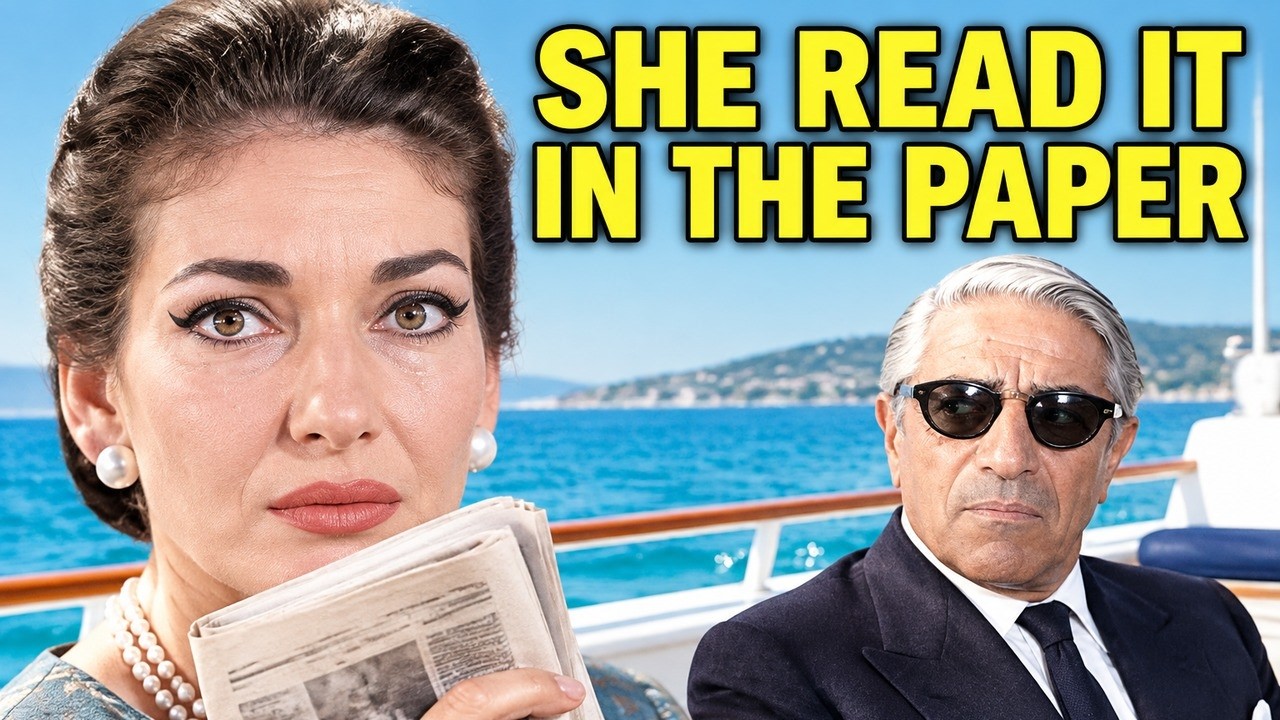
She read the news like everyone else. After nine years at his side, she wrote: “He was obliged, at the very least, not to let me find out about it through the newspapers. ” On the night of the wedding, she put on her best dresses, went out in Paris, and smiled at the cameras as if nothing had happened. Within weeks, the new husband was calling her again.
His name was Aristotle Onassis. And hers was Maria Callas. For the rest of his life, the richest Greek in the world kept returning to the woman he had cast aside. He took her to dinner where the photographers could see them.
His wife flew to Paris to sit in the same restaurant. And when he lay dying in a Paris hospital, the blanket covering him was not a gift from his wife. It was a gift from Maria. So why did a man who had just married the most beloved woman in America go back to the woman he had left?
And why did she let him in? The story began on a yacht nine summers earlier, with Winston Churchill on board. In the summer of 1959, the yacht Christina—325 feet long, named after Onassis’s daughter—sailed from Monte Carlo toward the Greek islands. The guest list was extraordinary.
Sir Winston Churchill and his wife Clementine, Onassis’s wife Tina, and Maria Callas with her husband and business manager, Giovanni Battista Meneghini. She was thirty-five. He was sixty-four. Callas and Onassis had met two years before, at a party in Venice.
He later explained the attraction in a single sentence: “It was just natural curiosity. After all, we were the two most famous Greeks alive in the world. ” She was the greatest opera singer on earth, and the most controversial. He was a former night telephone operator from Buenos Aires who now owned one of the largest oil tanker fleets in the world.
The year before, she had walked off the stage in Rome after the first act of Norma, with the President of Italy in the audience. The Metropolitan Opera in New York had fired her. The papers called her “the lioness. ” Onassis had a legend of his own.
As a teenager, he survived the burning of Smyrna in 1922. He arrived in Argentina with almost nothing and built a fortune from ships, oil, and nerve. Two Greeks who had fought their way to the top. Two people nobody could tell what to do.
On that cruise, everything collapsed in public. Meneghini later described it in a single sentence: one night, his wife came back from a party at the Istanbul Hilton and said she loved another man. Tina Onassis left the yacht in Venice and took the children to Paris. Within weeks, the newspapers had the whole story.
Meneghini did not leave quietly. He told reporters, “I made Callas, and she repaid me with a stab in the back. ” Callas said only this: “I am now responsible for myself. And for Onassis.
My relationship with him concerns business matters. ” Nobody believed her. Onassis, for once, sounded almost modest. “Sailors are not usually attracted to sopranos,” he said.
“I would really be flattered if a woman of her class fell in love with me. ” By November 1959, Maria Callas had left her husband, and Tina Onassis divorced Aristotle the following June. They were both free. He did not propose.
For the first time in her adult life, Maria Callas stopped working. She followed him from the yacht to Paris, then to the island of Skorpios. She insisted on paying her own way. She even bought her own tickets on Olympic Airways, the airline he owned.
In 1963, the director Franco Zeffirelli asked her why she had stopped training. She said, “I have been trying to fulfill my life as a woman. ” What she wanted was simple. She wanted to be his wife.
It was not the first time she had reshaped her life for someone. Her mother had always preferred her older sister, thin and beautiful. As a young singer, Maria was heavyset and severely nearsighted. In the early 1950s, she lost so much weight that audiences barely recognized her.
She had transformed herself into Callas. Now, for him, she was transforming herself back into Maria. Some biographers, including Nicholas Gage, say she gave birth to his son in March 1960, and the child lived only a few hours. Others say it never happened.
Her husband wrote that she was unable to have children. It has never been settled. What is clear is that the stage began to slip away from her. Her voice was already having problems, and now she rarely used it.
In 1964, according to her biographers, they finally set a wedding date. Then they quarreled, and the date was lost. On July 5, 1965, she sang Tosca at the Royal Opera House in London. It was the last time she ever sang opera on stage.
In 1966, she gave up her American passport. Under Greek law, that ended her marriage to Meneghini. Nothing stood between them now. Still, he did not ask her to marry him.
Onassis had begun looking at another kind of fame. In 1963, his name was linked with Lee Radziwill, the younger sister of the First Lady. In November of that year, after Dallas, the First Lady herself became the most famous widow in the world. In June 1968, Callas and Onassis had a final violent quarrel.
Four months later, on October 20, in the rain on the island of Skorpios, he married Jacqueline Kennedy. Days later, Callas wrote to her old singing teacher, Elvira de Hidalgo. The worst of it was that he told me nothing about the marriage. After spending nine years at his side, she wrote, I think he was obliged to, or at least not to let me learn about it from the newspapers.
Then came the anger. It is cruel, she wrote. They must both pay, and they will. You will see.
She said she would erase him from her memory. But on the night of the wedding, she did not hide. She went out in Paris, to the theater, then to Maxim’s, the restaurant where she used to sit with him. She kept smiling all evening.
The next morning, the photos ran side by side: Jackie and Onassis on a rainy Greek island, and Maria in Paris, laughing. She was not going to give anyone that satisfaction. The following year, Maria Callas went to Turkey and Syria to make her only film, with the Italian director Pier Paolo Pasolini. It was Medea, the ancient Greek story of a woman who gives up everything for a man—her home, her family, her country—and is then abandoned by him so he can marry a princess.
She did not sing a single note in it. Audiences could not stop thinking about the timing. A Greek woman abandoned by her man for a more powerful bride, staring into the camera. She never said publicly that it was about him.
She did not have to. Only weeks after the marriage, Onassis began calling her. In a later letter, Callas told her teacher that he called three times. She refused one call.
The other two, she wrote, were disastrous. But she did not cut the connection. Kiki, the private secretary of the Onassis family, later said plainly: “Even during his marriage to Jackie, he met Maria often in Paris, where they resumed what was now a secret affair. ” According to the writer Christopher Anderson, Onassis would leave his new wife on Skorpios for weeks while he moved between Athens and Paris.
In Paris, he sent Maria flowers and called her again and again. Meanwhile, his wife’s bills kept coming. Anderson writes that Jackie once spent about $60,000 of his money on two hundred pairs of shoes. His driver, Jacinto Rosa, saw it all from the front seat.
The truth, he said, is that Maria Callas was the only true love of Aristotle Onassis. Then why marry Jackie? Remember what he said about Callas: we were the two most famous Greeks alive. He collected fame the way he collected ships.
And there was no bigger name on earth than Jacqueline Kennedy. He married the name. Then he went back to the woman. The name had a price.
Before the wedding, reports said Onassis agreed with Ted Kennedy to pay $3 million to Jackie, plus a million dollars for each of her two children. For Maria, he signed nothing at all. On May 21, 1970, Onassis took Maria Callas to dinner at a restaurant in Paris. According to Anderson, he did nothing to hide it.
On the contrary, he made sure the photographers got their shot. The next morning, the story was everywhere. Jackie called her husband. Within twenty-four hours, she herself was in Paris, dining with him at the same restaurant in front of the same photographers.
Two women, one table, two nights apart. Days later, Maria Callas was taken to a hospital in Paris. She had swallowed too many sleeping pills. What happened that night is still disputed.
Anderson describes it as a suicide attempt. Those close to her always said it was an accident. She had accidentally overdosed before, on a sedative which, according to one account, Onassis himself had introduced her to. She survived, and it was not long before he was back in her life again.
Anderson writes that around that time Onasus asked his lawyers about divorcing Jackie and offered her more money than their contract required. A book published after his death claimed he was planning exactly that when he died. But he never filed for divorce. In January 1973, Alexander, Onassis’s only son, died after a plane crash.
He was twenty-four. Something inside the father broke. He was already suffering from a muscle disease called myasthenia gravis. Now he aged ten years in one year.
In February 1975, he had gallbladder surgery in Paris. He never fully recovered. For five weeks, he lay connected to a respirator at the American Hospital in Neuilly. When he was admitted, he brought one thing with him: a red cashmere blanket from Hermès.
Maria had given it to him for his birthday. What happened next has two versions. In one, told by the writer Niall Morris, she was secretly brought to his room through the service elevator and sat beside him for an hour while he was in a coma, to say her final goodbye. In another, from her biographer Arianna Huffington, she could not bear the wait.
On March 10, she flew to Palm Beach, Florida. She was there when the news arrived. On March 15, 1975, Aristotle Onassis died. He was sixty-nine.
His daughter Christina was in Paris. His wife was in New York. A few days later, while opening a pile of condolence letters, Maria Callas stopped and said one sentence: “Suddenly, I am a widow. ” She was never his wife.
Not for one day. Jackie flew in for the funeral on Skorpios. In the will, she received far less than she expected. Two years later, his daughter Christina paid her about $26 million to walk away from the Onassis fortune for good.
According to the records, Maria Callas received nothing. No ship, no share, not even a single line. She tried to sing again. In 1973 and 1974, she toured the world with her old partner, the tenor Giuseppe Di Stefano.
The critics were harsh. But the audiences came anyway. Her last public performance was in Sapporo, Japan, in November 1974. After that, she mostly stayed inside her apartment at 36 Rue Georges Mandel in Paris.
She told the writer John Ardoin: “It is so terrible to be Maria Callas. ” On September 16, 1977, she died in that apartment of a heart attack. She was fifty-three, two and a half years after him. Her ashes were placed in Père Lachaise cemetery.
They were stolen, then recovered. And in June 1979, her ashes were scattered over the Aegean Sea—the same sea his yacht had sailed that summer with Churchill on board. So why did Onassis always come back to her? Because Jackie was the name, and Maria was the person.
Callas was the only one in his life who had built herself from nothing. Just like him. Greek like him. Stubborn like him.
She paid for her own plane tickets on his airline. She bargained with him like an equal. He could buy Jackie two hundred pairs of shoes. He could never buy Maria.
And why did she let him come back? Because she had already given him the one thing she could never take back: the stage. She walked away from it for a man who would not marry her. And when he finally did marry, he chose someone else.
All she had left from that bargain was him. She once said she was trying to complete her life as a woman. In the end, the man she had given everything to came back to her—everything except the one thing she asked of him.
