In September 1989, weeks before her death, Bette Davis sat in her Paris hotel room and spoke on a recording that would not be heard for another fifteen years. Asked if she regretted her marriages, she said without hesitation: “I loved them all. I destroyed them all. I’d do it again.
” When pressed to clarify, she said, “They wanted to own me. I let them think they could. ” She lit a cigarette and added, “Fair was never the contract. ”
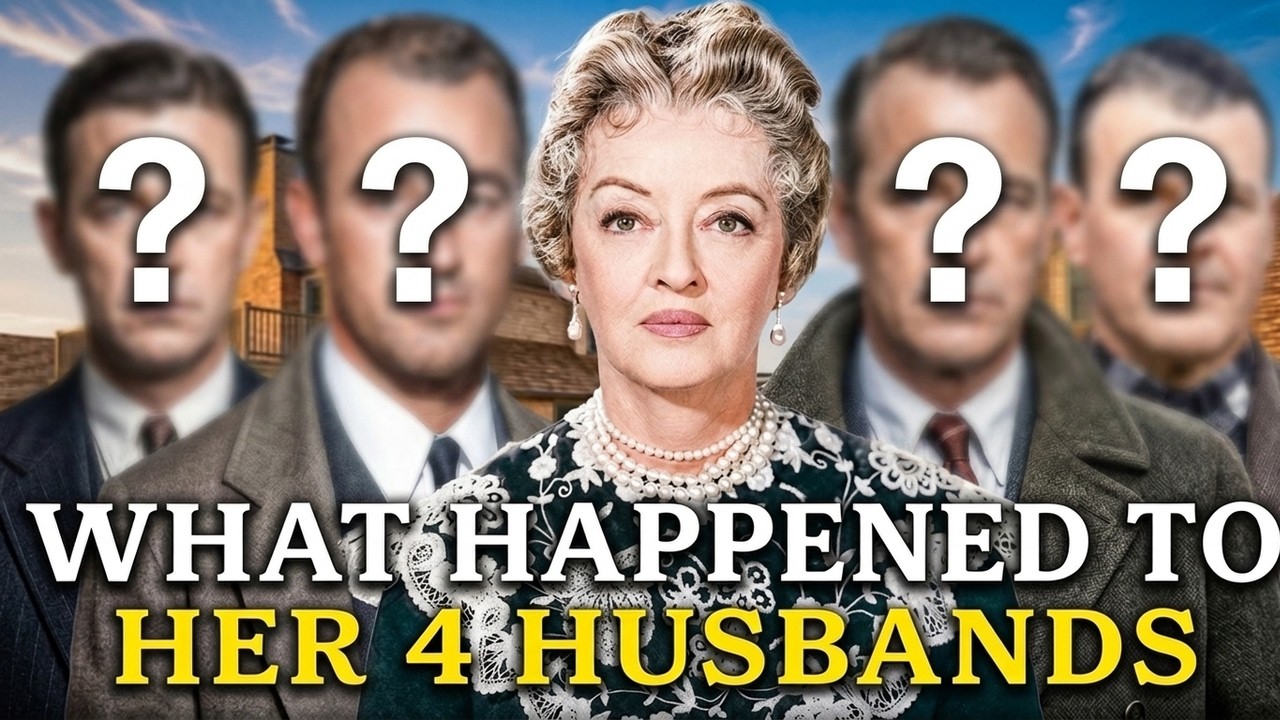
She had been married four times, divorced four times, and the embers of each union followed her to the grave.
Davis met her first husband while still a drama student in New York. Harmon Oscar Nelson Jr. was a band leader from Massachusetts, steady and unassuming. They married in August 1932 in Yuma, Arizona, just as her film career was beginning with uncredited roles at Universal.
For two years the marriage held. Then Warner Brothers signed her to a seven-year contract, and the studio consumed everything. Within eighteen months she was shooting three pictures a year, working six days a week. Of Human Bondage in 1934 made her a star, and the house in Hollywood Hills went quiet.
By 1936 she was earning fifteen hundred dollars a week, and the press called her the fourth Warner Brother. On the set of Jezebel, she began an affair with director William Wyler, who was involved with another actress. Nelson filed for divorce in 1938, and the settlement was stark: no alimony, no percentage of her earnings, nothing but his name and his bandstand. He never spoke about her again, not even in his 1976 obituary.
Her second husband was Arthur Farnsworth, a former assistant to an aviation executive who managed an inn in New Hampshire. She met him in 1939 during a holiday, drawn to his indifference to Hollywood. They married on New Year’s Eve, 1940. Farnsworth managed her finances, stayed out of the society columns, and flew small planes out of Burbank.
Friends called him Farney. For three years it was the closest she came to an ordinary marriage. Then, on August 23, 1943, he collapsed on Hollywood Boulevard. He never regained consciousness.
The autopsy found a fractured skull at the base of his brain, an injury weeks old that had been bleeding slowly into his cranial cavity. A fall on the sidewalk could not have caused it. The official ruling was accidental death. No witness came forward, no prior incident was documented, and the file was quietly closed.
Davis retreated to New England and refused every interview request. She returned to work in February 1944, wearing black for three weeks and barely speaking between takes. Her third husband was William Grant Sherry, a former semi-professional boxer and abstract painter. They married in November 1945 at the Mission Inn in Riverside, twelve guests in attendance.
Sherry moved into her house and immediately rearranged the furniture. He quit his job expecting her income to carry them both. Within months, the fighting turned physical. A neighbor filed a police report in March 1946 about shouting and breaking glass.
In May, Davis appeared on set wearing heavy makeup over her left cheekbone; a studio grip later described a bruise the size of a fist. They had a daughter, B. D. , born in May 1947.
Davis kept a log of Sherry’s drinking and documented the bruises. Her attorney advised her to wait until the child turned two so the custody hearing would favor her. When she finally filed in 1950, the judge took eleven minutes to decide. She received full custody, supervised visitation contingent on sobriety, and kept the rights to her daughter’s image.
Sherry spent the next decade writing letters she never answered. Her fourth husband was Gary Merrill, her co-star in All About Eve. His divorce was finalized in June 1950; they married in Mexico on July 28, six weeks later. She was forty-two, he was thirty-five, and they did not pretend it was a fairy tale.
They moved to Cape Elizabeth, Maine, adopted two children, and lived through a decade of escalating alcohol and violence. Margo, the adopted daughter, was diagnosed with severe intellectual disability in 1953 and placed in the Lochland School in upstate New York. Merrill stopped visiting almost immediately. He drank bourbon every day and told her she was a has-been, that she had destroyed his career.
Davis drank vodka but controlled it, enough to dull the edges, never enough to lose herself. She ended the marriage in 1960. He told a reporter in 1989 that marrying Bette Davis was the single worst decision of his life and that he had made it sober. He died of lung cancer the following year, alone and broke.
Davis attended no service and issued no statement. After 1960, she kept a vow never to marry again. She lived alone, worked relentlessly, and poured what remained into her children and her craft. The loneliness showed in small ways: unanswered dinner invitations, a house that felt too large, scripts read late into the night.
The cost of the four marriages was immense. Divorce settlements, alimony, legal fees, and the care of Margo consumed her fortune. By 1982, her liquid assets had shrunk to four hundred thousand dollars. Margo’s institutional care alone had cost nearly two million dollars over three decades.
Davis paid every invoice without question and established trust funds to ensure the money kept flowing after her death. She took television movies and guest spots she would have refused a decade earlier, anything to keep the funds going to Geneva. In 1983, a stroke left her partially paralyzed. The income stopped.
She sold her house, moved into her son’s smaller property, and watched her bank account drain while Margo’s bills arrived every month. Doctors found advanced breast cancer that same year. She ignored their advice to stop working, filming through chemotherapy. By 1985, the cancer had metastasized.
She finished one last shoot in England, collapsing between takes, her weight below ninety pounds. In 1989, she left for a film festival in Spain, accepting the fee because it would cover four months of Margo’s residential care. Her strength failed. She never returned.
The American Hospital of Paris admitted her on October 2, 1989. The cancer had spread to her bones and liver. Her son Michael sat beside her bed, holding her hand as the monitors slowed. She died on October 6, 1989, at the age of eighty-one.
The will was nineteen pages. Michael inherited the house, the residuals from eighty-three films, and control of her image rights. A trust funded Margo’s care for the remainder of her life. B.
D. received nothing except a single line acknowledging her existence and stating there was no provision for her. Davis had revised the will six weeks after B. D.
‘s memoir, My Mother’s Keeper, hit bookstores in 1985. She had told the press, “I will never speak to my daughter again. ” She kept that promise until death. Years after her death, letters surfaced that complicated the public record.
A 1959 letter to Gary Merrill, written on Warner Brothers stationery, confessed that she understood he wanted a wife who could sit still, that she had chosen the studio over him eleven times in the past year, that the work was the only thing that made sense. His reply was brutal: she wanted an audience, not a partner. He signed it Gary, and closed with the hope that the work was worth it. Archivists also found drafts of an unfinished memoir she had begun in 1975, locked away in a safe deposit box.
The Gary Merrill section stopped at page twenty-two. She had started it four times, each draft angrier, then softer, then somewhere worse. One deleted paragraph, still legible under the ink, read: “I didn’t stay with Gary because I loved him. I didn’t stay because I thought it would get better.
I stayed because walking away from a fourth marriage would make me the common denominator and I’d built a career on being exceptional. ” The margin note beside it asked, “True, but who wants to read this? ” Three weeks later she abandoned the project entirely, writing on a loose sheet: “Can’t finish this. Tried four times.
The truth makes me look weak. The lie makes me look like him. ”
Her son Michael found the manuscript after her death and never published it. Some truths, he decided, his mother had earned the right to bury.
The memoir stayed unfinished. The drawer stayed closed. The woman who had played so many indomitable characters could not hold a marriage together, and the legend required silence.
