The warrior who was screaming and crawling through deep snow was now just a noise in the forest, and Simon Kenton had to stop himself from thinking about it. It was the middle of winter. He had the meat on his back, and he had to get it back to the fort, and the men who were chasing him were not going to stop just because he had put one of their own down in the snow. He kept moving.
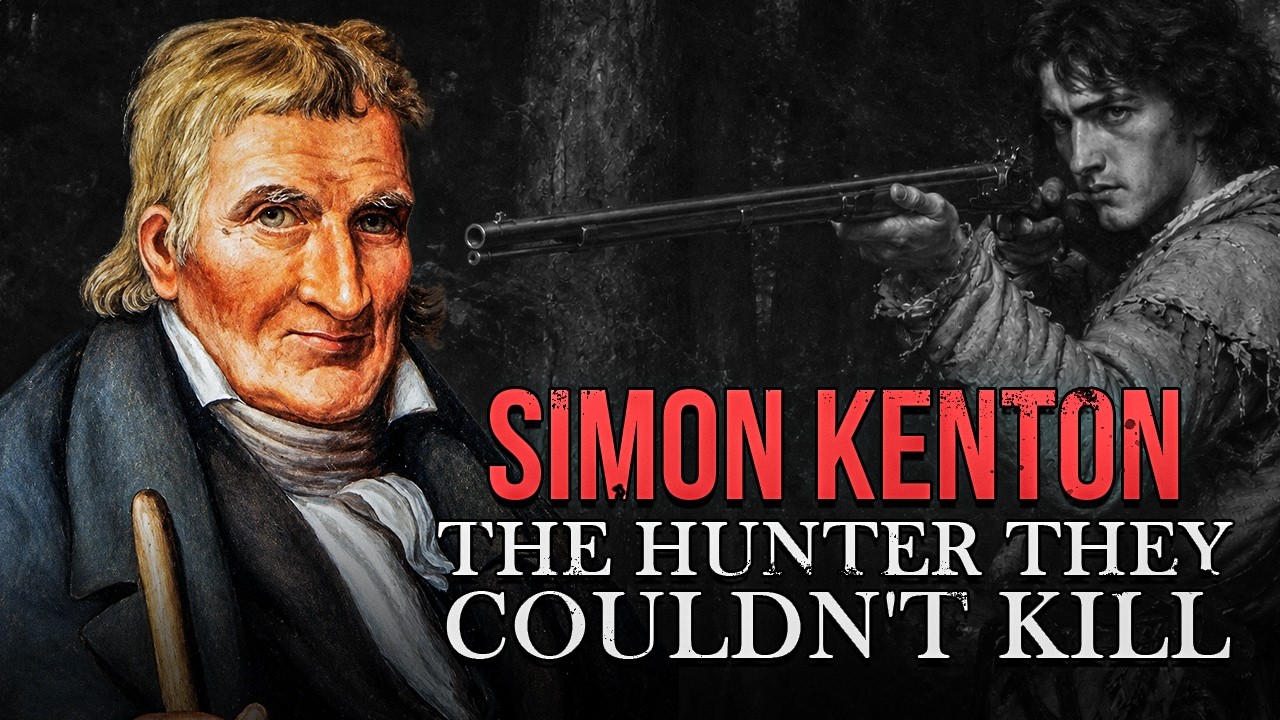
He was used to being hunted. He had been hunted for years, and the men who hunted him had a name for him they hated to say. Bodler. The hunter they couldn’t kill.
The thing that made Simon Kenton the most dangerous man on the American frontier began with a lie he never told. It began in a log cabin in Prince William County, Virginia, on the first day of April 1755. Mark and Mary Kenton had a new son, and Mary wanted to call him Benjamin. Mark, an Irish tenant farmer who had come to the colony under contract and stayed after the contract was done, drew himself up to his full six feet and said the boy’s name was Simon.
Mary repeated it. Simon. And so it was. Mark Kenton was not an ambitious man.
He planted tobacco, paid rent, and asked nothing more from life. Every year, the tobacco barrels were rolled forty miles into town to cover the debt. They got by, some years just barely. Everyone in that world carried their share except Simon.
He would spend a whole day tracking deer in the woods without complaint, but put him to work planting or hoeing a field, and no hickory switch could keep him at it for more than a few minutes before he slipped off into the trees. When asked to work, he would say that he’d sooner die first. By fifteen he was nearly six feet tall, with thick, disordered auburn hair and blue eyes sharp as his father’s. The whole community agreed something was broken in that boy.
What they didn’t understand was that he needed a bigger world. And then Ellen Cummins came along. She was three years older, with hair the color of rust. She looked at Simon like he was something.
She said his refusal to attend school was a sign of independence, that his knowledge of plants and animals was worth more than anything taught inside four walls. If she had told him he could fly, he would have jumped off the ridge to prove her right. Then she married another man, William Leechman, the son of the nearest neighbor. He was twenty years old, educated, always in clean clothes, the kind of man Simon had quietly looked down on his whole life.
Simon disappeared into the woods for four days when he heard the news. On the Saturday of the wedding, the little church at Hopewell was packed. When the couple turned to walk out, Simon was standing in the doorway, barefoot, shirtless. His eyes were no longer blue but a smoky gray.
He called Leechman a thief and a coward and dared him to step outside. Leechman had five years and thirty pounds on him, and it wasn’t a fight. It was a lesson. When it was done, Simon was on the ground, his pride destroyed in front of every soul he had known since birth.
For the next year, he worked in silence, splitting rails, hauling rocks, running up and down hillsides until his legs gave out. Nobody understood that it wasn’t repentance. It was training. At sixteen, he was bigger than his father.
Then one day, sent to borrow a tool from the neighbors, he found Leechman alone in the woods cutting cedar fence posts. What happened in the minutes that followed, Simon never described in much detail. What’s known is that he tied Leechman’s hair queue to a sapling and beat him until more than a year’s worth of rage drained out completely. When he stopped, Leechman was on the ground, not moving.
Simon knelt down, pressed his ear to the man’s chest, and heard nothing. The anger left him, replaced by a cold, hollow fear. He ran south along the ridge, wedged himself into a crack in the rocks, and crouched there shaking. He believed he had killed a man.
With that belief, Simon Kenton ceased to exist. He was sixteen years and seven days old. There was one place to go: the middle ground, the land beyond the mountains his uncle had described years before, while the boy lay in the dark grass outside listening. The land where a man could disappear.
He left the crevice at dusk. No shoes, no weapon, no money. He didn’t know that Leechman was alive, and he wouldn’t know for more than ten years. Back home, the search parties went out for two days.
They found his shoes, but not Simon. The jury acquitted Leechman for lack of evidence since there was no body. Mary Kenton kept searching after everyone else had stopped, alone for days, calling the name of a boy who wasn’t in those hills anymore. The flight was sixteen days on foot, more than 140 miles.
He slept in caves, ate roots. He learned quickly that a barefoot boy walking roads alone drew notice, so he developed a system: stop at a farmhouse, ask the family name, then present himself as a distant relation at the next farm down the road. He’d eat, rest, move on. One night on a mountain pass, he looked back and thought he could still make out his father’s house on the horizon, no bigger than a thimble.
He stood a moment, then turned and kept walking. Warm Springs was the biggest town he had ever seen: six streets, two-story buildings, two bridges over the same creek. He stopped under a big oak and rehearsed what he’d say before he knocked on the miller’s door. The man was Jacob Butler, about fifty, sandy-haired, Irish to the bone.
Simon said, “My name is Simon Butler,” inventing a distant connection to Ireland. Butler was taken with the notion and hired him on the spot. To his surprise, Simon liked the work—fixing the mill dam, sacking flour, hauling what needed hauling. It was the same work he had refused on his father’s farm, but it was different because nobody had told him to do it.
He had chosen it, and Butler treated him like someone worth something. Weeks turned to months. Simon saved money and wore the name Butler so completely that he nearly forgot the other one. When the time came to head for Fort Pitt, the gateway to the Ohio, Butler took him to his room and lifted a rifle off the wall.
It was a fine piece with an octagonal barrel, a figured maple stock, and an eight-pointed star and crescent moon inlaid in brass. It had belonged to a dead friend, Butler said, and he wanted Simon to have it. Simon named the rifle Jacob. On the morning of his departure, Butler didn’t get up to see him off.
Simon understood: the man had done it on purpose so his kindness wouldn’t stand in the way of the leaving. Fort Pitt sat where two rivers came together to make the Ohio, with the town of Pittsburgh growing up around it: tents, cabins, the smell of fresh-cut timber, horses everywhere. Lord Dunmore, the Virginia governor, was declaring war on the Shawnee and needed men, and the ones who arrived were enlisted almost on the spot. One afternoon, Simon came across three uniformed officers beating a smaller man in the middle of a busy street while a crowd stood watching.
Simon pushed through, grabbed one officer by the collar, and threw him into the other two. He leveled the rifle Jacob at them and announced that the next man who touched the smaller fellow was getting a ball. The man Simon had pulled out of it had a black eye and a split lip. He gave his name: Simon Girty, interpreter and spy.
He spoke more Indian languages than any other white man on the frontier. As a boy, his stepfather had been tortured to death at Fort Granville, and Girty had lived with the Seneca for years before finding his way back. The soldiers called him an Indian lover like it was an accusation. The two worked together through Dunmore’s War, weeks of missions into Shawnee territory, carrying dispatches between armies that were days apart.
Simon had an uncommon talent for moving without being seen. On one run, he delivered a message so fast that the general who received it didn’t believe he was human and locked him up while he sent riders to verify. The story checked out. One night in a cave along the Muskingum River, Girty proposed something: a Seneca rite.
Two men make shallow cuts on their wrists, press them together, and swear to protect each other for the rest of their lives. Simon agreed, and they pressed their forearms together until the cuts met and said the oath. They were quiet for a while. Simon trusted Girty completely, but even so, he couldn’t bring himself to give his real name that night.
Leechman’s shadow was still too large. The war ended with a treaty negotiated on the Scioto Plains. Before the signing, one thing Simon never forgot. A chief named Logan had lost his entire family in a massacre and had spent the summer killing whites in revenge.
When peace came, he refused to attend the conference, but he sent word. Simon and Girty went to find him. They found Logan under an elm tree by a creek, alone and still, no weapon, the look of a man who had run dry of everything. He dictated his message in a low voice without changing expression: “I appealed to any white man to say if ever he entered Logan’s cabin hungry, and I gave him not meat; if ever he came cold and naked, and I gave him not clothing.
But there runs not a drop of my blood in the veins of any living creature. I have sought revenge. I have killed many. I have fully glutted my vengeance.
But who is there to mourn for Logan? Not one. ”
Simon listened and said nothing. He kept those words somewhere deep.
It was the first time he understood what it meant to lose everything and keep walking. When the peace was settled, the restless men looked south toward the lands beyond the Ohio that nobody had claimed yet. Simon was one of them. No farm waited on him, no family called him back.
Just the description his uncle had given years before: a land where the grass touched your belly and the buffalo made the ground shake. The hills of Kentucky rolled soft as standing waves. The Shawnee hunted it but didn’t settle it, by an old agreement with the Cherokee. For a man coming down the Ohio, it was a physical shock of beauty.
Simon arrived with a partner named Williams and stood there looking. They planted the first corn white men had ever put in that ground. They made land claims by blazing trees with a tomahawk, since lawyers were hundreds of miles away. Simon knew that country like nobody else: every trail, every spring, every place where the ground favored an ambush.
Settlers coming down the Ohio by boat would land at Limestone Creek and find this big red-headed man waiting on the bank, ready to guide them wherever they needed to go. Daniel Boone was twenty years older, already a well-known man, but the two of them hunted together for weeks in near-total silence. Their language was tracking and instinct, each one catching the same sign at the same moment that nobody else in the party had noticed. When Shawnee raids started picking up, Simon became the fort’s hunter.
Harrodsburg had close to a hundred people inside the walls and needed meat. He’d go out alone before dawn, walk for miles in the dark in temperatures well below freezing. His trick was to light white oak bark—the one wood that burns almost without smoke—in a small hole in the ground, cover it with dirt, and hunker down over it with a blanket, warm as a room inside. He slept that way with his hand on the rifle.
In the morning he’d hunt, holding still for hours, bring down an animal, then stay absolutely motionless for a few minutes, listening to see if anybody had heard the shot. Then he’d walk back to the fort with two hundred pounds of meat on his back. One afternoon, a branch snapped behind him, and Simon spun. A Shawnee warrior thirty yards off was already raising his rifle.
Simon dove sideways, rolled, came up on one knee, and fired. The ball caught the man in the throat. Two more burst from the trees. Simon ran while he reloaded, and when he looked back, they were gathering up the body of their fallen companion.
Only then did he realize he had just killed his first Indian. He stayed quiet, thinking on it for a while, then went and dressed the meat. In September of 1778, Simon was on a mission to recover stolen horses from the main Shawnee village in Ohio. He had two companions: Alexander Montgomery, big and dependable, and a fat, cowardly fellow sent along by a general who liked surrounding himself with admirers.
They watched the village from the woods for two days and a night. Simon mapped an isolated paddock holding about fifty horses. The second night they slipped in quiet, used salt to settle the animals, picked the seven best, and eased out. They were nearly clear when one horse panicked, and in a second the whole paddock was chaos.
Simon threw the gate wide open, galloped to the far side, shouted, and fired. The horses burst through the gap and scattered into the night, and nobody from the village would round them up before morning. They rode hard for the Ohio with the seven, but the river was mean—high wind, strong current—and the horses refused to go in. They were stuck on the north bank for two days.
The fat man begged to leave the horses and swim across, but Simon and Montgomery wouldn’t hear of it. On the morning of the second day, Simon climbed a rise to check the back trail. On the other side, he saw five mounted Shawnee warriors coming up. He raised the rifle Jacob, pulled the trigger, and it misfired.
A white cloud of smoke rose above Simon’s head, enough for all five warriors to find him. He ran for a dense thicket where no horse could follow. The lead warrior, quick and lean, leapt from his horse and came after him on foot. When Simon broke out the other side, two riders were waiting on either flank.
He stopped, tried to turn back. The warrior caught him by the shoulders and dropped him with a knee to the small of his back. He was on the ground, flat on his back, a tomahawk above him. A hundred yards back, Montgomery had stopped and was drawing a bead.
Simon shouted for his friend not to shoot, to run. Montgomery fired anyway. The ball passed close to the warrior, and the other four went after Montgomery. A few minutes later, they came back.
One of them was carrying a sandy-colored scalp stretched on a willow hoop. It was Alexander Montgomery’s scalp. The warriors took turns slapping it, wet and bloody, across Simon’s face, repeating in English, “You steal Shawnee horse! ” The fat man had escaped by swimming the river clinging to a log.
He got home before any of them. Then one of the warriors stopped and studied Simon’s face. He took a step back. “Bodler!
” The others crowded in. Bodler, the name the Shawnee had given the man they had been hunting for years: the hunter they couldn’t kill, who had slipped away once, then again, then again, while others died. Taking Bodler alive was a prize nearly as great as taking Boone himself. He wouldn’t be killed here.
He would be brought before the whole nation and executed with every ceremony a man of his standing deserved. That night Simon was staked flat on his back at four points. Flies, ants, and mosquitoes worked every cut and bruise. Warriors came in the dark to spit on him or grind a heel into him.
Simon lay there looking up at the stars and settled one thing in his mind: they could do what they wanted with his body, but they weren’t going to hear him ask for anything. A gauntlet is a double line of people—hundreds of them, from old men to small children—each holding a branch, a switch, or a club. You run from one end to the other, and if you go down, you start over. The goal is to reach the door of the council house at the far end.
Once inside, nobody can touch you. The first time, Chillicothe had four hundred people in the lines, a quarter mile of them. The warrior who had captured Simon waited for the drum to sound, then hit him across the back with a force that would have split a plank, before Simon had taken a single step. He ran.
Near the end, a warrior stepped into the lane with his club raised. Simon sped up instead of slowing, caught the man square between the eyes with his fist, and put him down. The pause cost him: a heavy club caught his temple, and he went down. He woke up back at the start of the line.
He ran again. This time a cluster of women brought him down near the end. He woke up at the start again. Inside the council house, the trial was short.
The principal Shawnee chief, Blackfish, walked up to Simon and struck him twelve times across the back and legs with his staff, then turned to the assembled and declared the verdict: condemned, death by fire. They painted Simon’s body black from head to foot. That night, a black man who had been adopted into the tribe came up to Simon, grabbed his hair, and shook it like he was insulting him. Then he whispered in English with his mouth barely open.
He said they were going to burn him. He said if Simon could get free, there was an escape route along a creek to the south. But Simon was tied in a way that made any movement impossible. A young woman named Sutani tended his wounds between gauntlets with herbs and careful hands.
One afternoon she told him that the next day he’d be declared condemned, that Blackfish had come back from Boonesborough in a fury, and that there weren’t enough votes to save him. There were four more gauntlets on the march from village to village, and Simon ran them all in the same progressive state of ruin. The oldest chief in the nation, a man so ancient the whites called him the King of the Shawnee, who went by the name of Maluntha, stood up before his own warriors and shamed them: “What kind of courage is it to beat a man who can no longer raise his arms? ” It still wasn’t enough votes.
On one of those trails, a warrior came riding back at a gallop and caught Simon with a tomahawk on the top of his skull. Not the blade—the opposite end, the round poll. An accident that should have killed him. Instead, Simon was in a coma for two days.
He woke up with a headache that lasted for weeks. Days later, an old Shawnee on the roadside who had lost his son in battle recognized the name Bodler, grabbed the axe he’d been using to cut firewood, and broke Simon’s right collarbone with one blow. Simon fell, got up, kept walking. At Wapatomica, the geographic heart of the Shawnee nation, the eighth gauntlet was waiting.
It was the longest yet. Near the end, a woman found the exact spot on Simon’s skull where the bone had been driven in, and he crossed the threshold of the council house on his knees, unconscious. The evening before the date set for the burning, they planted a post in the center of the village and started stacking firewood around it. Simon spent that night staring at the post.
It wasn’t quite fear, more the kind of clarity that settles in when there is nothing left to do but wait. On the morning set for the execution, a column of warriors rode in from a raid in Kentucky: one hundred and twenty men, eight prisoners. The prisoners had to be tried first, and Simon’s execution was put off. He was tied inside the council house, his body still black with paint, when a man came in with the column.
Medium height, black hair to the shoulders, a way of moving like he owned whatever space he was standing in. He spoke Shawnee without an accent. When the firelight caught his face, Simon knew him. Simon Girty.
Girty gave his report on the raid, then walked over to the important prisoner set apart from the others against the wall. He looked at the face covered in soot and old scars and didn’t know him. Simon said in English, “I never thought I’d live to see the day Simon Girty didn’t know his own blood brother. ” Girty went still, grabbed the prisoner’s arm, and looked close.
He pulled Simon into an embrace with real force. Tears came without warning. Two men who had pressed their cut wrists together in a cave years before and sworn to protect each other. Then Girty turned to face the assembled warriors and called for quiet.
He said the condemned man was his brother, that they’d fought side by side, that in a cave on the Muskingum they’d made the Seneca oath with mingled blood before the Great Spirit. He said he had served the Shawnee, carried their messages to the British, and never asked for a thing in return. This was the one favor he would ever ask: killing Simon was killing a part of him too. The room went quiet in a different way.
Old Maluntha rose and called for a new vote. It was the closest vote of the whole ordeal, but when the notches were counted, there were more on the side of mercy. Blackfish walked over to where Simon and Girty were standing and placed both hands on Simon’s shoulders. “You are no longer condemned.
Tomorrow you will be adopted into the Shawnee nation. ” Simon nearly wept right there. The adoption ceremony was the following day. A woman who had lost a son in combat—the same son who had most likely died in the siege of Boonesborough, where Simon had fought on the other side—poured warm water over his arms and chest, blew on her open palms, made the motion of throwing away the white skin, and said, “Now you are a great white wolf, beloved son of Sugar Tree.
May Moneto walk always beside you. ” Simon was quiet for a moment after she finished. He might have killed her son. The blood oath the two men had sworn in a cave years before hadn’t been fully paid out yet.
Months later, on a scouting mission around Chillicothe, Simon and three companions were riding back when they passed within yards of a ravine where Girty and a group of warriors were hiding. One of the warriors recognized Simon, raised his rifle, and already had his finger closing on the trigger when Girty covered the lock with the flat of his hand. The gun made a dry click. Simon never knew how close it had been.
He only found out later from someone else. Girty never said a word about it. But the story wasn’t over. Weeks after the adoption, a war subchief returned from a raid in Kentucky with dead warriors.
He was furious. He argued the adoption had been irregular, that a death sentence couldn’t simply be reversed, and that the deaths of his men required blood in return. Simon was condemned a third time. Girty still had a card to play.
As a British agent with influence among the allied tribes, he argued that an execution of this significance deserved a larger audience. It ought to happen at Upper Sandusky, where representatives of all the allied tribes were gathered. The chiefs agreed. On the road there, Bona—one of the war chiefs whose anger had built with every delay—broke Simon’s left arm with a war club over some invented reason.
The old man with the axe had already taken the collarbone. Two broken bones, a cracked skull, the whole body covered in marks. Simon didn’t stop. He kept walking because there was no other way.
Chief Logan, the same Logan who had dictated the words Simon had been keeping inside since Dunmore’s War, was Mingo, not Shawnee. He had no authority here. But he sent runners to Upper Sandusky with a message for the British captain in charge of trade with the tribes. The ninth gauntlet was at the entrance to Upper Sandusky.
Only thin switches this time. The rumor that the Great Spirit was protecting this man had gotten around. Simon walked it slow. The blows that came were hesitant.
On the morning of the burning, the wood was stacked, the post was set, and Simon was being led toward it. The rain started without warning, heavy and steady, soaking the wood in minutes. Some of the warriors looked up at the sky. An hour later, a British captain arrived in a scarlet-and-gold uniform.
He explained that the prisoner had information the governor in Detroit required. He offered rum and powder to secure temporary custody. Bona agreed on the condition that when the questioning was done, Simon would be returned for execution. Simon was put in a canoe.
Bona stood on the bank watching. Simon didn’t look back. It was weeks by canoe across Lake Erie before Detroit appeared on the horizon. Simon arrived with a caved-in skull, two broken bones, and scars covering just about every surface of his body.
The military surgeon who examined him walked around him in genuine bewilderment, saying he’d never seen such a variety of wounds on a single human being, and that the bone fragment in his skull was medically inexplicable. He broke the arm again and reset it. Simon passed out during the procedure. Then came months of decent food and rest.
At twenty-four, he weighed 250 pounds, all muscle. The townspeople called him the giant; he was the tallest man in the city. As a prisoner of war, he was free to move around town but had to report to the commandant on Sundays. Simon used that time doing what he knew how to do: watching, counting, memorizing how many soldiers, where the supplies were kept, the pattern of the sentries.
Detroit was rattled after Clark’s victories on the frontier, and the garrison was thinner than they wanted anyone to know. A woman named Rachel Edgar remembered Simon from a brief meeting years before. She was the wife of a wealthy trader, nineteen years older than Simon, fair-haired, with the kind of mind that makes a conversation last for hours without you noticing. Simon thought it was friendship.
She knew better. When he said he was going to escape, she went pale. She spent weeks trying to talk him out of it. When she understood there was no changing his mind, she helped.
She and her husband hid supplies in an abandoned outbuilding on the edge of town, and the captain who had rescued Simon at Upper Sandusky arranged the weapons and the route. On the night of the escape, Simon stopped by Rachel’s room to say goodbye. She said in a low voice that she was going to keep watch on the bundles of trophy scalps the Indians brought into the city, that she knew one day she’d see his among them. Simon wiped the tears from her face with his finger and left.
The route was counterintuitive: northwest first, then west for three days across open country before turning south. Every man who had tried to escape before had gone straight south and been caught. Simon took thirty days to reach Kentucky with two companions who were next to useless in the woods. Back in Kentucky, he went straight to Clark and said Detroit was ready to be taken: weak garrison, low supplies, a commandant with no fight in him.
Two hundred good men was all it would take. Clark agreed with every word. He didn’t have two hundred men, and Virginia wasn’t sending reinforcements. The window to take Detroit closed and never opened again.
A year later, in the summer of 1780, the British crossed the Ohio with a force of more than a thousand men and six cannons—the first artillery Kentucky had ever seen. A single shot blew open the north wall of a wooden fort like it was cardboard. The garrison leader raised a white flag, and the British captain promised safe treatment. The gates opened.
The warriors poured in, screaming. More than twenty dead. A mother jumped into a fire to save her baby who had been thrown in, and was tomahawked as she fell into the flames. Simon arrived afterward with others who came to see the damage, and walked among the bodies without saying anything.
But there was something to be done. In the retreat, Simon and a companion spent hours flat on their stomachs on a spit of land thick with willows at the mouth of the Licking River, perfectly still, watching the British and their allies cross the Ohio with the prisoners. A water moccasin passed within a foot of Simon and slid off into the willows. He didn’t move.
The last canoe crossing the river was slower than the others. Simon watched it in the growing dark and understood why: a wheeled cannon lay across the center of the boat, pushing the bow almost to the waterline. He touched his companion’s arm and whispered something. The man went very still for a moment, then nodded.
The two of them pulled off their shirts and moccasins, left their rifles on the bank, and slipped into the river without a sound. They stood on the muddy bottom with the water at their chests, only their heads above the surface. When the canoe was twenty feet away, they went under, walked along the bottom to meet it, and at the same moment surged up and shoved. The canoe rolled.
The cannon hit the water with a dull thud and was gone. Four soldiers went in the river. What Simon did in the next few minutes doesn’t need much telling. When the two men swam back to the bank and got dressed, there were four fewer soldiers in the king’s army.
Clark recovered the cannon from the bottom of the Licking weeks later, along with twenty cannonballs, and put it to use in the next campaign. The winter after his escape from Detroit, Simon stopped at a settlement called Quick’s Run to rest for a few days and stayed for months. There was a woman there named Ruth. Something honest between them from the start.
When she told him she was carrying his child, Simon proposed, said he’d marry her if she wanted. Ruth looked at him for a long moment and said no. She said Simon didn’t love anyone enough to stay put, and she wasn’t going to be a woman waiting on a man who might not come back. There was a young man who truly wanted her, who already knew everything and wanted to raise the child as his own.
The baby was born some months later. The young man insisted the child carry the father’s name, and Simon didn’t object. The boy was called Simon Ruth Kenton: the father’s first name, the mother’s last name in the middle. Weeks after that, late at night, someone knocked at the cabin door in Limestone Creek.
Simon grabbed his rifle and opened it. It was the British captain from Detroit—gaunt, bearded, barely able to stand. He had been arrested after Simon’s escape, lost his rank, his property, his family. He had gotten out of a cell by bribing a greedy guard.
He was no frontiersman, and the last leg of the journey from Chillicothe to that cabin had taken weeks. Simon made food and listened to the story. Then he said there were two hundred acres across the creek he’d claimed in his first year in Kentucky, and the cabin could be used for as long as the man needed it. The captain tried to say something.
Simon said there was nothing to say. In August of 1782, a force attacked Bryan Station, six miles north of Lexington. The fort held for two days. When the attackers pulled back, a group of 176 men went after them on horseback.
Boone, who was in that group, looked at the trail heading toward the Blue Licks and said it was an ambush. The ground beyond was a maze of ravines. He said to wait for reinforcements that were a day behind. A major didn’t want to wait.
He shouted that anyone who stayed was a coward, spurred his horse into the river, and crossed. The men followed because men do that. In fifteen minutes, seventy were dead. Simon was at Logan’s Fort when the news came in.
He rode with 470 men and arrived in the early hours of the following morning. He crossed the ford and walked out onto the field. He knew those faces. John Todd was there, the lawyer who had signed with Simon the first petition asking Virginia to recognize the territory.
Steven Trigg. Israel Boone, Daniel’s son. Five lieutenants—all five of them. And the major who had ordered the charge, who had caused all of it, had walked away without a scratch.
Simon stopped in front of one of the bodies and stood there for a while. He wasn’t the kind of man who wept in front of others, but there was something in his face that the people around him chose not to look at directly. Then he went to find Clark in Louisville and asked for another campaign. Clark went.
They burned Chillicothe and Piqua Town again, this time down to the grass. The formal war with the British ended in 1783, and Kentucky had survived. And it was sometime around then, the records don’t say exactly when, that Simon found out William Leechman was alive—had been alive for more than a decade. He had survived, recovered, been acquitted at trial.
He was a neighbor of Simon’s parents. Simon went very quiet when he heard this. There’s no record of what he said or did in that moment. Only the silence of a man in his thirties understanding that he’d been running from a ghost his whole adult life.
He took back the name Kenton. Not with any ceremony. He simply became again who he had always been. He married a woman named Elizabeth, and they founded a station in Ohio that grew into a town.
Elizabeth asked to name it. She chose Washington. The land was the problem. Simon had claimed hundreds of thousands of acres over the years, blazing trees as he went.
But perfect memory of the forest isn’t worth a thing in a courtroom. He was illiterate. He signed papers without understanding what they said. A schoolteacher who had worked for him once wrote to a friend that Simon could manage a kind of scrawl that, if you knew what you were looking at, you could read as Simon Kenton, but it was more like a hieroglyph than writing.
Every paper signed with that scrawl was a paper signed with his eyes shut. In two separate rulings, he lost 300,000 acres at once. In the end, there was almost nothing left. Courts couldn’t touch what people said when they heard the name Kenton.
He was appointed Brigadier General of the Ohio Militia. The man who couldn’t read a line now commanded a state. And there was the ten-year-old boy who had stood quiet outside the council house at Chillicothe while the others threw stones. That boy had grown up to become the most eloquent leader the Shawnee ever produced: Tecumseh.
The two men met many times. Tecumseh brought his family and camped a stone’s throw from Kenton Station for weeks at a stretch. Simon wasn’t afraid of him. Tecumseh wasn’t afraid of Simon.
Between them was a respect that didn’t need words, the kind that only exists between two people who know exactly what the other is capable of and have chosen not to do it. In the War of 1812, Simon Kenton Jr. was captured by the British, just the same as his father had been captured by the Shawnee decades before. The son survived too.
Simon died in 1836, eighty-one years old. Poor, landless, surrounded by respect. Sometimes he knocked on strangers’ doors asking for food the way he’d done when he was sixteen years old and running. Nobody ever turned him away.
There’s a question that stays with you when you think on this story. What would you do if you found out that the whole life you had built—the running, the suffering, the friends you lost, the years under a borrowed name—all of it started from a mistake? That the man you believed you had killed was alive? Without that flight, Simon Kenton dies growing tobacco on a rented farm in Virginia.
Kentucky maybe doesn’t survive the years it had to survive. The settlers coming by boat wouldn’t have had their guide. The ones freezing inside Harrodsburg waiting on meat wouldn’t have eaten. The cannon that could knock down any fort in the territory would still have been in service.
The sixteen-year-old boy who pressed his ear to a man’s chest and heard nothing was wrong in a way that produced the only future where certain things were possible. Or maybe the most important stories don’t begin with choices. They begin with accidents.
And what a person does after the accident is all there is.
