A sluggish brown haze of dust hung around them, dense enough to burn the eyes and settle in the throat. The morning was April 2, 1855, and Nelson Lee was traveling a dirt track north of Brownsville, Texas, pushing horses westward toward California alongside a few other men. The sun had only just risen above the mesquite, casting long shadows over the hard-baked earth. Lee was forty-seven years old.
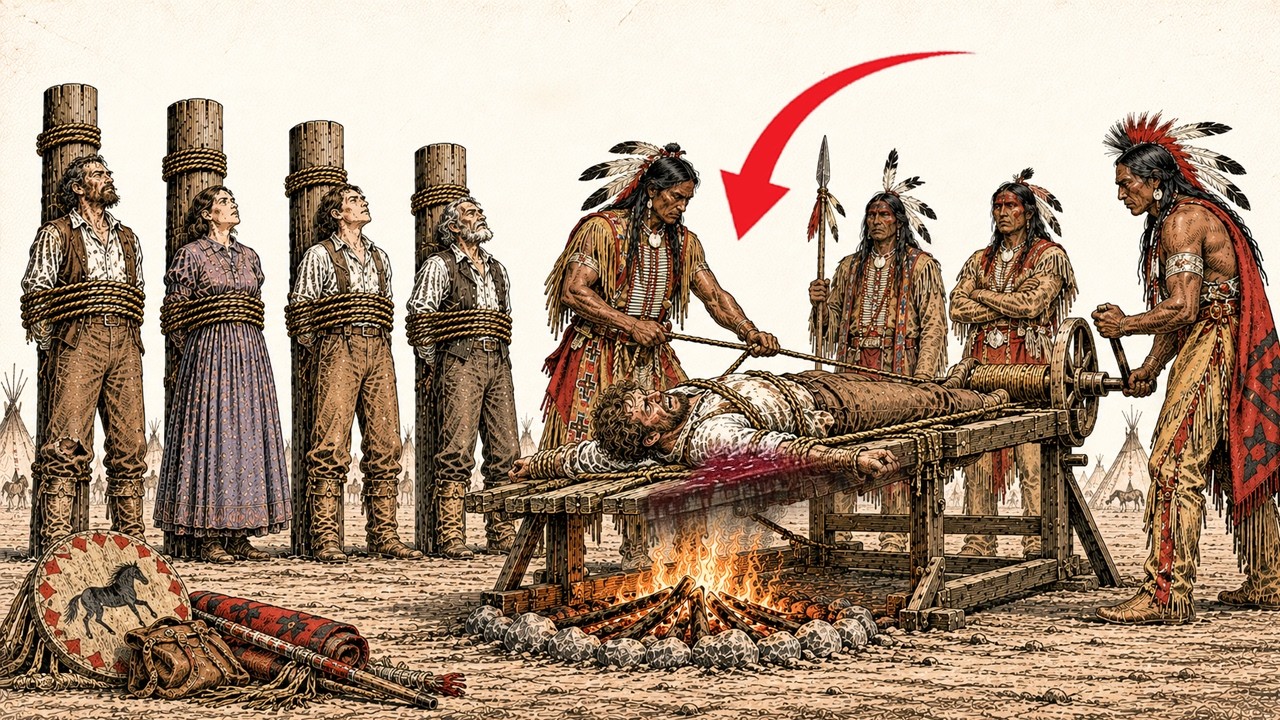
Within roughly two minutes, every man riding beside him would be dead—all but three. And for the next three years he would be traded like livestock among the Comanche warriors of the southern plains. The tale America came to know about Nelson Lee was not the tale that truly unfolded. One account was printed in 1859 to move copies off shelves.
The other may never have seen the light of day. According to the Texas State Historical Association, just four men came through the first hour of the assault alive. Lee was among them. What kept him breathing—what spared him from being cut down where he stood—was not bravery.
It was not fortune, either. It was something in his pocket worth under a dollar. What that item was, and what effect it had on the men who came upon it, is the most peculiar piece of this whole account. But a second question loomed, and it was worse than the first.
The book Lee brought out four years afterward—the book that brought him renown and molded how a generation of Americans pictured the Comanche—carried a caution in its first pages. A caution set down by the editors themselves. That caution signified that what you were about to read might not, taken literally, have taken place at all. Nelson Lee should have known better.
Born in 1807, while Thomas Jefferson sat in the presidency, he had by 1855 already lived two frontier lifetimes: years as a Texas Ranger, years working cattle, years observing other men repeat the very error he was on the verge of making. Still, that spring he consented to help move a band of horses from Brownsville to California. The appeal of the route was plain. It was 1855, and the nation was still deep in the wake of the Gold Rush.
In California, horses commanded several times their Texas price. Every man on that trail rode it because the arithmetic waiting at the far end was impossible to resist. A man stood to make a fortune—if only he could deliver the herd alive. Lee grasped the arithmetic.
He grasped the danger as well. He rode out regardless. The trouble lay in the trail itself. The road leading from Brownsville stretched north and west into country the United States Army did not hold.
It skirted the fringes of Comanchería, the Comanche empire that in those years reached from the Arkansas River south into northern Mexico. A man did not merely cross Comanchería. He entered by their leave and departed by their leave. The Comanche governed the movement, the pace, and the very survival of anyone reckless enough to traverse their territory.
A contradiction sits at the core of Lee’s entire story. Nelson Lee, the celebrated frontier writer, could not write—not smoothly, not for print. Every word published under his name following his captivity had to pass through someone else’s pen. The men who struck the horse train the following morning were no mere silhouettes daubed in war paint.
They were Comanche riders of the final full generation of Comanche might, and their world was caving in around them in ways they could sense in the very air. Anglo-American settlers, Mexican ranchers, sickness, the dwindling buffalo—all of it bore down from every side. Striking a band of white men herding horses across their land was, by their reckoning, no crime. It was defense.
It was economics. It was survival. A number of the warriors in that raid were probably teenagers. Some had children awaiting them in lodges a hundred miles to the north.
History would never set down their names, yet they were people and they were present. And on the morning of April 2, they had their eyes on the road. What accounts survive point to several men driving the herd. The precise count is difficult to pin down, since the primary source is Lee’s dictated narrative, and that source carries well-known problems.
Even so, the outline of the group is plain enough: a small band of men, poorly guarded for the land they were crossing, gambling that speed and distance would see them through. The horses would have kicked up a dust column a mile in their wake. The clatter of hooves on hard ground is hardly a quiet thing. Any man within five miles who cared to know they were approaching would know it.
The herd was a lodestone, a plodding beacon threading through the brush, and the men driving it must have realized as much. Their only requirement was to believe themselves quicker than whatever might hear them. April in South Texas is not the empty desert people picture. It is a mingling of thorn scrub, mesquite, and open vistas interrupted by the low green of the brush country.
A man on horseback could vanish entirely into it at two hundred yards. An ambush here required no canyon. It required only patience. In 1855, the Comanche were the finest light cavalry on the North American continent.
This is no overstatement; any historian of the plains will tell you the same. Ever since the horse entered their world, they had devoted 150 years to remaking themselves into a mounted force able to outride, outshoot, and outmaneuver every army sent against them—until repeating rifles and the Civil War shifted the equation. In 1855 that equation had not yet shifted. A handful of whites driving horses across open country against a Comanche raiding party was no fair contest.
It was simple arithmetic. No photograph of Nelson Lee exists. Think about that. He reached New York City in November 1858 as one of the most celebrated captivity survivors of the decade, dictated a book that turned into a bestseller, and left behind not a single verified image of his face.
The man is at most a voice—and even that voice, as you will discover, was not wholly his own. It is late summer 1858, three years and some months since his capture. Nelson Lee is somewhere in a Comanche camp on the southern plains. The precise location is among the many particulars the narrative leaves obscure.
He is severely emaciated. He has been sold three times over. At this point in the story he belongs to a warrior the narrative names Rolling Thunder, and for months he has been turning over a single question. The question is not whether he ought to escape, but whether escape is even a word that still applies to him.
He is forty-nine years old, stranded in the heart of a continent, without a horse, without water, without any map that could help him, and without the faintest notion whether the closest white settlement lies a hundred miles off or four hundred. Should he walk out of the camp, he will in all likelihood perish alone in a land that would not even surrender his bones. Should he remain, he will die inside the lodge of a man who bought him. In that moment, on that particular night, he makes his choice.
Lying awake, hearing the camp’s sounds around him, breathing in the smell of fires settling into coals, a decision takes shape in his chest—one he cannot undo once he begins to move. Whether it came on a single dramatic night or across weeks of gradual surrender to the thought, we cannot say. The dictated narrative smooths these edges away to make a story. Only one thing about that moment is beyond dispute: at some point, this man chose the desert over the lodge.
He chose the near-certain death he could walk toward under his own power over the certain death that waited for him if he stayed. This is no battle scene. This is no heroic charge. This is a man in the dark deciding to rise.
It is the most important thing he ever did. He does not know it yet, but if he makes it out alive, three months later he will walk into a room in New York City and sit before two editors employed by a publishing house called Baker & Taylor. What those two editors do with his words will prove nearly as important to Nelson Lee’s story as anything the Comanche did to him. But first, he has to survive the road.
And to survive the road, the story must go back. Back to April 2, 1855, and to the two minutes that split his life in two. Back to the road outside Brownsville. Present tense, it is morning.
The dust is rising. The sun has only just cleared the mesquite. The horses shift in their scattered mass, churning up that slow brown fog. The men ride along the flanks, holding the herd together, their eyes sweeping the brush.
Somewhere among the thorn trees, the Comanche riders are already in place. The group on the road does not know it yet. They will not know anything for another sixty seconds. Then the attack begins.
The first shots come out of the brush. The horses panic and scatter. The men who fall in those first moments never get up. The men who try to fight are killed for trying.
The men who try to flee are run down and killed for fleeing. It is swift, savage, and utterly one-sided. By the end of the first minutes, most of the party lies dead in the dirt. Only four remain alive.
Nelson Lee is one of them. The trouble, when trying to reconstruct what happened in the minutes that followed, is that everything known comes from a single source: a book published four years later, whose editors wrote in its opening pages that it was recorded as it fell from the lips of Nelson Lee, day by day, not accurately in his own words—for he is not an educated but an intelligent man—but his history is related substantially as he related it. That is the warning the editors set down themselves. Substantially.
Not accurately. Hold on to that word, because it will matter enormously by the end of this. Here is what is not known. The names of the Comanche men who attacked the group are unknown.
Their band is unknown. Their number is unknown. Later summaries of Lee’s story supply names for his captors, but whether those were their true names, or translated names made for the book, or some mixture of all of it, no independent record has ever confirmed. The men who changed Nelson Lee’s life more than any others on earth are, in the historical record, faces without documentation.
Now comes the moment that alters the course of the story—and it hinges on something that seems almost absurd. Nelson Lee, crouching or standing among his captors in whatever posture follows a battle, reaches into his clothes and draws out a pocket watch. He holds it out to them. He does something with it.
He winds it, opens it, makes it tick, makes it chime. And the men who just killed his friends stop. This is the story as it was later told. In every summary and reprint of Lee’s narrative, this is the turning point.
The watch—that small mechanical thing that ticks—is the reason he was not killed on the road with the others. It fascinated the men who captured him. It made him worth keeping. Not quite a prisoner.
Not a slave in the sense that word is usually used. Property. Possessed of a strange value attached to owning something that made a strange sound. The watch was not worth a dollar on the streets of New York.
A man’s life, bought and sold on a piece of brass and glass and a spring inside that a watchmaker could have replaced in an hour. The distance between what a thing is and what it can mean is the distance Nelson Lee’s life fell into that morning. It is why he was still breathing at sunset. What remained of the group—the other three survivors, whose fates the narrative does not follow in the same detail—was taken with the raiders, and Lee was among them.
The country they crossed was harsh. The pace was merciless. The endurance demanded of captives merely to keep up was staggering. He was a forty-seven-year-old horseman driven across the country at a warrior’s pace for days on end.
He was not fed as the men who captured him were fed. He did not sleep as they slept. He was watched constantly, because the watch—the thing that saved him—was now the thing that bound him to whichever man currently owned him. Later catalog descriptions of Lee’s book promoted it shamelessly as a tale of Indian life as it is on the warpath and in the camp.
That phrase is worth pausing on, because it was the selling point. It is what the book was selling to readers in 1859 who were hungry for exactly such stories. From the moment Lee opened his mouth in that editor’s office in New York, the narrative was already being shaped for what the market wanted to hear. By the end of the journey, Lee no longer belonged to the men who had captured him.
He was given, or traded, or sold—the accounts vary—to a warrior whose name the narrative translates as Big Wolf. His first of three lives inside the Comanche world was about to begin. What follows is the part of Nelson Lee’s story that sold the book. Three years, 1,095 days in a world he could not name, sold and resold among warriors whose language he never mastered, kept alive by an object none of them fully understood.
From this point on, everything in the record reaches us through his voice, strained through his editors and aimed at his readers. What follows is Nelson Lee’s own account of what took place. Whether it happened in precisely that manner is a question the closing part of this story will take up. Big Wolf was the first to own him.
As the narrative tells it, this is the man who took Lee and the watch in the wake of the raid. A warrior of rank, his authority over Lee was complete, and his motive for keeping the man alive was bound up entirely with the object in Lee’s pocket. Lee’s work in the camp was lowly and backbreaking. The watch was a ceremonial piece, produced for show, wound in front of visitors, its chime demonstrated to men who traveled from distant camps just to hear it.
Lee was lowered to the position of caretaker for the watch. In the eyes of the men around him, who he was dissolved into nothing more than the noise that object produced. Consider what that does to a mind: surviving because of a machine, knowing that if the machine failed, he failed with it. Winding it each day with hands that grew weaker in a camp where he was already the least significant presence there.
The publishers of the 1859 book marketed Lee’s story as a window onto a world their readers had no other way to see. They billed it as a look at the Comanche as they are. That claim asserts a documentary authority the book cannot truly support, since every page of it traveled through a captive’s memory, three years of trauma, and two New York editors before it reached the reader. Each “as they are” in the book is in truth “as he remembered them” and “as we decided to set that down.
“
At some point during his captivity, the narrative never says how long this took, Lee stopped belonging to Big Wolf and became the property of a warrior named Spotted Leopard. In the narrative, the handover comes about through trade, through gifts, or through the shifting currents of Comanche internal politics. The text is vague, and it is our only witness. What counts is the pattern.
Lee was no longer a man. He was a thing tethered to another thing, and either could be passed to a new owner. The forty-seven-year-old who had left Brownsville was now forty-eight, then forty-nine. His body was not what it had been.
The frontier toughness that had carried him into this country was wearing away under malnutrition, exposure, and a life that allowed him no rest. Later summaries and the covers of new editions describe the book’s contents as torture and unprecedented escape—the vocabulary of the genre. Because that is what a captivity narrative meant in 1859: a genre. It came with conventions.
It came with expected rhythms. Readers purchased these books anticipating torture and an escape that felt miraculous. And the publishers gave them what they anticipated, which means that even if every word of Lee’s narrative were true, the narrative’s shape had been fixed by the market before he ever opened his mouth. Then, somewhere in his second or third year, Lee passed to a new owner.
During the three years Nelson Lee was held captive, the United States held two presidential elections. Buchanan replaced Pierce. The country he had left was drifting toward a civil war he had no idea was coming. Newspapers were rolling off presses in cities he could not have named from where he stood.
And Lee was out somewhere on the southern plains, winding a watch each morning to prove he was still worth the food it took to keep him alive. The middle years were the long, grinding heart of the captivity. The camp moves. Lee moves with it.
He picks up fragments of the language—enough to sometimes catch what is being said about him, not enough to argue back. He watches men come and go. He watches other captives, since he was not the only one, though his narrative keeps its focus on himself, and they arrive and vanish—killed, ransomed, absorbed, or gone in ways he never learns. Captivity demands a particular kind of endurance, unlike the endurance of battle.
A battle is minutes. Captivity is years. It has nothing to do with the capacity to fight. It has to do with the capacity not to lose yourself when everything around you says, day after day, that you no longer exist.
Seen from the other side, from the standpoint of the men who owned him, Nelson Lee was surely not the center of anyone’s world but his own. He was a curiosity, a tale told to visitors. The men who held him had wives, children, relatives, disputes, hunting trips, deaths, weddings, wars—none of it connected to the old white man in the corner of the lodge. To shrink the Comanche side of this story down to merely being Nelson Lee’s captors is to repeat the same mistake as the 1859 book: reducing an entire people to their relationship with one white man’s ordeal.
The editorial note in the 1859 edition stated once more that the book was recorded as it fell from the lips of Nelson Lee day by day. Day by day. Across multiple sessions spanning an unknown stretch of time, the editors sat with Lee and molded what he said into a book. Each night one of those editors went home.
Each morning one of them returned. Between sessions, choices were made. Choices about pacing, about drama, about which portions of Lee’s raw account earned a place in the book and which did not. Choices over which Lee himself, unable to write, held no real control.
By the time he was sold for the final time, Lee had spent close to three years in Comanche country. He was fifty years old. He belonged, in the narrative’s phrasing, to a warrior named Rolling Thunder. And he was on the verge of making the decision that would end it all.
Here is what Nelson Lee did not know as he lay awake in Rolling Thunder’s camp plotting his escape. He did not know that his own book, still unwritten, would within a few decades of his death become one of the most argued-over captivity stories in American literature. He did not know that some scholars would one day question whether the whole account was, at best, heavily embellished and, at worst, largely invented. At that moment he was a real man planning a real escape from real captivity.
But the story he would later tell about it, when he told it, would be taken by the historical record as far less solid than the ground he was about to run across. The escape. He goes at night. He goes alone.
He carries almost nothing. The narrative later dramatizes this scene, and the later summaries stress what they call his unprecedented escape. What can be stated with reasonable confidence is that a man in his condition, in that country, in that season, set out toward the horizon. The attempt should not have succeeded.
It succeeded regardless. The days without water. The way a human body, driven to that brink, keeps moving on nothing but a refusal to stop. The moment when he could no longer tell whether he was walking or dreaming that he was walking.
At last he arrives at the settled edges of the American Southwest. The narrative delivers him to El Paso in a state the TSHA summary sums up in two words: severe hardship and extreme hunger. That is the clinical phrasing. What those words conceal is a man who emerged from three years with a body that could hardly remain upright.
From this point onward, Lee’s story differs fundamentally from everything that preceded it. Once he reaches the white settlements, there are witnesses. There are records. There are people who see him, feed him, speak with him.
Before El Paso, there was only his own testimony. After El Paso, there were documents. That boundary between the years only he could attest to and the instant he re-enters the documented world is the exact fault line on which any serious reading of Nelson Lee must rest. He came out of the desert into the fringes of settled society in the fall of 1858, and the world had to pause and take notice of him.
Take notice of his feet. Only his feet. Whatever was left of the shoes he had left camp in had disintegrated by the time he reached the settlements. His feet were the feet of a man who had walked out of his own existence.
Cracked, bleeding, wrapped in whatever fabric he could tear from his clothing. A doctor in El Paso would have recognized immediately that he was seeing something men seldom survive. That is what Nelson Lee looked like in El Paso in November 1858. His recovery was gradual.
He ate with caution, because a starving man cannot eat freely without killing himself. He rested. He started telling his story to those around him in pieces. Word spread.
A man who had come out of Comanchería. A man who had survived three years. A man who wanted to go east. He sailed from the Gulf, according to the records, and reached New York City on November 10, 1858.
New York in November 1858 was a city already tilting toward a war it would not emerge from intact. Lincoln was two years away from the presidency. Fort Sumter was two and a half years off. The city was full of publishers who understood better than most what sold.
A man walks into that city claiming he was held captive by the Comanche for three years. Publishers did not need to be told twice. Within days, he was seated across from the editors at Baker & Taylor, and they were asking him to tell them everything from the start. Here the story shifts completely.
Nelson Lee sits in a room in New York. He is fifty-one years old. Only weeks have passed since he left the Comanche world. Across from him sits at least one editor, perhaps two, with pen and paper, and Lee begins to speak.
He speaks day after day, in the editors’ later phrasing, not in a single session, not in a single week, but over multiple sessions, long enough to form a book. In each session, another person writes down what he says. In each session, another person decides what to retain and what to omit. In each session, the man being interviewed is a trauma survivor whose memory bore the weight of three years of captivity, whose body had only recently recovered enough to speak fluently.
And that watch—the watch that saved his life on the road, the watch that made him worth keeping, the watch that became the central character of his captivity—is now the focus of the book being written around it. In the narrative that takes shape, the watch is not merely an object. It is the explanation for everything. It is what transformed killing into captivity.
Whether it was truly central, or whether it became central because it made a great story, is a question the records cannot fully answer. The full account: three years and some months of captivity until freedom. 1,095 days at minimum. Three owners, if the narrative is to be trusted: Big Wolf, Spotted Leopard, Rolling Thunder.
Most of the horse train he was leading to California died on the road outside Brownsville. The other three survivors of the first hour, whose fates the narrative did not follow with any interest, largely vanish from the records afterward. Lee came out of Comanche country a man of fifty. He had entered it at forty-seven.
The three years between those two numbers are the book’s three years. They are also the three years in which he remains the only surviving witness to his own side of the story. But the escape was not the end of Nelson Lee’s story. The end of Nelson Lee’s story happened in that editor’s office in New York, and there lies the uncomfortable truth about his captivity.
Three Years Among the Comanches was published in 1859, one year after Lee arrived in New York. It sold. It sold well. It fed a market of American readers who desperately wanted to know what the Comanche world looked like from the inside, and who were not at the same time interested in the accuracy of what they were reading.
The book gave them Big Wolf. It gave them Spotted Leopard. It gave them Rolling Thunder. It gave them torture and captivity and a miraculous escape.
It gave them everything they had come to expect from the genre. And in the opening pages, in a note most readers ignored, the editors had revealed the truth about what they had made. He could not write. Read that again.
The man whose name appears on the cover of one of the most famous Comanche captivity narratives in American history could not write fluently. Every word of that book passed through another hand before it reached the page. Here is the note, the precise editorial admission at the front of the 1859 edition: This narrative has been recorded as it fell from the lips of Nelson Lee, day by day, not accurately in his own words, as he is not an educated but an intelligent man, but his history is related substantially as he related it. Read that carefully.
Not accurately in his own words. Substantially as he related it. This is not a book. This is a book about a man, written by other men, based on what the man was able to say aloud in a room across several sessions, then shaped by the editors to fit what the market wanted.
The publishers of 1859 were not hiding this. They put it in the opening pages. But no one read the opening pages. They read about the torture.
They read about the escape. This is why, for more than a century and a half, researchers have argued over what percentage of Nelson Lee’s experience during his three years among the Comanche is genuine experience, what percentage is editorial drama, and what percentage, if any, was wholly fabricated. Some readings treat the book as a largely honest account that underwent revision. Other readings treat it as closer to a hoax dressed in memoir clothing.
The truthful response is that the documents cannot put the question to rest for good. The one person who could have done so has been gone for over 140 years. This brings us back to the second question raised at the outset: whether the book that brought him fame was in fact true. The response is that the New York editor himself declared in the opening pages that it was not.
Not with accuracy. Not in a literal sense. Not verbatim. The book is a faint echo of a man’s testimony, molded by people he did not know, sold to readers who craved a particular kind of story.
The painful reality of Nelson Lee’s captivity is not what the Comanche did to him out on the plains. It is what New York did to him inside a publisher’s office. Return to the road beyond Brownsville. April 2, 1855.
Dust is swirling upward. The horses are in motion. A man of forty-seven rides along the fringe of his doomed group. In about two minutes, every person around him will be dead but three.
By now you know what spared him: a pocket watch worth under a dollar. By now you know what unfolded over the following three years. Or you know what he claimed unfolded, once it had been filtered through editors and fashioned into a book. You know that Nelson Lee’s story is not truly a single story.
It is two. There is what took place on the plains, which can only be glimpsed in part. And there is what took place in that New York office, which is the very reason the plains can only be glimpsed in part. The painful reality of Nelson Lee’s captivity is that the account of it was never entirely his to tell.
It issued from his mouth. It was set down by other men. It was purchased by the public.
And what passes for his history is whatever endured that process.
