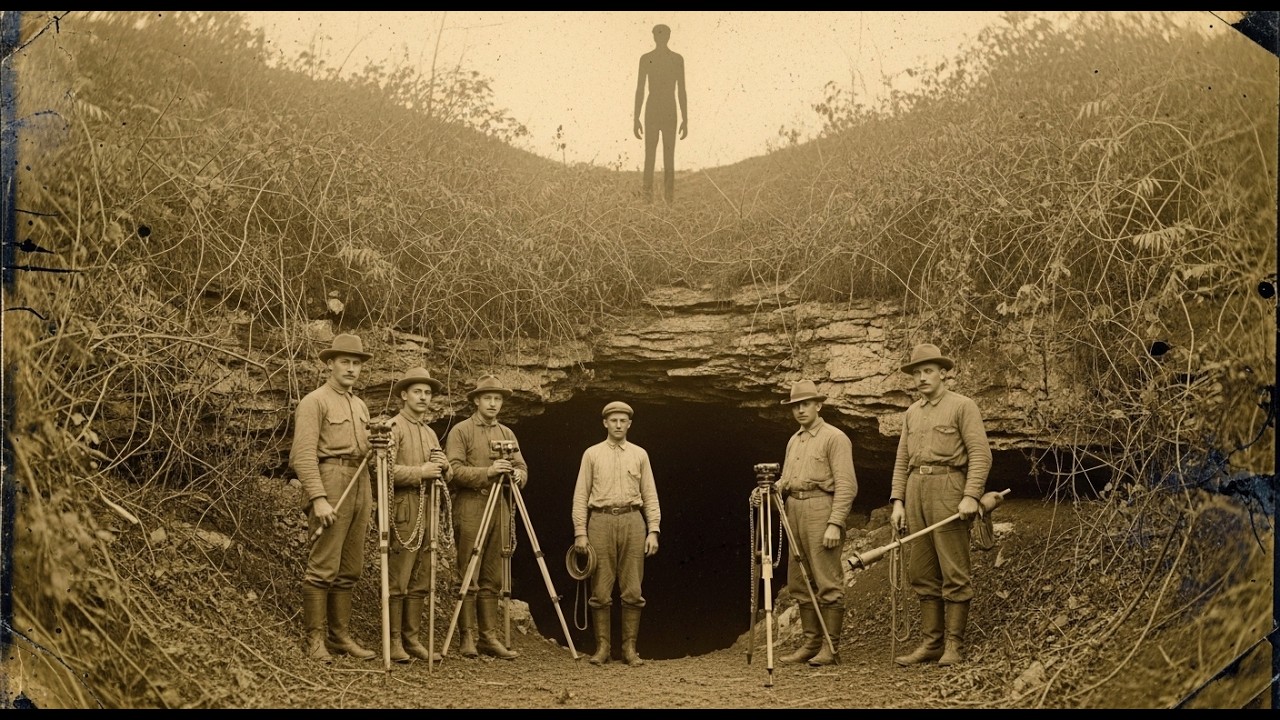
The photograph sat on Virgil Hatcher’s desk in the late afternoon sun, casting long shadows across the floor, and he could not stop looking at it. Five men in heavy canvas surveyor’s clothing stood in front of a cave entrance, theodolites and measuring chains in their hands, their faces serious in the way of men who did not yet know what was behind them. Barely visible in the shadowed mouth of the cave, something tall stood watching, something that did not fit the scale of everything else in the picture. Virgil Hatcher was forty-seven years old that summer, a geology professor at a small university in Missouri, a man who had spent twenty-three years teaching young people about the bones of the earth.
He had the kind of face that looked carved from the same limestone he studied, tall, just over six feet two, with shoulders permanently hunched from years bent over rock samples and field notebooks. His hands were stained with mineral dust that never quite washed clean, and he had a habit of running his thumb along his jawline when he was thinking, which was most of the time. The letter that came with the photograph arrived on a Tuesday morning in late May, delivered by a postal worker who seemed relieved to hand it over and leave quickly. The envelope was yellowed, as if it had sat somewhere for years before being mailed, and it smelled faintly of wood smoke and something else Virgil could not identify, something organic and old.
The handwriting was shaky but deliberate, the kind that came from a hand that had once been steady but was now fighting against tremors, or age, or fear. Inside was a single sheet of paper and the photograph. The letter was from a man named Cornelius Whitmore, who identified himself as a surveyor who had worked in the Ozarks back in 1894. Cornelius was now seventy-three years old and living in a veteran’s home in Arkansas.
He wrote that he had seen Virgil’s name in a university bulletin, that he had read an article Virgil had written about unusual geological formations in the Ozark Plateau. He wrote that he had been waiting for someone like Virgil, someone who might understand, someone who might believe. The letter explained that in 1894 Cornelius had been part of a surveying team mapping uncharted sections of the Ozarks for the federal government. They had been working in a region the locals called the folded hills, a series of valleys and ridges so tangled and confusing that compasses seemed to spin without settling.
On their third week in the wilderness, they had found a cave system that was not on any of their preliminary maps. They had gone inside to take measurements. Three of the five men in the photograph never came back out. Cornelius was one of the two who escaped.
For twenty-seven years, he wrote, he had kept quiet, had told himself it was shock or exhaustion or bad air in the caves. But he was an old man now, and old men stop lying to themselves when they run out of time. He wrote that something lived in those caves, something that walked upright but was too tall to be a man, something that moved in the darkness with a purpose that felt older than the mountains themselves. He wrote that he had heard it breathing, that he had felt its hand, if you could call it that, brush against the back of his shirt as he ran, that he had smelled it, a smell like wet stone and rotting meat and something sweet underneath, like honeysuckle blooming on a grave.
The letter ended with coordinates written in Cornelius’s trembling handwriting and a single sentence: “If you go there, Professor Hatcher, take more men than we did and don’t go deeper than the third chamber. ”
Virgil should have thrown it away. He should have written back with polite skepticism, the kind of gentle dismissal he used on students who brought him rocks they thought were meteorites but were just slag from old foundries. But Virgil Hatcher had spent his entire life studying the earth’s secrets, and here was a secret that called to him with a voice he could not ignore.
By the end of June, he had assembled his expedition team. Dalton Fairweather was a mining engineer from Colorado, thirty-nine years old, built like a fire plug with hands that could bend iron rebar and a mind that understood tunnels and shafts the way other men understood city streets. Dalton had red hair going gray at the temples and a scar across his left palm from a cave-in in Nevada that should have killed him but didn’t. Montgomery Ashford was a photographer and documentarian from New York, fifty-two years old, thin as a fence post with nervous hands and eyes that never stopped moving, always looking for the next shot, the next angle.
Montgomery had documented expeditions to Alaska and the Amazon, and he moved through the world like a ghost, present but somehow separate. Rutherford Gates was a physician who had served in the war in France, forty-one years old, with a steady gaze and steadier hands, who had seen enough torn bodies and shattered minds to not be easily shaken. And Phineas Merrow was a local guide from Arkansas, sixty-two years old, who knew the Ozarks like other men knew their own kitchens, who could read weather in the way leaves turned and find water by the smell of the air. They met in the town of Hollow Point, Arkansas in the first week of July, when the heat sat on the land like a weight and the cicadas screamed from dawn to dusk.
Hollow Point wasn’t much of a town, maybe forty buildings scattered along a muddy road, a general store, a blacksmith, a church with a steeple that leaned slightly to the left. The locals watched Virgil’s team with the kind of quiet suspicion that comes from living in places where strangers rarely bring good news. When Phineas asked around about the folded hills, about the cave system in that region, people got quiet. An old woman selling eggs at the general store crossed herself when she heard the name.
The blacksmith, a man with arms like tree trunks, said that his grandfather had told him stories about that area, about how animals wouldn’t go there, about how the fog never quite lifted even on clear days. Some places just feel wrong, like the air itself is trying to warn you. The folded hills were like that. Virgil’s team packed up their gear, loaded it onto three mules and two horses, and headed into the wilderness on a Thursday morning when the sky was the color of old bruises.
Phineas led the way on a trail that was barely a trail, more like a suggestion in the underbrush, winding between limestone bluffs and through stands of oak and hickory so dense the sunlight came down in fragments. The temperature dropped as they climbed, which didn’t make sense because they were heading into July heat, but Virgil marked it in his notebook anyway. Temperature anomaly, elevation nine hundred feet, fifteen degrees cooler than valley floor. They made camp on the second night in a clearing beside a creek that ran clear and cold over smooth stones.
Montgomery set up his camera equipment, glass plates carefully wrapped in cloth, tripods assembled with the precision of a man who had done this a thousand times. Dalton walked the perimeter of the camp studying the rock faces, running his hands over the stone like he was reading braille. Rutherford organized his medical supplies with the methodical calm of a man who had learned to prepare for the worst. Phineas built a fire and cooked bacon and beans in an iron skillet while the forest around them filled with the sounds of evening crickets and tree frogs and the distant call of a whip-poor-will.
They ate in relative silence, each man alone with his thoughts, watching the fire burn down to coals. Virgil took out the photograph Cornelius had sent, studied it by firelight for what must have been the hundredth time. That shape in the cave mouth, that tall shadow that didn’t quite resolve into anything he could name. Montgomery noticed him looking.
“You think it’s real? ” Montgomery asked, his voice quiet, almost reluctant. “The thing the old surveyor wrote about? ” Virgil folded the photograph carefully and put it back in his jacket pocket.
“I think Cornelius Whitmore believed it was real,” he said. “And I think three men died in those caves. Whether those two facts are connected, that’s what we’re here to find out. ” Dalton spat into the fire.
“I’ve been in caves all over this country,” he said. “Montana, Nevada, down in New Mexico. I’ve seen things that would make your skin crawl. Rock formations that look like faces, echoes that sound like voices, pockets of bad air that make you see things that aren’t there.
But I’ve never seen anything that walked upright that wasn’t a man or a bear, and I’ve never seen a bear that tall. ” He pointed at the photograph. “That thing in the background, if it’s not a trick of the light, if it’s not a shadow from the man standing in front, it’s got to be eight or nine feet tall. ”
They reached the coordinates Cornelius had provided on the afternoon of the third day.
The entrance to the cave system was exactly where the old surveyor had marked it, hidden behind a curtain of wild grapevine and sumac, set into a hillside that rose like the shoulder of something buried. The entrance was roughly circular, about twelve feet across, and when Virgil stood at the threshold and struck a match, the flame barely pushed back the darkness inside. The air that came out of the cave was cold and damp and carried that same smell Cornelius had mentioned in his letter, wet stone and decay and something sweet and wrong underneath. Phineas refused to go in.
He stood at the entrance with his hat in his hands, an old slouch hat stained with sweat and dirt. “This is as far as I go, Professor,” he said. “I’ve lived in these mountains sixty-two years, and I know when a place wants to be left alone. This place has been trying to tell you to turn around since we crossed into the folded hills.
If you’re going in there, you’re going without me. ” Virgil didn’t try to change his mind. He respected that kind of certainty, the kind that came from bones and blood, not books. Virgil, Dalton, Montgomery, and Rutherford entered the cave system while Phineas stayed outside with the animals and a rifle across his knees.
They brought kerosene lanterns and electric torches, rope and pitons, notebooks and sample bags, Montgomery’s camera equipment, Rutherford’s medical kit. The entrance tunnel sloped downward at a gentle angle, the walls smooth limestone worn by water that had been flowing for thousands of years before humans learned to make fire. Their footsteps echoed in ways that made it hard to judge distance, each sound bouncing and returning and bouncing again until it seemed like there were more than four men walking through the darkness. The first chamber was enormous, maybe a hundred feet across and sixty feet high, the ceiling lost in shadows that their lanterns couldn’t quite reach.
Stalactites hung down like teeth, and stalagmites rose from the floor in formations that looked almost intentional, almost arranged. Montgomery set up his camera and took photographs, the flash powder igniting with a hiss and a flare that left spots in Virgil’s vision. Dalton walked the perimeter, tapping his walking stick against the walls, listening to the way the stone answered. “This formation doesn’t make sense,” Dalton said, his voice carrying strangely in the big space.
“The striations are all wrong. Limestone caves form from water dissolution, right? Water flows, it carves, it creates patterns. But these walls, it’s like something scraped them smooth, like something wore them down through contact, not flow.
” Virgil made notes. Anomalous wall texture, first chamber, possible mechanical abrasion. He didn’t write what he was thinking, which was that the walls looked worn in the way a doorframe gets worn when thousands of people pass through it over years and years, their hands and shoulders brushing the same spot until the wood goes smooth and dark. They found the first of Cornelius’s markers in the passage leading to the second chamber.
It was a wooden stake, almost rotted through, with the initials CW carved into it and an arrow pointing back toward the entrance, a way to find the way out if the darkness got confusing. Virgil felt a strange kinship with Cornelius in that moment. This man he’d never met, this surveyor from twenty-seven years ago, who had stood in this same passage and driven this stake into the ground, who had been thinking about escape before he even knew he’d need to. The second chamber was smaller than the first, maybe fifty feet across, but the ceiling was higher, disappearing into darkness that seemed absolute, that their lanterns couldn’t even begin to penetrate.
There was water here, a pool in the center of the chamber, perfectly still, reflecting their lights like a mirror. Rutherford knelt beside it and dipped his hand in. “It’s warm,” he said, surprise in his voice. “Almost body temperature.
That’s not right for ground water this deep. ” He pulled his hand out and dried it on his pants, and Virgil noticed that Rutherford was looking at his palm like he expected to see something there, some mark or stain. Montgomery was setting up his camera again when he stopped mid-motion, his hands frozen on the tripod legs. “Do you hear that?
” he asked, his voice barely above a whisper. They all stopped, stood perfectly still, lanterns held high. At first, Virgil heard nothing but the usual sounds of a cave, the drip of water, the settling of stone, the rush of his own blood in his ears. But then he heard it, too, a sound like breathing, slow and deep and rhythmic, coming from somewhere deeper in the cave system, from the passage that led to what Cornelius had called the third chamber.
It was the sound of something large drawing air in and pushing it out, something with lungs bigger than any lungs should be. Dalton moved toward the sound, his lantern held out in front of him like a weapon. “Could be an airflow,” he said, but his voice lacked conviction. “Could be wind moving through a restriction making that sound.
” But Virgil had spent enough time in caves to know what wind sounded like, and this wasn’t wind. This was breath. They found the second marker at the entrance to the passage leading to the third chamber. Another stake, another set of initials, but this one had something else carved into it, a single word: run.
Cornelius had carved it deep into the wood, the letters rough and panicked, made by someone whose hands were shaking. Virgil ran his fingers over the word, felt the grooves worn smooth by time and moisture. “Cornelius said not to go deeper than the third chamber,” Virgil said, looking at his team. “Maybe we should listen to him.
” But Dalton was already moving forward, his engineer’s curiosity stronger than his caution. Montgomery followed, his camera bag over his shoulder, unable to resist the documentation of whatever lay ahead. Rutherford looked at Virgil and shrugged, a gesture that said, “We’ve come this far,” and followed the others. Virgil took a breath, smelled that sweet rot smell stronger now, and went after them.
The passage to the third chamber was narrow, barely wide enough for a man to walk upright, and it twisted like an intestine, turning back on itself in ways that made Virgil lose his sense of direction. The breathing sound got louder as they descended, and with it came a new sound, a wet sliding sound like something heavy being dragged across stone. The walls here were different, not smooth, but marked with scratches, deep gouges that ran horizontally about seven feet up from the floor. Dalton stopped and examined them with his lantern held close.
“These are fresh,” he said, his voice tight. “I mean, relatively fresh, within the last few decades, maybe. And they’re not natural. Something made these marks, something with—I don’t know—claws, nails, something hard and sharp.
” Virgil touched one of the gouges, felt how deep it went, felt the way the stone had been split and scraped. Whatever made these marks had been strong, terribly strong. The third chamber was where everything changed. They emerged from the passage into a space that was somehow worse than the others, not because it was bigger or stranger, but because it felt occupied.
The chamber was maybe seventy feet across and shaped like an egg lying on its side. The ceiling was low here, only about ten feet up, close enough that Virgil felt like it was pressing down on him. But it was what was in the chamber that made Montgomery drop his camera bag, made Dalton take a step backward, made Rutherford’s hand go to the hunting knife on his belt. The floor was covered in bones, not scattered randomly, but arranged.
Piles of bones sorted by type. Femurs in one pile, ribs in another, skulls in a third. Human skulls and animal skulls, deer and bear and something else Virgil couldn’t identify. Something with teeth too long and eye sockets too large.
The bones were old, some of them crumbling to dust, but some were newer, still carrying scraps of dried tissue. And in the center of the chamber, in a space cleared of bones, was a shape. It was tall, maybe eight and a half feet, and it was curled on its side like something sleeping. In the lantern light, Virgil could see that it was covered in something that looked like skin, but moved wrong, that seemed to shift and flow, even though the thing itself was still.
The smell was overwhelming here, that sweet rot smell mixed with something else, something that made Virgil’s throat close and his stomach turn. Montgomery raised his camera, his hands shaking so badly the equipment rattled. “I need to document this,” he whispered. “I need to.
” But before he could set up the tripod, the thing moved. Not much, just a twitch, like a dog dreaming, but it was enough. Enough to see that what they had thought was skin was actually thousands of pale writhing things, like maggots or worms, covering the thing’s body, moving in waves. Enough to see that the thing had hands, or something like hands, with fingers too long and too many joints.
Enough to see that it was breathing, that the sound they’d been hearing was coming from this thing, this impossible thing that shouldn’t exist, but was lying right there in front of them. Dalton made a sound, something between a gasp and a moan, and stumbled backward. His boot came down on a pile of ribs and they shattered with a crack that echoed like a gunshot in the enclosed space. The thing stopped breathing, just stopped mid-exhale.
And the silence that followed was so complete it felt like the whole mountain was holding its breath. Then, slowly, horribly, the thing began to unfold. It rose to its hands and knees first, and Virgil saw that its spine was wrong, that it bent in too many places, that it moved like a snake wearing a man’s skeleton. The things covering its skin, the pale writhing things, moved faster now, agitated, and Virgil realized they weren’t separate organisms at all.
They were part of it, extensions of it, growing from it. When it turned its head toward them, Virgil saw its face, and something in his mind just refused to hold onto the image. His brain slid off it like water off glass. He got impressions: too many eyes or not enough, or eyes in the wrong places.
A mouth that opened vertically instead of horizontally. Teeth that looked more like the teeth of some deep sea thing than anything that should live in a cave. The thing made a sound, a low rumbling that Virgil felt in his chest more than heard, and then it stood up. Fully upright, it was massive, easily nine feet tall, its head brushing the ceiling of the chamber.
Its arms hung down too far, its fingers nearly touching the ground. And it was looking at them with something that felt like recognition, like it remembered humans, like it had been waiting for more to come back. Rutherford broke first. He turned and ran back toward the passage, his lantern swinging wild, throwing crazy shadows.
Montgomery grabbed his camera bag and followed, abandoning the tripod, abandoning everything but his documentation. Dalton and Virgil stood frozen for one more second. And in that second, the thing took a step toward them. Not a lunge, not an attack, just a step, curious, testing, seeing if they would run or stand.
Virgil grabbed Dalton’s arm and pulled him backward, and they both turned and ran, their lanterns clanging against their legs, their breath coming in ragged gasps. Behind them, they heard the thing moving, heard its hands, if they were hands, hitting the cave floor with wet slapping sounds, heard it making that rumbling sound again. And this time, it almost sounded like words, like it was trying to shape human speech with a throat that had forgotten how. The passage out of the third chamber seemed longer than the passage in, seemed to twist more, seemed to want to keep them there.
Virgil could hear the thing behind them, could hear it squeezing through the narrow space, could hear its skin scraping against the stone walls. Montgomery was ahead, then Rutherford, then Dalton, then Virgil bringing up the rear. Virgil’s lantern went out, the kerosene sloshing out when he stumbled over a rock, and he was running in darkness with only the faint glow from Dalton’s light ahead of him. He felt something brush the back of his shirt, felt something that might have been fingers, might have been something worse.
And he screamed without meaning to, a raw sound of pure animal terror. They burst into the second chamber and didn’t stop, running along the edge of the warm pool, their boots splashing through shallow water at the edges. The thing came out of the passage behind them, and in the reflected light from the pool, Virgil saw it fully for the first time, saw how wrong it was, how it moved like it was in pain, like existing was agony. Saw how those pale things on its skin reached out toward them like tiny hands.
Montgomery was at the passage to the first chamber now, Rutherford right behind him, and Dalton was pulling at Virgil’s arm, shouting at him to move, to run, to not look back. But Virgil couldn’t help it. He looked back and saw the thing standing at the edge of the pool, its too-long arms hanging down, its head tilted at an angle that would have broken a human neck. And it was making that sound again, that almost-word sound, and this time, Virgil thought he could make out what it was trying to say.
It sounded like stay, or maybe wait, or maybe just please. They ran through the first chamber without stopping to gather any of Montgomery’s equipment, without pausing to catch their breath. The stalactites and stalagmites blurred past them, and Virgil heard something crash behind him, heard the thing knocking aside stone formations that had been growing for ten thousand years. The entrance tunnel was ahead, and Virgil could see daylight, real blessed daylight filtering in through the cave mouth.
Phineas was there, silhouetted against the light, his rifle raised, and when he saw them running, he started shouting, started yelling for them to hurry. They burst out of the cave into afternoon sunlight that felt like a physical blow after the darkness. Virgil fell to his knees, gasping, his heart hammering so hard he thought it might break his ribs. Rutherford was vomiting against a tree.
Montgomery was checking his camera bag with shaking hands. Dalton was standing with his hands on his knees, breathing in great whooping gasps. Phineas had his rifle pointed at the cave mouth. “What is it, Phineas?
” he asked. “What’s in there? ” But before any of them could answer, they heard it, that breathing sound coming from just inside the entrance, in the shadows where the daylight didn’t quite reach. The thing was there, just inside, just out of sight.
They could see a shape, tall and wrong, moving slightly, that wet sliding sound as it shifted its weight. And then, incredibly, it spoke. Not the almost-words from before, but actual words, shaped with effort, pushed out of a throat that wasn’t made for human speech. “No.
” “Leave. ” It said. The voice wet and thick and wrong. “No.
Leave us alone. ” And then it was gone, withdrawn into the darkness, and they heard it moving away, heard it going deeper into the mountain, back to whatever place it came from. They packed up their camp in twenty minutes, leaving half their gear behind, loading onto the horses and mules only what they could grab quickly. Phineas led them out of the folded hills by a different route, a faster route, and none of them asked why he knew a faster way out.
They made it back to Hollow Point by nightfall, riding hard, not speaking, each man locked in his own thoughts. In town, they went to the boarding house where they’d left some of their supplies, and they sat in the common room while the landlady brought them coffee and bread. None of them ate. None of them spoke.
Finally, Montgomery opened his camera bag and took out the glass plates he’d exposed in the cave. He held them up to the lamplight one by one, examining them. His hands were steady now, but his face was pale. “They’re all blank,” he said quietly.
“Every single plate. Like the flash went off, but captured nothing. Or like something took the image, pulled it right off the glass. ” He looked at Virgil.
“We have no proof, no documentation, nothing but our word that any of this happened. ” Virgil reached into his jacket pocket and pulled out the photograph Cornelius had sent him, the one with the five surveyors and the shape in the background. He looked at it for a long time, at those men who didn’t know what was about to happen to them, at that tall shadow that three of them would never escape. “Cornelius has been living with this for twenty-seven years,” Virgil said.
“He’ll believe us. Maybe he’s the only one who will. ”
They left Hollow Point the next morning before dawn, not bothering to say goodbye to anyone, not wanting to answer questions. The train back to Missouri took two days, and they barely spoke to each other the whole time.
At the station in Columbia, they went their separate ways with handshakes and promises to stay in touch that they all knew were lies. Some things you can’t share. Some things you have to carry alone. Virgil went back to his office at the university, back to his classes and his rock samples and his comfortable, predictable life.
But something had changed in him. He found himself jumping at shadows, found himself unable to go into basements or storage rooms without his heart racing. He started sleeping with a lamp on, which he told himself was ridiculous, which he knew wouldn’t help if anything was really there. He wrote to Cornelius a long letter describing everything they’d seen, everything they’d experienced.
He mailed it to the veterans home in Arkansas and waited for a reply. It came three weeks later, but it wasn’t from Cornelius. It was from the home’s administrator, informing him that Cornelius Whitmore had passed away two days after Virgil’s team had entered the caves. Heart failure.
Peaceful in his sleep. The administrator said that Cornelius had seemed at peace in those final days, like a weight had been lifted, like he’d been waiting for something and had finally received it. Virgil kept teaching for another twelve years. He published papers on Ozark geology, on limestone formations, on the effects of water erosion on sedimentary rock.
He never mentioned the cave system in the folded hills. He never filed a report about the expedition. He told himself it was because he had no proof, because Montgomery’s photographs had all been blank, because no one would believe them anyway. But the truth was simpler and darker.
He was afraid that if he told anyone, if he drew attention to that place, someone else might go looking. Some other curious academic or adventure seeker might read his report and decide to investigate. And he couldn’t bear the thought of sending someone else into that darkness. He heard about Montgomery three years after the expedition.
The photographer had moved back to New York and started drinking heavily. One night, drunk and rambling in a bar in the village, he’d told some people about a cave in Arkansas, about a thing that lived there, about photographs that showed nothing. Someone had written it up as a joke piece in a local paper. “Mad photographer claims to have seen cave monster.
” Montgomery read the article, walked to the Brooklyn Bridge, and jumped off. They found his camera bag on the walkway, empty except for a note. “It took my images. It took my proof.
Now it’s taking my sleep. Better to end it. ” Virgil went to the funeral, stood in the back of the church, didn’t speak to Montgomery’s widow. What could he say that wouldn’t sound insane?
Dalton lasted longer. The mining engineer went back to Colorado and threw himself into his work, taking jobs in deeper and deeper mines, places where other men refused to go. Virgil got a letter from him in 1928, seven years after the expedition. Dalton wrote that he’d been working in a silver mine near Leadville, working a shaft that went down nearly three thousand feet.
He’d found marks on the walls down there, marks that looked like the ones they’d seen in the cave in Arkansas. Scratches, gouges made by something that wasn’t mining equipment. He wrote that he’d started hearing things in the deeper tunnels, breathing sounds, movement sounds. He wrote that he thought maybe it wasn’t alone, that thing in the Ozarks, that maybe there were others scattered through the mountain ranges of America, sleeping in caves and mine shafts, waiting.
The letter ended abruptly, mid-sentence. Dalton was found a week later at the bottom of a shaft, his neck broken. The official report called it an accident, said he’d fallen. But Virgil knew better.
Dalton had jumped. Dalton had chosen the fall over whatever he’d heard in the darkness. Rutherford, the doctor, seemed to have fared the best of them, at least for a while. He went back to his practice in St.
Louis, back to treating patients and setting bones and delivering babies. But he started refusing cases that required him to work at night. Started closing his office at sunset and not opening until well after dawn. His colleagues thought he was getting old, getting cautious.
But Virgil knew. Rutherford couldn’t bear to be outside in the dark, couldn’t stand the thought of what might be moving in the shadows. They corresponded occasionally, brief letters that never mentioned Arkansas, never mentioned caves. But in 1932, Virgil got a telegram from Rutherford’s son.
The doctor had suffered some kind of mental collapse. He’d been found in his office at three in the morning, all the lights on, barricaded behind his desk with medical instruments scattered around him like weapons. He kept saying something was coming, something was getting closer. They put him in an asylum where he died six months later.
Heart failure, the official cause read. But Virgil wondered if a person could die of fear, if terror could accumulate over years until it just stopped the heart. Phineas, the guide, disappeared. Virgil tried to find him a few years after the expedition, sent letters to Hollow Point, asked around.
No one had seen him. The locals said he’d gone deeper into the Ozarks, said he’d built a cabin somewhere in the most remote part of the mountains, somewhere without roads or trails. Someone claimed to have seen smoke from his campfire once, up on a ridge that didn’t have a name. But Phineas never came out, never came back to civilization.
Virgil understood that, too. How do you live among people? How do you go about normal life when you’ve seen something that proves the world is stranger and more terrible than anyone knows? Maybe Phineas had it right.
Maybe isolation was the only answer. As for Virgil, he kept teaching until 1933, when he retired at fifty-nine, earlier than he’d planned, but he couldn’t keep up the pretense anymore. Couldn’t stand in front of students and talk about the rational, orderly processes of geology when he knew there were things in the earth that didn’t follow any rules he understood. He moved to a small house in Columbia, Missouri, a house with good locks and lots of windows, a house where he could see anyone approaching from any direction.
He kept his field notebooks in a safe in his bedroom, all except one. The notebook from the expedition to the folded hills, that one he burned. Burned every page, burned his notes about the breathing sound and the bone piles and the thing that had spoken to them from the darkness. Burned the coordinates Cornelius had sent him.
Let the ashes scatter in the wind. But he kept the photograph, the one of the five surveyors standing in front of the cave entrance, the one with that tall shape in the background. He kept it in an envelope in his desk, and sometimes, on nights when he couldn’t sleep, he’d take it out and look at it. He’d think about Cornelius, who had lived with his secret for twenty-seven years.
He’d think about the three men who hadn’t made it out of that cave in 1894, about what might have happened to them, about whether that thing had killed them or if something worse had occurred. He’d think about the bone piles, sorted and arranged with a terrible patience. He’d think about how the thing had spoken to them, had said, “No. Leave us alone.
” Like it was tired, like it wanted to be forgotten. He’d think about that word us, plural, and wonder how many of them there were, scattered through the mountains, through the caves and deep places of the world. In 1941, when Virgil was sixty-seven years old and his health was failing, he received a package in the mail, no return address, postmarked from Arkansas. Inside was a newspaper clipping from the Hollow Point Gazette, a tiny paper that probably had a circulation of about fifty people.
The clipping was dated three weeks earlier, and the headline read, “Local man missing after exploring old cave system. ” The article was brief. A man from Little Rock, an amateur spelunker named Harold Dunsworth, had been exploring caves in the folded hills region. He’d told his wife he’d be back in two days.
That had been a week ago. Search parties had found his car, found his equipment at the cave entrance, but no sign of Harold himself. The cave entrance matched the description in his notes. Deep circular opening hidden by vegetation in a hillside that rose like a buried shoulder.
Virgil stared at that clipping for a long time. Then he took out a piece of paper and wrote a letter. He addressed it to the sheriff of Hollow Point, Arkansas, though he didn’t know if the town even had a sheriff anymore. In the letter, he explained that he was a retired geology professor who had explored that cave system in 1921.
He explained that the cave was dangerous, unstable, prone to bad air pockets that could cause hallucinations. He explained that it should be sealed, blasted shut, marked as condemned. He explained that no one else should go in there. He explained everything except the truth.
He mailed the letter and waited. He never got a reply. He didn’t know if they sealed the cave. He didn’t know if Harold Dunsworth was ever found.
He didn’t know if the thing was still there, waiting in the third chamber surrounded by its bone piles, speaking its few words to the darkness. Virgil died in 1943, alone in his house in Columbia, Missouri. The coroner said it was a stroke, quick and final. Virgil’s nephew, who inherited the house, found the desk with the envelope inside, found the photograph of the five surveyors, and that tall shadow in the background.
The nephew thought it was just an old picture, a bit of family history, maybe a great uncle or something. He put it in a box with other papers and photographs and stored it in his attic. The box sat there for thirty years gathering dust until the nephew died and his daughter found it while cleaning out his house. She looked through the photographs trying to identify the people, trying to piece together her family history.
She didn’t recognize anyone in the surveyor photograph, didn’t know who those five men were or why they were standing in front of a cave, but something about the photograph bothered her. That shape in the background, barely visible in the shadows. The more she looked at it, the more wrong it seemed. Too tall, too thin, proportions all off.
She showed it to her husband, who was a photography buff who collected vintage cameras and old glass plates. He looked at it through a magnifying glass and said it was probably just a defect in the developing process, a shadow artifact or light leak. But his hands were shaking when he handed the photograph back and he didn’t want to look at it again. She put it back in the box and forgot about it, or tried to.
But sometimes late at night, she’d remember that shape in the cave mouth and she’d lie awake wondering if it was really just a defect or if the photographer had captured something real, something that had been looking out at him while he took the picture. The box with the photograph is still out there somewhere, passed down through Virgil’s family line, sitting in someone’s attic or basement or storage unit. Maybe you’ve seen it if you’re into vintage photographs, if you collect old images from estate sales and antique shops. Five men in surveyors clothes standing in front of a cave entrance, instruments in their hands, serious expressions on their faces.
And if you look closely at the background, at the shadows just inside the cave mouth, you might see something. Something tall and wrong and watching. The photograph is real. The expedition was real.
And if you ever find yourself in the Ozark Mountains in a region where the valleys fold back on themselves and compasses spin without settling, if you find a cave entrance hidden behind wild grapevine and sumac, circular and about twelve feet across, if you smell wet stone and rot and something sweet underneath, turn around. Walk away. Don’t go inside, because some things should stay in the darkness. Some things are waiting there on purpose, waiting with a patience older than human history, waiting for someone curious enough or foolish enough to come looking.
Virgil Hatcher knew that. Cornelius Whitmore knew that. Three unnamed surveyors from 1894 knew that, though they learned too late. Harold Dunsworth from Little Rock learned it in 1941, and maybe others have learned it since.
People whose disappearances got written up in small town newspapers and then forgotten. The folded hills are still there. The cave is still there. And the thing in the third chamber surrounded by its bone piles, breathing its slow, patient breaths, speaking its few words to the empty darkness, it’s still there, too, waiting, always waiting.
Because that’s what it does. That’s what it’s always done. It waits in the deep places, in the caves and mine shafts and forgotten corners of the earth. And it waits for us to come looking.
And when we do, when we bring our lights and our cameras and our scientific certainty down into its domain, it shows us that the earth holds secrets we were never meant to uncover, that some questions should never be asked, that some doors should never be opened. Virgil understood that in the end. That’s why he burned his notebooks. That’s why he tried to warn the sheriff in Arkansas.
That’s why he died with that secret locked inside him, never speaking of it, never publishing anything about it, letting the official story be that the expedition was canceled due to weather or funding or some other mundane reason. He understood that the thing in the cave had let them leave, had chosen to let them run, had spoken to them from the darkness asking to be left alone. And Virgil honored that in his way. He left it alone.
But others haven’t. Others won’t. Because humans are curious creatures and we can’t resist the unknown, can’t resist the mystery, can’t resist going just a little deeper, just a little farther, just to see what’s there. And maybe that’s fine.
Maybe that’s how it should be. Maybe the thing in the folded hills understands that, too. Understands that we’ll keep coming generation after generation, drawn by rumors and photographs and old letters. Understands that it will never truly be alone.
That every few decades someone will find their way into the third chamber, will see the bone piles and smell that sweet rot smell and hear that breathing in the darkness. Understands that this is the bargain, the ancient, terrible bargain between us and the things that lived in the earth long before we did. They wait. We come.
And some of us leave, and some of us don’t.
