On the night of May 10, 1904, a violent thunderstorm swept across the Ozarks. Lightning struck a tree on the eastern edge of the Miller farm. Through the rain, the nearest neighbor, Harold Jenkins, watched Jacob Miller walking in circles around his property, carrying what appeared to be a lantern, stopping every few yards to pour something onto the ground. A traveling salesman named Thomas Crawford, sheltering in an abandoned hunting cabin half a mile away, later swore to the sheriff that he heard cries carried on the wind between the thunderclaps—sounds that began like a woman screaming but twisted into something deeper, more resonant, as if many voices were layered over one another.
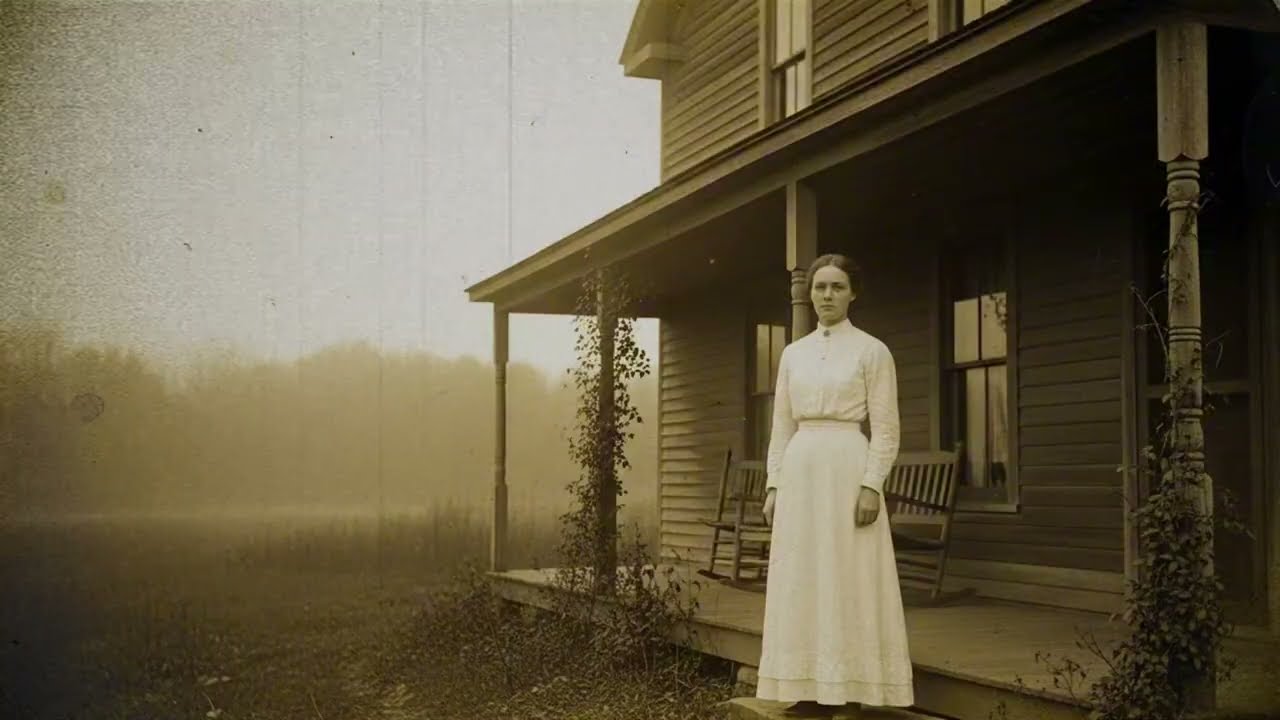
Crawford claimed twenty years of wandering these hills had never prepared him for what he heard that night. By morning, Jacob Miller was dead on the road to Fayetteville, a mile from his farm, his clothes soaked through, a small leather bag clutched in his hand containing what appeared to be dirt from his own property—soil that a coroner’s exam would find laced with unidentified organic matter not native to the region. This is the story of what happened at the Miller farm in Washington County, Arkansas, in 1904. It is a story that never made the national headlines, yet the locals have whispered about it for generations.
At the center of it stands Elizabeth Miller, remembered in the sparse records as the “afflicted daughter of the Ozarks,” though the true nature of her affliction remains unresolved to this day. Before her decline, Elizabeth Miller lived a quiet life. Born to Jacob and Margaret Miller in 1878, she grew up on the family’s modest forty-acre farm, where they raised chickens and grew tobacco. Neighbors described her as reserved but kind, often seen helping her father at the market on Saturdays.
She was the third of five siblings and the only one who remained at home past the age of twenty, a fact that later fueled speculation about her relationship with her parents. Tax records from 1900 show the farm struggling financially, with three consecutive years of declining output. A severe drought had hit the region, and many small farms were barely surviving. Two of Elizabeth’s brothers had moved west to Oklahoma Territory; her two sisters married and relocated to Missouri.
When her mother, Margaret, died in 1899 of what death records vaguely called “consumption of the lungs,” Elizabeth was left alone with her father. The Miller house was a two-story timber structure built in the 1870s, with a stone foundation and a steep roof typical of Ozark architecture, designed to shed heavy snow. It contained four rooms on the ground floor—a kitchen, a dining room, a living room, and Jacob’s bedroom—and two upstairs rooms, one of which belonged to Elizabeth. A narrow staircase connected the floors, creaking loudly with every step, as Harold Jenkins would later describe.
Behind the house stood a tobacco barn, a chicken coop, and a small smokehouse. A hand-dug well provided water, located about twenty yards from the back door. The farm sat in a small valley surrounded by dense forest on three sides, with a dirt road connecting to the main route into Fayetteville. Harold Jenkins, the nearest neighbor, lived half a mile down that road.
This isolation would later become significant as events unfolded. Elizabeth’s daily life before her trip to St. Louis followed a predictable pattern. She rose before dawn to tend the chickens and prepare breakfast for her father.
Mondays were for laundry, hung on a line stretching from the house to a large oak tree in the yard. Tuesdays and Wednesdays were devoted to the small vegetable garden that supplied much of their food. Thursdays she often spent in Fayetteville selling eggs and sometimes tobacco when they had a surplus. Fridays and Saturdays were for cleaning and baking; Sundays were nominally for rest, though Jacob rarely attended the local Baptist church after his wife’s death.
Elizabeth had few social connections outside the family farm. Martha Simmons, who delivered milk to outlying properties, recalled in her statement to authorities that Elizabeth seemed hungry for conversation during her brief visits, asking about the finest details of town life—who had visited the general store, what new goods had arrived by train, even the weather in other parts of the county. One detail mentioned in several accounts was Elizabeth’s interest in plants. The small garden behind the Miller house included not only practical vegetables but also a section of medicinal herbs and unusual flowering plants that Elizabeth tended with particular care.
In an earlier journal entry from 1900, when Dr. Thomas Hargrove treated Jacob for a persistent cough, the doctor noted that the daughter displayed considerable knowledge of herbal remedies, suggesting dog fennel tea and wild cherry bark—which he admitted proved effective. Neighbors remembered Elizabeth collecting specimens from the surrounding woods, especially fungi and mosses, which she pressed carefully between the pages of an old ledger book. Martha Simmons recalled that Elizabeth once remarked that plants speak to those who know how to listen, especially those that grow in dark places.
In January 1904, something out of the ordinary happened. According to passenger records preserved in the Missouri Pacific Railroad archives, Elizabeth traveled alone to St. Louis—a journey of about 300 miles from her isolated farm life, representing her first known departure from Washington County. She stayed there for exactly six weeks.
The purpose of her visit remains unknown, though it coincided with early preparations for the 1904 St. Louis World’s Fair, scheduled to open that April. The trip was exceptional for several reasons. It represented a significant financial investment for a struggling family.
It was highly unusual for an unmarried woman to travel such a distance alone in rural American society at that time. And no record exists of who might have invited her or where exactly she stayed in St. Louis. The only documentation of her time in the city comes from a single postcard sent to her father, postmarked January 21, 1904.
The card, bearing an image of the newly constructed Union Station, contained a brief message: “Father, the treatment is going well. Dr. K. says I am showing unusual responsiveness.
The headaches have stopped, though the dreams have become more intense. Will write more soon. E. M.
” No other correspondence was ever found. The identity of Dr. K. remained unknown until the discovery of Elizabeth’s partial diary decades later.
Elizabeth returned to Fayetteville on March 2, 1904, as confirmed by the station master’s record. Wilma Patterson, who ran the general store, later told investigators that Elizabeth came in the day after her return. She looked different, Patterson noted. She kept glancing out the window while paying for supplies, as though someone might be watching her.
When asked about St. Louis, Elizabeth only said it was bigger than she had expected and changed the subject. Patterson also noticed that Elizabeth purchased items not usually on her list: extra kerosene, several yards of heavy fabric, a new lock, and a large quantity of salt. When questioned about these purchases, Elizabeth explained that the winter had lasted longer than expected and the farm needed extra supplies.
Harold Jenkins reported encountering Elizabeth about a week after her return. He had brought a repaired harness for Jacob and found Elizabeth alone in the house. Jenkins remembered that she stood in the kitchen perfectly still, staring at the wall. When he called her name, she did not respond for nearly half a minute.
Then she turned and smiled, but it was not her usual smile. Her lips moved, but her eyes remained fixed and vacant. She said, “They are settling in well,” which he assumed referred to new chickens or something similar, although he saw no sign of new livestock on the property. Within two weeks of her return, Elizabeth began to change more dramatically.
Jenkins met Jacob Miller at the edge of the farm in mid-March and reported that Jacob looked as though he had not slept in days. When asked about Elizabeth, Jacob said she had taken to bed with a fever. Jenkins offered to send his wife with soup, but Jacob refused sharply, saying it was not that kind of illness. During this period, several unusual incidents occurred around the Miller farm.
Farmers reported cattle behaving strangely, horses refusing to pass by the property, and livestock breaking fences to move away from the direction of Miller land. Samuel Whitaker, whose property adjoined the Miller land on the western end, noted in his personal diary—discovered during a home renovation in 1957—that his dogs howled constantly when the wind blew from the east, carrying a scent from the Miller place. The dogs refused to hunt on that side of the property, cowering and whining when urged in that direction. By early April, rumors were spreading through Fayetteville.
Martha Simmons reported hearing terrible sounds, like someone in agony trying to stifle their voice, coming from the Miller house when she approached with deliveries. She noticed that Jacob met her at the edge of the farm and no longer invited her inside as he once had. His appearance deteriorated with each passing week. His clothes hung loose, suggesting significant weight loss.
Dark circles shadowed his eyes, and his hands trembled when counting out payment for the milk. Once, when she asked him directly about Elizabeth’s health, he stared past her toward the forest and whispered, “She brought something back with her. Something hungry. ” Before she could ask what he meant, he gathered his purchases and hurried back toward the house, glancing over his shoulder as if expecting someone to follow.
On April 17, 1904, Dr. Thomas Hargrove was summoned to the Miller farm by Jacob. The doctor’s diary, discovered in 1961 during a renovation of the old Fayetteville Medical Society building, contains a disturbing entry. “Called to the Miller farm.
The daughter, Elizabeth, 26, shows signs of acute mental disturbance. The father claims her condition deteriorated after her return from St. Louis. Patient has no fever but does not respond to basic stimuli.
Her eyes are fixed on the corners of the room. Prescribed bed rest and valerian tincture. ” In an addendum dated April 18, Hargrove wrote further: “I am concerned about the Miller case. The patient’s physical symptoms do not align with her mental state.
No fever, regular pulse, pupils responsive, yet she displays complete detachment from her surroundings. When asked about pain, she only whispered, ‘It moves when I sleep. ‘ The father refused further examination and seemed agitated when I suggested transferring her to the county hospital for observation. ” Most concerning was the condition of the patient’s skin.
Along her arms, Hargrove noted several small, precise wounds, about half an inch long, in various stages of healing. When questioned, Jacob claimed his daughter had developed a habit of scratching herself in her sleep. However, the uniform nature and placement of these wounds suggested they were deliberate rather than unconscious self-harm. Beneath the skin surrounding these wounds, Hargrove felt slight movement upon pressure, though the patient felt no pain during the procedure.
The doctor concluded his entry with a troubling observation: as he was preparing to leave, he noticed unusual growth patterns in the vegetation immediately surrounding the Miller home. The plants appeared unnaturally vigorous despite recent drought conditions, particularly along the north wall of the house, where a type of moss he could not identify had spread in an almost geometric pattern. He collected a sample for later examination. There is no record of Hargrove analyzing this sample, though a later entry mentions sending it to a colleague at the University of Missouri for identification.
The reply, if it arrived, was never recorded. What exactly happened to Elizabeth in St. Louis? No definitive answer exists in any of the documents found.
However, potential evidence emerged in 1964 when historian Margaret Wilson discovered correspondence between Dr. Elias Crane of the St. Louis Medical Society and a colleague in Boston. In a letter dated February 1904, Dr.
Crane mentioned a remarkable case. “A young woman from rural Arkansas participating in experimental treatment for nervous exhaustion is showing astonishing response to new electrotherapeutic methods, though she complains of unusual sensations afterward. I intend to document this approach thoroughly for the medical conference. ” A follow-up letter dated February 27 contains a more enigmatic passage.
“I have ceased documentation of the Arkansas subject. The results exceeded expectations to such a degree that discretion has become paramount. I recommend similar caution regarding your case in New Hampshire. These transformations are proving more volatile than anticipated, especially in females from rural environments, and I suggest observation without intervention following discharge.
The natural course is clearer when unobstructed. ” Whether these references pertain to Elizabeth Miller cannot be confirmed with absolute certainty, though the timing coincides with her stay in the city. Research conducted in 1965 revealed that all of Dr. Crane’s patient files from January through March 1904 were missing from the St.
Louis Medical Society archives. His death certificate, dated December 1904, lists the cause of death as acute respiratory failure resulting from a fungal infection of unknown origin. By late April, the situation at the Miller farm had deteriorated significantly. Local weather records indicate that the spring of 1904 brought unusually heavy rains to the Ozark region, with reports of flooding in low-lying areas around Fayetteville.
The Miller property, situated in a small valley, would have experienced considerable moisture—ideal conditions for fungal growth. On April 29, 1904, Sheriff William Dougherty visited the property following neighbor complaints about disturbing noises at night. His official report, preserved in county records, states: “Arrived at the Miller farm around two in the afternoon. Jacob Miller appeared disheveled and unshaven, claimed his daughter was improving but sleeping, refused me entry to the house.
I noticed an unusual odor resembling copper and rotting meat. ” When questioned, Miller explained he was treating a sick cow in the barn. The sheriff had no legal grounds to force entry. In his personal notes, however, Dougherty recorded additional observations not included in the official report.
The Miller property was in a state of neglect beyond what would be expected even for a struggling farm. The livestock appeared underfed. The chickens were unusually agitated. Most striking was the condition of the vegetation around the house—abnormally dense despite surrounding farmers reporting drought effects.
He particularly noted unusual growth on the north side of the house, a type of fungus or moss forming patterns across the wooden boards and extending about seven feet up the wall. Miller became agitated when he noticed the sheriff’s interest in this growth, positioning himself to block the view and insisting Dougherty leave immediately. The sheriff never returned. On May 3, 1904, Jacob Miller appeared at the office of Fayetteville attorney James Whitaker.
According to Whitaker’s notes, found among his possessions after his death in 1938, Miller wanted to update his will to leave everything to his sons in Oklahoma without any mention of Elizabeth. When Whitaker inquired about this omission, Miller reportedly said, “She will not need worldly possessions much longer. ” Whitaker’s notes continue: “The client displayed severe nervous agitation throughout our meeting. His hands trembled constantly.
His eyes were bloodshot, and his clothing was stained and odorous. When I pressed him about his daughter’s welfare, he became emotional and said, ‘What lives in my house now is no longer entirely my daughter. ‘ I attributed these statements to apparent exhaustion and possible psychological strain. Recommended medical consultation, which the client strongly refused.
”
On May 7, 1904, Jacob Miller purchased unusual supplies from the general store and pharmacy in Fayetteville. Records show he bought fifty feet of heavy chain, three new locks, twenty pounds of salt, and a large quantity of laudanum. The pharmacy ledger contains a note from the pharmacist: “Inquired why the customer was purchasing such a large amount of laudanum. He claimed it was for severe back pain and insomnia.
The customer appeared extremely agitated. I filled his order reluctantly. ” Wilma Patterson reported that Jacob’s appearance was barely recognizable by that time. His clothes hung off his body, his beard had grown wild and unkempt, and he emitted a strange odor, earthy and rotten at once.
When she asked about Elizabeth, he stared at her with an intensity that made her step back. He said in a voice that was almost a whisper, “She is starving. No matter what I feed her, she remains hungry. ” Patterson assumed he meant his daughter was recovering from her illness and regaining her appetite, though his tone suggested otherwise.
During this period, several Fayetteville residents reported unusual phenomena around the Miller property. Harold Jenkins documented in his personal diary that for three consecutive nights he observed lights moving through the woods adjacent to the Miller land—not lanterns or torches, but a faint blue illumination that seemed to hover a few feet above the ground, moving with purpose among the trees. The local Baptist pastor recorded in the church register that attendance had declined because many families living near the old Miller farm refused to travel that road after dark, claiming strange effects affected both livestock and humans at nightfall. The storm of May 10 brought the crisis to a head.
After Jacob Miller was found dead the following morning, the authorities finally entered the Miller farm on May 12. What they discovered there would become the subject of speculation and rumor for decades. Sheriff Dougherty’s crime scene report, classified as confidential and sealed until 1954, provides troubling details. Upon entering the Miller residence, an acrid odor was detected throughout.
Its source was traced to the upstairs bedroom. The door was secured with a lock and chain. When the room was forced open, a female presumed to be Elizabeth Miller was discovered. She was bound to the bed with heavy chains attached to the bed frame.
The room was in a state of utter chaos. The walls were covered with unusual markings in what appeared to be a mixture of blood and dirt. The individual was severely emaciated and showed signs of prolonged restraint and neglect. Attempts to speak with her failed.
She appeared conscious but unresponsive to questions, repeating the phrase “It grows under the skin” regardless of the question asked. She was transported to the state hospital in Little Rock for emergency treatment and evaluation. Deputy Samuel Fletcher, who accompanied Sheriff Dougherty, later told his son—who shared the story with researchers in 1952—that the bedroom resembled a scene from a nightmare. According to this secondhand account, Elizabeth appeared to have been restrained for weeks.
The walls were not only covered with dirt and blood but with writing in an incomprehensible language. Most disturbingly, Elizabeth’s skin showed the marks of multiple small wounds, especially on her arms and legs, which appeared to have been opened repeatedly. Fletcher’s account continues: “The worst part was not the smell, though God knows it was bad enough. It was the movement.
The woman lay there, chained to that bed, eyes wide open, but she was not seeing us. And beneath her skin, I swear on my father’s grave, there was something moving. Faint ripples, like a fish swimming just beneath the surface of still water. The sheriff saw it too, though he never put it in any official report.
When we tried to release her restraints, she became violently agitated, screaming that we must not let them out, that her father had been trying to contain the spread. It took both of us to control her enough to remove the shackles and get her out of that house. ” The chains Jacob had purchased were indeed found securing Elizabeth to the bed frame. Salt was scattered in lines across the thresholds and window edges throughout the house.
The empty laudanum bottles indicated he had been sedating her, perhaps to perform his primitive procedures without resistance. When authorities searched the house more thoroughly, they discovered additional disturbing items. In the kitchen, preserved food was contaminated with what appeared to be the same fungal growth observed on the exterior walls. Jacob’s bedroom contained numerous books on botanical subjects, many with passages about fungal species marked or annotated in the margins.
Most significantly, a diary was found hidden beneath a floorboard in Jacob’s room containing entries from the weeks following Elizabeth’s return from St. Louis. The diary, which disappeared from evidence storage in 1927, was said to contain increasingly panicked observations about Elizabeth’s condition. According to Sheriff Dougherty’s notes referencing the diary, Jacob initially believed his daughter was suffering from a conventional illness or perhaps nervous exhaustion.
His perspective changed dramatically in late March when he noticed thread-like growths emerging from one of the small wounds on Elizabeth’s arm while she slept. The diary purportedly described his attempts to extract the invader by reopening the wounds and applying various substances, including alcohol and tobacco poultices, and finally salt, which he claimed made the threads retract. As his daughter’s condition deteriorated, Jacob apparently came to believe she had been infected with something not of natural origin during her treatments in St. Louis.
His final entries reportedly detailed his conviction that whatever had taken root in his daughter was spreading across the property and would eventually reach town if not contained. Dr. Philip Sanders, who examined Elizabeth upon her arrival at the state hospital, wrote in his admission assessment: “Patient is in a state of severe malnutrition and dehydration. Multiple lacerations in various stages of healing, concentrated primarily on the extremities.
Patient displays extreme sensitivity to light and negative reaction to physical contact. When conscious, the patient alternates between stupor and periods of severe agitation during which she attempts to open her wounds further. She claims something is moving inside her. Preliminary diagnosis: acute nervous breakdown with severe self-harm tendencies.
” A more detailed medical examination conducted the following day recorded numerous physiological abnormalities not easily explained by known medical conditions. Dr. Sanders noted: “The patient’s blood samples display unusual characteristics. Coagulation occurs at an accelerated rate and produces formations not typical of human blood.
Microscopic examination reveals undefined cellular structures mixed with normal blood cells. These structures appear to possess the capacity for independent movement even outside the body. Consultation with the hospital pathologist yielded no definitive conclusions. ” The report continues: “Particularly concerning are the areas surrounding the patient’s self-inflicted wounds, where tissue displays abnormal color and texture.
Under magnification, fine filamentous structures can be observed penetrating the muscle tissue. These filaments respond to stimuli independently of the surrounding human tissue. When a sample was isolated for further study, the filaments appeared to rapidly degrade once separated from the host, preventing detailed analysis. ”
Elizabeth Miller spent three months at the state hospital.
Her treatment records are sparse, though monthly reports indicate she showed only slight improvement despite various interventions. Dr. Sanders noted: “When restrained to prevent self-harm, the patient becomes severely distressed, insisting she must let them out before they migrate deeper. Consulted colleagues regarding possible organic brain condition or unknown parasitic infection, but physical examinations revealed no medical explanation for the delusions.
” Nursing records from that period indicate Elizabeth often refused food during daylight hours, drinking only water left in direct sunlight, and appeared to be speaking to herself in whispered conversations when she thought no one was listening. Sanders noted in his July report: “The patient remains convinced that her body is hosting foreign entities. One nurse reported finding Elizabeth standing motionless by her window at night, pressing her palms against the glass while staring at the moon. When questioned about this behavior, Elizabeth allegedly responded: ‘They reach out to their kin in the sky.
They remember where they came from. ‘” By July, Elizabeth’s physical condition had stabilized somewhat, though her mental state remained unchanged. Sanders’s notes indicate the wounds on her limbs had mostly healed, though she constantly attempted to create new wounds when not restrained. Of particular interest is an entry dated July 22: “The patient’s hair has undergone an unusual transformation.
Despite no access to dyes or chemicals, her previously brown hair now displays a greenish tint, clearly visible in sunlight. The texture has also changed, becoming more brittle. Several staff members reported that the patient’s shadow sometimes appears to move independently of her, though I have not personally witnessed this phenomenon. ”
On August 17, 1904, Elizabeth Miller disappeared from the state hospital.
The night nurse recorded checking her room at midnight, finding her sedated and asleep. By the four o’clock check, the room was empty. Despite the facility’s secured windows and doors and the presence of night staff, no one reported seeing her leave. Searches of the grounds and surrounding areas yielded nothing.
The official report concluded she must have slipped away past an inattentive staff member, though several employees insisted this was impossible given her weakened physical condition. What the official report omits is information contained in a separate internal memorandum discovered during the hospital’s closure in 1957. This document, written by the facility director to the state medical board, describes unusual circumstances surrounding Elizabeth’s disappearance. The room showed no signs of forced exit; the window remained barred, and the door was locked from the outside.
The patient’s restraints were found intact, buckles fastened, though empty. Most concerning was the condition of the mattress to which the patient had been secured. The center section showed significant deterioration. The material appeared to have been consumed or dissolved, creating an opening approximately eighteen inches in diameter.
Beneath this opening, the floorboards were similarly damaged, revealing an outlet to the crawl space beneath the building. A substance resembling fungal growth was noted in all deteriorated areas. Extensive search of the infrastructure revealed no human presence, though a breach was found in the northeastern section of the foundation wall, leading to the outside grounds. For three weeks, no trace of Elizabeth was found.
Then, on September 8, 1904, a hunting party discovered her body in a remote area of the Ozark National Forest, approximately thirty miles from the hospital and fifteen miles from her family farm. The circumstances of the discovery and the condition of her remains constitute perhaps the most controversial aspect of this entire case. According to the official report by Washington County coroner Edward Phillips, the body was found in a small clearing arranged in a manner that appeared deliberate. Her arms were extended outward, and a ring of unusual fungus had grown around the perimeter of the body.
The report states: “The deceased appears to have been at the site for two to three weeks. Advanced decomposition present. Cause of death undetermined due to condition of remains. No evidence of animal disturbance despite forest location, which is highly unusual.
”
What the official report omits are details shared by Franklin Reed, one of the hunters who found the body. In a personal letter to his brother dated September 10, 1904, Reed wrote: “I cannot get the image out of my mind. The woman lay as if arranged, yet no human could have reached this isolated spot carrying a body without leaving tracks. We found none.
Most disturbing was the condition of the remains. The flesh appeared to have collapsed inward as if hollowed out where the skin had split, especially along those wound marks on her limbs. Fine fibrous growths, like plant roots but thinner, extended outward into the surrounding soil. I know how this sounds, brother, but I swear on our mother’s grave, this is what we found.
” The coroner seemed more interested in hastening the remains into a sealed coffin than in documenting these deformities. Reed’s letter continues with observations excluded from all official records. “The clearing itself defied natural explanation. Perfectly circular, about thirty feet in diameter, with vegetation around its perimeter growing in patterns I have never seen in nature, spiraling inward toward the center where the body lay.
The fungus surrounding the remains emitted a faint luminescence even in daylight, visible when standing in its shadow. Most unsettling was the absolute silence within the circle. No insects buzzed, no birds sang, and even the wind seemed to die at the edge of this space. ” Sheriff Dougherty ordered photographs taken, but when the photographer developed his plates two days later, only darkness appeared where the body and surrounding growth should have been.
The coroner claimed a chemical processing error, but the photographer, Wilson Taylor, privately told Reed that all other photographs from the same batch had developed normally. Elizabeth Miller was buried in an unmarked grave in Fayetteville Cemetery on September 11, 1904. The location was recorded only in the cemetery’s master register, with no stone marker. When researchers attempted to locate the grave in 1965, they discovered that portion of the cemetery had been redeveloped in the 1930s, with remains supposedly relocated.
However, no record confirms that Elizabeth’s remains were among those moved. The Miller farm remained abandoned after Jacob’s death. In November 1904, a fire of unknown origin destroyed the house and most of the outbuildings. By the time the Fayetteville fire brigade arrived, nothing could be saved.
The land was eventually sold for back taxes in 1906 to a lumber company that harvested the timber but never developed the property. Workers who cleared the timber reported that unusual conditions persisted on the property for years. Supervisor William Blackwood recorded in his work log: “Crew refuses to work in the southeastern section of the Miller land. They claim tools break and equipment stops working for no reason.
Several men reported unusual rashes after contacting the soil in that area. We agreed to leave about five acres uncleared rather than risk further delays or crew departures. ” This southeastern section, where the house had once stood, remained untouched for decades. Local hunters avoided the area, claiming game was absent within its boundaries.
Stories circulated of individuals who ventured into this section after dark and experienced confusion, some unable to find their way out until morning despite the area’s small size. In 1935, botanist Dr. Robert Thornton conducted a survey of unusual plant species in the Ozark region. His field notes, preserved in the University of Arkansas archives, contain a strange entry dated June 18.
“Examined the former Miller property based on local accounts of unusual fungal growth. Discovered a circular area approximately thirty feet in diameter where vegetation displays abnormal characteristics. Specimens collected are of common species but show accelerated growth rates and unusual structural properties. Soil samples show elevated levels of unidentified organic compounds.
A local resident reports the area is considered cursed by old-timers. Further laboratory analysis required. ” Thornton’s subsequent laboratory notes describe microscopic examination of the samples collected from the Miller property. “The fungal specimens display highly unusual cellular structure.
Unlike typical fungi, these specimens contain hyphae resembling neural tissue capable of transmitting electromagnetic signals. When placed in a nutrient solution, the specimens displayed growth patterns suggesting primitive intelligence, expanding toward nutrient-rich areas while avoiding added toxins without direct contact. Most surprising is the behavior of the specimens under moonlight. Increased activity was observed when exposed to moonlight filtered through quartz but not glass, suggesting sensitivity to specific light wavelengths.
” No record exists of Thornton’s complete findings, though a colleague mentioned in correspondence that Thornton became extremely secretive about the Ozark specimens in the months following that trip. In a letter to the university department head, this colleague wrote: “Robert has become increasingly reclusive, converting his basement into a laboratory where he spends most of his nights. He refuses to share his results but has mentioned communicating with his specimens. I fear prolonged isolation has affected his scientific objectivity.
When I visited last week, I noticed unusual growth in his laboratory which he hastily covered, claiming it was sensitive to unfamiliar people. His physical appearance has deteriorated markedly. Significant weight loss, pallor, and most concerning, discolored skin patches on his hands and forearms where he claims he has been inoculated. ” Thornton himself disappeared during a return visit to the region in April 1936.
His equipment was found abandoned near the former Miller property. After a three-week search failed to locate him, he was declared legally dead in 1937. The search party reported finding his camp intact with food still cooking over a dead fire, indicating a sudden departure. His recovered diary contained increasingly erratic entries, the last of which simply stated: “They sing at night.
The language is becoming clearer. I am beginning to understand what they want. ”
In 1952, the Journal of Abnormal Psychology published a retrospective analysis of the Elizabeth Miller case by Dr. Eleanor Granville, titled “Shared Psychosis in Isolated Rural Environments: The Miller Case.
” The article attributed the events to shared psychosis between Elizabeth and her father, exacerbated by isolation and grief following Margaret Miller’s death. Dr. Granville suggested Elizabeth’s trip to St. Louis may have exposed her to ideas that triggered latent schizophrenia, which then affected her already vulnerable father.
The article makes no mention of the unusual circumstances of Elizabeth’s disappearance from the hospital or the condition of her remains when found. This academic interpretation might have become the accepted narrative were it not for the discovery of Dr. Hargrove’s complete diary in 1961. Beyond his initial observations, later entries reveal he continued investigating the case secretly after Elizabeth’s institutionalization.
On June 2, 1904, he recorded: “Visited the state hospital under the pretext of a medical consultation on another matter. Observed Miller, the patient, from the window of the isolation room, and noted concerning changes since the initial examination. Her skin has a grayish tint despite the absence of signs of cyanosis. Most concerning are the eyes.
The pupils now display unusual filamentous structures extending into the iris. When I inquired about these symptoms, Dr. Sanders became evasive, mentioning the possibility of an unknown pathogen, and denied me further access. ”
Hargrove’s diary reveals his growing obsession with the case, particularly the biological aspects that defied his medical understanding.
On June 14, he wrote: “Examined soil samples from the Miller property under the microscope. The results challenge conventional biology. The fungal structures present contain cellular arrangements unknown in any documented species. When exposed to electrical current, the hyphae display coordinated movement, suggesting a nervous response.
Most horrifying was their behavior when the sample accidentally contacted blood from a minor cut during slide handling. Immediate attraction and an apparent attempt to integrate with the blood cells. Destroyed all samples immediately. I wonder whether the vector of transmission is primarily airborne or requires direct contact with an open wound.
” A later entry dated July 8 documents Hargrove’s visit to the abandoned Miller property. “The vegetation surrounding the former house site displays abnormal vigor despite the summer drought affecting adjacent areas. The growth pattern was particularly notable. The plants appear to radiate outward from a central point, forming concentric circles extending about fifty yards in all directions.
At the center, I discovered an unusual fungal formation resembling a common shelf fungus in structure but with a color and texture unlike any known species. When I touched it with my bare hands, I immediately felt heat spreading up my arm accompanied by brief auditory hallucinations. A voice like a distant whisper. I collected a sample using protective gloves for further study.
”
Most significantly, Hargrove visited the clearing where Elizabeth’s body would later be found weeks before the hunting party discovered it. On August 28, 1904, he wrote: “A local guide led me to an unusual clearing in the forest. He claims the area is known to the native people as the thin ground where things can cross through. I observed a perfect circle of altered vegetation about thirty feet in diameter.
The plants within the circle appear excessively saturated with moisture despite recent drought conditions. The soil is unusually dark and emits a faint odor reminiscent of that detected at the Miller farm. The guide refused to enter the circle and insisted we leave before sunset. I will return with proper equipment to collect samples.
” The guide, identified in earlier records as James Blackwater, a man of mixed Cherokee and European descent who had lived in the Ozarks his entire life, later provided a statement to local historian William Crawford in 1937. According to this account, Blackwater was reluctant to lead Hargrove to that spot, describing it as a place his grandfather had warned him about where the membrane between worlds becomes thin. Blackwater claimed similar spots appear throughout the mountains roughly every thirty years, always following the same pattern: a perfect circle where normal plants give way to those that do not belong here, and where animals refuse to enter. Blackwater’s statement continues: “The doctor would not listen to my warnings.
When we found the circle, I stood at its edge while he walked its perimeter taking notes and collecting samples. As sunset approached, I insisted we leave, explaining that darkness makes the barrier weaker. He laughed at what he called my superstitions, though he agreed to go. As we were leaving, I noticed a change in him already.
His movements were slightly uncoordinated, as if he was learning to walk again. When I remarked on this, he said he felt perfectly fine, better than ever, but his voice had a quality to it that I can only describe as reminding me of many voices speaking with slight asynchrony. ” The final entry in Dr. Hargrove’s diary, dated September 4, 1904, states simply: “I will return to the forest site tomorrow.
I have observed unusual growth patterns in the samples I collected previously. If the theory is correct, it is important to reach the site before the next full moon. ” No further entries exist. Historical records confirm that Dr.
Hargrove failed to appear for his scheduled appointments on September 6, 1904. A search party found his horse tied to a tree about two miles from the clearing, but no trace of Hargrove himself was ever discovered. Like Elizabeth, he had vanished into the Ozark wilderness. A strange footnote to Hargrove’s disappearance emerged in 1965 when a routine inventory of the Fayetteville Medical Society archives revealed a sealed envelope addressed to the society president with instructions to open it only in the event of Hargrove’s death or disappearance.
The envelope, never delivered after his disappearance, contained a single sheet of paper with a detailed drawing of a fungal structure alongside human neurons showing integration points between the two. A handwritten note at the bottom read: “They are not parasites in the traditional sense. They do not merely feed; they transform. They remember, and they have existed far longer than we have.
”
In 1963, geologist Dr. Martin Sullivan conducted a soil analysis across the Ozarks as part of a mineral survey. His samples from the former Miller property and the clearing where Elizabeth was found displayed unusual characteristics. Sullivan’s report notes: “The samples show abnormally high organic carbon content and the presence of undefined fungal networks extending to depths of up to six feet.
” More strangely, the report reveals “electrical conductivity patterns inconsistent with known geological processes. We recommend further interdisciplinary study. ” Sullivan’s field notes, more detailed than his official report, describe his experience collecting samples from that clearing. Standard collection protocols initially failed.
Equipment malfunctioned, batteries drained unexpectedly, and compasses spun erratically. He eventually obtained samples using plastic tools rather than metal ones. Inside the clearing, he felt a persistent sense of being watched despite being certain he was alone. Audio recording equipment registered only static when operated within the circle, while functioning normally when moved just ten feet outside its boundaries.
The most surprising phenomenon occurred during nighttime collection. The soil exhibited faint bioluminescence visible only when all artificial light sources were extinguished, forming patterns resembling electrical circuit traces that changed configuration approximately every four to six minutes. Such an interdisciplinary study was never conducted. Sullivan’s findings were archived and largely forgotten until uncovered by historian Margaret Wilson during her research for a book on Ozark folklore in 1967.
Wilson also discovered a series of local newspaper articles from 1904 and 1905 documenting unusual phenomena in Washington County following Elizabeth Miller’s death. The Fayetteville Observer reported multiple cases of livestock exhibiting strange behavior near the former Miller property, unexplained light phenomena witnessed by multiple observers, and an unusual number of missing persons reports in the area—approximately seventeen individuals over eighteen months. While some were eventually found or their disappearances explained, seven cases remained unsolved. The newspaper accounts, despite their sensationalist early-twentieth-century style, contain elements consistent across multiple witnesses.
On October 23, 1904, the Observer published a story titled “Strange Lights Worry Local Farmers,” quoting five different landowners who reported seeing glowing mist moving with purpose across their fields at night. Animals reportedly refused to approach these lights, and plants exposed to them for extended periods showed accelerated growth followed by rapid decay. An article dated November 18, 1904, documents the disappearance of Raymond Fletcher, a 28-year-old farmhand hired to salvage usable materials from the burned ruins of the Miller house. According to his employer, Fletcher worked at the site for three days without incident.
On the fourth day, the employer arrived to find Fletcher’s tools neatly arranged beside the foundation and his lunchbox unopened, but no trace of the man himself. A search party tracked what appeared to be his footprints leading into the forest behind the property, but the trail ended abruptly in a small clearing about half a mile from the house site. Fletcher was never found. By January 1905, rumors and fears had spread sufficiently that the Observer published an editorial calling for rational assessment of recent events rather than hysterical speculation.
The article attributed the unusual occurrences to natural phenomena misunderstood by superstitious minds and suggested the missing persons may have voluntarily left the area following economic hardships from poor harvests. However, private correspondence between the newspaper editor and Sheriff Dougherty, found in the county historical archives, reveals the editor himself had witnessed unusual phenomena but chose not to publish his experiences for fear of causing panic. Wilson’s research was never published. According to colleagues, she abandoned the project after visiting the clearing where Elizabeth’s body was found.
She reportedly told a fellow historian that she understood why some doors must remain closed. Wilson shifted her academic focus to Civil War history and never touched the Miller case again. In her personal papers donated to the University of Arkansas after her death in 1979, researchers found a sealed envelope containing a single photograph and a brief note. The photograph, taken of what appears to be a forest clearing, shows nothing unusual to a casual viewer—simply an open space surrounded by trees.
But the note reads: “Photograph taken June 12, 1967, approximately 2:30 PM. What my eyes saw does not appear in the developed photograph. What I heard cannot be recorded. The pattern continues.
The circle expands. Some truths must remain buried, not because knowledge itself is dangerous, but because what comes through the door behind that knowledge cannot be controlled. ”
In 1968, during a road expansion about five miles from the former Miller property, workers discovered a sealed mason jar containing a diary. The faded handwriting was identified as Elizabeth Miller’s through comparison with samples from her school records.
The diary covered only the period from December 1903 to February 1904, documenting her thoughts before and during her trip to St. Louis. The contents reveal that Elizabeth traveled to St. Louis seeking treatment for recurring headaches and insomnia she had suffered since her mother’s death.
She wrote about finding a doctor who promised new treatments using the power of electrotherapy to reset the nervous system. Her early entries express optimism about the procedures, but later entries become increasingly disturbed. An entry dated January 16, 1904, reads: “Third treatment today. Dr.
K. assures me the unusual sensations are normal and indicate the treatment is working. The crawling feeling under my skin persists for hours afterward. When I told him I feel something moving inside my arm, he became very interested and took extensive notes but offered no explanation.
The other patient I met, Mrs. Clarence, experiences similar sensations. She has been here longer and says it becomes almost pleasant with time, like hosting friendly visitors inside you. ” An entry dated January 23 describes a concerning development: “Dr.
K. has modified the treatment protocol. It now involves injecting a greenish liquid before the electric shock sessions. He claims it will enhance the nervous system’s conductivity.
The sensation afterward is different, less painful, but feels more intrusive. The movements under my skin are more coordinated now. Last night, I watched in the mirror as something pushed my skin outward along my forearm, creating a visible protrusion that traveled from wrist to elbow before fading. Dr.
K. says this indicates successful integration and seems pleased. When I asked him directly what has been put inside me, he only smiled and said, ‘You are hosting the future. ‘” By early February, Elizabeth’s entries became increasingly erratic in both handwriting and content.
On February 8, she wrote: “It is difficult to sleep now. They become more active at night, especially when moonlight touches the skin. Dr. K.
has added five more patients to the program. We are housed together now in a private wing. Mrs. Clarence disappeared yesterday.
Dr. K. says she graduated from the program and returned home, but her belongings are still here. The others do not talk much.
We are all aware that something is growing inside us. Sometimes at night, we sit in silence and feel them communicating across the distance between our bodies. They recognize each other. ” The final entry, dated February 20, 1904, is particularly disturbing.
“Dr. K. insists I am cured and must return home tomorrow. When I expressed my concerns about the movements under my skin, which are now constant, he gave me a special tincture to apply to the areas where the sensations are strongest.
He says I must not speak of the treatments to anyone at home because rural people often misunderstand modern medical science. I asked him what is happening inside me. He smiled strangely and said, ‘Something miraculous, my dear. You are hosting the future of medicine.
They grow stronger in exceptional vessels. ‘ I am afraid to go home, afraid of what is growing under my skin, but he refuses to extend my stay. He says they need a natural environment to complete the growth cycle. ” The diary ends abruptly at this point.
Its discovery sparked renewed interest in the case, but by then most direct witnesses had died. The diary itself disappeared from the Washington County Historical Society archives in 1969, with conflicting accounts of whether it was stolen or deliberately removed by government authorities. A former archivist at the historical society claimed in a 1975 interview that two men identifying themselves as representatives of the state health department confiscated the diary, citing public health concerns regarding potentially infectious materials. No record of such confiscation exists in official state documents, and when pressed for details, the state health department denied knowledge of the Miller case or any related materials.
In 1966, anthropologist Dr. Katherine Marshall interviewed elderly residents of Washington County as part of a broader study of Ozark folklore and oral traditions. Among her recordings, preserved at the University of Arkansas, is an interview with 93-year-old Abigail Jenkins, daughter of Harold Jenkins, the Millers’ nearest neighbor. Abigail, who was 31 during the events of 1904, provides a perspective absent from official records.
“People do not understand what really happened with the Miller girl. The official story says she went mad and her father chained her up to protect her. That is what people needed to believe to sleep at night. But those of us who lived nearby saw things that could not be explained so simply.
For years afterward, nothing grew properly in the fields adjacent to their property. Cattle born in that area came out malformed. Too many legs, or eyes that did not look like any animal’s eyes should. And the disappearances did not stop with the doctor and the Miller girl.
Every few years, someone would vanish in those woods. Always the same pattern. No struggle, no signs of violence, just disappearance. And always around the full moon in early September.
” When asked about the clearing where Elizabeth’s body was found, Abigail became visibly agitated. “That place existed before the Millers came here. My grandmother told stories about it. How the Cherokee avoided it.
How older tribes, even before them, left offerings at its edge. The circle moves through the decades, but it never fully disappears. ‘Gate’ is not the right word. Closest would be a membrane.
Sometimes things cross over from elsewhere. And sometimes things take people with them. What happened to Elizabeth is not that she went mad. It is that something considered her suitable.
Dr. Crane in St. Louis knew what he was doing. He was not the first to find these things, and he was not the last to try to use them.
”
The most recent development in this long-dormant case came in 1967, when Dr. James Blackwood, a mycologist from the University of Arkansas, published a paper documenting the discovery of a previously unknown species of fungus in the same clearing where Elizabeth Miller’s body was found. Named Mycophysica elizabethii, the fungus displays unique characteristics, including bioluminescence during certain lunar phases and a mycelial network that appears to conduct electrical impulses in patterns resembling neural networks. Most concerning, however, was Dr.
Blackwood’s observation that when cultivated in laboratory conditions, the fungus displayed growth patterns mimicking human tissue structures. His paper, which suggested the possibility that this species might be capable of colonizing and potentially modifying mammalian tissue, was met with skepticism by the scientific community. Subsequent attempts to locate and study the species failed. The clearing itself, marked on forest maps until 1965, somehow disappeared from later editions.
In his research notes, more detailed than his published paper, Blackwood documented experiments involving introducing the fungus to various organic substrates. He wrote: “When introduced to animal tissue samples, M. elizabethii demonstrates a remarkable ability to integrate with host cells rather than merely consuming them. Most exceptional is the fungus’s apparent capacity to extend hyphae that mimic nerve fiber structures, suggesting the potential for interfacing with the host’s nervous system.
In samples containing neural tissue, electrical activity increases by 300% after fungal integration, with patterns suggesting coordinated discharge rather than random activity. ” Perhaps most disturbing was Blackwood’s final series of experiments, documented in notes dated January 1968 but never published. “Self-experimentation phase initiated after inconclusive results with animal subjects. Applied a minute quantity of M.
elizabethii spores to a small incision on the left forearm under controlled conditions. Initial local inflammation followed by unusual healing pattern. The wound closed within hours rather than days. Site remained slightly discolored but otherwise appeared normal.
Experiencing occasional tingling sensations radiating from the inoculation site along nerve pathways. Most remarkable development: vivid dreams since the procedure consistently featuring a circular clearing in a forest environment and distant voices speaking in an unfamiliar language. I consider the results promising but recommend caution in conducting further human trials. ” Dr.
Blackwood died in a laboratory fire in 1968 that destroyed all samples and research notes. The official investigation concluded the incident was accidental, though colleagues reported that Blackwood had become increasingly paranoid in the months before his death, claiming interested parties were monitoring his research. His final correspondence with a colleague at Harvard University, dated one week before his death, contains an enigmatic warning: “If my suspicions are correct, these organisms represent something fundamentally different from all known terrestrial life forms. Their capacity to interface with human neural tissue suggests a purpose beyond simple reproduction or consumption.
I believe they are attempting to communicate. More concerning is the possibility that they are not the message but merely the medium. Something else speaks through them from a place beyond our immediate understanding. I recommend extreme caution in future research.
Some doors, once opened, cannot be closed again. ”
Today, the Miller case remains an obscure footnote in Ozark history. The land where the farm once stood is now part of a protected forest area, unmapped and largely forgotten. Local residents still avoid the approximate location of the clearing where Elizabeth’s body was found, though most struggle to explain exactly why.
Forest rangers responsible for the area have reported several abnormal phenomena over the decades, yet these observations rarely appear in official reports. In 1982, ranger Thomas Wilson documented an unusual circular clearing not appearing on any Forestry Service maps, describing it as perfectly round, approximately thirty feet in diameter, with unusual vegetation growth concentrated at its perimeter. His request for a biological assessment was denied due to budget constraints. When he returned to the site two weeks later, the clearing had apparently vanished, with natural forest growth showing no trace of the open space he had previously documented.
Similar reports appeared in 1994, 2008, and most recently in 2019, always describing a circular clearing that seems to appear and disappear unpredictably. The reports note electronic equipment malfunctioning in the vicinity of these clearings, and several rangers have documented unexplainable temporal discrepancies—entering the area in daylight and emerging after what seemed like minutes to discover darkness had fallen. What happened to Elizabeth Miller during her six weeks in St. Louis?
What was the true nature of the electrotherapy treatment administered by Dr. K.? Was Jacob Miller trying to help his daughter or contain something he feared she had brought back with her? And what connection might exist between this isolated case and the seventeen disappearances that followed?
Some answers may lie in Elizabeth’s complete diary, if it still exists somewhere, or in the lost research notes of Drs. Thornton and Blackwood. Other answers may be found in the sealed medical records of the state hospital that closed in 1957, its archives placed under restricted access. Perhaps most telling is the fact that the precise coordinates of the Miller farm and the forest clearing have been systematically removed from official maps and documents.
When regional maps were updated in 1965, these locations simply disappeared from the records despite prior documentation. In 1967, journalist Michael Collins of the Arkansas Gazette attempted to locate the clearing based on old maps and descriptions from the 1954 coroner’s report. After a three-day search, he reported finding a circular area where nothing grows and where the air feels wrong. His subsequent article was never published, and Collins resigned from the newspaper shortly thereafter.
When contacted by researchers in 1968, he refused to discuss the matter, saying only: “Some things should remain undiscovered. The earth keeps its secrets for a reason. ”
Local folklore has incorporated elements of the Miller story into broader narratives about the Ozark wilderness. Hikers occasionally report encountering unusual circular clearings that appear on no maps.
These stories typically share common elements: perfect circles where vegetation grows differently, unusual silence within the boundaries, and a persistent sense of being watched. Those who have found such places claim their compasses spin uselessly, their watches stop or run backward, and they feel an overwhelming urge to leave before sunset. The Miller case raises more questions than answers. Was Elizabeth a victim of unethical medical experimentation, as her diary suggests?
Was she suffering from a mental illness exacerbated by isolation and grief? Or was something inexplicable happening in those remote Ozark hills—something that may still dwell there, growing unseen beneath the forest floor? What is known for certain is that in a small clearing in the middle of the Ozark wilderness, an unusual fungus still blooms in a perfect circle. Local guides refuse to approach the area.
Wildlife avoids it. And on certain nights when the moon is full, hikers report seeing a faint bioluminescent glow emanating from the earth, pulsing in patterns some say resemble the rhythm of a human heartbeat. The Miller house has been gone for a long time. Its foundation stones have scattered with time and weather.
No marker indicates where Elizabeth Miller ultimately came to rest. The records are incomplete, the witnesses long dead, and the evidence lost or deliberately obscured. All that remains are fragments of a story that seems to resist full comprehension—perhaps for good reason. As Dr.
Hargrove wrote in his diary before his disappearance: “Some infections do not merely change the body. They reshape the world around it, preparing for something beyond our comprehension. ” In the years following these events, the Ozark Mountains have kept their secrets well. But those who know where to look may still find traces of Elizabeth Miller’s legacy—in the unusual fungi that bloom after heavy rains, in the unexplained cold spots hikers sometimes report, and in the deeply held local belief that certain parts of the forest should never be entered after dark, especially when the moon is full.
The last known photograph of the Miller farm, taken in 1904 shortly before the fire, shows a simple two-story house with a sagging porch and weed-choked fields. In the background, barely visible through the morning mist, a perfect circle of dark vegetation creeps slowly toward the house like an approaching shadow. This photograph vanished, along with most other physical evidence related to the case, from Washington County records during an archive reorganization in 1968. All that remains now is the story itself, preserved through scattered documents, fading memories, and persistent whispers that still echo among the old-timers of the Ozarks.
Perhaps that is for the best. Some mysteries, if fully illuminated, might reveal truths we are not prepared to accept. In the case of Elizabeth Miller and what happened to her in that St. Louis clinic, the fragments in our possession may tell us more than we should ever know.
As Elizabeth wrote in the final entry of her diary: “Some things, once allowed in, cannot truly be removed. They only burrow deeper. “
