On the morning of the 11th of November, 1922, a logger named Royden Hessler was passing the cabin in the cedars on his way to a felling site about a mile and a half up the slope. The door was standing open. The chimney was cold, not just unlit but cold in a way that suggested no fire had burned there for at least a full day, possibly longer. In that season, going a full day without a fire could kill a person.
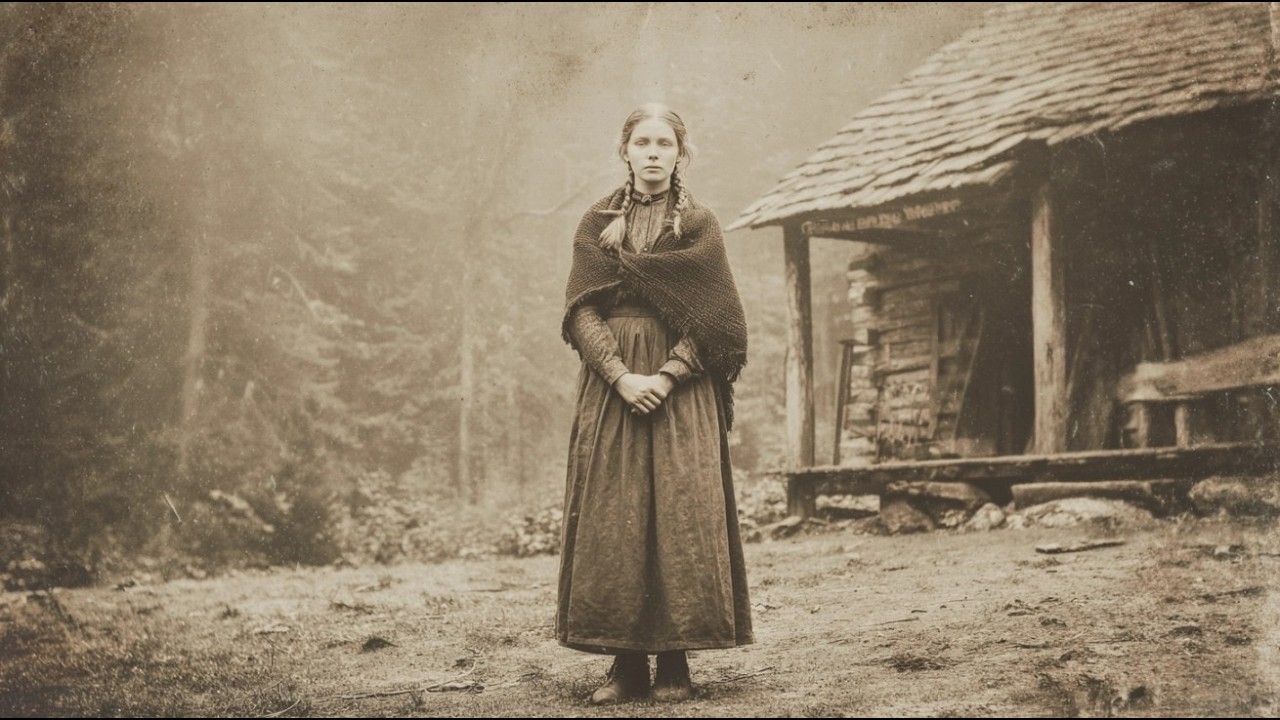
He went up the porch. He called her name. He stepped inside. The cabin was perfectly orderly.
The bed was made. The dishes were clean and stacked. A small stack of chopped kindling sat beside the stove. A half-finished cup of tea on the table had gone cold.
The bundles of herbs hanging from the rafters were undisturbed. Her coat was on its hook by the door. Her boots were beside them. Her shawl was folded on the back of a chair.
She was not there. Royden Hessler sat down in her chair, the one nearest the wood stove, and stayed there for what he later told the search party was a little while. Asked why, he said he had wanted to see the cabin from where she had seen it. He said that from her chair the cabin felt different.
He could not say how. He left, went down the mountain, and told the first person he saw that the woman in the cedars had gone missing. There was no sign of a struggle. No forced entry.
No tracks leading away in any direction. No body in the cellar, the woodshed, or the cedar grove behind the cabin. She was simply gone. On the kitchen table, beside the cold cup of tea, lay a single sheet of paper torn from a larger sheet.
The handwriting was hers. The note was not addressed to anyone. It said, in full, “I have been listening for a long time. Tonight, I am going to listen from a closer place.
Do not look for me. There is nothing to find. ” It was unsigned and undated. The note stayed on the table for nearly six years until the cabin was demolished in 1928.
Nobody admitted to taking it. Nobody has ever produced it. This was the end of the woman the loggers and miners of the eastern slope of the Cascades had called a healer. Her name was Edith Vandermeer.
She was 31 years old in the autumn of 1911, when her name first appears in any surviving document. She lived alone in a two-room cabin set back from a logging road in a stand of cedar so thick that travelers passing within 40 feet of her property could miss the chimney smoke entirely. She was tall for the time, about five feet ten inches by measurements taken later, lean, with the corded forearms of a woman who split her own wood. Her hair was the color of old straw.
Her eyes were a pale, washed-out gray, and people who met her once tended to remember the eyes for years afterward. She had no certificate, no schooling past the age of fourteen, and no church affiliation anyone in the valley could vouch for. But by the autumn of 1911, three counties knew her name, and five doctors had written about her in letters they later asked to be returned. The first time her name appears in any surviving document is in the journal of a country physician named Dr.
Marius Austendorf, who kept his journal from 1896 until his death in 1923. The relevant entry is dated the 14th of October, 1911. It begins: “I am writing this so that I will not later believe I imagined it. ”
Everything that follows unfolded out of one cold afternoon in October, when a logging accident on the slopes above a settlement called Cold Mount Crossing brought Dr.
Austendorf into the same room as Edith Vandermeer for the first time. A crew working a stand of old cedar had a tree go the wrong direction during a fall. Three men were caught underneath the upper limbs. Two were pulled out alive.
The third, an experienced sawyer, was carried down the mountain on a stretcher made from two coats and a length of rope. By the time they reached the bottom of the trail, he was no longer fully conscious. His left leg was crushed below the knee. He had a wound across the side of his chest that nobody who saw it expected him to survive past nightfall.
His breathing came in short, wet pulls. The crew bypassed the nearest town and went directly to the cabin in the cedars. Austendorf, who had been in the area visiting another patient, met him there because one of the loggers had ridden ahead to fetch him. He arrived expecting to make a dying man comfortable.
He had done it many times. He was 47 years old and had been a country doctor for over twenty years, and he wrote in his journal very plainly that he had stopped expecting miracles a long time before. He found the sawyer laid out on a long pine table in the front room. Edith Vandermeer was already at work.
She did not look up when the doctor came in. She had a basin of steaming water, a folded square of clean linen, and a small dark bottle the doctor could not identify. He wrote later that the bottle had no label. When he asked what was in it, she answered, “Yarrow, mostly, and other things.
” He did not press the question. He could see, even from across the room, that the bleeding from the chest wound had already slowed. That should not have been possible. Austendorf had been a battlefield surgeon during the Spanish-American War, and he understood what kinds of wounds bled fast, what kinds bled slow, and what kinds bled until the heart gave out.
This wound was the third kind, yet the bleeding had slowed. He asked how long she had been working. “About 20 minutes. ” Had she used a tourniquet on the leg?
“No. ” How then had she stopped the bleeding from the femoral artery, because by every rule of medicine he had learned in twenty years, that man should already have been dead? She looked at him for the first time. He wrote in his journal that the look lasted no more than two seconds, and that for the rest of his life he could close his eyes and recall the exact color of her irises in that moment, which he described as the gray of river ice just before it cracks.
She said, “Pressure. ” He thought he had misheard her. She turned back to her work. “Him.
The bleeding. ” She did not explain further. He stayed in the cabin for nine hours. He assisted her where she allowed it and observed where she did not.
He watched her clean the chest wound and work on the leg. At one point she rested two fingertips on the sawyer’s forehead and remained perfectly still for eight or nine minutes while his breathing changed beneath her hand from short and wet to long and steady. Austendorf wrote that during those minutes the room was so quiet he could hear the kettle ticking on the stove as it cooled, and the sap popping inside one of the cedar logs in the wood box. He became suddenly aware of his own pulse in his ears and had to remind himself twice to breathe.
When she finally lifted her fingertips, the man on the table opened his eyes briefly, looked directly at her, said a single word Austendorf could not catch, and slept. Her hand was trembling very slightly as she stepped away, and she put both hands behind her back in a gesture he came to recognize over the next eleven years as the one she made when she did not want anyone to see that her hands were shaking. The sawyer survived the night, survived the next, sat up by the end of the second week, and walked on a crutch by the end of the third. The leg never healed fully, and he carried a limp for the rest of his life, but he lived another 41 years and died in 1952 of an unrelated heart condition.
His admitting paperwork at a hospital in Spokane still listed, under prior major injuries, the words “crushed leg and chest wound, October 11, treated by E. Vandermeer. ” That paperwork still exists, one of the only direct documented references to Edith Vandermeer in any official record that survived past the 1920s, and it survived only because the admitting clerk in 1952 did not know who she was and copied the name down without recognizing it. Austendorf wrote about her on and off for the next eleven years.
The other four doctors who wrote about her between 1911 and 1922 each encountered her in the course of trying to help a patient that medicine had given up on, and each came away shaken in some specific way that they could only describe in private letters and journals. Because here is the part that matters. Edith Vandermeer was not a healer. That is the word people in the valley used, but by the accounts of the doctors who watched her work, it was not an accurate word.
She did not heal anyone. She listened. She paid attention to the body in front of her in a way the doctors could not match, and she responded in ways that, on at least eleven separate documented occasions, produced outcomes the medicine of 1911 could not produce. Dr.
Alma Steiner, who met Edith Vandermeer in 1916 during an outbreak of pneumonia in a mining settlement north of the cabin, wrote the most detailed account that survives. Steiner was 38, had trained at Johns Hopkins and practiced for twelve years when she watched Edith Vandermeer work on a 56-year-old miner whose lungs had filled with fluid to the point that he could no longer lie down. Steiner wrote, “I have never seen anything like it and I do not know how to write what I saw without sounding ridiculous. ” Edith Vandermeer placed her ear against the man’s back and listened for nearly 25 minutes without moving while he breathed his short drowning breaths above her and the cabin grew dark.
Then she stood, fetched a particular root from a hanging bundle, prepared a tea, gave it to the man in small sips, and placed her hands, one on his chest and one on his back, for over an hour. His breathing changed gradually, then more rapidly, then began to clear. Within four hours he was sleeping without the rattle. Within three days he was walking.
Steiner wrote, “I cannot say what I observed. I can only say that I observed it. ” Asked what she had been listening for, Edith Vandermeer said the same thing she had said to Austendorf. “The body.
You have to listen long enough to let it talk. ”
On a second visit, Steiner watched Edith Vandermeer treat a woman in her 40s named Lucinda Merrow, suffering from what the company doctor had diagnosed as chronic stomach inflammation. Steiner had reviewed the notes and agreed; she had no useful treatment to offer beyond a bland diet and a bismuth preparation that had not helped. Edith Vandermeer asked Lucinda to lie on the pine table.
She placed her hand flat against the hollow just below the woman’s sternum and stood like that for a long time, longer than 440 seconds. Then she asked, “Who told you to keep this? ” Steiner wrote that she did not understand the question and that Lucinda Merrow understood it immediately. The woman began to weep very quietly without changing her breathing.
Edith Vandermeer left her hand exactly where it was. After perhaps 15 minutes the woman stopped crying, sat up, and thanked her in a voice Steiner described as the voice of a person who has just put down a heavy bag she had been carrying for so long she had forgotten the bag was hers to put down. Lucinda Merrow’s condition cleared within two weeks and did not return. A year later the company doctor wrote that she was in better health than she had been in over a decade, with no medical explanation for the change.
Steiner wrote at the bottom of her notes, “I do not know what was inside her stomach. I do not believe it was an inflammation in any sense the word usually carries, but I have come to believe that some illnesses arrive in the body because there is nowhere else for them to go. Edith Vandermeer seems to know this. I do not think she learned it.
I think she has always known it, and I do not know how a person comes to always know a thing. ”
The third doctor, Lloyd Cranak, was a city doctor from Tacoma, 61 years old when he met Edith Vandermeer in the spring of 1918, a man who had built his reputation on refusing to entertain anything that could not be measured. He had written a long and angry pamphlet against the country quacks of the Cascade slopes and named fourteen rural practitioners he considered fraudulent. Edith Vandermeer was not among them because her work had not yet reached his attention.
By 1918 it had. Cranak went up the mountain in March, accompanied by a junior physician named Howell Burchard, intending to expose her. He carried a notebook to record every measurable detail. He spent four days in her cabin.
He never published anything. The notebook exists, found after his death in 1927 in a locked drawer in his Tacoma office. The first three pages contain what he set out to record: times, temperatures, pulse readings, descriptions of the cabin, the names of two patients she treated, both of whom Cranak himself examined before and after and both of whom showed measurable improvement he could not attribute to her treatments because her treatments did not include anything his medicine recognized as having an active mechanism. The fourth page and every page after it is blank, except for one line written in pencil in a hand that does not match the rest of the notebook, in Cranak’s own handwriting, shaken in a way the earlier entries are not.
It reads, “She knew about the boy. I never told anyone about the boy. She knew. ” That is all.
Cranak had no children, no nephews. There is no boy in his published work, his correspondence, or any surviving family record. Whatever he meant died with him in 1927. But on the third day of their visit, Burchard recorded, Cranak left the cabin alone for several hours and walked into the cedars.
When he came back he did not speak for the rest of the evening. On the wagon ride down the mountain he asked Burchard very quietly whether he believed in second chances. Burchard said yes. Cranak nodded.
That was the only conversation they had on the way back to Tacoma. Burchard returned to the cabin on his own three more times between 1918 and 1922. His notes are the most clinical of any surviving account. He approached Edith Vandermeer neither with hostility nor reverence, he wrote, but the way he would approach a phenomenon in nature that did not yet have a name in any textbook he had read.
When he asked how she had come to learn what she knew, she told him her mother had taught her some of it, and her mother’s mother had taught her mother some of it, and the rest she had learned by sitting still long enough. How long is long enough? “It depends what you are trying to hear. ” Had she ever been wrong about a patient?
She was quiet for a long time. Then she said, “Twice. Once in 1904, once in 1908. I was wrong both times.
I do not want to talk about either. ” He did not press. The fifth doctor, whose first name has been lost, was Dr. Voltro.
He came to the cabin only once, in the summer of 1921, and his account survives only as three letters he wrote afterward. The first asked a question: “Have you ever felt afraid of her? ” The second contained the line that Edith Vandermeer would not be able to carry what she carried much longer. The third, dated October of 1921, contains a single passage: “I treated a man last week in my own surgery here in Wenatchee for a wound that I knew, before I had even cleaned it, that I could not heal.
I did what I could. He died on the third day. I sat with his widow afterward, and she asked me whether anything more could have been done, and I said no. And then, Marius, I sat in my office that night, and I thought of the woman in the cedars, and I understood, perhaps for the first time, what she meant when she said she could not help that trapper in 1917.
There are things in the body that are not the body, and there are things in a room that are not in the room. And once you have learned to feel the difference, you cannot unlearn it. I do not know how she has carried that knowledge for so long without becoming strange. Or perhaps she has become strange, and I am only too kind in my letters to say so.
”
What happened in 1917, when she said she could not help the trapper, is the part the doctors could not discuss in public. In late February of that year, a man named Hollis Whittaker was brought down the mountain on a sled. He was a trapper, 44 years old, alone in a remote line cabin for most of the winter. He had been alone for at least nine days with what his rescuers initially thought was a head injury.
He could not speak in full sentences. He could not remember his own wife’s name. He flinched at light, at sound, at things in the corners of rooms that did not appear to be there. They brought him to Edith Vandermeer because the nearest hospital was two days’ travel away and they did not believe he would survive two days.
Austendorf was sent for and arrived on the second day. When he came through the cabin door, Edith Vandermeer was sitting in a chair on the far side of the front room watching Hollis Whittaker, who lay on the same long pine table where Peter Marchand had once been laid. She was not working on him. She had been watching him, the wife of one of the rescuers later told Austendorf, for almost six hours.
Austendorf examined him and found no head injury at all. No swelling, no external trauma, no bruising. The pupils responded normally. The reflexes were intact.
By every measure, Hollis Whittaker was a healthy 44-year-old man who had been alone in a cabin for nine days. But he was not present. He looked through Austendorf. He flinched at things that were not there.
He spoke in fragments. He said at one point, “The door was wrong. ” At another, “She was standing in the snow, but there were no tracks. ” A third time: “Do not let it count me.
” Austendorf wrote down each phrase exactly and underlined the third one twice. When he turned to ask Edith Vandermeer what she made of it, he found her watching him instead of the patient. He had been in her cabin perhaps a dozen times by then. He had seen her tired, focused, distracted, gentle, occasionally amused.
He had never before that afternoon seen her afraid. She said, “Marius, I cannot help him. ” He said he did not understand. She said, “Whatever he saw out there, it came back with him, and I cannot ask it to leave.
” She said it in the same flat, plain voice she used for everything else. But Austendorf wrote that the words made the back of his neck go cold in a way that twenty years of medicine had never made him cold. He asked what she meant. She said, “I have asked the body to listen.
The body is listening. But there is something else in him, Marius, and it is listening, too, and I do not know its name, and I do not want to learn its name, because if I learn its name, it will know mine. ”
Austendorf stayed the rest of the afternoon. He gave the man a sedative, changed his clothes, tried to feed him broth.
Around dusk the candles in the cabin began to flicker. There was no draft. The door was shut. The windows were shut.
The fire was burning steady. But all four candles began to flicker in a slow, deliberate rhythm, as if something were walking past them from left to right across the room where Hollis Whittaker lay. Edith Vandermeer stood up from her chair. She said very softly to the empty air, “Not in this house.
” The candles steadied. Hollis Whittaker did not. Austendorf wrote that the next several hours were the longest hours of his medical career. He did not sleep.
He sat in a chair at the foot of the pine table and watched his patient, the candles, and Edith Vandermeer, who had returned to her chair and resumed her quiet observation. In the small hours of the morning he stood to add wood to the fire, and his own shadow on the cabin wall did not move with him. He stood still. The shadow was still.
He took two steps to the right toward the wood box, and the shadow took two steps to the right a fraction of a second after he did, as if it were copying him from a distance. He stopped moving for a long time. He eventually crossed himself, which he had not done since his mother’s funeral in 1893, and the shadow crossed itself with him, and this was somehow the worst part. Not that the shadow had been wrong, but that the shadow agreed with him.
He went back to his chair without adding wood to the fire. Edith Vandermeer, who had watched all of this without comment, said only, “Try not to look at the corners. ” He did not look at the corners. Hollis Whittaker never left the cabin.
In the morning he was taken out by his own family and moved to a hospital in Seattle, where he was admitted to a long-term ward and remained until his death in 1923. He never spoke again in full sentences. His case file references exposure to extreme cold and isolation as the cause of his condition and makes no mention of Edith Vandermeer at all. Austendorf left the cabin that morning and did not go back for two years.
When he finally returned in the spring of 1919, he found her thinner than he remembered and quieter. She made him tea and asked after his wife. She did not ask why he had stayed away. She did not need to.
He wrote in his journal that night, “I have known her for almost 8 years. Tonight, I understood for the first time that she has known for almost 8 years exactly what I am and exactly what I am not and she has been kind to me anyway. I do not deserve that kindness and I do not understand the cost of it. ” He never elaborated on what he meant by the cost of it.
After her disappearance, three things happened. In the spring of 1923, a woman named Gertrude Fenimore, one of Edith’s occasional patients, stopped on the logging road to look at the cabin from a distance. She wrote to her sister that she had the very clear, very specific feeling that someone was standing on the porch watching her back. The porch was empty, but the feeling was so strong she could not bring herself to wave, because she did not want to be rude to the empty porch.
When she reached her friend’s house on the far side of the ridge, her friend looked up from the kitchen and said, without any preface, “Gertie, did you walk past the cedars? ” Gertrude said yes. Her friend said, “I dreamed about that road last night. I dreamed someone was standing on the porch and waving at me, and the waving was wrong.
I do not know how to say what I mean by wrong. I have been thinking about it all morning. ” The two women drank tea and did not talk about the porch again. The letter ends, “I do not know what to make of any of this, but I am 58 years old and I have learned by now when not to make anything of a thing.
Some things are simply true. Some things are simply there. The porch is one of them. ”
In 1928, a logging company sent a crew to demolish the cabin.
By midday three of the four men had walked off the job. The fourth, the foreman, finished tearing down the front wall and then he, too, walked away. One of the men, a young man named Calvert Rose, told his wife he had heard a woman’s voice behind him say, “Thank you for coming. ” He turned around.
The room was empty. He continued working, because he was not a man who walked off jobs. Then the voice said, “You did not need to come. ” He set down his pry bar and never set foot in the cabin again.
A second man, a Norwegian immigrant named Halvor Eikeland, would not say what made him leave. He told his foreman only, “I have a wife. I have a mother. I will not bring this back to them.
” He took no pay for the day’s work and walked the eleven miles back to his lodgings without stopping. The third man’s account does not survive; he left the territory within a month and was never heard from again. The foreman, Conrad Meystrick, 46, a veteran of demolition work with no patience for ghost stories, said that he had been pulling boards loose one by one, and that when he pulled the seventh board loose he looked through the gap into the cabin’s interior and saw, very briefly, a woman sitting in a chair beside the wood stove looking out at him. She nodded to him.
He pulled the eighth board loose. The chair was empty. He walked off the job, told his employer he had hurt his back, never worked another demolition job, and took a position as a watchman at a lumber mill until his death in 1944. The only further reference to the cabin in his correspondence is a single line in a letter to his brother dated December of 1928: “I do not believe she was angry with me.
I do not believe she was angry with anyone. But I am not the man to finish what I started up there. Let someone else do it. Or let nobody do it.
I do not care. ”
The cedar stand was eventually cleared by a different crew brought in from out of state who knew nothing about the woman who had lived there. They burned the remaining structure to the ground in the autumn of 1929. According to the foreman of that crew, the fire burned for a full 26 hours, which is not how cedar burns.
Cedar burns hot and fast; a cabin of that size, fully dry, should have been ash inside of six hours. The foreman, who kept a brief log of the burn, wrote that on the second night the fire was still throwing visible flame, and that the flame, looked at from a particular angle on the road below, looked more like a window than a fire. He did not explain what he meant. He drew a small, rough sketch in the margin of the log of a rectangle inside a larger rectangle and labeled the inner rectangle with the word “her.
” That sketch is the only known visual record of the burn. The third thing happened in 1941. A young woman named Wilhelmina Austendorf, granddaughter of Dr. Marius Austendorf, was going through her grandfather’s effects in a storage room of the family home in Wenatchee.
She found his journal, read the entries about Edith Vandermeer, and found tucked between two pages near the back a single piece of paper that had not been written by her grandfather. The paper was folded in quarters. The handwriting was careful, plain, and slanted slightly to the left. It said, “Marius, thank you for coming up the mountain in October of 1911.
I knew before you arrived that you would come. I knew before you arrived that you would not understand what you were seeing. I knew before you arrived that you would stay anyway. That last part is what mattered.
The rest was always going to be impossible to explain. Be well, E. V. ” The paper was not dated, but the journal entries around it were from 1915, six years before Edith disappeared, six years before, by every rule of physics and time, she could possibly have known whether Marius Austendorf would come up the mountain when she sent for him in 1917, or whether he would come up the mountain when she did not send for him in 1919, or whether he would come up in any of the dozen visits he made between 1911 and 1922.
She had written it before any of it happened, and she had thanked him for it. Wilhelmina Austendorf, a librarian by trade and a careful woman by temperament, did not publish the letter or show it to anyone outside the family. She placed it back in the journal and the journal back in the storage room. She lived another 51 years and died in 1992.
The journal passed to her niece, who passed it to a regional historical society in 2007, where it remained in a box of uncatalogued materials until a researcher went looking for it in early 2023. In a reading room in Central Washington, the journal lay on a table, and the researcher read every entry and held in his hands the piece of paper Edith Vandermeer wrote at some unknown date. Austendorf died 14 months after her disappearance, in January of 1924, of pneumonia, in his own bed, with his journal on the nightstand. After walking through the empty cabin on the 19th of November, 1922, he had written in an entry shorter than any other surviving entry about her: “Cabin empty.
She is not here. I do not believe she is dead. I believe she has gone somewhere I cannot follow. I am too old to pretend I do not understand what that means.
” He never wrote about her again. The cleared ground where the cabin stood has not in over ninety years grown back the way the rest of the cedar grove has grown back. The cedars on either side have leaned away from it in a slow, patient curve, as if giving the empty space room to breathe. In the last surviving entry that mentions her, Austendorf wrote, “I think she was always leaving.
I think we were lucky to overlap with her at all. ”
