The Gent family arrived at the edge of the Ozark Mountains in 1847, and within four years, the first warning was left at the base of their land: the severed head of a neighbor’s cow, eyes and tongue removed, a strange symbol carved into its forehead. The farmer who found it understood the message without a word being spoken. He turned around, walked home, and never climbed that trail again. For nearly ninety years, that is how the people of Taney County, Missouri dealt with the clan that ruled the valley they called Morning Fork.
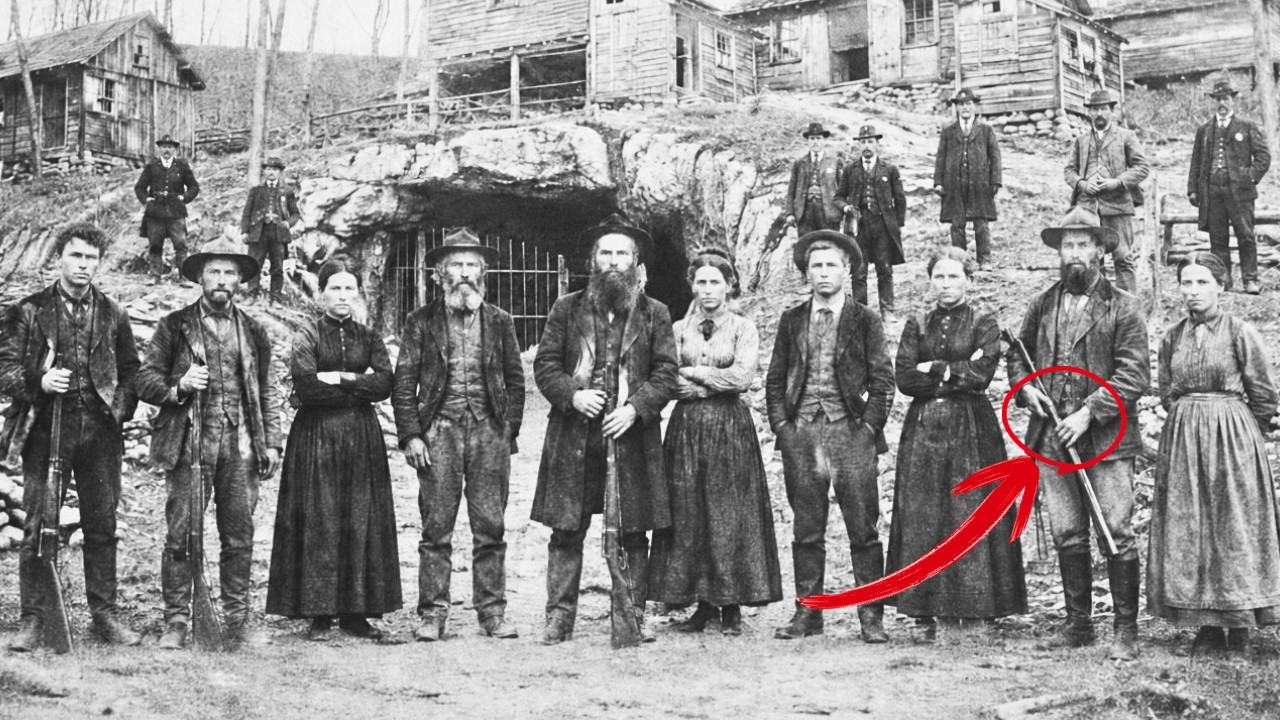
The family’s patriarch, Elias Gent, came from the Appalachian foothills of East Tennessee with a wife, six children, and a quantity of gold no one could explain. He never held a job or owned land in Tennessee, yet he paid cash for 1,100 acres of the roughest, most useless forest in the county. The seller thought he had swindled a fool. In truth, Gent knew exactly what he was buying: a network of caves stretching for miles beneath the hill, a spring that never froze and never dried, timber so thick a man could stand ten feet from a cabin and not see it, and only one narrow path in and out, winding back on itself seven times.
A single man with a rifle at any of those turns could hold off an army. That is precisely what the Gents did for the next nine decades. The first recorded incident came in 1851, when a traveling preacher named Josiah Bellamy stopped at a farm at the base of Gent land for water. The farmer, Cletus Warren, told him about the cow.
Bellamy wrote it down in his journal that night, and that journal survived. Soon Bellamy learned the wider pattern: the Gents were not thieves, they did not steal livestock, and they never came down the mountain to cause trouble in town. But if you set foot on their land for any reason, you paid the price. Sometimes the price was only a warning: a dead animal on your porch, a felled tree blocking your lane at night.
Sometimes it was worse. In 1849, a father and son went up the trail to hunt deer and never returned. Their bodies were found six months later at the base of a cliff on the far side of the hill, as if they had been thrown from above. The county sheriff climbed to the Gent cabin to ask questions, returned pale two hours later, declared the case closed as accidental death, resigned three weeks afterward, and moved to Kansas.
He never spoke of what he saw on that mountain. Over the next three decades, the clan swelled to somewhere between forty and sixty people living on those 1,100 acres. Census takers refused the assignment; one waited at the base of the trail for three days hoping someone would come down. On the fourth day, he saw two figures watching him from the first turn.
They stood motionless for over an hour. On the fifth day, he returned to town, submitted his estimates, and requested a transfer. By 1880, every official in Missouri state government knew the rule. Do not send men to Morning Fork.
Not if you want them back. The Gents ran a small economy no outsider could fully explain. They did not farm traditionally, they did not sell timber, and they came to town for supplies only three or four times a year, always in groups of six or eight, paying with old silver coins and speaking to no one they did not have to. Yet they had money, enough to quietly buy 2,000 additional acres between 1875 and 1895 through intermediaries.
The official theory was moonshine; they did operate distilleries in the caves beneath their land, producing whiskey regarded as the finest corn liquor made in Missouri, sold at premium prices in Kansas City, Memphis, and New Orleans. But moonshine alone did not explain everything. In 1889, a University of Missouri geologist conducting a survey found traces of gold in the streams that rose from Gent property. He submitted his report to the university.
It vanished. The geologist, Harold Prescott, died six months later in what the coroner classified as a hunting accident, shot in the back of the head at close range with a weapon never found. Nobody in Taney County believed it was an accident. Between 1891 and 1934, at least twenty-seven people disappeared within five miles of Morning Fork, a number certainly higher given the countless travelers who passed through with no records kept.
The first documented case was Samuel Kirby, a nineteen-year-old walking tour through the country in June 1891. He was last seen alive on the road at the base of the mountain by a woman hanging laundry outside her cabin. He asked her the distance to the next town, thanked her, walked on, and vanished around a bend. His family hired a private investigator from St.
Louis who traced his path to that cabin and nothing beyond. An old man living two miles east told the investigator he had heard what sounded like a young man calling from up the hill, toward Gent land, growing fainter for two or three minutes, then stopping. The investigator did not include that statement in his official report. In a private letter, he wrote that he had spent twenty-two years as a detective in three cities and never encountered a group of people who inspired the kind of fear the Gents inspired in Taney County residents.
He said he would rather chase a serial killer through the slums of St. Louis than knock on a Gent cabin door. Samuel Kirby was recorded as missing, presumed drowned in the White River. The disappearances continued.
A widow traveling with $240 in cash from the sale of her husband’s land, last seen buying flour and cheese in town, found only by her abandoned mule and overturned wagon near the first turn of the Gent trail. The money was gone. A Methodist minister, his wife, and two young children who camped beside a stream that ran from the Gent caves against a farmer’s explicit warning, never seen alive again. Two years later, a hunter found a small leather-bound Bible with an inscription to the minister inside, handed it to the sheriff, who placed it in a drawer that was emptied and discarded in 1954.
Between 1891 and 1910, sixteen more people disappeared within five miles of Morning Fork. Every one was traveling alone, every one was last seen on a road bordering Gent land, and every investigation, when one happened at all, stopped at the start of the trail. By 1905, the sheriff’s office had an unofficial policy: files involving travel past Morning Fork received a small red dot in the top corner, meaning do not investigate, do not risk the deputies, just file the papers and close the case. A researcher allowed to examine the sealed Taney County archives in the early 2000s counted sixty-three red dots between 1891 and 1936.
By 1910, the Gents were running a larger operation involving the buying and selling of people. The Ozarks were full of isolated communities, pockets of families living so far from main roads they existed outside any government. Some were harmless. Others had built generations-long trading systems completely outside the law, trafficking livestock, moonshine, stolen goods, and human beings.
Runaway girls from factory towns, orphaned boys who wandered too far, immigrants who got off the train at the wrong station. Anyone who could vanish without a search party. The Gents sat at the heart of this trade in southern Missouri, operating through a chain of what historians now call stopover stations, isolated farms and cabins a day’s wagon ride apart, each run by a family brought into the network through payment or threats. Those who refused knew what happened to the family that burned in the night, the son who went hunting and never came home, the message delivered at dawn tied to the neck of a dead dog.
The network lasted at least forty years, and the mountain at Morning Fork was the final destination for a large share of those who entered it, as well as a redistribution point. They were not always kept there. Some were held for weeks then sold to buyers farther south into Arkansas and Louisiana, where state governments were weaker and isolated communities more secretive. The Gents kept a ledger.
It listed buyers, prices, dates of transfer. When researcher Dr. Aaron Whitfield matched surviving fragments of the ledger against missing persons records from surrounding states in 2004, he confirmed the identities of forty-seven distinct individuals whose disappearances matched ledger entries, out of 134 names in the surviving fragments, which represented at best perhaps a quarter of the complete record. The true scale of what happened at Morning Fork over forty-five years may never be fully known.
The federal government knew. In 1927, an agent named Thomas Reeves investigated the disappearance of a seventeen-year-old girl from Joplin, traced her to Morning Fork, and requested a warrant to search Gent property. His request was denied. The official reason was insufficient evidence.
A private memorandum that surfaced decades later said a raid would require a force of at least 100 armed federal agents and result in heavy losses on both sides, and the bureau was not prepared for such action. Agent Reeves did not close his investigation. He went to Morning Fork alone in the winter of 1928, carrying a rifle, a pistol, and a letter of instructions for his wife in case he did not return. He passed the first turn, then the second.
Between the third and fourth, something happened. His body was found at the base of the mountain seven weeks later, arms folded over his chest, his federal badge placed on his forehead, a note pinned to his coat reading “Do not send another. ” The bureau did not. The agent’s case was closed as a hunting accident.
The memorandum stayed in a file cabinet for fifty years. The thirty-s began the collapse, not because the state found courage, but because the family began to fall apart from within. Generations of intermarriage had taken their toll. A doctor summoned to the mountain in 1931, blindfolded and taken in under threat of arms, refused to describe in detail what he saw for the rest of his life.
He only said the mother and child did not survive, and on his way back down he passed a room where he heard at least twelve people making sounds he described only as “not normal. ” In 1933, a young Gent named Cyrus did what no Gent had ever done. He left the mountain. He walked into town, surrendered at the sheriff’s office, and said he wanted out.
The sheriff, Wade Coleman, locked him in a back cell and wired the state capital for instructions. The reply came the next morning: move Cyrus Gent to St. Louis immediately, tell no one, stop for nothing. The sheriff put him in the back seat at 3 a.
m. and drove north. He never reached St. Louis.
The car was ambushed outside Roller. The sheriff was killed with four bullets. The deputy survived. Cyrus Gent was taken from the back seat and carried away in a wagon that emerged from the woods.
He was never seen again. The most likely explanation, which state investigators eventually accepted, was that he was returned to Morning Fork and executed by his own family as a warning to any other Gent considering departure. It worked. No Gent ever left again, not voluntarily.
But the murder of a sheriff on a public road in front of witnesses was something Governor Guy Park’s pride could not accept. In the fall of 1934, he did something no Missouri governor had ever done. He ordered the mobilization of the state militia, more than 300 armed men, with orders to move on Morning Fork and end the Gent family once and for all. The operation was called Operation Mountain Cleanup.
It launched on October 14, 1934. The militia surrounded the entire property under cover of darkness, cut off every escape route, placed snipers on the hills overlooking the cabins, and set up a light artillery piece about 800 yards from the main compound. At dawn on October 15, an officer with a megaphone walked to the start of the trail and demanded the surrender of everyone inside Gent property, giving them one hour to come down with their hands up. The response was silence.
The officer waited the full hour. Then he gave the order. The howitzer fired first. These militiamen were not professional soldiers.
They were farmers, mechanics, factory workers, World War I veterans given three days of refresher training before being sent to the mountains. Most had never heard of the Gent clan. They were told they were being sent to arrest a family of moonshiners and criminals who had killed a sheriff. They did not know what was inside the caves.
They did not know what was inside the cabins. They did not know they were about to become the first outsiders in nearly ninety years to set foot on top of that mountain. The first shell hit the main cabin roof. The second hit the barn.
The third hit the smokehouse. The Gents returned fire from positions among the trees and from the mouths of the caves. For the next two days, a full-scale battle raged on the slopes of Morning Fork. The militia lost twenty-two men.
The Gents lost at least forty. By the evening of October 17, resistance from the mountain had ceased entirely. The militia advanced. What they found above that mountain is the reason the report was sealed.
The cabins that still stood were full of people, but not fighters. The ones who had defended the mountain were mostly dead. What remained were the women and children, and those the doctor had heard forty years earlier making sounds he could not describe. People who had never left the mountain in their lives, born on that land, raised there, living their entire lives within the boundaries of Gent property.
Some could not speak. Some did not understand what was happening. Some attacked the militiamen with knives and had to be subdued. And some, as the report described in language later investigators found difficult to read, were no longer human in any meaningful sense.
The militia also found the rooms, windowless, sealed from the outside for what forensic examination later determined was in some cases over a decade. When those rooms were opened, the militia found the remains of people who had been left to die within the walls. Some of the remains were old, reduced to bone and dust. Others were more recent.
The state medical examiner, who examined the recovered remains, reported that he could not determine the exact cause of death in most cases due to the grim conditions inside those rooms, but what he could determine was that the people imprisoned there had not died quickly. There were marks on the walls, marks suggesting fingers had been scratching at the wood for a very long time. The examiner requested a transfer to other work after completing his report. He never worked another case for the state of Missouri.
The militia also found the cages. There were seven of them, built into the walls of the largest cave beneath the property, each large enough to hold one adult. Each had been in continuous use, based on wear to the bars and the accumulation of filth on the floors, for at least thirty years. The militia found three people alive inside the cages: two women and a man.
None were Gents. All had been reported missing from various towns in Missouri and Arkansas between 1919 and 1932. They were all brought down from the mountain alive. Only one of them survived the first year afterward.
Prudence Kelso, missing from a mill town in Arkansas in 1919 at seventeen, was thirty-two when brought down. She had spent fifteen years in one of those cages. She could no longer walk, her eyesight was severely damaged by years of near-total darkness, and she spoke in short phrases using only about forty words. She died in a state hospital six months later.
The nurses said she had stopped eating in her final weeks and seemed, in the end, to want to go. Hannah Bell, missing from a Missouri farm since 1927, spent seven years in captivity, was returned to her family, never spoke of what happened, and kept a notebook she would not let anyone read. When she died in 1978, her family burned it unread per her instructions. Her relatives say only that she was a good woman who loved animals and remained afraid until the end of her life of footsteps outside her bedroom door at night.
Wallace Prime, taken from an Oklahoma logging camp in 1932, did not survive his first year outside the mountain. He attacked hospital staff, escaped three times, and in the summer of 1935 succeeded. He fled wearing only a hospital gown and disappeared into the countryside. His body was found the following spring by a hunter at a stream about seventy miles east of Morning Fork.
He had been walking in a straight line toward the mountain. He did not make it. Three survivors, three people who came off that mountain alive, and within eighteen months, all three were dead. The militia found the ledger, locked in a box beneath the floorboards of the main cabin.
Inside was a leather-bound book, kept in meticulous handwriting across four generations of Gents, recording every person they had abducted, every transaction, names, dates, purchase prices, sale prices. It dated back to 1889 and ran over 300 pages. By the time state investigators finished analyzing it, they had identified the fates of 134 missing people over forty-five years. Some were sold to other communities in the hollows.
Some were held on the mountain until they died. And some, according to entries in the ledger, had been consumed. That is the word the ledger used. Consumed.
The Operation Mountain Cleanup report was completed in the spring of 1935. It ran over 400 pages, included photographs, transcripts of interviews with surviving militiamen and surviving prisoners, and a complete copy of the Gent ledger. By order of the governor and the state attorney general, it was sealed for seventy-five years. The stated reason was that public knowledge of the report’s contents would cause panic throughout the state, damage the reputation of the Ozarks region for generations, and possibly inspire similar crimes in other isolated communities.
The report was placed in a vault in the state capital. According to state records, the vault was opened only once in the next seventy-five years, in 1962, when a new governor requested a summary. It was delivered orally. The governor asked no follow-up questions.
The vault was locked again. In 2010, after seventy-five years, the report was due for release. It was not released. According to a statement from the Missouri State Archives, the report was discovered to be missing during preparations for declassification.
An internal investigation concluded the report had been misfiled at some point during the preceding decades and could not be located. No further explanation was offered. No further investigation was conducted. The Operation Mountain Cleanup report, one of the most important law enforcement documents in Missouri history, simply vanished.
What remains is fragments. A photograph in a private collection appearing to show the interior of one of the cages. A page from the ledger photographed at some point and kept by an unnamed government employee. Interviews with descendants of militiamen, some of whom spoke of what they saw before they died.
Notes from the doctor’s son and a few researchers who devoted their careers to trying to reconstruct what the state worked so hard to erase. From those fragments, this much is known with certainty. The Gent clan of Morning Fork was not merely a family of mountain folk or aggressive moonshiners. For nearly ninety years, they ran one of the most organized, successful, and protected criminal enterprises in the history of the American South, trafficked in gold and liquor on the surface, and built on the trafficking and destruction of human beings in the shadows.
They survived because they terrorized an entire region into silence. They ended only when the state of Missouri decided that ending them was cheaper than allowing them to continue. The mountain itself still exists. The land is now part of a state-protected area.
The trail is officially closed to the public. The cabins are gone, mostly destroyed by artillery, the rest burned by the militia before they left. The caves remain, vast and largely unexplored. In 1978, a group of University of Missouri students attempting to explore the main cave system as a class project were turned back by state officials at the base of the mountain.
The official reason given was safety concerns about unstable rock formations. The students were told the state would survey and map the caves at a future date. That survey was never conducted. The caves beneath Morning Fork have never been officially explored.
The official position of the state is that every Gent on the mountain was either killed in the battle or died in the years immediately following. The last documented Gent, an elderly woman named Ada captured during the operation, died in a state institution in 1949. She had been mentally disabled to the point of near-total non-communication, spoke no complete sentences in fourteen years, and died of pneumonia. She was buried in an unmarked grave, and with her death, the Gent bloodline officially ended.
Unofficially, the story is different. The ledger’s surviving fragments indicated something the state investigators were reluctant to publish. Not all Gents stayed on the mountain. Over the decades, they had quietly sent members of their family, mostly young women, into the outside world to marry into other families in other states under other names, to Arkansas, Oklahoma, Texas, Louisiana.
The purpose, based on the ledger’s own notations, was insurance. If the mountain were ever taken, if the family were destroyed, there would be Gent blood and Gent knowledge and Gent connections scattered across the South, waiting. On one of the last surviving pages, in handwriting appearing to belong to one of the younger Gents, was a passage. “We are not the end of the bloodline.
We are the keepers of the bloodline. What Elias began, we carry. What we carry, our cousins in the lowlands will complete. The mountain sleeps, but the mountain does not die.
When the time comes, we will wake it again. ” That passage, based on ink and paper analysis conducted decades later, was written sometime in the early 1930s, by someone who knew or suspected Operation Mountain Cleanup was coming. Dr. Whitfield, the researcher who matched the ledger to missing persons records, spent the last decade of his career trying to identify those cousins in the lowlands.
He believed, based on the marriage records in the ledger, that at least six young Gent women had been sent south between 1905 and 1925, married into families in three specific Louisiana parishes, and that their descendants were alive today and may have some knowledge, however vague, of what their ancestors had been part of. He died in 2019 before completing his research. His notes were donated to the University of Missouri, where they remain out of public reach. In the decades following Operation Mountain Cleanup, a small number of isolated communities across the American South showed patterns disturbingly similar to the Gent clan: communities that seal themselves off from the outside world, that pay for land with old silver coins, that do not welcome strangers, that do not report disappearances, where the local sheriff has an unwritten but understood policy of not sending his deputies past a certain road.
These communities stretch from the Arkansas Ozarks to the Louisiana swamps to the pine forests of East Texas. No connection has ever been proven. But researchers who have studied the Gent ledger have their doubts, and when pressed, they will quietly tell you they believe the Gent clan did not end on that mountain in 1934. They believe the Gents simply went to ground.
They believe Gents are still out there. And some of the people living in the towns around Morning Fork believe that day may have already come. In 2016, an experienced hiker named Kevin Breen vanished from a marked trail three miles from the old Gent land. A search involving more than forty people, three helicopters, and four dog teams over eleven days found nothing.
No tent, no backpack, no trace. The park ranger who led the search retired the following year and moved to Colorado. When a journalist contacted her in 2020, she said only: “We were searching in the wrong direction, and I knew it, and there was nothing I could do about it. ” She declined to elaborate.
In 2019, a farmer in a neighboring hollow reported losing his best cow. Three days later, he found the cow’s head on his porch, eyes removed, tongue removed, a symbol carved into the forehead. He described it as looking like a spider with too many legs, or a hand with too many fingers. The same description Cletus Warren gave the preacher in 1851.
A University of Arkansas folklorist spent six years tracing the origin of the symbol, collected over thirty descriptions spanning a hundred years, and when she overlaid the drawings, she found it was not a stylized spider or hand at all. It was a map, its lines nearly matching the design of the cave system beneath Morning Fork as partially mapped by geologist Harold Prescott just before his death in 1889. The symbol carved on the heads of mutilated animals, for over a hundred years, was a warning pointing specifically to those caves. A warning meaning, in essence: this is where you will end up.
This is what awaits you under the mountain. She published her findings in a small academic journal in 2018 and received almost no attention. Her tenure was denied the following year. She now teaches at a community college in a state she asked not be named.
She has told researchers she believes the symbol is still in active use, that someone somewhere in the Ozarks is still carving that mark on animal heads and leaving them on the porches of people who need to be warned. She has said clearly that she does not know who is doing it and does not want to know. The journal that published her findings only once. The reporter who covered the 2019 cow incident never published the article.
She left journalism six months later, works in another state, and tells researchers only that she wishes she had never accepted the assignment and hopes for everyone’s sake in Taney County that the story is not true. She was not sure. Each October, on the anniversary of Operation Mountain Cleanup, a small group of people gathers at the base of Morning Fork. They do not go up.
They stand at the start of the trail, look at the hills, and wait. They wait until the sun sets. They wait until the wind changes direction. Then they light candles for the sixty-three people whose names received a red dot in the Taney County archives, the sixty-three who walked past that mountain and never made it home.
Nobody who attends the gathering ever climbs the trail. It is not organized by any group or church or civic association. It has no leader. It has no name.
It happens because it has always happened. There is a small pile of stones at the start of the trail, growing slightly larger each year, over 400 stones now, one for each candle lit, one for each name whispered into the wind. And every year, without exception, someone adds a new stone that no one at the gathering can explain the origin of. The name Morning Fork was removed from official maps in 1936.
The area is now designated simply as Protected Area 4B. The name does not appear on any official document issued after that year. But if you stop at a gas station in Forsyth, or a diner in Branson, and ask the old timers where Morning Fork is, they will know. They will point toward the hills.
They will tell you the trail starts behind an old barn about four miles east of town. And they will warn you before you leave: do not go up there. Not alone, not in a group. Not ever.
When you ask why, they will give you the same answer their grandparents gave before them. Because the Gents may have been gone. But the mountain remembers, and the mountain is patient.






