In the spring of 1862, the letter reached Robert E. Lee while he was commanding troops in Virginia. It was from his wife, and it carried the news no father should have to read. His daughter Annie was dead, taken by typhoid fever at twenty-three in a North Carolina plantation house far from home.
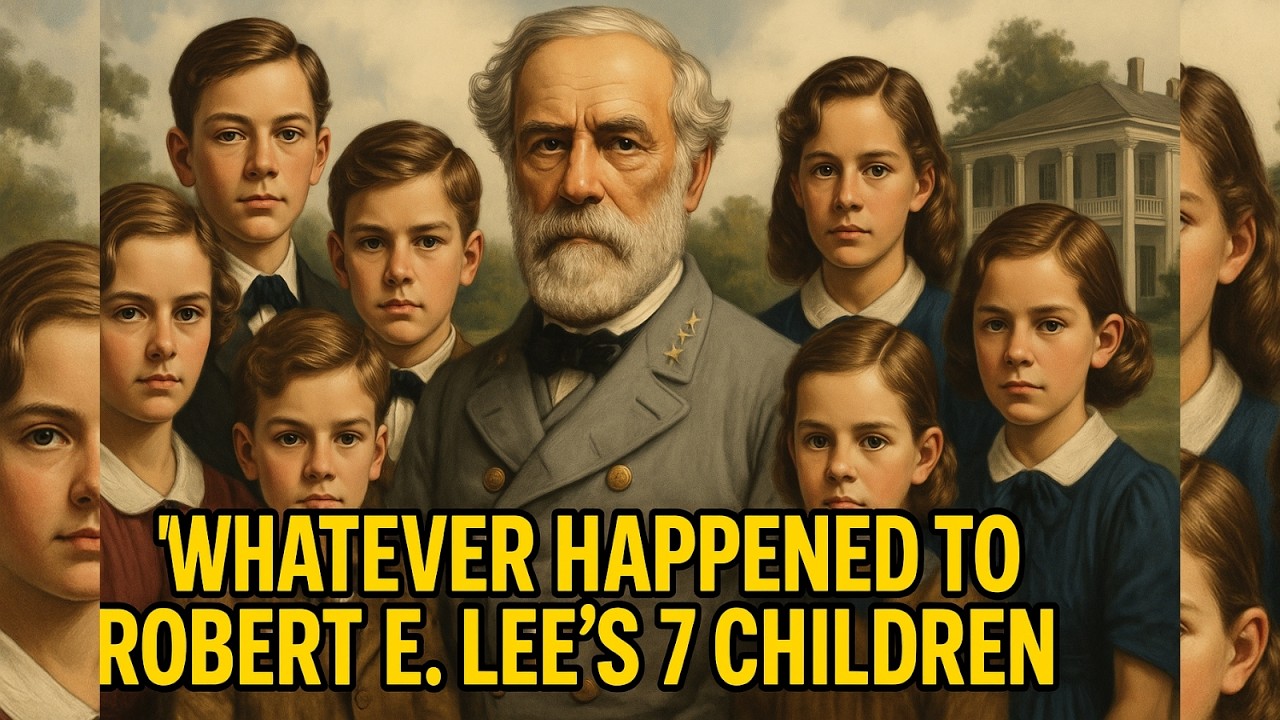
The general who had built his life on composure, who had trained himself to mask every emotion behind the discipline of a soldier, broke down and wept openly. He wrote back to his wife that the pain of knowing he would never see his daughter again on earth was agonizing in the extreme. Those words, meant only for Mary, would later become inscribed on Annie’s tombstone. To understand how that moment came to pass, and how the seven children of Robert E.
Lee lived out their lives in the shadow of their father’s name, one must begin before the war, when the Lee family was still whole. By the time Robert E. Lee became the Confederacy’s most celebrated general, his children were already grown. They had been raised at Arlington House, the Virginia estate that belonged to Mary Custis Lee’s family, under a regimen of discipline, religious devotion, and the expectation of public service.
Their father was a man of restraint and duty, and he demanded the same of them. Seven children bore his name, and each in turn would wrestle with the weight of that inheritance. Some would live in quiet devotion, others in tragedy or obscurity, and together they formed a portrait not of battlefield glory but of what it meant to live after history had already chosen its heroes and villains. The eldest was George Washington Custis Lee, born in 1832.
His name alone bound him to two of Virginia’s most powerful families, the Lees and the Custises, and from birth expectation towered above him. Bright and reserved, he mirrored his father’s temperament without inheriting his charisma. He entered West Point at seventeen and in 1854 graduated first in his class, exactly as his father had done decades earlier. It was a symbolic passing of the torch, the son achieving perfection at the same institution that had launched the father’s career.
Custis served as an engineer in the United States Army, designing fortifications and teaching military science, until Virginia seceded in 1861. Then, like his father, he resigned his commission and followed the South into the Confederacy. But whereas Robert E. Lee became legendary for his battlefield brilliance, Custis’s service was largely administrative.
He spent most of the war in Richmond, acting as an aide to President Jefferson Davis and advising on fortifications. Some saw him as overly cautious, others as too intellectual for war. Only in the final desperate days of the Confederacy did he command troops in the defense of Petersburg, where he was captured just days before his father’s surrender at Appomattox. After the war, his life took a quieter turn.
In 1871 he succeeded his father as president of Washington College, later renamed Washington and Lee University, and under his leadership the school stabilized and grew. But he never married, and those who knew him described a man withdrawn, formal, and haunted by history, a scholar weighed down by duty rather than passion. He died in 1913 at eighty, the last surviving Confederate general of his generation, having spent his entire life within the long, unyielding shadow of his father. The eldest daughter, Mary Custis Lee, was born in 1835.
Of all the children, she most inherited her father’s intellect and her mother’s independence. She was sharp-minded, strong-willed, and had little patience for sentimentality. Her father adored her, often calling her “my steadfast Mary,” though even he sometimes found her spirit difficult to contain. When the war came, Mary was twenty-six, old enough to understand the collapse of her family’s world.
When Union troops seized Arlington House, she was there with her mother, forced to leave under orders from the government her father had once served. The estate would later become Arlington National Cemetery, an act of political symbolism that forever linked the Lees’ family loss to the nation’s sacrifice. After the war, Mary’s life diverged sharply from her siblings’. While her brothers and sisters married or settled into domestic roles, Mary remained single and increasingly independent.
When her father became president of Washington College, she accompanied her parents but refused to limit herself to the quiet life of mourning that Southern society expected of a general’s daughter. After her father’s death in 1870 and her mother’s in 1873, she inherited not only her share of family property but a measure of freedom unusual for a woman of her era. With that freedom, she chose the world. Over the following decades she became an inveterate traveler, visiting Europe, the Middle East, and Asia, meeting figures as varied as Queen Victoria and Pope Leo XIII.
The newspapers called her “the wandering Lee,” sometimes admiringly, sometimes mockingly. In 1902, at age sixty-seven, her independence made headlines again. She was arrested in Alexandria, Virginia, for refusing to move to the segregated section of a streetcar. Whether her act was civil defiance or simple stubbornness remains debated, but the image of Robert E.
Lee’s daughter being detained under Jim Crow law was a striking irony of history. Mary never married and spent much of her later life abroad. She died in 1918 at eighty-three, the last surviving child of Robert E. Lee, her death symbolizing the final fading of the Confederate generation.
William Henry Fitzhugh Lee, known to his family as Rooney, was born in 1837 at Arlington House. If Custis was the scholar and Mary the wanderer, Rooney was the soldier, a man of vigor, humor, and loyalty who most resembled his father in both stature and temperament. In youth he was sociable and full of energy, a favorite among his siblings. Robert E.
Lee, though strict, took pride in Rooney’s physical strength and bravery, once writing that his son had the frame of a warrior and the heart of a gentleman. After studying at Harvard, Rooney joined the United States Army, serving with distinction in the Sixth Infantry and participating in campaigns in the West. But when Virginia seceded in 1861, he resigned his commission and joined the Confederate cavalry. Under the legendary cavalry commander J.
E. B. Stuart, Rooney proved a daring and capable officer. By 1863 he had been promoted to major general, commanding cavalry forces under his father’s overall leadership.
Father and son shared the battlefield, not side by side, but bound by duty and unspoken understanding. That same year, fate struck with cruel precision. During a cavalry clash at Brandy Station, Rooney was wounded and captured while recovering at his wife’s family plantation. He spent eight months as a prisoner of war.
During his captivity, tragedy compounded. His wife Charlotte died of illness, and their two small children soon followed. By the time he was exchanged and returned to service in 1864, Rooney had lost nearly everything but his name and uniform. After the war, he returned to the ruins of family life.
In 1867 he remarried, settling at the reconstructed White House plantation in Virginia, determined to restore the land and the Lee family’s place in postwar society. Unlike many ex-Confederates, Rooney found a second act in politics. By the 1880s he had been elected to Congress, representing Virginia’s Eighth District as a Democrat, a former Confederate general serving in the government his father had once fought against. It was a symbol of reconciliation and a quiet irony that would have astonished the world twenty years earlier.
He died in 1891 at fifty-four, still in office. His funeral drew soldiers, statesmen, and citizens from both North and South, a gathering that suggested time had softened the wounds of the past, even if it had not healed them. Anne Carter Lee, born in June 1839, was the second daughter, gentle, vivacious, and deeply kind. Known within the family as Annie, she was considered the most tender-hearted of the children, the one who could ease her father’s stern moods with laughter and compassion.
Robert E. Lee often called her “my gentle Annie,” a phrase that would later become both a memory and a lament. Her childhood unfolded at Arlington House, filled with education, music, and the religious devotion instilled by her mother. When war erupted, Annie, along with her sisters, aided the Confederate cause by knitting socks for soldiers and tending wounded men in makeshift hospitals.
By 1862, the conflict had scattered the Lees across the South. Annie and her sister Agnes were sent to stay with family friends in North Carolina for safety. There she fell gravely ill with typhoid fever. Her mother and sister nursed her day and night, praying for recovery, but after weeks of struggle, Annie died on October 20, 1862, at just twenty-three.
Her final words, whispered to her beloved sister, were a quiet plea: “Where’s Agnes? ” The bond between the two sisters had been so close that relatives described them as like twin roses on one stem. Because of the war, the family could not retrieve her body immediately. She was buried on a quiet plantation in North Carolina.
Years later, in 1994, her remains were moved to the Lee family crypt in Lexington, Virginia, beside her parents and siblings. Eleanor Agnes Lee, born in 1841, was the fifth child. Known within the family simply as Agnes, she was the intellectual heart of the household, reflective, disciplined, and profoundly spiritual. Where Annie had been light and laughter, Agnes was stillness and depth.
Her father, who admired self-control above all virtues, cherished her deeply. From a young age she displayed a keen mind and a writer’s sensitivity, keeping a detailed diary for nearly five years, chronicling the daily life of the Lee family at Arlington before the war. Through her writings, historians have glimpsed moments otherwise lost to time: skating parties on the canal, visits from family friends, and the ordinary joys of a family unaware that history was about to shatter their world. When the war began, Agnes’s diary fell silent.
The death of her sister Annie in 1862 left a wound that never fully healed. In the months that followed, Agnes withdrew from society, her humor dimmed, and her letters filled with grief. Around the same time, another heartbreak struck: the execution of Orton Williams, a distant cousin and close family friend rumored to have been her suitor. Within a single year, Agnes had lost both the sister she adored and the man she may have loved.
After the war, she joined her parents and younger sister Mildred in Lexington, devoting herself to caring for her parents and to church work. Her health, always fragile, began to decline. In 1870, after her father’s death, she fell into deep mourning. Three years later, in 1873, she developed what doctors called an intestinal disorder, likely typhoid or cholera.
Too weak to recover, she died on October 15, 1873, exactly three years and three days after her father’s passing. She was just thirty-two. Agnes was buried in the Lee family crypt beside her father, her coffin resting near that of her sister Annie. Her mother, already ill and heartbroken, followed her in death less than a month later.
Robert Edward Lee Jr. , known as Rob or Bob, was born on October 27, 1843, the youngest son. Of all the Lee sons, he was perhaps the most easygoing, modest, humorous, and approachable, with a warm temperament that balanced the gravity surrounding the family name. When the Civil War began in 1861, Rob was still a student at the University of Virginia.
By 1862 he had enlisted in the Confederate Army, serving as a private in the Rockbridge Artillery and later as an aide-de-camp to his elder brother, General Rooney Lee. His father initially resisted the idea, reluctant to see another son drawn into the conflict, but Rob insisted, declaring that he could not remain idle while Virginia fought for her life. He was just eighteen when he first rode into battle. Throughout the war, Rob gained a reputation for quiet courage.
He fought at Sharpsburg, Fredericksburg, and Petersburg, rising to the rank of captain. One story often retold by veterans described how he continued to command his artillery battery under relentless fire, his horse shot from beneath him, his uniform singed with powder smoke, yet never losing his composure. When the Confederacy collapsed in 1865, Rob was twenty-one, his youth spent on battlefields rather than in classrooms. After the surrender at Appomattox, he returned home with little more than his father’s respect and a worn uniform.
Taking charge of part of the family’s diminished estate, he devoted himself to farming at the Romancoke plantation in King William County. He rebuilt the farm with his own hands, laboring beside former slaves now working for wages, a silent acknowledgment of how the world had changed. He married Charlotte Haxall in 1871, but she died the following year, reportedly from complications after a miscarriage. Years later, in 1894, he remarried Juliet Carter and had two daughters, whom he named Mary Custis and Anne Carter, preserving the family’s history through names rather than monuments.
His later years were devoted to writing. In 1904 he published Recollections and Letters of General Robert E. Lee, a collection of personal correspondence that revealed a gentler, more human side of the man history often painted as a stoic icon. The book remains one of the most valuable insights into the private world of the Lees, written not by a historian but by a son who had loved and admired his father.
Rob died in 1914 at seventy, outliving nearly all his siblings, and was buried beside his parents and sisters in the family crypt. Mildred Childe Lee, born in 1846, was the youngest of the seven children. Nicknamed “Precious Life” by her father, later shortened to simply “Life,” she arrived sixteen years after her eldest brother Custis and brought unexpected joy to parents already entering middle age. Her father doted on her, calling her his joy and comfort, though he still expected from her the same composure and moral strength demanded of his sons.
When the war broke out, Mildred was fifteen and away at boarding school in North Carolina. She returned home to help her mother, knitting socks for Confederate soldiers and volunteering in hospitals to tend the wounded. Friends recalled her as lively and charming, with a quick wit that often lightened her father’s somber moods during visits. When Richmond fell in 1865, she and her mother refused to abandon their home even as fires raged nearby.
That moment, a young girl standing beside her mother amid the ruins of the Confederacy, would shape her forever. When Robert E. Lee accepted the presidency of Washington College, Mildred finally lived with him full-time, becoming his constant companion during his final years. They walked together each evening, sharing stories and reflections.
He teased her for her poor handwriting, her love of cats, and her mediocre cooking, but the affection between them was unmistakable. After her father’s death in 1870 and her mother’s in 1873, Mildred found herself the last unmarried daughter of a fallen general. Though she had suitors, she never married. To me, she once wrote, he seems a hero and all other men small in comparison.
That devotion drew her into a life of quiet service. She managed the family household, cared for relatives, and preserved her father’s correspondence and memorabilia, becoming in effect the guardian of the Lee family legacy. In later years she found solace in travel and faith, visiting England for Queen Victoria’s Golden Jubilee in 1887, touring the Mediterranean, and even seeing the pyramids of Egypt. Yet her heart remained tethered to Lexington and the memory of her father.
All that I am, she once confided to a friend, was shaped by the shadow and the light of his presence. Mildred Childe Lee died in March 1905 while visiting New Orleans, likely from complications of a stroke. Her death was widely mourned throughout the South. Flags at Washington and Lee University were lowered to half-staff, and Confederate veterans accompanied her coffin back to Lexington, where she was laid to rest beside her parents and siblings.
She had no titles, no great fortune, and no descendants, yet among the Lees she was the keeper of the flame, the daughter who stayed behind to preserve the memory of a family whose name once commanded both devotion and division. Each of the seven children bore a different reflection of their father’s legacy: Custis, the scholar burdened by intellect; Mary, the independent spirit who defied convention; Rooney, the soldier who turned war into reconciliation; Annie, the heart lost too soon; Agnes, the soul who chronicled their quiet sorrow; Rob, the steady hand who turned conflict into remembrance; and Mildred, the last flame who carried their memory into the new century. Some retreated into silence, others rebuilt, and still others sought meaning in learning and service. Each in his or her own way wrestled with the question that haunted their father to the end: what is honor when the world has changed?
By the time Mildred passed in 1905, the age of the Lees had become history. Yet their lineage, preserved in letters, diaries, and the university that still bears their name, endures as a mirror of a nation’s struggle to reconcile its past with its conscience.
