She was twenty-two years old when they hanged her, and even in the final moments of her life she showed no remorse. They had called her the most beautiful woman in Nazi Germany, and also the most sadistic. She had walked the filthy, stinking alleys of Auschwitz-Birkenau in her immaculately pressed uniform, a pistol holstered at her hip and a plaited whip coiled in her hand. And she had done things there that still defy comprehension.
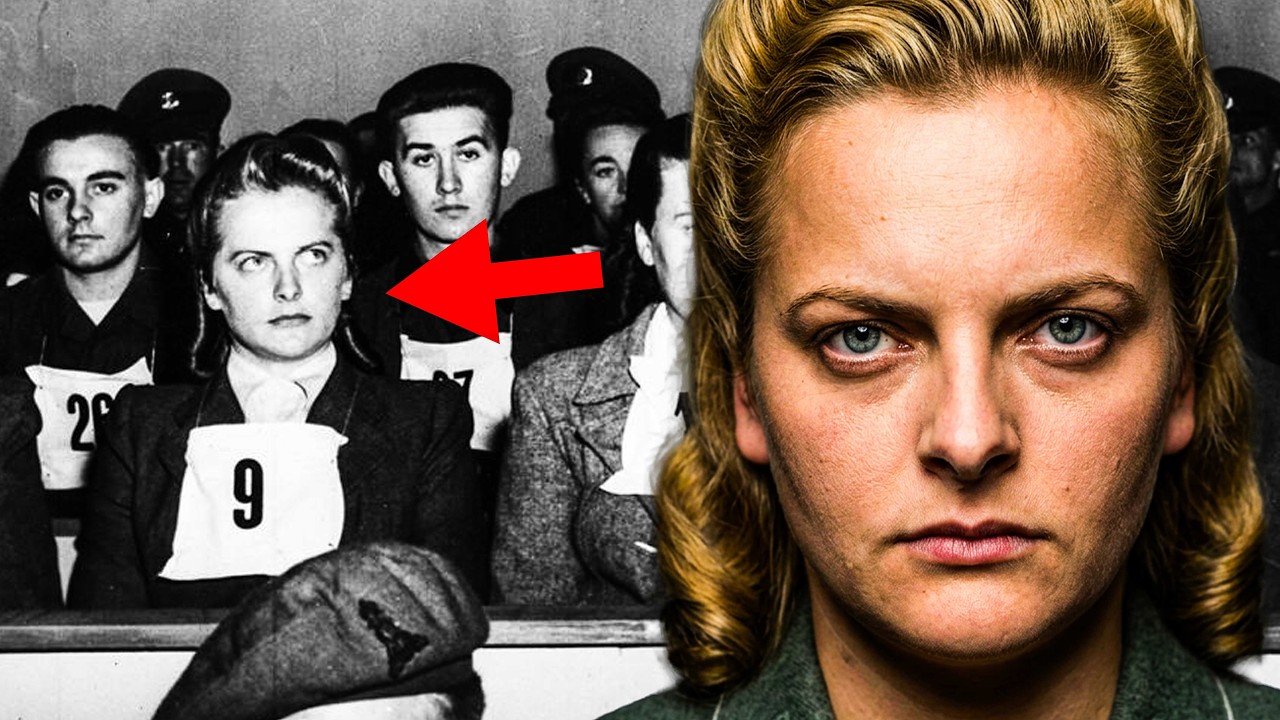
Her name was Irma Grese. She was not a soldier, not a general, not an ideologue in the conventional sense. She was a farm girl from Mecklenburg who had wanted to be a nurse and ended up becoming a monster instead. How does that happen?
How does an ordinary young woman become one of the most feared and reviled figures in the entire apparatus of the Holocaust? Irma Ilse Grese was born on October 7th, 1923, in the small village of Reen in the Mecklenburg region of northeastern Germany. Her family was not wealthy. Her father, Alfred Grese, was a farm laborer, a quiet and deeply conservative man who harbored modest ambitions and no great political passions at the outset of his daughter’s childhood.
Her mother, Berta Grese, had a more turbulent history. When Irma was only thirteen years old, Berta swallowed acid and died. A suicide that shattered the household in ways that were never quite healed. Alfred Grese struggled to keep the family together after his wife’s death.
He was a stern disciplinarian, deeply critical of the Nazi party in its early years, which put him at odds with much of the social pressure building around rural Germany through the 1930s. He disapproved so strongly of Irma’s later involvement with the SS that he reportedly disowned her—a fact her defense attorneys would later try to use on her behalf, arguing that she had been pulled into the system against the wishes of a conscientious parent. Her formal schooling ended when she was fourteen, which was not uncommon for girls from rural working-class families in the 1930s. She joined the League of German Girls, the Bund Deutscher Mädel, the female branch of the Hitler Youth.
The organization was designed precisely to capture young women at that impressionable age and mold them into loyal servants of the National Socialist state. Through the League, girls were taught that their purpose was to serve the Reich, to be strong, obedient, and racially aware. Irma Grese proved an enthusiastic participant. After leaving school, she worked briefly on a farm and then attempted to train as a nurse, applying at several hospitals and medical institutions.
These applications were rejected. The rejections stung. She applied at a dairy farm and worked there for a period. But the work offered no status, no uniform, no sense of belonging to something larger than herself.
In 1941, when Grese was seventeen years old, she made the decision that would define the rest of her brief life. She applied to work as a guard in the SS-Gefolge, the female auxiliary service of the SS. The SS did not formally allow women to become full members, but they recruited women as female guards to manage the female prisoner populations in the concentration camps, since male SS guards were not permitted to directly supervise female prisoners. These women were civilians technically employed by the SS as contract workers.
They received basic training at Ravensbrück, the largest women’s concentration camp in the Nazi system, located about fifty miles north of Berlin. They were told that the prisoners were enemies of the state, subhuman criminals and racial threats. And they were placed in an environment that normalized cruelty at every level of daily interaction. The guards who showed the most ferocity were praised.
The guards who showed hesitation or sympathy were threatened with being sent to the front. Grese began her service at Ravensbrück in 1942, and she took to the work with a speed that alarmed even some of her colleagues. Ravensbrück held tens of thousands of women at its peak. Many of them Jewish, but also political prisoners, Roma women, Soviet prisoners of war, Jehovah’s Witnesses, and women accused of criminal offenses under Nazi law.
The conditions were deliberately designed to be brutal. Prisoners were malnourished, overworked, routinely beaten, and subjected to medical experiments without their consent. The guards had wide latitude to punish prisoners however they saw fit, and the system rewarded those who displayed the most merciless efficiency. By 1943, still only nineteen years old, Grese had been transferred to Auschwitz-Birkenau, the largest and most lethal killing complex in the entire Nazi camp system.
Auschwitz-Birkenau in 1943 was the epicenter of the Holocaust. The gas chambers were processing thousands of people per day. The camp complex covered miles of Polish countryside and held hundreds of thousands of prisoners in conditions of almost inconceivable misery. Disease was rampant.
Starvation was institutional policy. Violence was woven into the texture of every day. It was into this world that the nineteen-year-old Irma Grese arrived, not as a victim, but as a guard with authority over the lives of thousands of Jewish women. She was assigned to the women’s section of Birkenau.
Survivors who testified about Grese at her postwar trial described a consistent and deeply disturbing pattern of behavior that went far beyond the institutional brutality of the camp system itself. She was not simply enforcing SS rules—she invented additional cruelties of her own. She carried a plaited leather whip and used it freely, lashing prisoners across the face and body without any provocation that could be identified as disciplinary. She wore heavy boots and kicked prisoners who fell or stumbled.
She kept two trained German shepherds that she would set upon prisoners at her own discretion, watching as the animals attacked the women and tore at their clothing and flesh. Survivors testified that she would select individual women for these dog attacks, seemingly at random, sometimes apparently deriving personal pleasure from the spectacle of suffering that followed. By 1943, she had been promoted to Rapportführerin, a senior supervisory role that gave her direct authority over thousands of prisoners in the women’s camp. She participated in the selections on the arrival ramp at Birkenau, the grotesque process by which SS doctors, most notoriously Josef Mengele, determined which incoming prisoners would be sent directly to the gas chambers and which would be retained for forced labor.
Grese stood alongside these selections, helping to sort the women and children who had just arrived from across occupied Europe into those who would live a little longer and those who would be murdered within the hour. What made Grese particularly distinctive, even within the brutal world of Auschwitz, was the combination of calculated sadism with apparent personal satisfaction. Multiple survivors independently testified to the same observation: Grese seemed to enjoy herself. She smiled during beatings.
She laughed when her dogs attacked prisoners. She chose victims for punishment in ways that seemed less about enforcing discipline than about the pleasure of exercising absolute power over helpless human beings. One survivor, a Hungarian Jewish woman named Dr. Gisella Perl, who had been a gynecologist before the war and was forced to practice medicine in the camp without equipment or supplies, later wrote extensively about Grese and described her as someone who had thoroughly embraced the ideology of the SS—not reluctantly, not out of fear, but out of genuine conviction and genuine enjoyment.
The physical appearance of Irma Grese became part of her legend. Photographs taken at the time show a young woman with fair hair, blue eyes, and regular features that met the Nordic ideal the Nazi propaganda apparatus had spent years promoting. The Allied press after her arrest repeatedly described her as beautiful, a fact that contributed to the fascination with her case that extended well beyond ordinary interest in a war crimes trial. British tabloids called her the Blonde Beast of Belsen.
Multiple survivor accounts describe her using her looks deliberately—approaching prisoners who did not respond to her authority with a kind of mocking sexuality before switching to violence. There is also the question of her relationships within the camp system. It was known within Auschwitz and testified to at her trial that Grese had a romantic relationship with Josef Mengele, the SS doctor whose medical experiments on prisoners, and particularly on twins, constitute some of the most documented crimes in the history of the Holocaust. The exact nature and depth of this relationship is difficult to establish with precision, since Mengele himself was never brought to trial, having fled to South America after the war where he lived under assumed identities until his death in 1979.
Grese was also linked romantically to Josef Kramer, who would later become the commandant of Bergen-Belsen and who would stand in the dock alongside her at the Belsen trial. Kramer’s testimony and the testimony of others suggests that Grese’s relationships within the SS hierarchy were conducted very much on her own terms. She was not a passive figure even in her personal life. Auschwitz was liberated by Soviet forces on January 27th, 1945.
But Grese was not there to see it. In the final months of the war, as the Red Army advanced from the east, the SS undertook a frantic series of evacuations, moving prisoners westward on what became known as the death marches—brutal forced marches through winter conditions during which tens of thousands of prisoners died of exposure, exhaustion, and deliberate murder by guards who shot those who could not keep up. Grese accompanied prisoners evacuated from Auschwitz westward through the Polish countryside. In March 1945, Irma Grese arrived at Bergen-Belsen concentration camp in northern Germany, near the town of Celle in Lower Saxony.
Bergen-Belsen in the final months of the war was undergoing a transformation from a transit camp into something resembling a circle of hell. As camps further east were evacuated, their surviving prisoners were funneled into Belsen, which had not been designed to hold anything close to the numbers now being crammed into it. Tens of thousands of prisoners arrived in conditions already close to death. Typhus spread through the overcrowded barracks with terrifying speed.
Bodies accumulated faster than they could be removed. The smell of Bergen-Belsen in those final weeks was reported by British soldiers who liberated it to be detectable from miles away. It was at Bergen-Belsen that she was captured on April 15th, 1945, when British forces under Brigadier Llewellyn Hughes accepted a formal handover of the camp. The British soldiers who entered Bergen-Belsen that day found approximately thirteen thousand unburied corpses lying around the camp and some sixty thousand living prisoners in conditions of extreme disease, starvation, and medical crisis.
Photographs and film footage taken at Belsen immediately after liberation became some of the most widely circulated images of the Holocaust in the immediate postwar period. Irma Grese was arrested that same day. She was twenty-one years old. British soldiers who arrested her later reported that she seemed entirely composed, almost contemptuous, showing no visible distress or remorse.
She was wearing her SS uniform, and she cooperated with the arrest with the same efficiency she had displayed in every other aspect of her work. The war ended officially on May 8th, 1945, with Germany’s unconditional surrender. The British moved quickly to prosecute those responsible for the specific crimes at Bergen-Belsen, and the result was the Belsen Trial, formally known as the trial of Josef Kramer and 44 others, which opened at Lüneburg, Germany, on September 17th, 1945. Forty-five defendants stood in the dock, including Grese, Kramer, and forty-three others, both male and female, who had served at either Belsen or Auschwitz, or both.
The prosecution had assembled an enormous body of evidence, including the testimony of dozens of survivors who had been tracked down across the displaced persons camps and hospitals of liberated Europe. The trial was conducted under the royal warrant of August 1945, which gave British military courts jurisdiction over war crimes committed against Allied nationals in German custody. Grese pleaded not guilty to all charges. Her defense counsel, Major Cranfield of the British Army Legal Corps, pursued a strategy that would become familiar in Nazi war crimes trials in the years ahead: arguing that his client had been acting under orders, that she had been young and impressionable and subject to a system she did not control, and that the witness testimony identifying her as specifically responsible for specific acts of cruelty was unreliable, contaminated by the psychological trauma of survivors who could not clearly distinguish one guard from another.
It ran headlong into the weight of the evidence. The prosecution called survivor after survivor to the stand over the weeks that the trial unfolded. They came from Hungary, from Poland, from France, from the Netherlands, from Greece. They described Grese’s whip, her dogs, her boots, her smile during beatings, her participation in selections.
Survivors identified the sound of Grese’s voice, the particular way she moved, the distinctive uniform she wore, the silver pistol she carried. They described murders that she had committed with her own hands—beatings so severe that prisoners died of them, the deliberate setting of her dogs upon women who were already too weak to defend themselves. One of the most striking testimonies came from Ilona Stein, a Hungarian Jewish woman who had been at Auschwitz and then at Belsen. She described in precise detail an incident in which Grese had ordered her to stand still and then beaten her across the face with the plaited whip until her cheekbone was fractured.
She remembered the expression on Grese’s face—calm, almost professional. Another witness, Hadassah Bimko, a Polish Jewish dentist who had been a prisoner at Auschwitz, testified about witnessing Grese shoot a prisoner who had attempted to pick up a piece of bread that had fallen from a guard’s hand. The prisoner was shot and left to die, and Grese had walked away without altering her pace or expression. British military doctors who had examined the surviving prisoners after April 15th testified about the specific injuries they had documented: injuries consistent with beatings with a whip or a cane, injuries from dog bites, injuries from kicks by booted feet.
These medical records provided physical corroboration for the survivor testimony that was difficult to argue against. One aspect of Grese’s crimes that received particular attention was the allegation that she had been involved in the selection of women prisoners for unnecessary and painful surgical operations. This charge was connected to the testimony of Dr. Gisella Perl, who described witnessing Grese participate in the process by which women with particularly severe wounds or injuries were selected not for treatment but for experiments or for death—operations performed without anesthesia, operations that served no medical purpose and were conducted essentially as a form of organized torture.
Grese gave her own testimony. She acknowledged that she had carried a whip and that she had used it on prisoners. She denied that she had ever shot a prisoner, denied that she had set her dogs upon prisoners deliberately, and denied that she had been involved in selections for the gas chambers. She claimed that her use of the whip had been consistent with SS regulations and had been in response to prisoner behavior that required correction.
She was calm on the stand, composed and apparently without any visible remorse. When asked why she had joined the SS camp system, she explained that she had applied because she had been unable to get other work and because she had been attracted to the wage and the uniform. The verdict came on November 17th, 1945. Irma Grese was found guilty of war crimes—specifically of crimes against Allied nationals in German custody in violation of the laws and usages of war.
The specific charges included deliberate cruelty to prisoners, physical assault causing grievous bodily harm, and participation in the selections that sent prisoners to their deaths. The court sentenced her to death by hanging. Grese was one of eleven defendants sentenced to death at the Belsen Trial—including Josef Kramer, the commandant of Bergen-Belsen, and one other female guard, Elisabeth Volkenrath, who had been the chief female guard at Auschwitz and Bergen-Belsen. Appeals were made on behalf of several of the condemned, including Grese, on the grounds that the laws under which they had been convicted had not existed at the time the crimes were committed, that the court had not provided adequate standards of evidence, and that the death penalty was disproportionate.
These appeals were considered and rejected. In the days following her conviction, Grese was held at Hamelin Prison in Germany. A German Protestant chaplain who visited her, Father Hermann Hahn, later reported that she received him courteously and that she seemed to have achieved a kind of internal equilibrium in the face of death. She spent her days reading and writing letters.
She wrote to her father, Alfred Grese, who had reportedly disowned her when she joined the SS, seeking some kind of reconciliation or at least acknowledgement. Whether he responded is not known for certain. She wrote to her younger sister, Helene, expressing what was described as genuine affection. She did not write anything that could be construed as a confession of guilt or an apology to her victims.
Albert Pierrepoint, the British hangman assigned to carry out the Belsen sentences, later wrote about the experience in his memoir, describing the morning of December 13th, 1945, when the eleven death sentences were carried out in succession at Hamelin Prison. He described Grese as having walked to the gallows steadily without assistance, without tears, saying nothing beyond a single word, which he rendered in his memoir as “schnell”—meaning quickly. He interpreted this as a request to be hanged without delay.
She was twenty-two years old when she died, and she became the youngest woman to be executed under British law in the twentieth century.
